
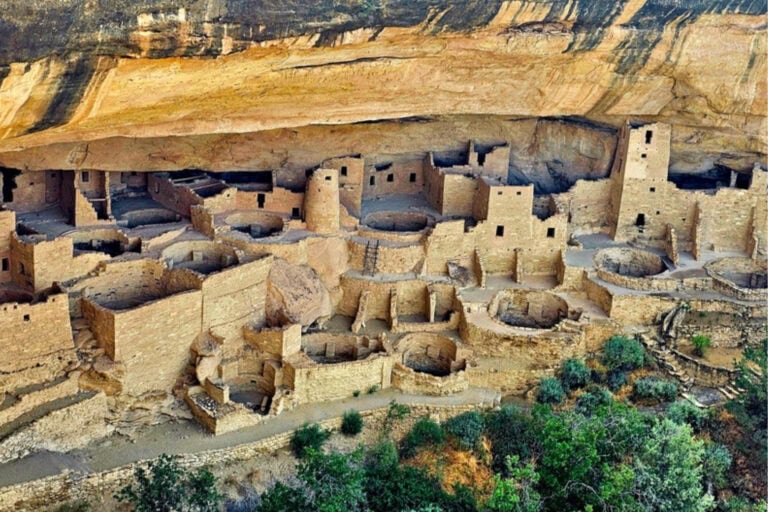
Mesa Verde National Park is considered the most important archaeological preserve in the Park Service. It covers 52,485 acres in Southwest Colorado. Established in 1906, this expansive park protects the land and teaches visitors about the Ancestral Pueblo people. They lived in this region from 600 CE to 1300 CE.
Today, the park has approximately 5,000 known archaeological sites, which include 600 cliff dwellings. These sites are some of the best and oldest preserved habitats in the United States. It is also a World Heritage Site and a Dark Sky Park.
The 700-Year Tour
If you only have half a day to see Mesa Verde, consider the four-hour 700-Year Tour. This is the best way to see and understand what went on here in a short time. Their website describes the tour as “The ultimate Mesa Verde deep dive…the tour is part history and part time-travel.”
The 700-Year Tour covers the Mesa Chapin Loop using a small, air-conditioned bus led by a National Association for Interpretation Certified Guide. (This is an individual who has been trained and tested during a 32-hour course on the architecture, lifestyle, and culture of the ancient Puebloan people).
Todd, our guide, was passionate and informative about the park and the Puebloans who lived here. While most people think of Mesa Verde as a place of cliff dwellings, Todd showed us how much more there is to this ancient land.
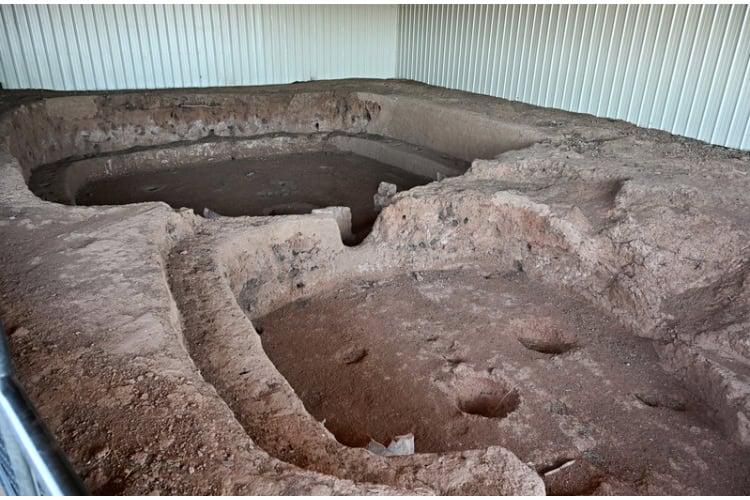
The 700-Year Tour had us stop at a few of the earliest ruins. At the 600 CE Pit House, we learned how the earliest simple homes were dug into the ground. They had one living area and an antechamber for storage. Wood supported the roof, which was covered in adobe or mud. These homes were insulated well from the cold and the heat.
We progressed through the Three Village site. The name comes from three different period villages built on top of each other, dating from 900 CE to 1100 CE. Here, we saw how homes improved over time, using hand-cut stone and masonry.
They also got larger. Eventually, the last people who lived here added small towers and tunnels. Throughout the building period, one constant was a fire pit with a stone placed near it to allow and divert fresh air, along with their kivas.
Todd explained that kiva is a Hopi word. It is a round room, sometimes partially or fully submerged. It is used as a gathering and ceremonial place. Throughout the centuries, the kiva changed little. It always had a fireplace, a large stone to divert the air, and usually a small floor hole called a sipapu, representing a gateway to the spiritual world.
As our drive continued, the bus stopped at overlooks to view the valley and several cliff dwellings below. These cliff dwellings were in various degrees of disrepair. Most of these were off-limits because they are fragile or too hard to climb down to. The tour continued to the Sun Temple, dated 1250 CE, and its vast views of the valley below.
Cliff Palace
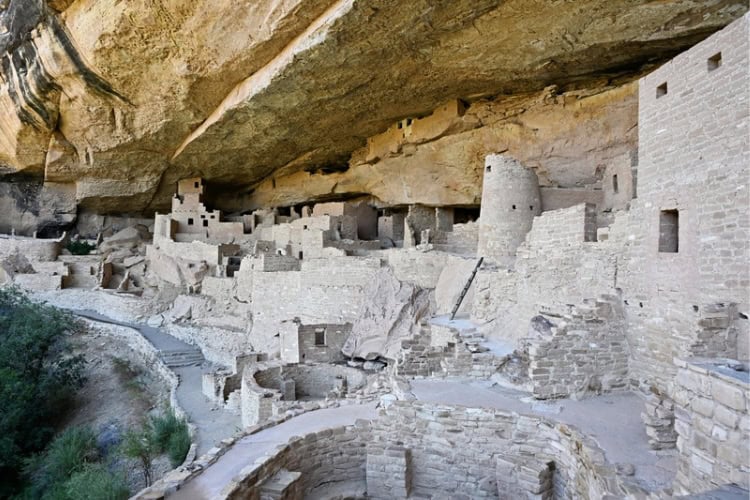
A highlight for many on the tour is the guaranteed entrance to Cliff Palace. Cliff Palace is the largest cliff dwelling in North America. It is in a sandstone alcove that is 90 feet deep and 60 feet high. Cliff Palace runs 300 feet long under the alcove and contains 150 apartments along with 23 kivas. It was home to about 150 people from 1190 CE to 1280 CE.
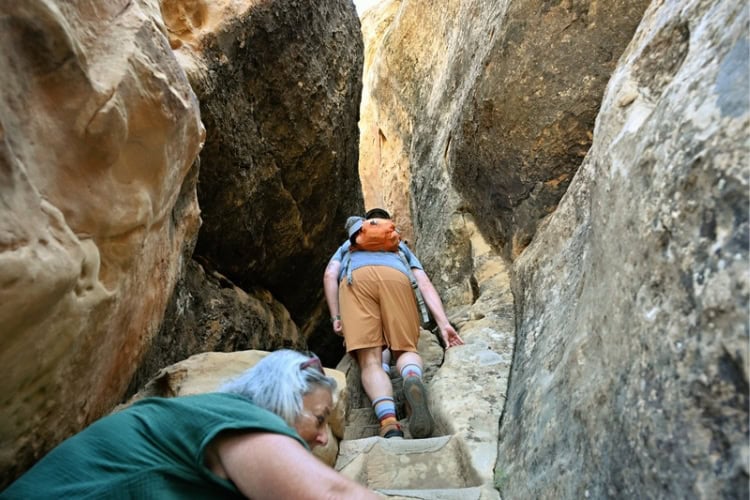
Getting to Cliff Palace, as with many of the other cliff dwellings, requires you to be sure-footed. Visitors climb up and down four ladders and use uneven steps. No one rushes you on these tours, so if you are in average physical condition and take your time, you will be OK.
During our tour, Ranger Caden explained the history of the people who lived here. He talked about apartments and how they were built, showing us some original logs holding up sections. We ended the tour looking down into one of the larger kivas in Mesa Verde.
The 700-Year Tour costs $129 for adults and $99 for children 5 to 11. For information and booking, go here.
Visitor And Research Center
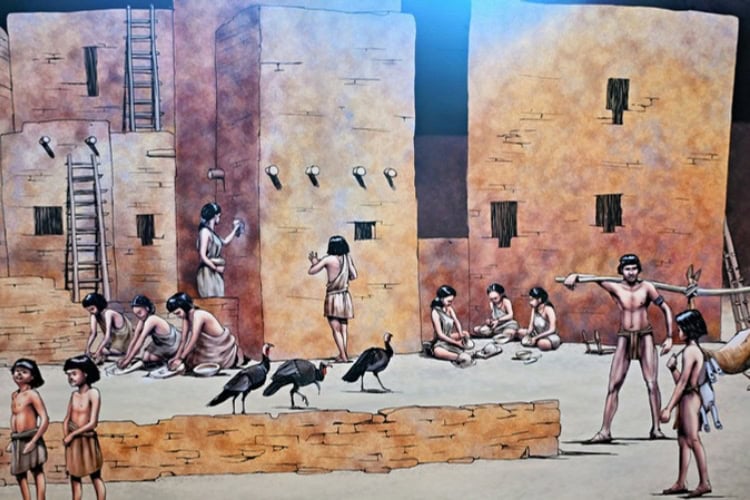
If you don’t take the 700-Year Tour, you can still learn a lot about the park on your own. The Mesa Verde Visitor and Research Center is a good first stop.
After viewing the tall statue of a Puebloan climbing a ladder, enter the center. Here, you will see various exhibits about the park. You can peek through the windows of the research area and see additional pottery. Rangers and volunteers are eager to help you get the most out of Mesa Verde with a map and information on what to see.
Wetherill Mesa Loop
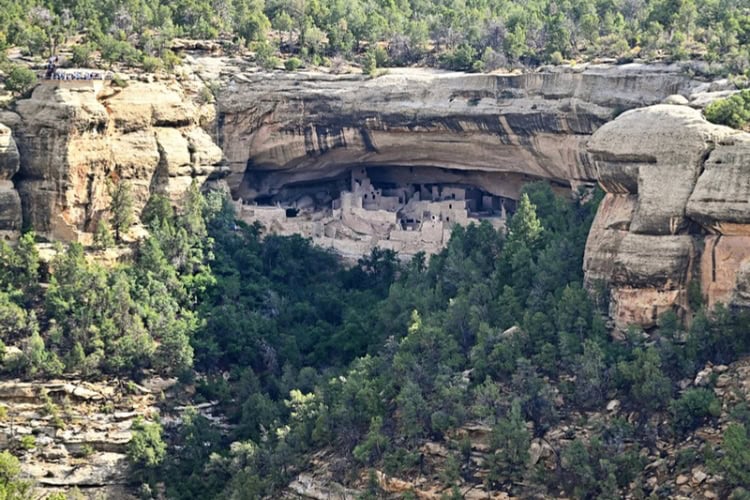
For a look at the equally historic but quieter side of Mesa Verde, consider visiting the end of Wetherill Mesa Road. Wetherill Mesa Road is a 12-mile, 35-minute winding road that takes you to Long House and other key ruins that are not accessible by car.
At the end of the road is a parking lot where the Long House Loop and Wetherill Mesa Trail start. These trails are three to five miles long depending on your visiting preferences. The sites are located on easy, flat trails that can be walked, biked, e-biked, or accessed using mobility scooters.
The trails take you to a few key ruins. This region of Mesa Verde is never crowded. Outside of ticket holders visiting Long House, we saw fewer than a dozen people for the 90 minutes we were there. Bring water and a hat or sun umbrella, as there is no shade anywhere here except at the covered ruins.
Long House Tour
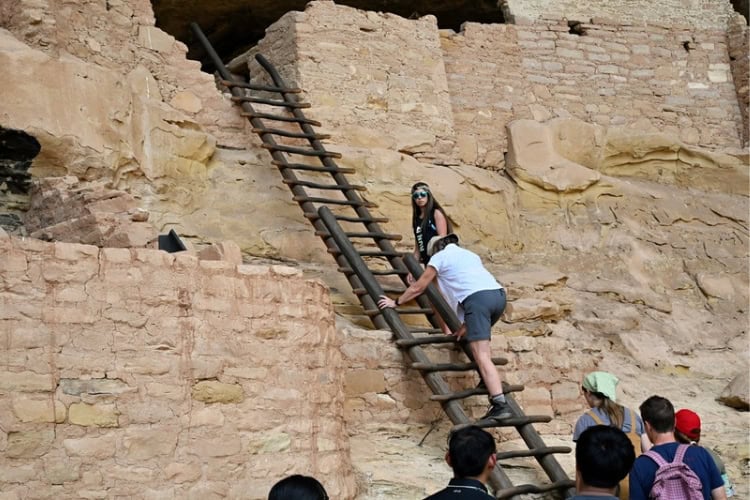
We planned our visit to this area of the park to coincide with the ranger-guided Long House cliff dwelling tour. When using your timed ticket here, keep in mind it is a ¾ mile, 20-minute walk to the Long House meeting place. Tours start promptly.
Our 90-minute tour started with a hike down switchbacks showing the remains of ancient farming practices. We accessed Long House via a steep staircase and two 15-foot ladders. (Ladders are permanently attached to the dwelling and angled so it is easy to climb.)
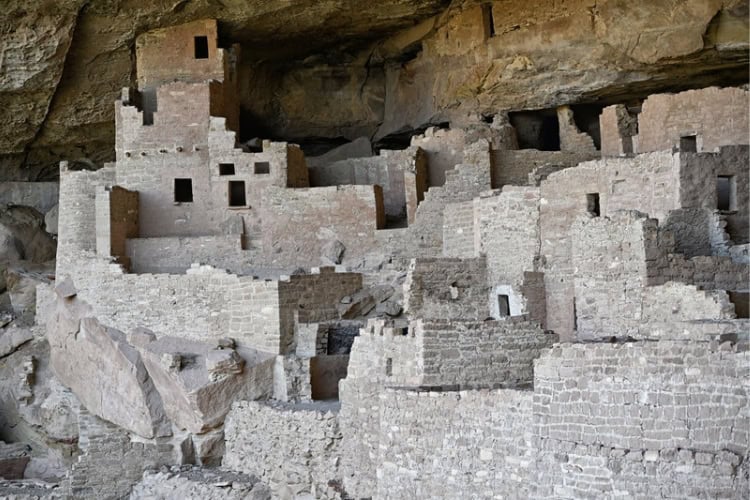
We learned the Long House is the second-largest cliff dwelling, measuring 298 feet long with 150 rooms. It may also have been a meeting place for others outside this house because of its large plaza with benches and fireplaces not seen elsewhere. In the very back of the alcove, we saw an active spring. We also viewed some of the 21 kivas. The masonry here is intricate and impressive.
During our two cliff dwelling visits, the rangers said the area was abandoned in the 1300s. This could have been due to drought and lack of resources after 600 years of existence here. We learned the Ancestral Puebloans migrated peacefully to other Pueblos in New Mexico and Arizona. The rangers also mentioned the ancient Puebloans lived in peace, as there was no evidence of weapons of war found on any site.
Badger House Community
While you are visiting Long House, walk down to the Badger House Community before or after the tour. The people here opted not to live in cliff dwellings.
Within a few minutes of each other are interesting historical ruins in different shapes and styles. The Pueblo Village from 620 CE to 860 CE looks like eight separate, one-room townhouses. Badger House, built in 1258 CE, has a tower and tunnels. Continue five minutes further to view Long House from the overlook. This section of the park in the summer can close as early as 3 PM with the last entry at 2 PM.
Ranger Programs At Night
When at the visitor center or Far View Lodge, ask about the nightly ranger programs. We thoroughly enjoyed a talk and slide show on the importance of turkeys to the ancient Puebloans. This included harvesting eggs, meat, and feathers to survive (the people here learned that turkeys, if plucked at a certain time, will not die). Talks change daily, except for the once-a-week sky show if the weather is clear.
For information on Mesa Verde and the five cliff dwellings you can visit, go here.
If You Go
The highlight of Mesa Verde is touring the cliff dwellings. To visit them, you will need to get a ticket from www.recreation.gov two weeks before you arrive. Get online at 8 AM for peak-season tickets. Each house has different tour hours. I recommend booking at least two of the houses that interest you. Tickets are $8.00.
At the time of your tour, make sure you have a screenshot or printed ticket, as cell service is sparse to open the app. Cliff dwellings are open from early May to late October. A park entrance fee for U.S. citizens is $30 for a seven-day pass. For a reasonable $80 per year, I recommend buying an annual pass if you plan to visit more than one national park.
Peak season in Mesa Verde is June through August, with an average of 85,000 visitors per month. Summer can bring brutal heat, with July having short but thunderous seasonal monsoons.
Lodging
For the convenience of being in the park, we stayed at the Far View Lodge located 15 miles from the entrance. I found Far View to be a good three-star hotel. The rooms are basic, but your terrace will look out over 50 miles, with views of Colorado, New Mexico, and Arizona. For hotels, activities, and food here, visit here. For hotels outside the park, consider the nearby towns of Mancos and Cortez.
Dinner
Located at Far View Lodge is the Metate Room Restaurant. They offer salads, soups, steaks, chicken, trout, fish, along with two vegetarian dishes. Our dinner here was good, and it was convenient not to drive out of the park during one rainy evening. There is an upstairs bar with a menu and weekly music.
For a better meal, I recommend driving 40 minutes from Far View Lodge (15 minutes from the park entrance) to La Casita de Cortez. This is one of the best Mexican restaurants I have eaten in the region. Portions are large, flavors are huge, and prices are reasonable.
For more, read Inside South Dakota’s Crazy Horse Memorial, a Mountain Sculpture Still Taking Shape.
Need a hand planning your trip? Here are the sites and services we rely on most, from booking tools to travel products we love.
Inspire your next adventure with our articles below:
- 6 Reasons Silverthorne Should Be Your Next Colorado Mountain Getaway
- Mount Rushmore Revisited: What a Return Trip Reveals About an American Icon
Author Bio: After 30 years in the business world, Tab Hauser reinvented himself as a journalist and professional photographer. His travels have taken him to seven continents and 100 countries or unique locations. He is an Explorers Club Friend, a member of the New York Press Association, a diver, and a U.S. Coast Guard Licensed Captain. This native New Yorker now calls Colorado home. Follow on Facebook.
Want to discover more hidden gems and helpful travel tips? Join our free newsletter for the latest travel secrets and travel articles.
We are reader-supported and may earn a commission on purchases made through links in this article.

- A Two-Day Itinerary for Mesa Verde’s Cliff Dwellings and Ancestral Pueblo Heritage - September 21, 2026
- Malta – A Jewel of the Mediterranean With a Distinctly English Flavour - September 21, 2026
- Chasing the Light: Winners of Our Golden Hour Photo Contest - September 20, 2026
Planning another trip soon? ✈️
Add GoWorldTravel.com as a preferred source on Google. Click the button below so our local guides, packing hacks, and hidden-gem itineraries always show up first when you search!
Add to Preferred Sources