
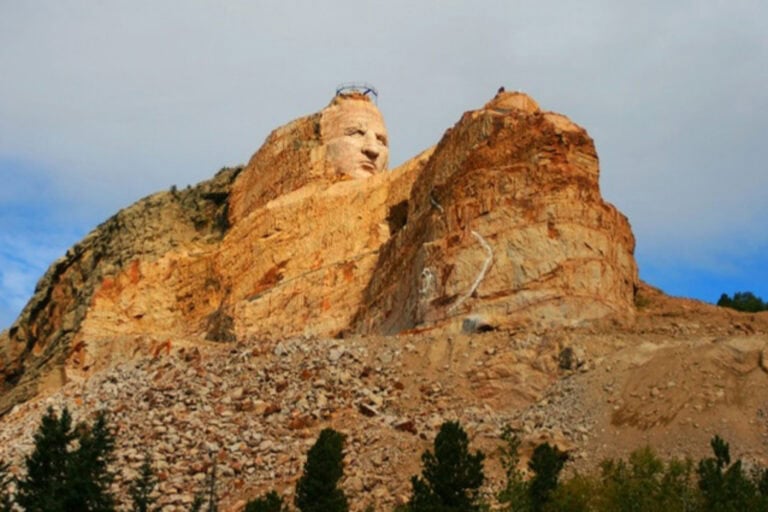
South Dakota’s Black Hills region is celebrated for its mammoth mountain carvings. Most famous is Mount Rushmore. Less known but by far a larger undertaking is the Crazy Horse Memorial.
Driven by deep-rooted Native American history, its massive edifice hopes to create an indelible monument to the region’s indigenous people.
We had not planned on stopping, but that face, resolute, looming and unignorable, beckoned.
I decided to visit after all. I paid our fee and parked, all the while the face never changed expression. Or did it?
It appeared more resolute since we were last there.
It was the thumb that caught my immediate attention, though. Even from 3/4 mile away, the distinctive, well-formed nail and defined knuckle creases are incredibly lifelike.
It is also incredibly large; the thumb is 35 feet long from the tip to the second knuckle. All told, it’s roughly 945 square feet of carved Black Hills granite.
It had not been there on our last visit.
The Black Hills’ Thunderhead Mountain
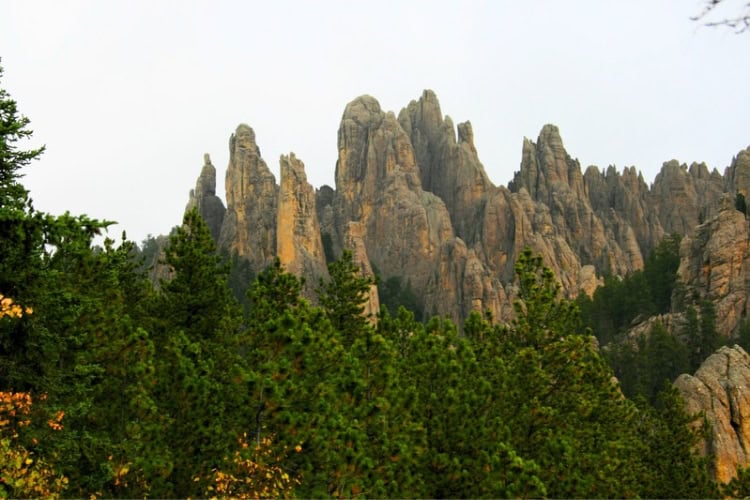
It had been well over a decade since I had last laid eyes on Thunderhead Mountain, located in the Black Hills of South Dakota in the upper Great Plains region of the United States.
Quite a lot had changed in the interim.
On the western edge of the flat lands of South Dakota, the earth thrusts itself heavenward. This is where the grasslands give way to forests of ponderosa pine, over a million acres, covering the tallest peaks east of the Rocky Mountains.
The deep, rich hues of the pines blanket the slopes in shadows that reminded the indigenous Lakota Sioux of the dark of night. These are the Black Hills.
In the midst of this lies Thunderhead Mountain. The 6,500-foot mountain, in and of itself, is fairly nondescript, ranking as only the 24th highest peak in South Dakota. Its uniqueness comes from the remarkable makeover it has undergone in nearly eight decades.
It is being transformed into what will probably be the largest stone sculpture in the world.
Carving A Legend
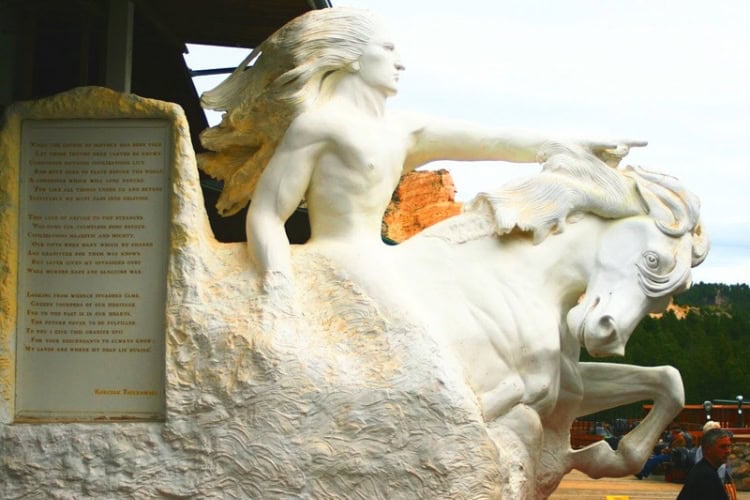
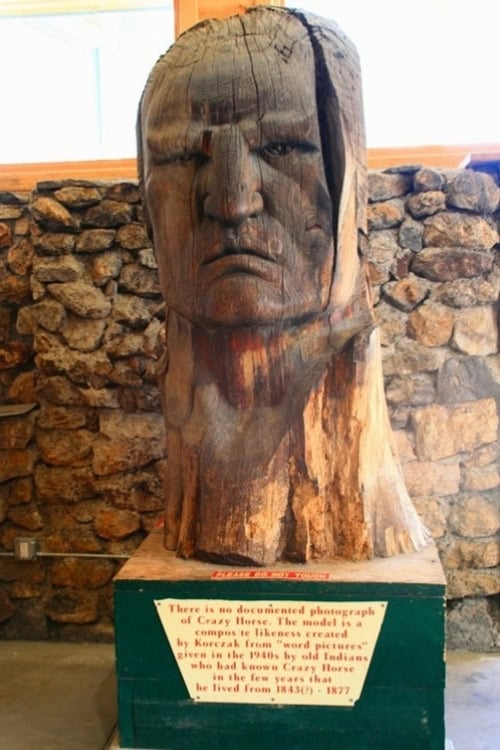
Long before we entered the grounds of the Crazy Horse Memorial, a disembodied, weathered face, hovering high above the valley floor, looked at and through us like an apparition. Its countenance is difficult to comprehend or describe.
It was the face that drew us in.
The carving is of Crazy Horse, or more aptly, Tasunke Witco, which is more correctly understood as “His horses are crazy” in the Lakota language. He was the inspirational leader of the Oglala Lakota tribe.
When complete, the colossal sculpture is planned to be 641 feet long and 563 feet high. It will depict the iconic Native American chief riding on the back of a fiery stallion.
After seventy-eight years of work, it is far from finished. At the time of our first visit, all that had emerged from Thunderhead Mountain was the enormous face of stone, surveying the horizon with the slightest of scowls and a furrowed brow.
Today, an outstretched left arm, all 263 feet of it, has taken form, including fingers and the aforementioned thumb. It is an impressive sight.
The Vision
Just 17 miles away is another mountain and another memorial, Mount Rushmore. In 1939, as that famous ode to presidential busts progressed, Chief Henry Standing Bear felt that the indigenous peoples should have a great monument also.
Standing Bear, of the Brulé Sioux, made it his life’s mission to see a memorial of Chief Crazy Horse created that would dwarf the monument to white leaders who, he and his fellow chiefs believed, had stolen the very Native American lands where it was being carved.
He wanted to create a monument to show the world that “the Red Man has great heroes also.”
In 1939, Chief Henry Standing Bear invited the little-known sculptor Korczak Ziolkowski to carve a memorial to all Native Americans in the Black Hills.
Korczak Ziolkowski
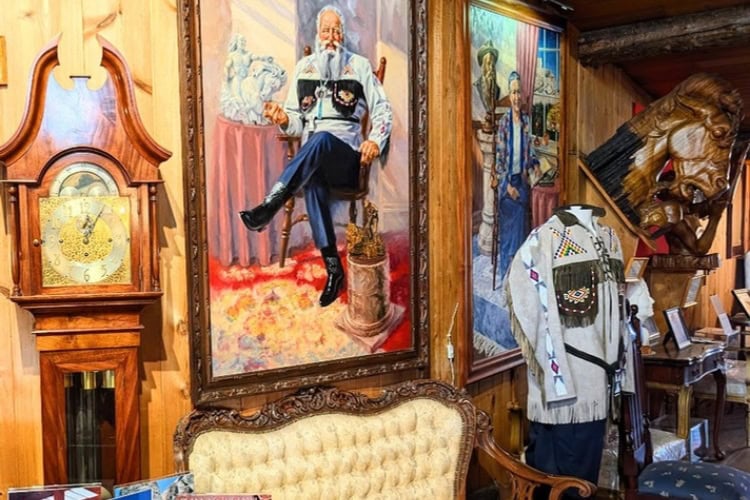
Standing inside his original studio, the portrait before me is remarkably similar to the jovial face of Santa Claus. Rosy cheeks and twinkling eyes framed by a white beard and a head of long, white locks.
Instead of the usual red suit with white fur trim, the gentleman is clad in a western-style shirt trimmed in beads, blue denim slacks tucked into black cowboy boots. A bolo tie with a silver clasp completes the ensemble.
This is Korczak Ziolkowski at the age of 73, only a year prior to his death. The merriment of the eyes hides the steely backbone that drove this Polish-American sculptor to climb to the peak of the mountain, more often than not alone, year in and year out as he blasted away tons of rocky exterior.
The Beginnings
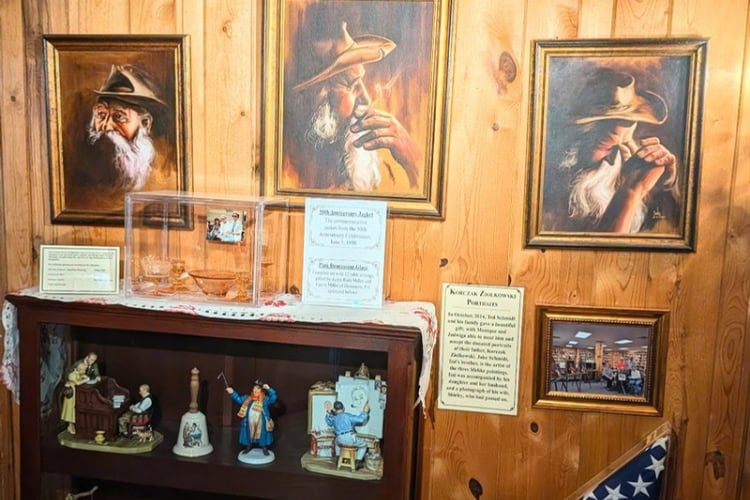
Ziolkowski, a self-taught artist who lost both his parents at a young age, came to Standing Bear’s attention after winning a sculpting prize at the World’s Fair in New York.
He moved to South Dakota in 1947 and purchased the mountain and surrounding land. A year later, he dedicated the memorial with an inaugural explosion.
In the early days, Ziolkowski went it alone. There was little money, a second-hand compressor that faltered more times than not, and a seven-hundred-and-forty-one-step wooden staircase that would never pass inspection today that led up the side of the mountain.
He lost one wife, gained another, lived in a tent until a cabin was completed, and raised 10 children. For 34 years, he continued blasting, forming, and blocking out the mountain with little to show for his work save for piles of blasted rock and a painted outline of a horse on the mountain.
In 1982, he passed unexpectedly at the age of 74.
The work on the mountain continued with his wife Ruth and family overseeing the project. In 1998, sculptors completed the face of Crazy Horse, the enduring face that had drawn us in, and now the work focuses on the horse’s head.
If and when the sculpture is completed, the stirring image of a great warrior will be sitting astride a horse with a flowing mane, his left arm extended in front of him, pointing towards the horizon.
The Indian Museum Of North America
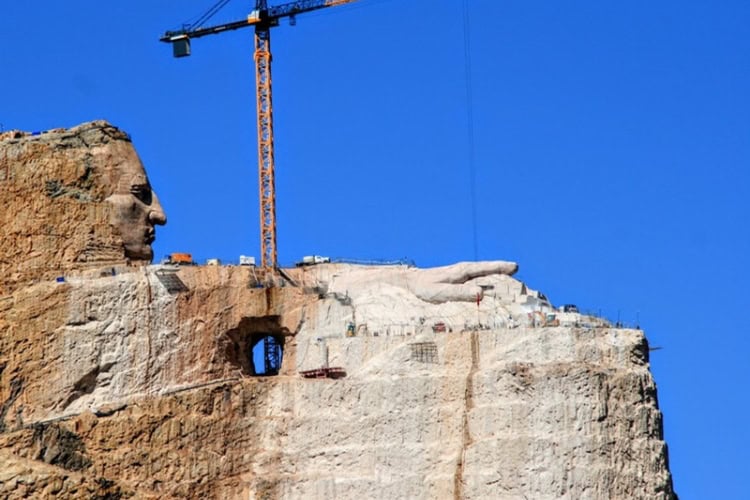
On a warm spring morning, which was eased with a gentle breeze, we parked amongst a bevy of SUVs, RVs, and a small herd of Harley-Davidson’s finest. From the parking lot, we could see the continuing work on the sculpture as a hoist rose on the enormous crane that extended far above the arm.
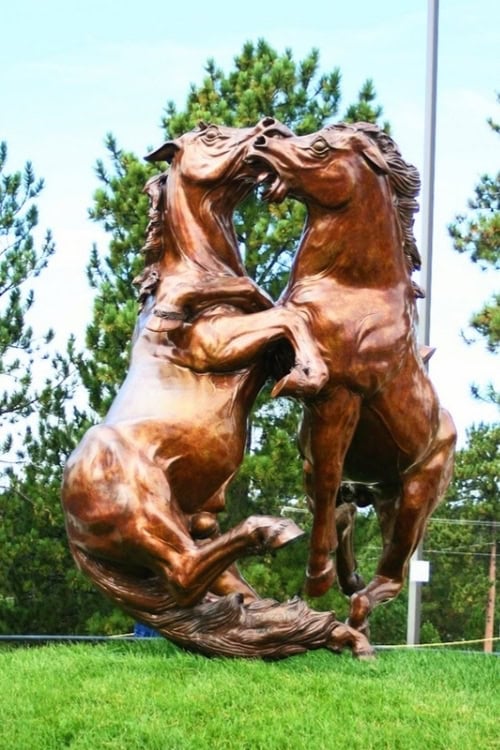
We walked past a magnificent bronze sculpture of two fighting stallions that seemed to sum up the spirit of the mountain.
We entered through the double doors of the visitor center, which doubles as The Indian Museum of North America®. The Center also houses Ziolkowski’s original studio, a gift shop, and a restaurant.
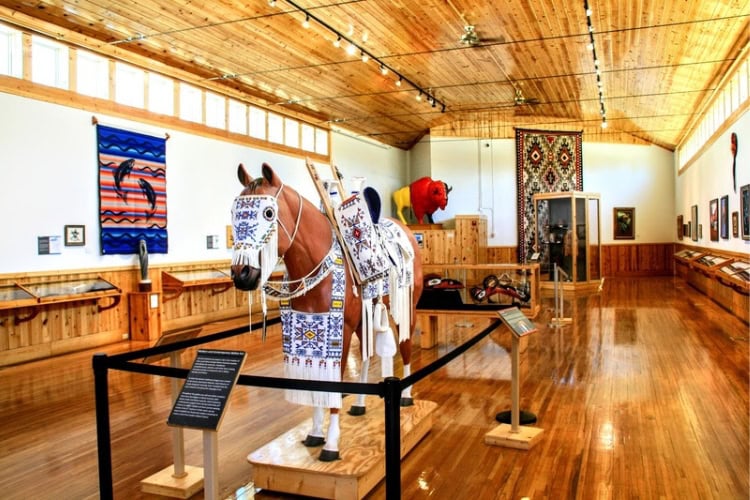
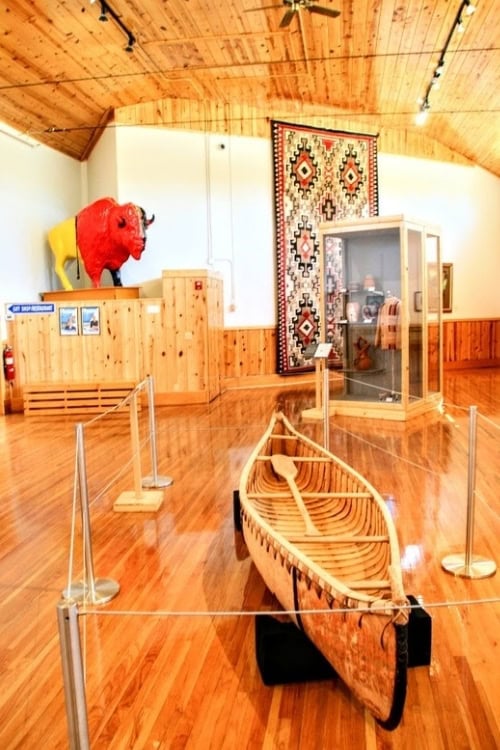
The museum has several wings that overwhelm the senses at first. It features a collection of approximately 14,000 Native American artifacts. Framed in floors and ceilings of warm pine boards, the displays tell a story of indigenous people and their lifestyles, if somewhat disjointedly.
The museum provides a solid introduction to Lakota; however, the Plains people were not one nation but many peoples and tribes, and like many nations, had their differences and shared interests.
As I walked past the beautiful displays of headdresses, beadwork, handcrafted clothing, and accouterments that reflected life on the plains, I wondered at the various peoples and how they came about.
What was their real story? With each step, each new display, I learned a little more.
The Sculpture
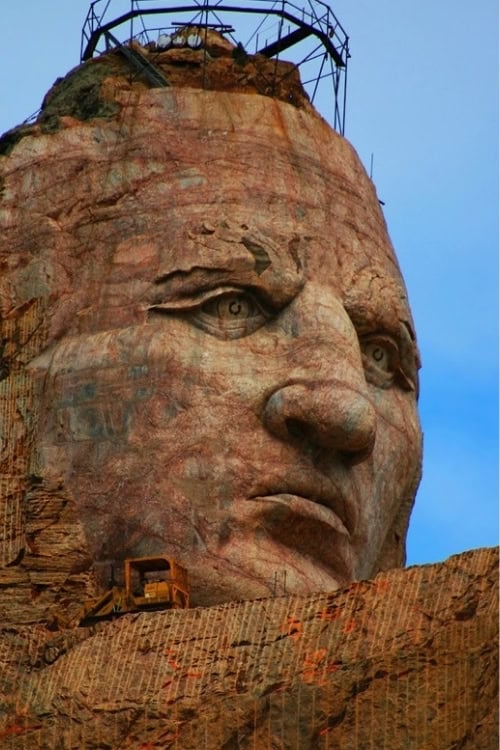
Outside the museum, an open-air pavilion provides a clear view of Crazy Horse.
At 87 feet tall, the face is enormous. In contrast, this is 27 feet taller than any face on Mount Rushmore. The Great Sphinx of Giza, Egypt, would sit roughly 21 feet below its crown.
Decades of exposure to the elements have left it with an indelible tan the color of tea.
It’s obvious where the newest work is taking place. The hand juts out like a blazing white scar across the mountain as if from a new wound.
The creation of Crazy Horse Memorial is artistry on an industrial scale. It is carved, or more precisely blasted, into the Thunderhead Mountain granite. The team uses a combination of defined rock-blasting, hand chiseling, and industrial saws guided by 3-D computer mapping to slowly shape the massive mountain.
Ziolkowski’s first blast in 1948 removed well over 10 million tons of mountainside. Since then, over 11 million tons of rock have been blasted away. As each new detonation occurs, nearly 30 tons a day when active, the gleaming white granite is exposed and a little bit more of the vision emerges.
For now, as I stood on the pavilion staring across the valley, I had to imagine that somewhere beneath the solid mountain were the flowing tresses, the stout chest, and the bulging biceps of “Tasunke Witco.” Hidden behind the mountain’s pale quartz, somewhere is an envisioned impressive steed.
Ziolkowski is said to have told his wife as he lay dying, “You must work on the mountain,” he told her, “But go slowly — so you do it right.”
I doubt I’ll see its completion in my lifetime.
Who Was Crazy Horse
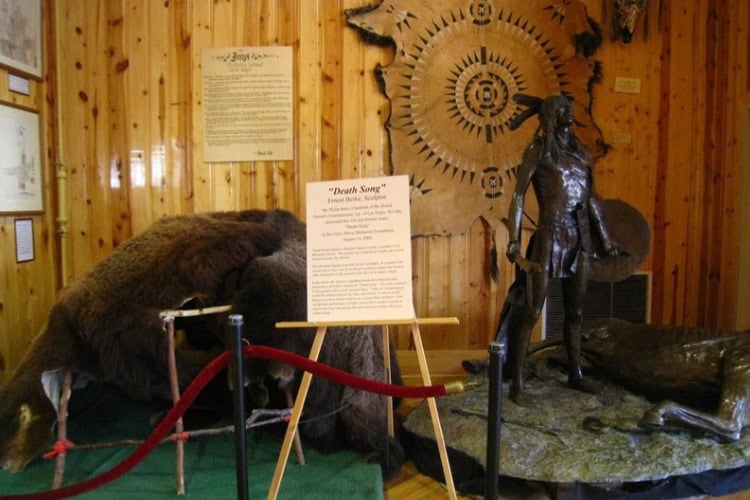
In the museum, I had learned that he was born around 1840 in Lakota Territory. Crazy Horse grew up in a time when white settlers, gold seekers, and trappers were already moving through the area.
By age 21, he was one of the bravest warriors of his time. Crazy Horse was also one of the most influential leaders among the Plains Indians: one of the most revered war leaders of his generation, second only to Sitting Bull in renown.
In 1868, the United States promised that the Black Hills would be “set apart for the absolute and undisturbed use and occupation” of the Sioux Nation. But, just six years later, the government sent Custer and the Seventh Cavalry into the Black Hills in search of gold, setting off several skirmishes. In 1876, 150 years ago, Crazy Horse and his warriors won a dramatic victory against Custer at the Little Bighorn.
After months of pursuit afterward, Crazy Horse surrendered to overwhelming U.S. forces in May 1877, seeking to secure the survival of his people.
While under guard, he was fatally wounded by a bayonet during a struggle.
His spirit and memory are revered to this day.
Controversy
Unfortunately, the memorial is not without controversy. Some Lakota tribe members believe that, far from being an inspiration to Native Americans, the sculpture is a scar on the landscape and against all that Crazy Horse stood for.
While Korczak insisted that the memorial was meant to be run for Native Americans, to the extent that he refused millions of dollars of government funding to keep the project in private hands, many Native Americans see little benefit from the monument’s construction and wonder why more of their people are not involved.
And, of course, the fact that it still is not finished intrigues and frustrates.
Seeing Beyond The Stone
As I turned from the immense profile that loomed above my head and the forest floor, I wondered at Korczak Ziolkowski and his vision of Crazy Horse in stone. Is it a worthy tribute to a much-admired figure of Native American history? Or is it simply the life’s ambition of an egotistical (his words) sculptor?
As I hefted a piece of quartz-granite from a box with a sign that stated, “Rock from Crazy Horse Mountain, take a piece of home”, I thought about our day.
We had not planned on returning, but the memorial gnawed at me. For most, it is simply a sculpture in process. Most admire it, a few do not. I think it’s more; the story behind the sculpture reverberates.
I pivoted to the gift shop where I bought two books about two men; I wanted to know more.
If You Go
Getting There
The Crazy Horse Memorial is located in the Black Hills of southwestern South Dakota, on US Highway 16/385, roughly 5 miles north of Custer and just 17 miles southwest of Mount Rushmore. Rapid City, home to the nearest airport, is about 60 miles north.
Crazy Horse Memorial®
12151 Avenue of the Chiefs
Crazy Horse, SD 57730-8900
Admission
- $35.00: 3 or more people in a vehicle
- $30.00: 2 people in a vehicle
- $15.00: 1 person in a vehicle
- $10.00: per person on a motorcycle, bicycle or on foot
Guided Tours
- For those who want the fuller regional picture beyond the memorial itself, the Premiere Private Black Hills Tour covers Mount Rushmore, Crazy Horse and Custer State Park in a single day with a private guide, letting someone else handle the driving through Needles Highway’s tunnels and switchbacks.
- The Top Rated Mount Rushmore Tour in the Black Hills is a solid group option that bundles entrance fees to all three sites into the ticket price, useful for travelers who would rather not juggle separate admissions.
Books
- To understand the man behind the mountain, Larry McMurtry’s Crazy Horse: A Life is a sharp, compact biography of the Lakota leader.
- For a perspective grounded in Lakota oral history, Joseph M. Marshall III’s The Journey of Crazy Horse offers a fuller picture than the museum placards can.
Need a hand planning your trip? Here are the sites and services we rely on most, from booking tools to travel products we love.
Inspire your next adventure with our articles below:
- 10 Iconic U.S. Road Trips Every Traveler Should Take
- Get Away From the Crowds: 6 Underrated National Parks in the USA That You Won’t Want to Miss
Author Bio: Frank Hosek relishes traveling with his wife, Kathy. He enjoys discovering new experiences, meeting the people that make those experiences memorable, and sharing their adventures with others. He has written for Go World Travel Magazine, The Daily Journal, News Gazette and Lifestyles magazine. Frank has won awards from NWPA and IWPA for his travel writing. He looks toward the horizon for the next adventure.
Want to discover more hidden gems and helpful travel tips? Join our free newsletter for the latest travel secrets and travel articles.
We are reader-supported and may earn a commission on purchases made through links in this article.

- The Sleeping Bear Dunes: Discovering the Splendor of Michigan’s National Lakeshore - September 24, 2026
- A Day On Tybee Island: 5 Things To Do When Exploring Savannah’s Beach - September 22, 2026
- The Great Lakes Shipwreck Museum: Honoring the Legend of the Edmund Fitzgerald - September 11, 2026
Planning another trip soon? ✈️
Add GoWorldTravel.com as a preferred source on Google. Click the button below so our local guides, packing hacks, and hidden-gem itineraries always show up first when you search!
Add to Preferred Sources