
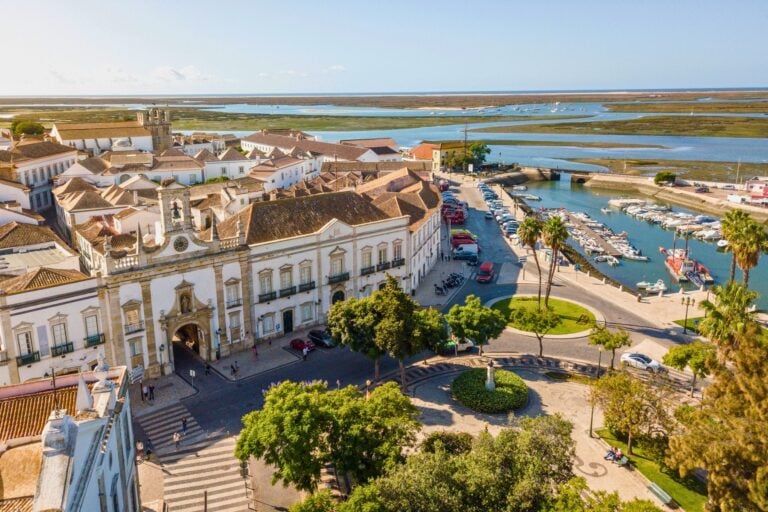
Driving into Faro, Portugal, you get the sense that it is a city that only somewhat reluctantly became the capital of the Algarve, Portugal’s southernmost region. Like that small neighborhood restaurant that had always been a well-kept secret in plain sight.
That is, until a celebrity mentions it on Instagram and it suddenly becomes impossible to book a table. Now the chef, and the city, while pleased to get the recognition, just want to keep doing things the way they always have: the right way.
When you pull off the motorway and roll down your window, the scent of orchards spiced by the salt of the sea just beyond the horizon replaces that rental-car smell. The A-22 runs across Portugal’s southern edge from the Spanish border to Lagos like a clothesline strung between vineyards and olive groves. Beach towns like Tavira, Albufeira and Portimão hang off the line, with Faro smack dab in the middle.
The Algarve stretches along Portugal’s southern Atlantic coast, famous for its golden cliffs, beaches and resorts, but Faro occupies a slightly different place in it. Low-lying buildings, fruit trees and gardens crowd the road into town, practically spilling their produce into your rolled-down windows.
Where you might expect billboards advertising amusement parks and tourist attractions, here ads for supermarkets and farming supplies compete for your attention as you enter the city.
Where the Tour Buses Don’t Stop
Few visitors arrive here by land, though. If the name Faro does ring a bell, it’s probably because of its airport. More than five million tourists a year fly into a city of around 65,000, only for most of them to be whisked away on buses bound for resorts elsewhere along the coast. The irony is that in their rush to reach the Algarve, most visitors leave its capital behind.
Faro is a university town and the Algarve’s administrative capital. It hasn’t had to rely quite so heavily on tourism, making it one of the region’s centers least transformed by the package tours its airport so readily feeds.
In Town for Faro Blues
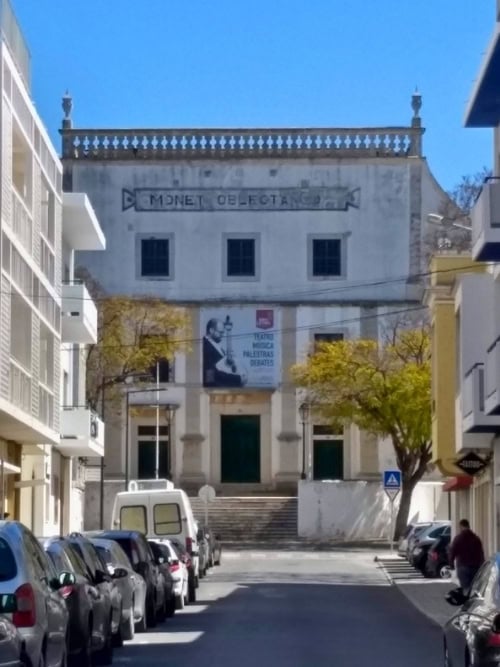
It’s early spring, and some are in T-shirts, others in puffer jackets, but everyone is outside on the raised parking-lot terrace at Maktostas (R. do Alportel 29) on the fringe of the old city. Despite the late hour, the air is warmed by the sea hidden by the seawall, and only the odd cool breeze reminds you it’s not quite summer yet.
The outside décor is a bit haphazard yet somehow fitting, since this isn’t necessarily a place to be seen, unlike the slicker restaurants nearer the port. This is where locals end up for the last drink of the evening, then a late-night deep-fried snack across the street at the Padaria Lisbonense.
I had come to Faro for the Faro Blues festival, an annual gathering that brings musicians from Portugal and farther afield to this corner of the Algarve. It was also how I came to be spending the evening with my old friend Hernani Nascimento, a blues DJ involved with Blues a Sul, the local association that organizes the festival, and my shaman of all things Algarve. If the festival had brought me to Faro, Hernani seemed determined to introduce me to the city that existed between the concerts.
A Mission Before Dawn
“7 a.m. is the best time to go,” Hernani tells me. “If we go to the market any later, all the best produce will be picked over.”
Seven in the morning was less than five hours away. That seemed unreasonable enough. Then Hernani told me what we were getting up to find.
“We need to get there as the fishing boats are coming in if we want to get a ray big enough to feed us all. You simply cannot leave without trying Raia Alhada à Moda de Olhão.”
Long before tourists arrived in the sixties, the Algarve was primarily a collection of small fishing communities, and the astonishing diversity of seafood found offshore remains part of that inheritance.
Just a few hours earlier we had eaten grilled sea bass and Lulinha à Algarvia—little, whole fried squid—paired with jugs of local wine up the street at the homey, family-run Casa de Pasto Flor do Roxo (R. Cruz das Mestras 57). Now our after-dinner drinks had somehow become a dawn expedition to Olhão, ten kilometres away, in pursuit of a huge ray.
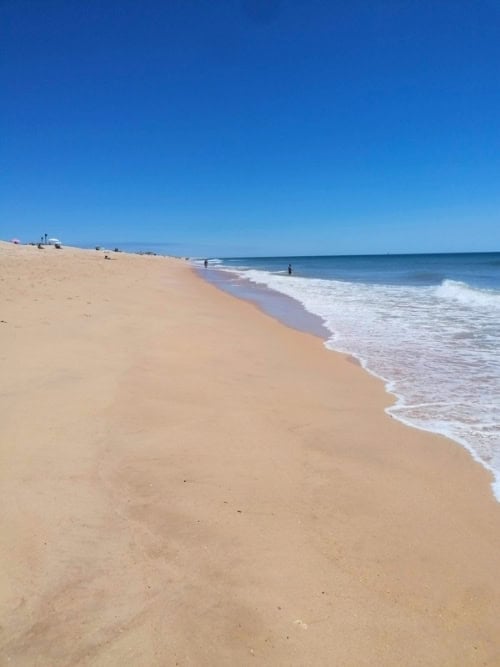
To reach it, we left Faro and followed the Ria Formosa east to Olhão. Faro itself sits back from the open Atlantic behind the barrier islands, dunes and lagoons of the Parque Natural da Ria Formosa. It has no beach directly in the city, but those same sandy barriers helped protect Faro from the tsunami that devastated much of the Algarve after the great Lisbon earthquake of 1755.
Nearby Olhão grew behind the same lagoons, its market conveniently close to the port where fishing boats unload their catch.
But first Hernani had other plans.
“If we want to catch a fish, we need to break bread with the men who catch them,” he reasoned as we ordered another round of Super Bock beers.
By last call, the plan was hatched.
Breakfast With the Fishermen
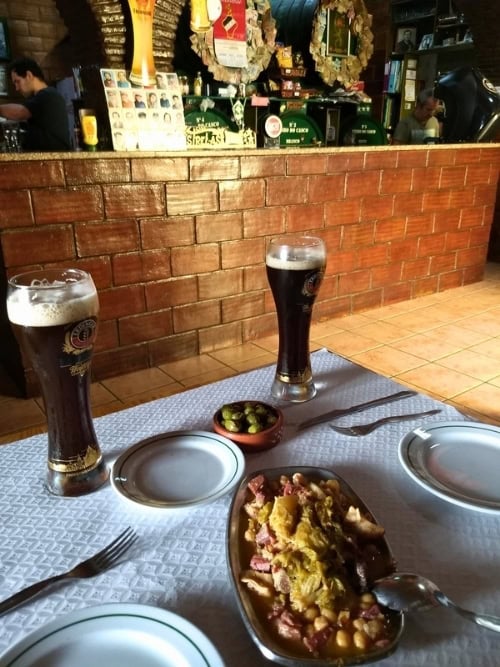
A brief nap later, as the already warm sun crept over Olhão’s deep-red market buildings, I found myself in a narrow lane in front of Casa Sete Estrelas (Travessa Alexandre Herculano 6). Fishermen, pensioners, delivery men and the odd tourist sat under the high brick-vaulted ceiling, and glasses of dark Super Bock stout outnumbered the early-morning bicos of strong Portuguese coffee on the simple wooden tables.
“The best way to start the day—or, in the case of the fishermen, finish it—is some Cozido de Grão com Presunto.”
Plates of shaved cured ham and dishes of hearty chickpea stew with ham and cabbage seemed to be on every table, bringing together those beginning their day with those bringing the previous one to an end.
“Now,” Hernani announced, “we just need to find out who caught a big ray last night.”
Heavily breakfasted and with the harsher edges of the early morning softened by the stout, we took our insider information in search of our prize.
Inside Olhão’s Market
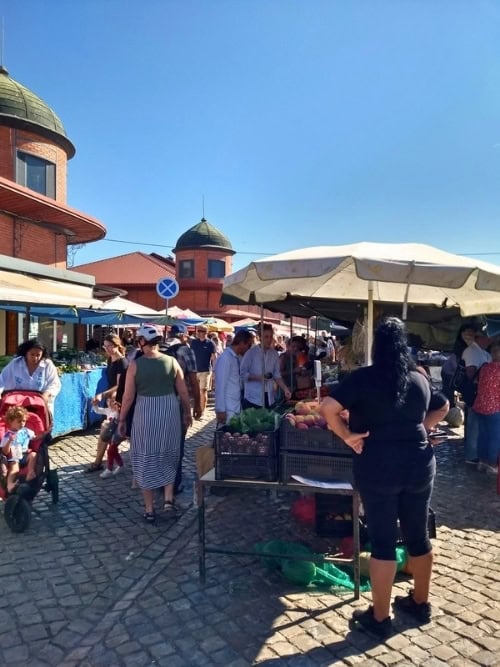
The market itself is large, but on Saturdays it expands further with the addition of a farmers’ market. Accompanying a regular through a market that still caters primarily to locals has its perks. At times, Hernani would approach a stall loaded with what seemed to be the freshest produce available, only to be met with a polite, “Sorry, Hernani, nothing for you today.”
This, I gradually understood, was secret code for: Sorry, nothing that meets your standards. Try tomorrow.
The Seafood Section
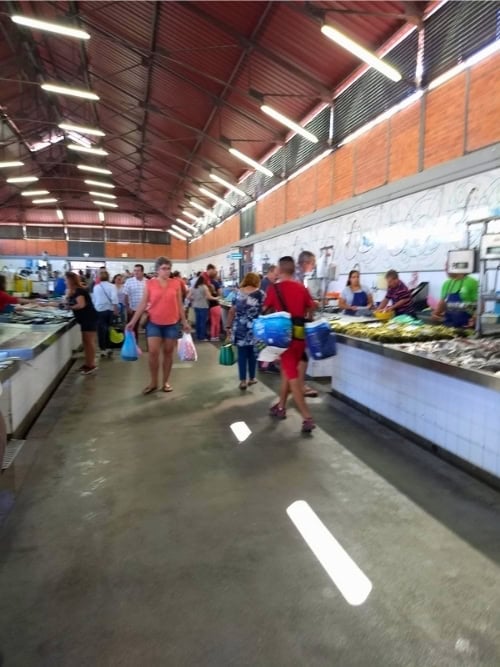
The seafood section is the heart and soul of the early-20th-century market building. The counters offer an inventory of the strange abundance that lives beneath the surrounding waters: moray eels, shark heads, piles of silver sardines and eerie creatures from deeper water. The Algarve sits at a marine crossroads, influenced by both the warmer waters associated with the Mediterranean and the cooler Atlantic currents farther offshore.
And somewhere among it all was the creature that had dragged me out of bed after barely a few hours’ sleep.
Finally we found it: our enormous ray, spread across the fishmonger’s counter, unmistakable among the smaller fish around it.
“Now that we’ve got our fish, we need to take it to the only person, other than myself, that I trust to cook it,” he laughed. “And I know just the woman.”
The Woman Who Could Cook a Ray
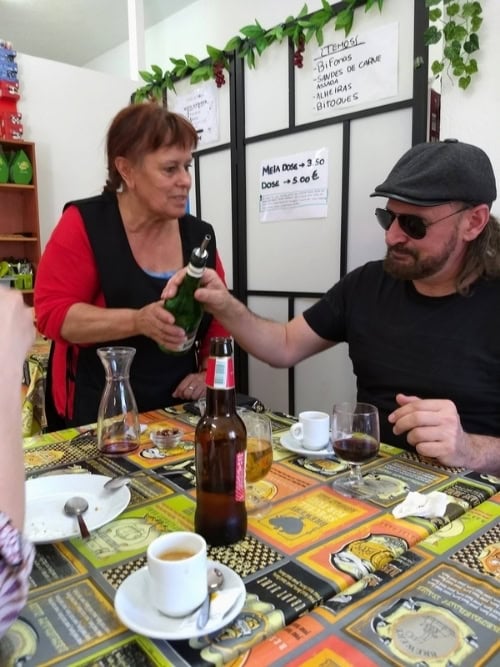
A short drive through the orchards surrounding Faro and we were back in the city, this time at a roadside café.
“I used to have lunch in the city center where Bia used to work,” Hernani explained, “but once she left to work out here, everything changed, and I followed her here.”
Bia Ribeiro has a smile that lets you know her welcome is as genuine as her cuisine. She invites us into her simple, airy café surrounded by olive groves and vegetable gardens and, apparently unfazed by our arrival bearing a large raw ray from the morning market, confidently takes our catch into the kitchen.
Tiny olives, goat cheeses and little clay bowls of Feijoada à Transmontana—bean stew with chorizo—keep us busy while we wait. The café is full of people sitting at long tables enjoying the day’s set menu of Coelho à Caçador, rabbit stew, or Bacalhau à Brás, cod with eggs and potatoes. No one seems in any rush to leave.
“The newest trends in cooking around the world seem to be focused on seasonality and local products, but here in the Algarve we’re ahead of the curve,” Hernani muses. “The thing is that we’ve had it here all along and haven’t had to change. Those potatoes are from the farm next door!”
It strikes me that this is the Algarve Hernani has been trying to show me all along: not a rediscovered culinary philosophy or fashionable return to localism, but simply a place that never entirely stopped doing things this way.
One More Algarve Secret
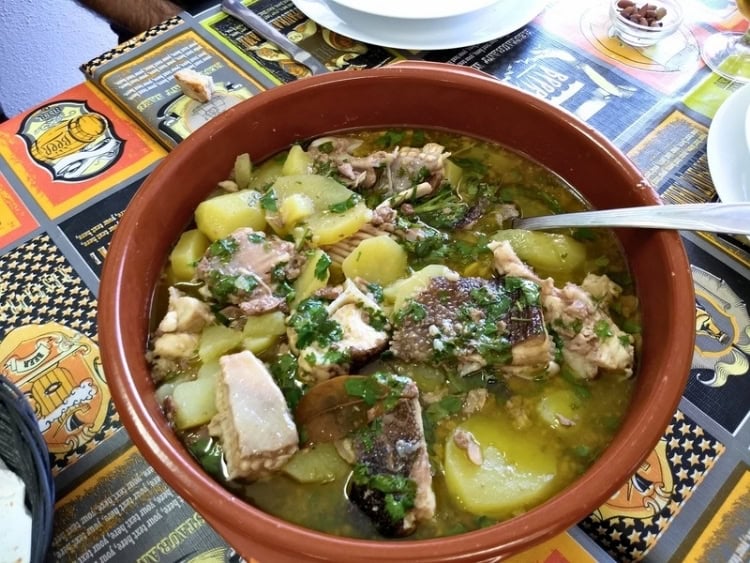
Bia places a large clay crockpot in front of us. Inside is our ray, the neighbor’s potatoes and, this being Portugal, heaps of cilantro.
“Raia isn’t only a challenge to cook, but you need to know how to eat it,” Hernani advises.
Ray is cartilaginous, and he shows me how to peel the white flesh away carefully. It slides surprisingly easily from the fine cartilage. Its gelatinous texture also helps thicken the sauce, Hernani explains, but one final Algarve trick remains.
He grabs a bottle of white wine vinegar and adds three healthy slugs to his plate.
“The Algarve still has a few secrets left for people to discover.”
Once again, Senhor Nascimento is right. The vinegar cuts through the richness and gives the stew exactly the hint of tartness it needs to come alive.
The Drunken Goats
By the time I reach the point of surrender, unable to eat another bite, my Algarve shaman comes to the rescue.
“Ever hear about the drunken goats?” he laughs as Bia lines up several tiny glasses and pours a clear liquid into them.
“This is licor de medronho.”
Medronho, the fiery local spirit distilled from the fruit of the strawberry tree, comes with one of those stories that seems almost designed for the end of a long Portuguese lunch: local shepherds, Hernani tells me, discovered the fruit’s intoxicating properties after watching goats getting drunk from eating too much fermented fruit.
“A sip or two of this,” Hernani assures me, “and you’ll be ready.”
The medronho burns its way down.
Hernani grins.
“Now you’re ready for what I have planned for dinner.”
I wasn’t sure if I was ready, but that was the magic of Faro—it didn’t demand you come with a plan. You just had to follow the right people, chase the right scents, and trust that the next meal, the next hidden spot, or the next Algarve secret would reveal itself when the time was right.
If You Go
Getting There
Faro International Airport (FAO) is the main gateway to Portugal’s Algarve region and lies only a few kilometers from central Faro. Visitors arriving from farther afield can connect through Lisbon or another major European hub. Faro is also connected by rail with Lisbon and other towns along the Algarve.
Getting Around
Central Faro is compact and easy to explore on foot. A rental car is useful for reaching smaller towns, beaches and rural restaurants around the Algarve, although trains and buses connect Faro with destinations including Olhão, Tavira and Lagos. Olhão is roughly 10 kilometers east of Faro and is easy to reach by road or train.
Where to Stay
- AP Eva Senses sits on Faro Marina, a short walk from the old town and the train station, with a rooftop terrace and a seasonal outdoor pool.
- 3HB Faro is a five-star hotel in the city center with a rooftop pool, a full-service spa and a firepit for evenings outdoors.
When to Go
Spring and autumn are particularly pleasant, with warm weather and fewer visitors than during the height of summer. July and August bring the hottest weather, busiest beaches and largest crowds.
Olhão Market
Go early, particularly on Saturday, when the regular market expands with additional local produce vendors. The fish market is at its liveliest in the morning, when the day’s catch is on display.
The Ria Formosa
The barrier islands that shelter Faro from the open Atlantic make up the Parque Natural da Ria Formosa. This catamaran trip to Deserta and Farol islands leaves from Faro Marina and stops at both for time on the beach.
What to Eat
Look beyond the familiar grilled fish and try Algarve specialities such as Lulinha à Algarvia and, if you can find it, Raia Alhada à Moda de Olhão. Finish with a small glass of medronho, but perhaps don’t make any ambitious plans immediately afterwards. For another Algarve food quest, read A Quest for the Best Frango Assado in Portugal’s Algarve.
Faro Blues
Music lovers may want to time their visit around Faro Blues, the city’s annual international blues festival, organized by Blues a Sul, the Associação de Blues do Algarve. The festival combines concerts with the chance to explore Faro and the surrounding Ria Formosa. Check the Blues a Sul website for upcoming dates and programming.
Need a hand planning your trip? Here are the sites and services we rely on most, from booking tools to travel products we love.
Inspire your next adventure with our articles below:
- The Remote Island of Madeira, off the Coast of Africa, Is Portugal with a Twist—on a Plate (and in a Glass)
- Asturias, Spain: Fishing Villages and Wild Beaches on the Green Coast
- Cies Islands: The Car-Free Paradise of Galicia, Spain
Author Bio: Troy Nahumko is an award-winning (Mercedes Calles y Carlos Ballesteros premio de periodismo) author based in Spain. His recent work focuses on travels around the West Africa and the Mediterranean. His first book, Stories Left in Stone, Trails and Traces in Cáceres, Spain focuses on travels around the province of Caceres published with the University of Alberta Press. He also wrote the Mid-Spain section of the Lonely Planet’s new Experience Spain. As a writer and photographer he has contributed to newspapers and media such as The Globe and Mail, The South China Morning Post, The Sydney Morning Herald, The Toronto Star, The Boston Review, Counterpunch, The Irish World, The Straits Times, Khaleej Times, DW-World, Rabble, El Pais, CTXT, Nueva Tribuna, SUR in English and has a bi-weekly column in Spanish in HOY.
Want to discover more hidden gems and helpful travel tips? Join our free newsletter for the latest travel secrets and travel articles.
We are reader-supported and may earn a commission on purchases made through links in this article.

- Uzbekistan’s Silk Road Cities: From Tashkent’s Markets to Samarkand’s Registan - November 9, 2026
- Faro, Portugal: The Algarve Gem Most Travelers Miss - November 9, 2026
- The Royal Edinburgh Military Tattoo: Scotland’s Annual Music and Dance Extravaganza - November 8, 2026
Planning another trip soon? ✈️
Add GoWorldTravel.com as a preferred source on Google. Click the button below so our local guides, packing hacks, and hidden-gem itineraries always show up first when you search!
Add to Preferred Sources