

As a gentle but warm rain fell, the street lamps reflected upon the glistening cobblestones. All around, umbrellas tilted rearward as a host of evening strollers, including myself, leaned their heads back, gazing upward.
I looked through the gauze of a curtain of falling drops, an occasional errant bead splashing upon my glasses. I was mesmerized by the Column of the Immaculate Conception.

A pillar of marble rose over 40 feet above my head and was capped by a bronze statue of the Virgin Mary.
It was not the most elaborate of monuments, and probably did not deserve the rapt attention I gave it, but, at that moment, in that evening, I was embracing an unexpected emotion that I can only attribute to our first night in Rome.
Fulfilling a Bucket-List Trip

Earlier that afternoon, we had settled into the gorgeous neoclassical Anantara Palazzo Naiadi Hotel, which fronts the Fountain of the Naiads, centered in a circular piazza.
Across from the hotel is the Michelangelo-designed Basilica of Santa Maria degli Angeli. Talk about an introduction to the Eternal City.
We met Valentina, or Val as she asked us to call her. Val welcomed us warmly and was to help guide us through the intricacies of seeing the must-see sites of her city.
A conversation about shared bucket lists over cocktails with friends nearly two years previously had led us on a trip both figuratively and literally to the Mediterranean and city of Caesar, Sophia Loren, and the Pontiff.
With less than 72 hours to explore, we did not linger long in our rooms. After a meal of stuffed zucchini flowers, eggplant parmesan, and guanciale, we set out walking through the drizzle for the historic center of the city.
Walking through Rome allows for discovery as each street, each alley seems to hold a revelation or hidden gem. It allows one’s gaze to linger and embrace the nuances of an art-filled city that might escape you if driving in Rome’s infamous traffic.
Read More: 12 Bucket List Adventures to Gift Your Travel Lover This Year
The Traffic
Ah, the traffic! All roads lead to Rome, says the old adage. If so, so does all the traffic.
Big buses, small cars, and the ubiquitous scooters, thousands of them weaving in and out of stop-and-go traffic. More stop than go.
I read that it’s one of the world’s most congested cities, with drivers being stuck in traffic for an average of around 254 hours every year. I don’t know where they come up with those statistics, but, needless to say, driving is to be avoided if possible.
The Pantheon

We walked through the Piazza Navona, built on the remains of an ancient stadium, with its three fountains, the most prominent being the Fontana dei Quattro created by Bernini in the 17th century.
In the neighboring plaza, we came upon Rome’s great temple—the Pantheon.
It is said that the Pantheon is the only ancient building in Rome in continuous use since its creation in 125 AD.
What makes the building so distinctive is its soaring self-supported interior dome, 142 feet from floor to ceiling. Unfortunately for us, the doors were locked for the evening.
The facade’s enormous granite columns, some 40 feet tall, supported a portico beneath which several visitors lingered out of the rain.
Nearby, the Piazza di Spagna, with its Spanish Steps, climbs a steep slope toward the Trinità dei Monti church. Long held hostage by a throng of people-watchers, this night, and forevermore, sitting on the rain-slicked steps is banned.
Trevi Fountain
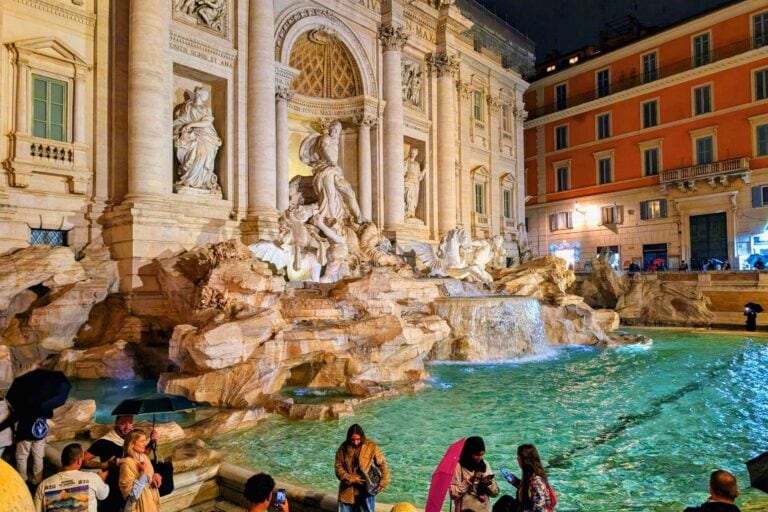
Influenced in no small way by the 1954 film, Rome’s iconic Trevi Fountain—dating from the 1700s—was a must for my wife.
The fountain marks the terminal point of one of the aqueducts that supplied water to ancient Rome. More than just a fountain, it’s a mighty façade of Baroque artistry, rising far above its base.
In its center, the mighty Oceanus rides a chariot made from a giant clam shell. All around him, water cascades into the basin below. His watery journey is heightened into a spellbinding spectacle by the floodlights illuminating the evening.
It’s said that if you throw a coin into this fountain, you will return to Rome. All around, umbrella-toting tourists, including us, tested their fate, trying to ensure a return.
Basilica di Santa Maria Maggiore
One of Rome’s four papal basilicas, this 5th-century church was built in 432 on Esquiline Hill’s summit, on the spot where snow is said to have miraculously fallen in the summer of 358.
It is only a few blocks from our hotel, so early Friday morning, we made our way to its steps. To our surprise, Mass was being held. We inched ourselves into the rear of the nave to witness the service.
The choir’s rich voices filled the cavernous, gilded ceiling before gently descending down around us like a melodic blanket.
The richly robed priest chanted his harmonious phrasings, while all around us, faces were in rapt attention. We could not understand the words, but the sentiment was well recognized.
Before departing, we paid our respects to Pope Francis, who was entombed here earlier this year.
Sistine Chapel

Later that same morning found me staring heavenward. My wife is staring heavenward. The closely jammed congregate of fellow gazers are all staring heavenward. Apropos, I suppose, as we are all taking in Michelangelo’s great masterpiece, the ceiling of the Sistine Chapel.
Perhaps the most famed ceiling in all of mankind is inside the Sistine Chapel. We are surrounded by slack-jawed, wide-eyed visitors, all of whom have made the pilgrimage to Vatican City for this very moment.
Above us is a celebration of beginnings, with God giving a pensive Adam the touch of life. Toward the door behind us, where we had entered, filling the entire wall, is the far grimmer Last Judgment. Its fresco is as damning as it is beautiful.
This is the Old Testament in all of its breathtaking glory as told by Michelangelo. It is beyond words that sustain, but glorious all the same.
Vatican City

Originally built as a private chapel for the Pope in the Vatican, the Sistine Chapel is also the site of the papal conclave, where new popes are elected.
Vatican City is, in fact, a country in and of itself. The world’s smallest independent city-state, it is entirely surrounded within Rome. It has its own post office, security, and coinage.
The Pope is both its religious and secular leader. And, along with thousands of others, we had crossed its borders on a Friday morning to explore its grand museums.
The only downside of a visit this day is that it’s jam-packed with people. Unknown to us at the time of our booking, 2025 is a Jubilee Holy Year, a special year of forgiveness and reconciliation.
As such, the throngs were even more prevalent and required a great deal of patience.
To avoid the notoriously long lines, a guided Vatican Museums and Sistine Chapel tour is a lifesaver. You breeze past the crowds and get the kind of context that makes Michelangelo’s ceiling even more incredible.
The Vatican Museums
Antiquities of the ancient world, mostly glorious, sometimes disturbing, and a few incomprehensible, are on display in the Vatican. The Vatican Museums have 1,400 rooms of art, nearly four miles of galleries, and unfortunately, you can’t see them all in a day, and we barely had that.
Our visit began in the Pinecone Courtyard, a vast green space, where we oriented ourselves. We went through galleries filled with an immeasurable amount of Greek and Roman busts and statuary, some dedicated to the gods, many dedicated to an individual whim.
Beyond, in an octagonal courtyard, we found some of the most gifted creations.
Life in Marble

The Apollo Belvedere statue slowed my pace as I admired the deft way it conveys movement in solid marble. However, I am completely stopped by the statue, Laocoön and His Sons.
With the warning, “Beware of Greeks bearing gifts,” the High Priest of Troy tried to warn his people against bringing the Trojan Horse into the gates.
The statue depicts the moment when the Greek gods sent giant snakes to crush Laocoön and his sons to prevent their warnings. The sheer terror and emotion depicted, the twisting muscular limbs and bulging veins are all impossibly conveyed into and through the marble.

In the next gallery stands the Belvedere Torso. This captivating marble sculpture depicts a male figure, truncated at the waist and missing its limbs.
While its original identity is unknown, some theories suggest it may represent Hercules or Ajax. The rippling muscles and contortions of the torso are said to have greatly influenced Michelangelo.
An Endless Array of Antiquity

Ancient pottery, sand sculpture, and sarcophagi. Aged maps and tapestries. Bronze Age weapons and tools. Hercules in bronze. Unending marble statuary of all sizes and quality, draped in diaphanous gowns or mere fig leaves.
The Vatican Museums are mesmerizing, enthralling, and overwhelming all at once.
Our final stop was the Sistine Chapel. Unlike any creation before, Michelangelo’s work has often been credited as being the greatest single piece of art by anyone. It is simply endearing and almost incomprehensible in its scope.
Merely holding my head in that dizzying upward position for a few precious moments was tiring. Imagine lying on your back, holding your arms above you hour after hour, year after year to create this masterpiece.
Afterward, we, along with the crowd, emptied like water released from a dam into St. Peter’s Square.
The large plaza located directly in front of St. Peter’s Basilica was filled with hundreds of pedestrian-looking folding chairs as the Vatican prepared for a Mass to be presided over by Pope Leo XIV for the Solemnity of All Saints.
The line to enter the basilica stretched for blocks, and, unfortunately, we simply did not have the time available.
The day ended over shared plates of pasta and pizza, complemented by cordial glasses filled with limoncello, several steps below street level beneath the canopy of the outdoor seating at the Ristorante Alessio.

Flavian Amphitheater
Okay, you’ve never heard of the Flavian Amphitheater. That is the original name of the Colosseum.
It was—and still is—colossal. It is a marvel of ancient Roman engineering, or any engineering for that matter. When I think of Rome, the image of the Colosseum immediately comes to mind.
It was begun in 72 AD when the Empire was nearing its peak. It was completed eight years later. Val was quick to point out that, in contrast, it has taken modern Rome over 20 years to build a single subway.
Our first view of the Colosseum from a distance does not disappoint. It is amazing.
Upon arriving, we first passed near the Arch of Constantine. Located outside of the Colosseum itself, this towering archway stands more than 60 feet tall and pays homage to Emperor Constantine.
The tribute, hailing Constantine’s 312 AD victory at the Battle of the Milvian Bridge, is the largest and best-preserved Roman triumphal arch remaining.
Creating A Marvel

Using travertine stone, Roman-pioneered concrete, and brick, the Romans created the five-story mega-amphitheater with their trademark round arches adorned with marble.
The Colosseum is an attraction entirely meant to enthrall and be marveled at for its grandeur. Walking up to the monument, I could not help but wonder at the impression it must have made on ancient Romans when it was in all its glory.
Stepping inside, you can almost hear the roar of ancient Rome. Spread out before us are the intricate passageways that were once covered by a wooden floor.
Between acts, animals and gladiators were shuffled beneath that floor out of sight. Creating a bit of theatrical magic, the Colosseum was, above all else, meant to entertain the ancient populace.

It is not difficult to imagine the place in action. The thrills, the horrors that took place in the giant amphitheater. The cheers, the shouts, and the spectacle.
Afterward, their bloodlust satisfied for the moment, Romans, thanks to its well-planned design, emptied the Colosseum’s 50,000 seats as quickly and efficiently as we do our mammoth stadiums today.
For a deeper look at the Colosseum’s underground passageways and the ruins of the Roman Forum, this guided tour is worth it. It connects all the layers of ancient Rome, plus includes Palatine Hill’s sweeping views.
Capitoline Hill
A short golf-cart ride away, we hiked to the top of Capitoline Hill, one of Rome’s famous seven hills.
It provided panoramic views of the skeletal remains of the architectural ruins of the Roman Forum, once the center of ancient Rome, rising against the evening’s skyline.
At the top of the hill is the Piazza del Campidoglio. Designed by Michelangelo, the piazza is a masterpiece of Renaissance design and is home to the Capitoline Museums and Rome’s City Council.
Crafting Pasta

That evening found me furiously cranking on a pasta press as my companions and twenty of our newest friends carefully passed a ribbon of fresh egg-and-flour pasta dough around a lengthy oblong table.
On our last night in Rome (we were leaving at 3 AM), we were learning how to make gnocchi and stuffed ravioli.
The sharp corrections from the distraught but smiling chef were directed at her charges as we struggled with the simplest of Italian dishes, bringing not too few chagrined looks and a great deal of laughter.
Clad in flour-coated aprons and with a few smudged faces grinning at each other, we finally settled into a pattern that even brought hard-won congratulations from our leader.
The newly formed noodles and pressed pockets of delight filled with a rich mixture of ricotta were dropped into a hot, watery bath and coated with savory sauces to be enjoyed by the excited class.
Sitting around our tables with emptied plates and full glasses of wine, we savored the past few days, regaled each other with favorite memories, and wondered if we would return.
We can only hope that a few odd coins tossed into an enchanted fountain will bring us back to a very magical place.
If you want to try this for yourself, this highly rated small-group pasta and tiramisu class teaches you to make fresh ravioli and fettuccine with a local chef, then enjoy your creations with wine and Prosecco.
Arrivederci, Roma!
If You Go
The best time to visit Rome, the Jubilee notwithstanding, is during the shoulder seasons (April to May and September to October) to find both pleasanter weather and fewer crowds.
A taxi from Fiumicino Airport to the center of Rome will take approximately 40 minutes for the 21-mile (34 km) journey and will cost approximately $58 (€50).
Several cruise lines put into Civitavecchia, the port of call for Rome, located about 45 miles northwest of Rome. You can get to the center by train, which takes about an hour, or by shuttle, car, or taxi.
Helpful links:
- Anantara Palazzo Naiadi Rome Hotel
- To expedite our visit, we used Trumpy Tours (no relation)
- The Vatican Museums
- The Colosseum
Recommended Tours:
- Vatican Museums, Sistine Chapel & St Peter’s Basilica Guided Tour
- Colosseum, Roman Forum, and Palatine Hill Guided Tour
- Rome Pasta and Tiramisu Class: Ravioli, Fettuccine and Fine Wine
Need a hand planning your trip? Here are the sites and services we rely on most, from booking tools to travel products we love.
Inspire your next adventure with our articles below:
- How to Spend 3 Days in Florence: Where Renaissance Art Meets Italian Living
- Skip the Crowds: 10 European Destinations That Are Actually Better in Fall
Want to discover more hidden gems and helpful travel tips? Join our free newsletter for the latest travel secrets and travel articles.
We are reader-supported and may earn a commission on purchases made through links in this article.

- The Great Lakes Shipwreck Museum: Honoring the Legend of the Edmund Fitzgerald - September 11, 2026
- Driving I-90 Across South Dakota: Badlands, Wall Drug and Roadside Icons - September 2, 2026
- Gettysburg National Military Park: A Visit to Hallowed Ground - August 31, 2026
Planning another trip soon? ✈️
Add GoWorldTravel.com as a preferred source on Google. Click the button below so our local guides, packing hacks, and hidden-gem itineraries always show up first when you search!
Add to Preferred Sources