

His throne is at least a millennium old. Its smooth marbled surface provides a cool respite from the heat of the day while it rises above the fray, providing a lofty perch to survey his dominion.
His somnolent eyes convey a haughty, dismissive demeanor as his subjects crowd around him seeking acknowledgment or some simple recognition. One of the more brazen, a fawning woman in sunglasses and a floppy hat, reaches out a hand hesitantly.
His only notice of her impertinent efforts is the slightest twitch of his tail as he disdainfully turns his head away from her.
He’s imperious, proud, and slightly overweight. He has his own Instagram page. He is Garfield, an orange, short-haired tabby who rules over the Ruins of Ephesus.
The Origins of Ephesus

Truth be told, until our planned cruise itinerary mentioned the nearby port city of Kusadasi on Turkey’s western Mediterranean coast, I was unaware of the ancient city of Ephesus, its historical ruins, or, least of all, Ephesus’ iteration of Garfield the Cat.
All of which, I’m sure, would raise a contemptuous eyebrow (do cats have eyebrows?) from his orangeness.
What I soon learned was that the city of Ephesus was one of the largest and most important port cities in the ancient Mediterranean world before devastating earthquakes and its harbor silted over.
It lies on the western coast of Asia Minor (modern-day Turkey). Originally a Greek settlement founded on the Aegean Sea in the 10th century BC, and the home of the Temple of Artemis, one of the Seven Wonders of the World, before its destruction.
It has seen the rule of Greeks, Persians, and Romans. Its largest growth, both architecturally and economically, came as a provincial seat of government under Roman rule.
The Excursion

Our day began early in the morning as our ship slowly traversed the eye-catching turquoise bay past an island ringed by an 18th-century castle. The skyline is dominated by mountainous terrain, stepped with homes and apartment buildings.
After docking, we boarded our bus parked just outside the main shopping bazaar. There, we met our guide for the day, Tunç (pronounced Tunch) Karaosman, a very knowledgeable and jovial gentleman.

A short, picturesque drive through the Turkish countryside brought us to the parking lot near the Upper Gate of Ephesus. Several other buses and vans had already disgorged their smartphone-toting contents.
It immediately becomes clear, as we joined the crowd, the depth and importance of Ephesus in its day. The very distinct, well-laid-out, extensive grid-pattern streets are still visible in the ruins today. The State Agora, a vast square, laid out before us.
The State Agora

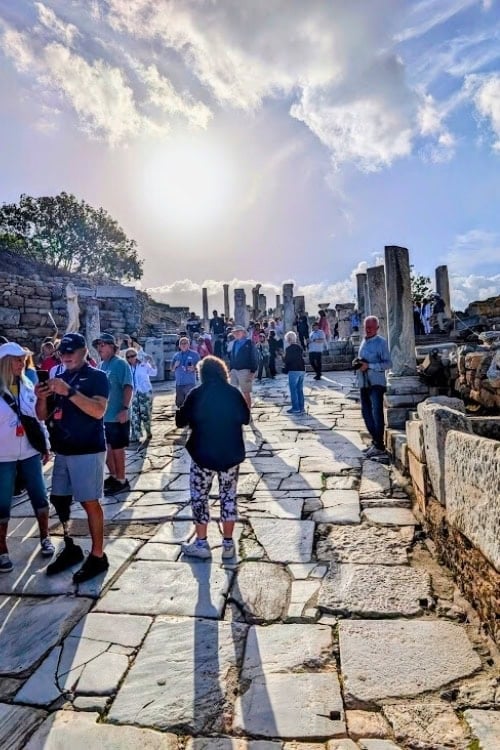
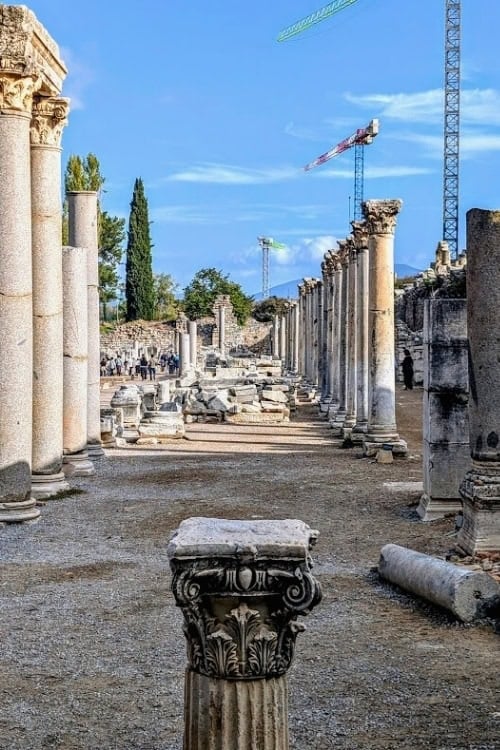
The public area where people gathered for political, commercial, and social reasons contains a parade of columns, in various states of decay, stretching around the perimeters. They once supported the roof of a stoa, or covered public hall.
It functioned as a walkway and pavilion for commercial stalls. As the morning continued to warm beneath a cloudless sky, I could appreciate the want of a covered walkway as citizens went about their day beneath the Anatolian sun.
Situated at the end of the Royal Road—the chief thoroughfare of the Roman East—the city was a western terminus of East–West trade and boasted one of the most important Mediterranean harbors of its time.
This square would have been the face of the city as visitors, traders, and pilgrims entered its gates.
The Odeon Amphitheater

Across from the Agora stands the Odeon. This small, open-air theatre had seating for 1,500, a stage building, and an area for an orchestra. It had a double function in use. The semicircular terraced seating arrangement leaves no doubt as to its use.
It’s a Roman design that has stood the test of time and has influenced modern theaters the world over. First, it was used for the meetings of the local Senate. The second function was for small performances.
In a nod toward charitable public works long before Carnegie, it was constructed in the 2nd century A.D. at the behest of two wealthy citizens in Ephesus.
Temple of Domitian

Across the way, the scattered remnants of the Domitian Temple are named for one of the more disliked and cruel emperors. Built in the 1st century A.D. in hopes of securing good relations and the support of Rome.
After Domitian was murdered by his own servant, it’s said that his statue within the temple was smashed by a mob.
Curetes Street

As we continued our explorations, I became more aware of the large pavers beneath our feet. I asked Tunç if they were original. He replied that the marble stones laid on Curetes Street, as it’s known, are original for over two football fields in length.
He stated that although beautiful, marble was not particularly practical due to its slickness. The street is noticeably steep, rising from where the harbor once lay to the upper gate.

He pointed out several stones with horizontal lines etched into them. A Roman attempt at creating anti-slip strips on the very smooth marble.
The street also hid a well-developed sewer system underneath it. The Romans created an underground maze of drainage, sewage, and water pipes; water and waste flowed into and out of the city through clay pipes.
Several of these have been unearthed and stacked nearby. I’m amazed at the ingenuity and application of such a system nearly 2,000 years prior to London implementing its own sewer system.
The Terrace Homes

Along the marble-paved street, there were once fountains, statues, and shops, of which those located on the southern side had two and three stories. At nearly 30 feet wide, the street could accommodate both pedestrian and chariot traffic.
Ruts carved into the marble from wagon wheels attest to this. The entire roadway was crowded with my fellow tourists. I wondered aloud to my wife if this was what it might have looked like as Ephesians poured out of their homes on market day.
As the primary thoroughfare of Ephesus, many of the buildings lining Curetes Street belonged to the wealthier families. The stone houses are terraced into the rising hillside. They date back to the year 1 A.D.
Many of them were three-storied and had interior columned porches creating courtyards surrounded by rooms that included frescoes and mosaics of mythological scenes.
These were luxuriously furnished private houses with fountains and central heating. Between the street and houses was a portico with a mosaic floor, behind which were shops. I knelt to examine and admire the mosaic pattern.
I’m reminded that some artisan had done the same over two millennia ago, tediously but delicately placing each stone to create the brilliant mosaic.
The Fountain of Trajan

Across from the Terraced Homes are the remains of an elaborate fountain. An inscription on the fountain says it was built in the 2nd century A.D. and erected in honor of the Emperor Trajan.
This fountain is considered to be one of the more magnificent fountains of Ephesus. It had two ornamental pools, one in the front and one at the rear. The upper-level pool was surrounded by Corinthian-style columns.
Water flowed from a pillar on which rested a colossal statue of Emperor Trajan. This pillar was at the very center of the largest ornamental pool. An inscription at the base stated that the world rested at the emperor’s feet.
This was symbolized by a round stone placed under the foot of the emperor’s statue. Today, only the pedestal and one of the feet belonging to this statue of Trajan have survived.
Temple of Hadrian

Above our heads, the face of fortune looks down upon us. I hope it is prophetic. Before us is the Temple of Hadrian, or what remains of it. Emperor Hadrian was a beloved leader, and the temple was built as a monumental love-fest to his name.
The facade of the porch would have had a pediment supported by two piers and two columns, including an arch in the middle. The columns and the arch remain.
The keystone of the arch has a relief of Tyche, the goddess of fortune. In the crescent arch over the entrance to the interior, there is another relief of a semi-nude girl, thought to be Medusa.
Artistic friezes complete the surviving framework. It creates a yearning to see the original shrine in all its glory.
The Celsus Library
The most spectacular building in Ephesus is seen in different stages as you proceed down Curetes Street. As we reached the end of the marbled thoroughfare, the Celsus Library overwhelms in its presence.
It was the third-largest library in the ancient world, built in the 1st century A.D. Nine stone steps lead up to the four double columns that supported the two stories of the building.
Large windows helped to illuminate the interior for reading. The structure was specially designed with a second set of walls around it to keep the humidity and temperature stable.
Statues symbolizing wisdom, knowledge, intelligence, and valor can be seen in niches in the facade. It’s immense and visually stunning, even in its partially restored state.
I stand across the street in front of a tumble of ruins to take in the beauty, which overwhelms everything else nearby. It dominates.
Interestingly, Tunç, who is standing nearby, explains that the ruins behind me are thought to be the remains of a brothel and that during excavation a tunnel was found to lead from it to the library.
It gives a whole new meaning to a “house of learning.”
The Great Theatre
Beyond the library, as we began our exit from Ephesus through what was once the commercial marketplace, or Agora, we met Garfield. The orange tabby is just one of the many felines that prowl the grounds.
The cats are welcomed by the staff to keep pests at bay. However, Garfield has become a particular favorite of all. Beyond Garfield, we could see the Great Theatre far above us.
Built high into the hillside, it was constructed so the audience would face the stage and have the harbor in the background. At its peak, it could hold 25,000 spectators.
From the earliest time of the Christian era, Ephesus was a key city in the expansion of Christianity. St. Paul lived in Ephesus for nearly four years and used the city as a hub for his preaching.
A silversmith named Demetrius incited a mob against the Apostle Paul and his companions because Paul’s teachings were seen as a threat to their livelihoods of creating silver shrines for the worship of the goddess Artemis.
They dragged Paul into the Great Theatre and held him hostage until the situation was defused.
At the end of our day, the bus deposited us at the entrance of the Kusadasi shopping bazaar that fronted our ship’s dock. Most of us melted into the array of small shops with euros and dollars in hand, looking for some memorable trinkets.
We had discovered some of the secrets of Ephesus, very little it turns out, as only fifteen percent of the ancient city has been unearthed.
We had walked its marble streets where historical notables like Alexander the Great, Cicero, Cleopatra, Marc Antony, John the Apostle, St. Paul, and Garfield the cat all once visited and walked.
Our visit was an immersive journey through the layers of human history and all that it entails. It was far more memorable than any trinket.
Read More: Ancient Wonder Above Modern Athens: A Sunrise Ascent to the Acropolis
Travel insurance is essential for any trip, offering peace of mind and protection. Explore options with SafetyWing or SquareMouth to find the coverage you need.
Planning Your Visit to Ephesus
Ephesus is located in Turkey, just outside the town of Selçuk and just 12 miles from the port city of Kuşadası in the Aegean region of western Turkey.
Ephesus World Heritage website
The current rates for entering Ephesus & Artemis Museum, per person: 40 Euro; 47 US
Terrace Houses; Per person: 15 Euro; 17.50 US
Need a hand planning your trip? Here are the sites and services we rely on most, from booking tools to travel products we love.
Inspire your next adventure with our articles below:
- From Climbing Inside the Great Pyramid to a Nile Cruise: Our Epic Egypt Experience
- Beyond Delphi: Discover Greece’s Peaceful Mountain Villages and a Magical Honey Farm
Want to discover more hidden gems and helpful travel tips? Join our free newsletter for the latest travel secrets and travel articles.
We are reader-supported and may earn a commission on purchases made through links in this article.

- The Great Lakes Shipwreck Museum: Honoring the Legend of the Edmund Fitzgerald - September 11, 2026
- Driving I-90 Across South Dakota: Badlands, Wall Drug and Roadside Icons - September 2, 2026
- Gettysburg National Military Park: A Visit to Hallowed Ground - August 31, 2026
Planning another trip soon? ✈️
Add GoWorldTravel.com as a preferred source on Google. Click the button below so our local guides, packing hacks, and hidden-gem itineraries always show up first when you search!
Add to Preferred Sources