
You step off the bus, and you think you know what you are going to see. You’ve seen the pictures, taken the rudimentary 8th-grade course on ancient Greece, and watched the movie “Clash of the Titans.” You think you know and think it will not surprise you. You are wrong. Or, at least, I was.
The sunrise had burst across the rows of olive and cypress trees surrounding the rocky edifice before us. Its rays fell across the wet cobblestone boulevard that a few moments before would have tripped up the unwary tourist, unaware of the uneven path beneath their feet.
We had started out before dawn. More coffee than breakfast fueled us as we fought with the early hour. We stood before the Acropolis, a steep limestone crag reaching skyward in the heart of modern Athens, Greece.
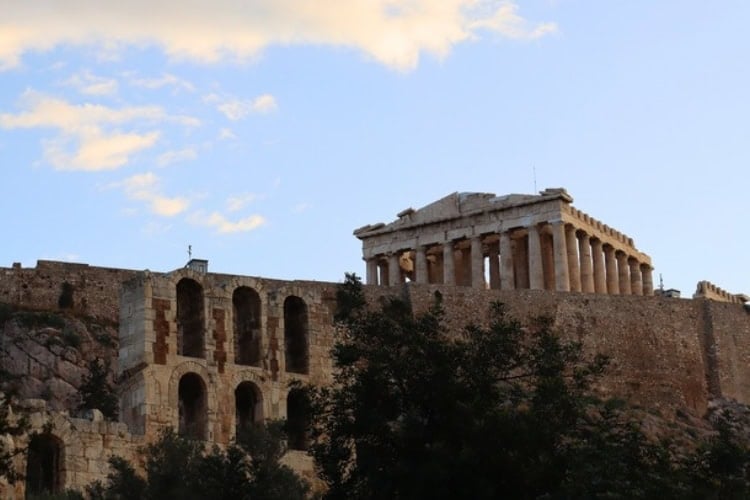
At the base of the mount before us were several stories of limestone and brick walls interspersed with the distinctive arched windows. These are the remains of the Stoa of Eumenes. This grand portico provided refreshment shops and shelter to Athenians who once lined the base of the crag.
Seeing the Parthenon for the First Time
We got our bearings, stepping gingerly across the rounded stones. Our tour guide, Lucy, trying to hurry us along, reminded us that we would have plenty of time on the way down to take pictures. She was ignored.
Above our heads, behind the crumbling fortress parapets that once sought to protect the very center of ancient Greece, we became aware of our goal. We were treated to a dramatic view of the Parthenon, one of the most dynamic of antiquities.
The Parthenon, a focal point of any good elementary school history teacher, is well-known to most.
Its columns, supporting the arched roofline of a massive, marble-clad temple that stood high above on an immense limestone escarpment, loomed before us.
Hiking to the Top of the Acropolis

The pathway to the top includes over 80 steps interspersed with paths weaving their way skywards. The surface is a mixture of modern concrete and, where preserved, marble pavers that are a millennium old.
The pavers are polished by the leather-clad sandals of past civilizations. As do the rubber-soled athletic shoes worn by today’s eager visitors, who are all seeking the Temple of Athena.
The Acropolis, meaning “High City,” of Athens towers above the surrounding neighborhoods. It reaches nearly 230 feet above the rooftops and encompasses approximately 7 acres.
The High Rock of Athens

My wife and I, along with our cousins, Linda and Greg, had joined a late-life cruise to the Mediterranean. We were seeking new experiences and celebrating 45 years of marriage.
One of the sought-after goals was experiencing the birthplace of Western civilization and democracy, Athens.
The heart of Athens is the Acropolis. You cannot ignore it. Truth be told, the Acropolis is nothing more than a huge rock that rises dramatically above the plains of Attica. Here, Athens was founded.
Settlements and walls were built around the high-and-mighty stony outcrop almost as soon as it was discovered some 4,500 years ago.
Nearly 2,500 years ago, during the so-called Golden Age of Athens, the massive, beautiful structures that we know today came into being.
As we slowly made our way towards the pinnacle, the early morning crowds were many more than I expected. The pathway passed by bits and pieces of ancient building blocks.
Huge blocks of cut marble, portions of hand-hewn columns, and an occasional intricately carved cornice piece were lying about like so many king-sized Legos. They lay about as though discarded by a child who had lost interest, albeit a very outsized child.
The Presidential Guard of Greece

Posed beneath a grove of cypress, we stood, wondering why we had stopped our ascent, slow as it was. Lucy, our impatient Greek guide, had actually halted her flock. She points out, with more than a bit of enthusiasm, a unit of the Presidential Guard.
They were clad in their full-dress uniform. The white, billowing kilt known as a fustanella, descending the Acropolis after the ceremonial raising of the Greek flag at the peak of the mount.
The Guard marched down the path in a slow, parade-like cadence, clad in their red berets, their bright white uniform, and turned-up shoes. I understood Lucy’s pride.
The Propylaea

Shortly, as we rounded a bend, the pathway widened onto a small plateau, where before us stood the Grand Entrance, or Propylaea.
Wide, majestic staircases of marble rose to meet the lofty entrance. Guarded by sturdy Doric and more refined Ionic columns, the massive entry gave some hint of what lay beyond.
Sweeping views of the city lay behind us, while ahead, the early morning crowds were dwarfed by the towering façade.
Lucy pointed out, as we passed between the rows of columns, that they were not one piece. They were several carved pieces stacked upon one another, giving the appearance of a single piece of marble.
On either side of the grand entrance were two colonnaded wings, all of which would have been roofed in marble and tiled over with fired-clay tiles.
In the southwest corner stands the small Temple of Athena Nike dedicated to a hybrid of Athena and Nike, a goddess of victory.
Dwarfed by the size of the entrance, the building is fronted and backed by four Ionic columns in which, at the time, a wooden statue of the goddess was kept. The statue is said to have been wingless in order that victory would never fly away from the city.
The Temple of Athena
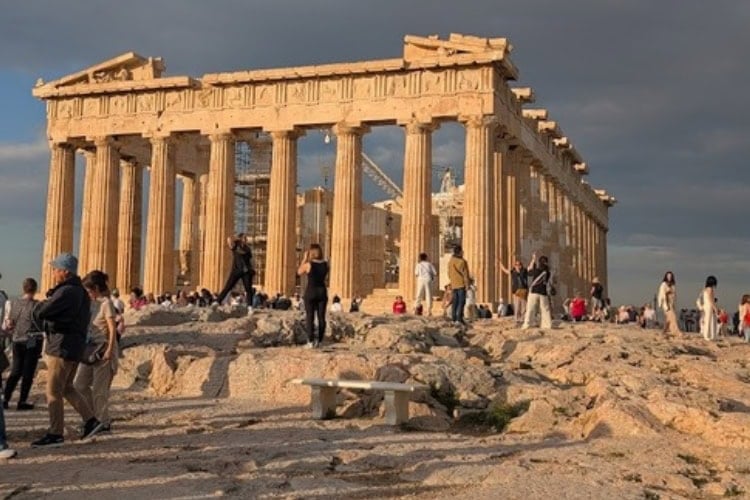
Photo by Frank Hosek
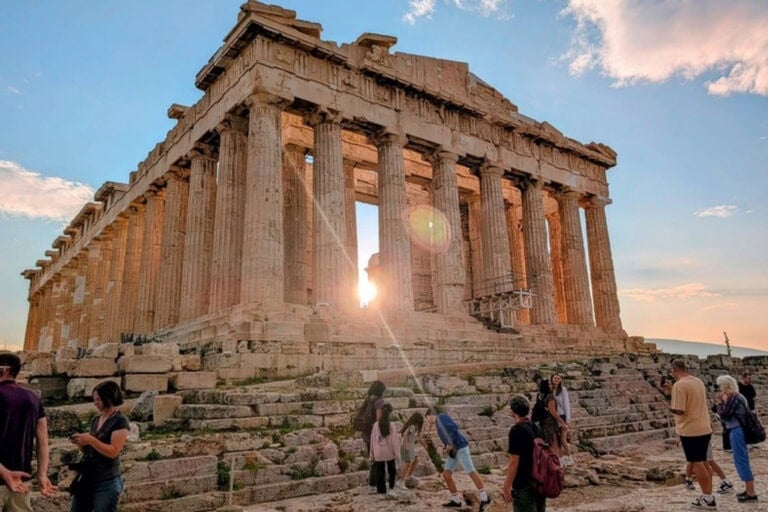
Having passed beneath and through the Propylaea, we received our first full view of the Parthenon. It amazes.
A forest of columns set upon a raised base of marble with three steps over 100 feet long. The columns are a marvel in aesthetic and functional engineering.
A slight curvature of the base, the swelling of the trunks of the columns, and the larger dimensions of the corner columns all create a harmonizing view to the human eye, all while supporting what was once a massive roof.
Begun under the great Athenian leader Pericles in 447 B.C., it is a monumental temple built to house a colossal gold and silver statue of the goddess Athena. The patron of all Athens, she was revered by the populace.
Athena and the Olive Tree

Athena is said, in a contest with Poseidon to win the favor of the Athenians, to have provided the first olive tree. A tree that could house, feed, and heat her mortal charges.
She won their favor over Poseidon’s promises of riches and military conquest. The olive branch forever after became the symbol of peace.
Beneath the roofline and through the Doric supports, the blue-painted skeletal arm of a modern crane could be seen standing incongruously in the interior. It was a reminder of the ongoing restoration and preservation work that has been continuing for decades.
For the first time in over 2 decades, the Parthenon can be viewed without the distraction of scaffolding encasing its exterior walls.
As excited and reverent tourists swarmed the exterior, you’re not allowed to enter the temple, voices of many dialects rose and fell in animated conversation as figures pointed, cameras clicked and eyes were mesmerized.
The morning sun, continuing its ascent over the edge of the craggy mount, flashed through the columns with blinding intensity.
The Caryatids

In the northern part of the Acropolis, hardly less noticeable, jutting out from a solid wall of marble are six statues of maidens standing on a tall porch. Upon their heads rests the portico’s roof.
It is known as the Porch of the Caryatids. This is the Erechtheion. The Erechtheion was dedicated not to one, but several entities of worship, including Athena, Poseidon and Erichthonios.
Smaller than the Parthenon, its solid walls are fronted by a six-columned entry. Located on the east side are the erect young ladies whose heads so easily held up the weighty roof.
Against a backdrop of gray clouds, the sun spotlighted their eternal chore. Today, the most sacred olive tree of Athens stands before the temple. Many believe it sprang from the first gifted olive tree to Athens from Athena.
The Architectural Beauty of The Acropolis

All around the plateau, palletized stacks of hand-cut marble lay about. Handcrafted puzzle pieces from over two thousand years ago are a testament to the work that lies ahead in piecing together the remarkable artistry of the Acropolis.
I walked near the edge of the rock-strewn plateau. The ochre-washed, stone-slabbed cubes stacked upon each other in cookie-cutter unison that houses today’s Athenians lie sprawling below us.
The indistinctiveness of today’s modern creations seemed so antithetical to the beautiful works that rose behind me. Athens proper has little of the astounding beauty that Greece’s many islands and the Peloponnese are famed for.
Surviving the Centuries

The disposable cities of today, built in haste with the ease of modern technology, seem so superfluous compared to those immense works of the Periclean Period, created by hand with the simple machinery of blocks-and-pulleys and hand tools.
The very fact that these wondrous architectural gifts remain is due, in no small part, to their location. Civilizations build atop each other.
Conquering nations, such as the Myceneans, the Romans, the Byzantines, Ottomans, and the Greeks. Always the Greeks. They used, reused, and built atop each other, creating archaeological layers.
The Acropolis was too, it seems, high and out of the way for the day-to-day life of the gentle Hellenic soul to bother with carting new building material up its slopes.
More than mere traces of a long-ago civilization, the Acropolis and its alluring architecture leave an enduring and endearing monument to humanity’s creative abilities and its belief in the best of our qualities.
If you go:
The Acropolis is open daily from 8:00 AM to 8:00 PM, with ticket prices starting at $35.00. You can explore on your own or join a guided experience for deeper context. If you prefer a more structured visit, these highly rated tours are great options:
- Acropolis & Parthenon Skip-the-Line Tour: For a smoother visit, the Acropolis and Parthenon Skip-the-Line Guided Tour offers fast entry and expert commentary that brings the site’s history to life.
- Acropolis + Museum Combo Tour: If you want the full picture, the Acropolis and Acropolis Museum Combo Tour covers both the ancient structures and the treasures housed in the museum below the hill.
Need a hand planning your trip? Here are the sites and services we rely on most, from booking tools to travel products we love.
Inspire your next adventure with our articles below:
- Top 10 Things to do in Greece
- The Ultimate Athens Guide: 12 Historic Sites and Day Trips Worth Your Time
Author Bio: Frank Hosek relishes traveling with his wife, Kathy. He enjoys discovering new experiences, meeting the people that make those experiences memorable, and sharing their adventures with others. He has written for Go World Travel Magazine, The Daily Journal, News Gazette and Lifestyles magazine. Frank has won awards from NWPA and IWPA for his travel writing. He looks toward the horizon for the next adventure.
Want to discover more hidden gems and helpful travel tips? Join our free newsletter for the latest travel secrets and travel articles.
We are reader-supported and may earn a commission on purchases made through links in this article.

- Two Weeks in Central Newfoundland: Sharks, Small-Town Culture and Come From Away in Gander - September 11, 2026
- Slow Down on Prince Edward Island: A Relaxed Four-Day Itinerary of Dunes, Seafood and Seaside Inns - September 11, 2026
- Cape Town’s Unique Experiences for the Curious Traveller - September 11, 2026
Planning another trip soon? ✈️
Add GoWorldTravel.com as a preferred source on Google. Click the button below so our local guides, packing hacks, and hidden-gem itineraries always show up first when you search!
Add to Preferred Sources