
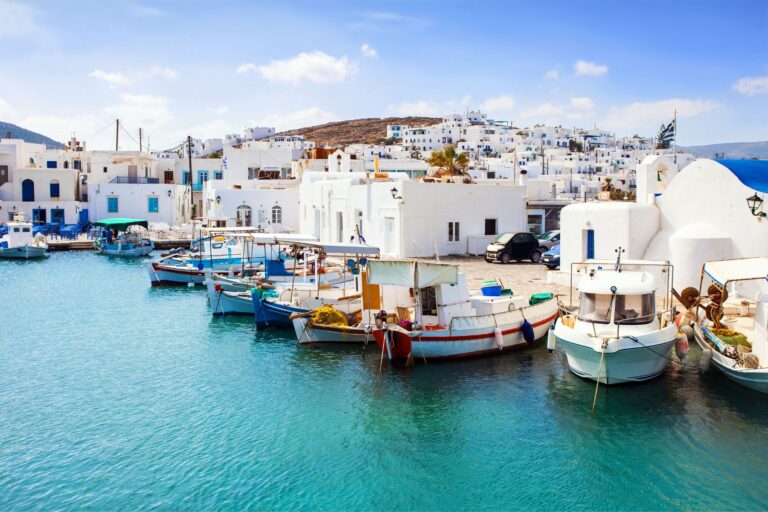
Let’s Play Jeopardy. The category: On the Map. The answer: In 2009, Forbes Magazine named it Europe’s most idyllic place to live. And Patricia Schultz, author of ‘1000 Places to See Before You Die,’ gave it a high ranking.
Without an airport, a boat remains the only way to get there, and devout Christians consider it a religious pilgrimage. Any guesses?
Here are more clues. Situated in the Aegean Sea off Turkey’s west coast, it carries the nickname of the ‘Holy Greek Island.’ There are less than 5,000 inhabitants, and it boasts a single UNESCO World Heritage Site woven from three sacred landmarks
Patmos, the Holy Greek Island
Cruising around the Aegean Sea on the fifty-passenger, small ship, Arethusa, proved to be an exceptional way to visit overlooked and underdeveloped Greek Islands. These are places where cruise ships teeming with thousands of tourists cannot dock.
For me, Patmos, the smallest and most northerly of the twelve original Dodecanese islands, soared to the top spot of our itinerary.
On this blissful escape, chateaus clung to steep slopes, perched atop rocky crags, seaside fishing villages hugged the unspoiled, coastal beaches. The focal point of the island, the Monastery of St. John the Theologian, loomed from the summit as Patmos offered us her tranquility.
During the Roman era, Patmos was a place of exile. John the Apostle was sent there in 95 A.D.
Christian tradition holds that it was he, John the Apostle, saw a vision and received instructions from Jesus Christ within what is now known as the Cave of the Apocalypse. Within this cave, John wrote the last book of the Bible’s New Testament, Revelation.
Other biblical scholars suggest that an alternative author, John the Presbyter, not the Apostle, drafted this book of religious prophecy.
The controversy continues, as the author describes himself only as ‘John,’ when he mentions Patmos in Chapter 1 Verse 9: “I, John, who also am your brother and companion in the tribulation and in the Kingdom and patience of Jesus Christ, was in the isle that is called Patmos, for the word of God and for the testimony of Jesus Christ.”
Travelers who’d rather have someone connect these threads for them can join a guided Patmos shore excursion that covers both the Cave of the Apocalypse and the Monastery of St. John in a single outing.
The Monastery of St. John the Theologian

Image by Freeartist from Getty Images Pro via Canva
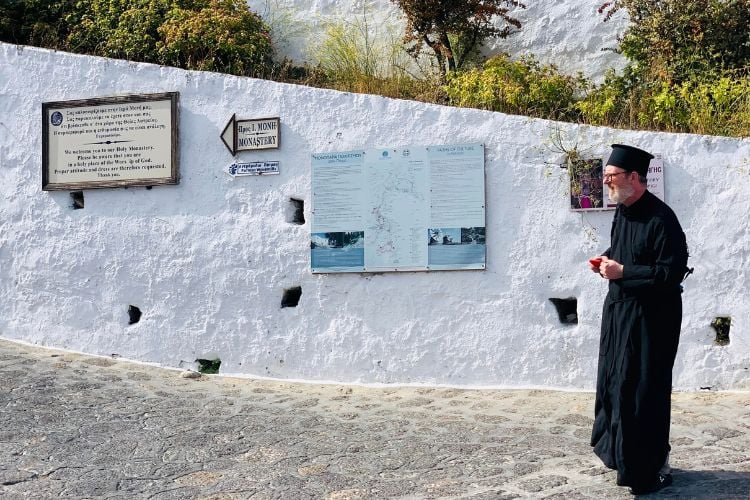
From our small vessel, we looked up to the highest point on the island to view a massive, fortress-like structure: the Orthodox Monastery of St. John the Theologian.
In 350 A.D., the Grand Royal Basilica had been built on this same site. However, in 1088, the year of its founding, work began to convert the structure into a monastery. Monks in residence continued the divine dedication to the works of St. John.
Due to threats of piracy, the monastery was protected by an imposing, fortified exterior that safeguarded its sacred icons, manuscripts, and religious paintings.
A bus waited at the only commercial port of Skala to take us around, up, and up higher, until we reached the summit and one of the world’s best-preserved medieval monastic complexes.
The resident monks have adjusted their vesper schedule, rising at 3 am, so that all their work can be completed by 8 am. This allows Christian pilgrims and tourists to explore the monastery every day of the year.
The oldest section, the main church, reveals delicate wall paintings and frescoes dating back to the Middle Ages.

A compelling museum, featuring religious icons and even the skull of St. Thomas, dazzled me with its antiquity.
The bell tower, the cross-wide dome, the gardens within, and the fact that this compound has functioned as a place of divine worship and learning center of the Greek Orthodox church for over 1500 years, roused my awareness of its historical weight.
Due to its theological significance to Christianity, the entire island of Patmos is dedicated to Saint John. A strange, enduring feeling of peace followed along as we drifted through the narrow alleys of whitewashed, elegant homes and public buildings.
Down the hill from the Monastery, the local people greeted us with quiet reverence in the central square of Hora, the UNESCO World Heritage ancient center.
An uninterrupted settlement since the 12th century, established to support the monastery, it became a successful trading center under Ottoman rule and thrived throughout the centuries.
The Cave of the Apocalypse

Halfway down the mountain, between Hora and Skala, we entered the complex of the Cave of the Apocalypse. Here, pilgrims come to touch the walls of the grotto where they believe aged John, the Apostle, authored the Book of Revelation.
Through a system of long corridors, we reached the dark, stone-walled sanctuary. Here we saw the lectern where John’s scribe wrote down his words, and the place where John allegedly sat.
We respected the pilgrims praying inside with our silence. I needed something to take away from this trilogy of experiences tied so closely together-the Monastery, Hora and the Cave.
Upon exiting, I saw unique bottles of olive oil for sale. They were said to be handcrafted and pressed by the monastery’s monks.
Perhaps trickery for the tourist, but I did not care. Naively, I could not fathom these people, dedicated to the tenets of Christianity, doing anything deceitful.
Out in the bright sunshine, the outline of Skala, the Aegean Sea and white buildings with tiled roofs sparkled in the distance.
A well-traveled path, down a gentle slope, through windswept grasses and wildflowers, beckoned us to walk to town, tramping over rocks smoothed by the ages.
We passed other travelers along the way, entered immaculate neighborhoods downhill, and explored three of the fifty tiny Orthodox churches that popped up on our trek to the port.
Local officials recognized the need to attract visitors to secular activities beyond the traditional religious ceremonies, which date back to ancient times and are still practiced here.
The island offers serene beaches, trendy high-end shops, charming guesthouses, seafood restaurants and coffeehouses.
Skala, the Only Commercial Port

Once we reached Skala, we stopped for a respite from the hike at the local favorite hotspot, Houston.
With the Artemis docked in direct view, we sat seaside, under the protective canopy from the blazing sun, for a much-needed, strong Greek coffee.
I knew I would not sleep for a week after this intense caffeine stimulation, but here we were. Here I had to experience everything like a Greek.
Patricia Schultz wrote of Patmos: “It’s quiet, traditional, and removed, but not primitive. That and a beautiful interior and great beaches draw a very sophisticated crowd. Patmos’ saving grace,” she continued, “is that it does not have an airport.”
As I sipped my brew and saw the dark sludge crystals that had settled to the bottom, I thought about the Greek mythology legend I had just learned.
Artemis, the goddess of deer, daughter of Leto, and sister of Apollo, engaged her brother’s help to persuade Zeus to allow this island to rise from the sea. Miraculously, Letois, the original name of Patmos, emerged from the water.
Patmos is a volcanic island, so who knows? Was it a cataclysmic eruption, or was it the divine intervention of a Goddess? The Greeks believe the latter, as their mythology lives on in the minds of these imaginative people.
I yearn that Patmos remains overlooked, so that the precarious peace I felt there hangs on. I also hope it never gets an airport.
Paros, the Star of the Cyclades Island Group

Our small seafaring vessel headed into the South Aegean, to Greece’s Crown Jewels, the Cyclades Islands.
Unknown destinations and notoriously familiar ones, Mykonos and Santorini, make up the group of 2,200 islands, of which thirty-three are inhabited. They encircle Delos, the uninhabited, sacred island, significant for its Greek mythology origins.
Other than visiting Santorini’s Pompeii-like archaeological site, Akrotiri, I was relieved when we left crowded Mykonos and Santorini behind. Both were staggering from overtourism.
To help alleviate this situation, their governments have levied a 20 Euro tourist tax per cruise ship passenger who disembarks at either port, effective July 1, 2025. Collection of this tax is anticipated every June 1 through September 30.
I felt calm reassurance when we docked at the port in Parikia, the capital of Paros, the quiet star of the Cyclades. Although no cruise ships have access to this port, ferry boats and small crafts are the preferred methods of arrival. However, it does have a national airport with service from Athens.
Each year, the number of visitors increases, but for now, the island does not have that overcrowded feel. Our excursion stopped there in May, and it seemed almost deserted, a perception welcomed anywhere in the Greek Isles.
As we traveled through the rural countryside, large chunks of white marble littered the roadside amongst twisted, ancient olive trees.
Paros carried the distinction of having the finest quality marble in Greece. Carvers used Parian marble for the Temple of Zeus at Olympia, the Venus de Milo, and the Temple of Apollo on Delos.
Ancient marble quarries date back to 3,200 B.C. and mining continued forward through the centuries. A current push to rehabilitate these abandoned excavations into archaeological sites remains a struggle.
For a closer look at that marble legacy, a full day tour of Paros traces it from the quarries at Marathi through Parikia’s old town and on to the villages of Naoussa and Lefkes.
The Enchantment of Paros

The enchantment of the windswept archipelago of Paros rested in the quintessential feeling of a Greek isle. Meltemi, the strong, summertime, northerly winds blowing across the Aegean, make Paros a favorite for wind and kite surfing enthusiasts.
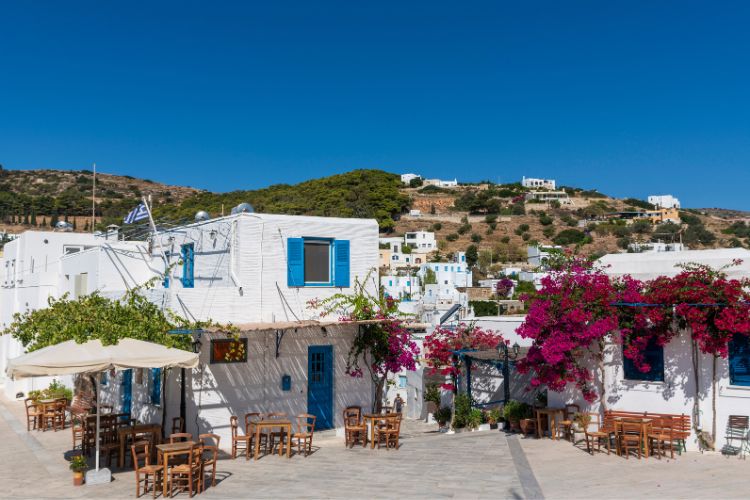
For me, the endless opportunities to get lost within mazes of narrow passages, gleaming white homes, and shops drenched in bursts of bougainvillea color, and the sapphire Aegean Sea always within view, drew me into the ambiance of three distinctly different but similar neighborhoods.
Capital of Paros, the Port of Parikia

Historic Old Town of Parikia vibrates with a chaotic charm. It functions as the island’s epicenter of commerce, catering to locals as well as tourists.
The waterfront operates as the only port for the arrival of goods, which makes it a busy marketing district.
Lodging, food, and merchandise cost far less in Parikia than elsewhere on the island. If shopping is on your itinerary, do it in the capital city, because euros seem to disappear into the wind in upscale shops and restaurants in the other major tourist setting, the authentic fishing village of Naoussa Harbor.
Aside from wandering through the twisted alleyways, Parikia offers the 12th-century Frankish Castle at the island’s summit. Additionally, there is an extensive archaeological museum and the ancient Panagia Ekatondapyliani stone church, located three blocks from the pier.
After a day of sightseeing or beach combing, who could resist Paros’ iconic sunsets? Onlookers are rewarded with glowing, vivid pinks and oranges that stream through the whitewashed passages.
With an Aperol Spritz in hand, I shall long remember the image of that golden sphere dipping into the Aegean Sea from the sun deck of the Arethusa.
Inland Village, Marpissa

Along the Byzantine mountain road that cuts across the inland villages, Marpissa maintains a quiet essence. There is little activity, no cars, only one supermarket, a central café and a restaurant to service the 250 year-round residents.
Lining the narrow cobblestoned walkways, vacant whitewashed, vine-covered homes, handed down through generations, waited to be filled with laughter again, when the summer season blossoms and their families return.
In the center of town, the café’s empty blue and white tables and chairs, the ancient Orthodox church and the simple open-air restaurant appeared eager for patrons.
We had the privilege of being invited into the home of one of the year-round residents, Marigoula.
The walls of her charming, centuries-old cottage, decorated with photos of parents, grandparents, nuclear and extended family members, told the story of these Greek Isle villages.

Image by C. Bowman
Reminiscent of handicrafts from years gone by, antique glassware and intricately crocheted doilies and coverings graced the table and buffet.
The homes remain within the family, passed down for the enjoyment of the next generation.
Marigoula and her husband owned a restaurant down on the Aegean coastal beach. She pointed to the location as we looked toward the sea from her flower-lined terrace. Now alone, she has returned to retake residence in her parents’ home.
Marigoula cherishes life in Marpissa, year-round. She is content to weave rugs, tapestries and handbags on the same antique loom that her mother and grandmother used.
She finds solace in embracing sunsets, savoring peaceful interactions with other year-round residents, and anticipating the arrival of her children and grandchildren for their summer visit.
I came away from Marigoula’s home with a much deeper understanding of life on the Greek Isles.
Fishing Hamlet of Naoussa Harbor

As we approached the center of the working fishing hamlet, Naoussa Harbor, seaside smells filled the air. Plus the familiar whiff that permeates from boats that harvest the sea’s treasures daily.
The harbor curved along an uneven, rocky coastline with fishing boats anchored against the contoured edges of the marina. Giant octopuses caught that morning, their tentacles draped over sidewalk railings, soaked up the sun’s strong rays. In my travels around the world, I had never witnessed octopuses hanging out to dry.
Aromas of garlic and oregano drifted from fifteen open-air restaurants adjacent to one another around the harbor.
Eateries placed iced containers of fresh lobster, whole red snapper, oysters, and crayfish at each entrance to entice patrons into their establishments. A hard sell in May, as we were the only clientele seeking food service.
Aside from one cluster of local fishermen at a table littered with local beer bottles, the emptiness permeated throughout restaurant row.
As we munched on succulent, fresh eel and calamari, I tried to imagine Naoussa Harbor from June to September. Then these vacant establishments will be filled. The summer sun seekers will be clogging the narrow streets. Shoppers will crowd into the now-empty, high-end boutiques scattered along the narrow alleyways.
I decided that I preferred Paros in the springtime.
Serenity in the Islands
Exploring the Greek Islands can be challenging. The timing and the islands you choose to visit can significantly impact the quality of your travel experience.
Select unfamiliar islands, travel during the shoulder seasons, stray from the tourist centers, and get lost in the passageways.
Make Greek experiences happen in overlooked places. Discover serenity in the islands of Patmos and Paros.
Need a hand planning your trip? Here are the sites and services we rely on most, from booking tools to travel products we love.
Inspire your next adventure with our articles below:
- Greece Island-Hopping with Sun Fun You: Mediterranean Voyages
- When Is the Best Time to Visit Greece?
Author Bio: After a lifelong profession of treating the mentally ill at a PA psychiatric hospital for 33 years, Carol L. Bowman retired to Lake Chapala, Mexico, in 2006 with her husband to pursue more positive passions. Her family thought that she, too, had ‘gone mad.’
Carol has taught English to Mexican adults and disadvantaged local children for the past 18 years. She writes for local, international, online, and print publications. Using her adventures to over 120 countries, she has captured a niche in travel writing, and her stories have been featured in Go World Travel Magazine.
A frequent contributor to El Ojo del Lago, the largest English-language magazine in Mexico, she’s won several literary awards from that publication. Her psychiatric field work netted a contribution to the anthology, Tales from the Couch. Recently, she has also been featured in two more anthologies, Insider’s Guide to the Best of Mexican Holidays, and Bravados, Life, Love and Living in Lake Chapala, Mexico, all available on Amazon.com.
Want to discover more hidden gems and helpful travel tips? Join our free newsletter for the latest travel secrets and travel articles.
We are reader-supported and may earn a commission on purchases made through links in this article.

Planning another trip soon? ✈️
Add GoWorldTravel.com as a preferred source on Google. Click the button below so our local guides, packing hacks, and hidden-gem itineraries always show up first when you search!
Add to Preferred Sources