
I’ve spent a lot of time thinking about what life would’ve been like during the peak of the Wild West. Whiskey-drunk outlaws getting into gunfights after a poker game dispute. Mountain men stumbling upon a geyser basin dotted with rainbow hot springs and bubbling mud pots. Pioneers thirsting for gold and a better life at the careless cost of indigenous lives.
The Wild West has a dark and unruly history that has left its mark to this day, but some pockets of Western America have preserved it better than others. Cody, Wyoming, is one of them, a town where I felt the spirit of the Wild West linger on.
Not only is the town of Cody fascinating on its own, but it is also the gateway town to Yellowstone National Park’s least crowded entrance. Yellowstone is one of America’s most iconic parks and has an incredible mix of wildlife and surreal, geothermal landscapes. It’s one of the only places in the world where you can see a moose peacefully drinking from the Shoshone River one moment and piping hot water erupting from the earth the next.
The Wild Wild West: An Introduction to Cody, Wyoming
Before Cody
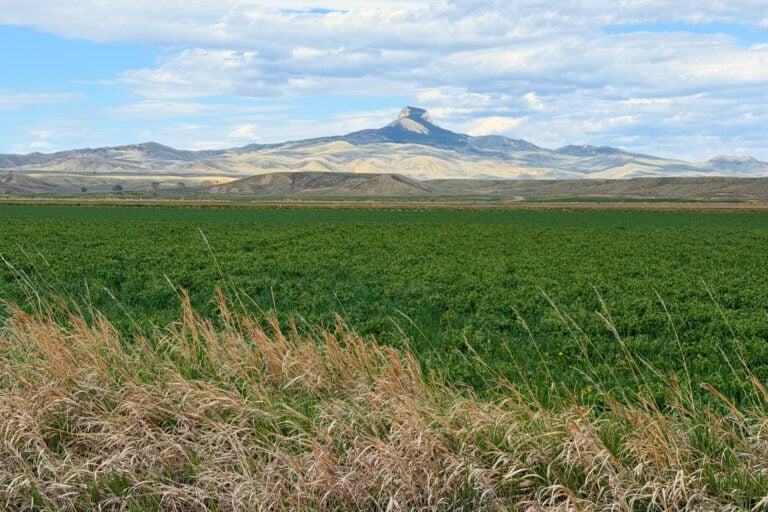
Before the town of Cody came into existence, its region, the Bighorn Basin, was a vast high desert wilderness with rugged, unforgiving terrain. Indigenous people have inhabited the region for more than 10,000 years, mostly living nomadically. The land was occupied primarily by the Crow (Apsáalooke) and the Eastern Shoshone tribes, though the Arapaho, Blackfeet and Cheyenne also claimed these fertile hunting grounds.
Outlaw Country
During Western Expansion and the gold rush, white settlers forced indigenous tribes out of the basin, despite treaties put in place with the supposed intention of protecting their land, a tale as old as time. Ranchers moved in next, driving out the bison population that once defined the land. By the early 1890s, the region had become a haven for outlaws, like the Wild Bunch, who hid in the Hole-in-the-Wall, a remote canyon where each gang established homesteads.
Read More: Exploring the Historic Oregon Trail and Its Legacy
A Showman Built a Town
In 1896, Cody, Wyoming, was established by one of the most famed figures of the Wild West, the showman Colonel F. Cody (Buffalo Bill). He was captivated by the area’s natural beauty, its expansive ranching land and its proximity to Yellowstone National Park. As a true businessman, he saw real potential in creating a prosperous town. And that he did.
Two Sides of Cody
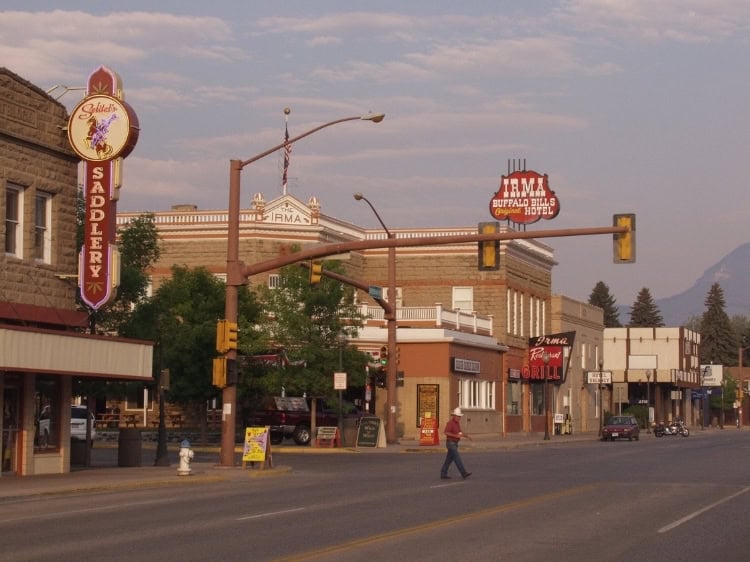
Buffalo Bill wanted Cody to look civilized, elite and refined. And it was, for about two blocks. The streets were wide and lined with high-end establishments, attracting wealthy tourists. But just around the corner, a boisterous entertainment district soon emerged.
Here, every classic Wild West stereotype thrived, down to whiskey-fueled saloon brawls, a red-light district and the occasional gunfight.
So that meant a wealthy traveler could stay at Buffalo Bill’s upscale Irma Hotel and enjoy a fine steak dinner while, a couple of blocks away, a drunken cowboy could be hurled through a saloon window for cheating in poker. Even Buffalo Bill himself spent time in this part of town and was a known participant in drinking, gambling and other illicit activities.
See Cody’s History for Yourself
If any of that history has you intrigued, a visit to Cody is the best way to get a real sense of what that Old West era was like, while walking the very same streets.
Take a Cody Trolley Tour
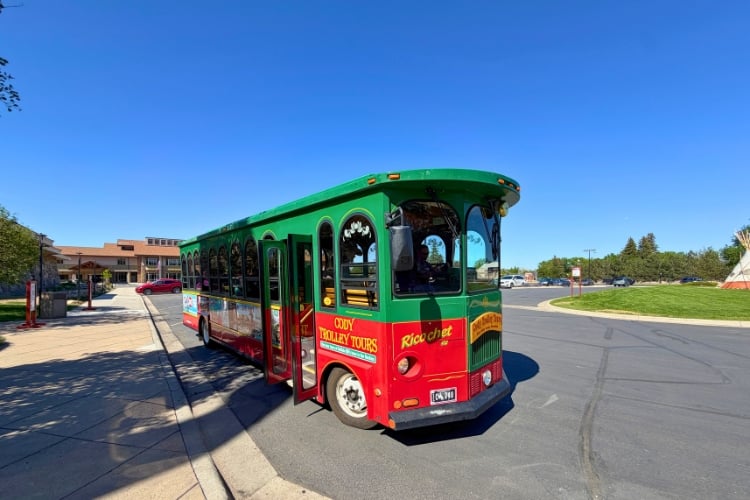
Cody Trolley Tours, an hour-long narrated ride through downtown, is a great way to get oriented. Guides point out which building was a saloon and which one saw a shootout, backed by old photos and audio clips woven into the tour. As they say, “Give us an hour, we’ll give you 100 years.”
Explore the Buffalo Bill Center of the West
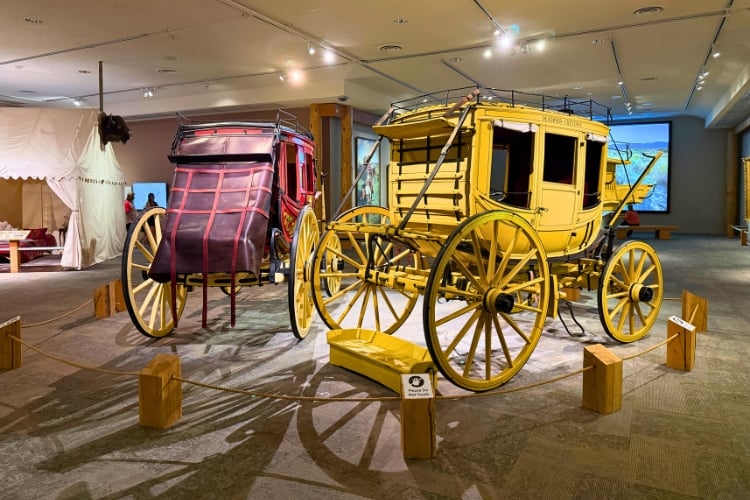
To dive even deeper, one ticket to the Buffalo Bill Center of the West grants you access to five museums, each covering a different angle on the American West. There’s an entire museum dedicated to Buffalo Bill himself, the visionary behind the town, whose Wild West show toured the world for decades.
You’ll also find the Plains Indian Museum, the Cody Firearms Museum, the Whitney Western Art Museum and the Draper Natural History Museum. You could spend hours roaming around and still only get a partial picture of what life in the West was really like.
Stroll Through Old Trail Town
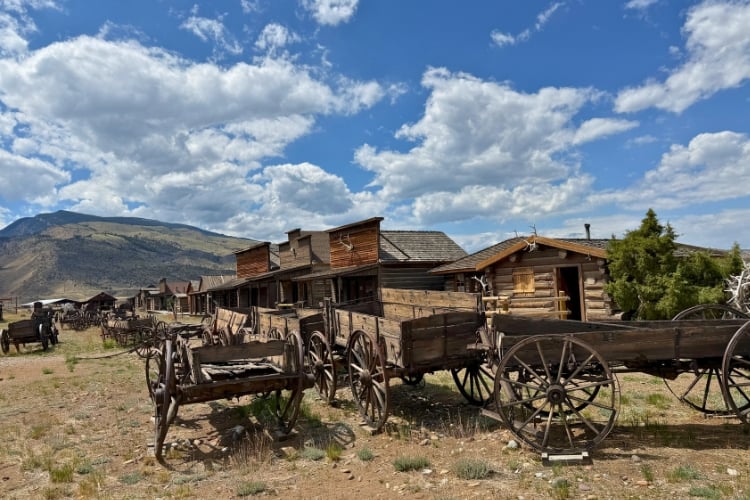
What really brought the Wild West to life for me was a visit to Old Trail Town, a collection of 28 original frontier buildings, transported from across Wyoming and Montana and rebuilt on the actual site of old Cody City.
Here you can walk through Butch Cassidy’s actual Hole-in-the-Wall cabin, and just steps away, Rosie’s Roadhouse and Brothel, once run by Rose Williams and a handful of other prostitutes, known as “soiled doves” at the time. Their stories, mostly ones of economic survival in a place with few options for women, are preserved right alongside the stories of outlaws.
This is where you feel the ghosts of the Wild West. A cemetery holds the grave of mountain man Jeremiah Johnston, alongside monuments to the fur trappers who first roamed this land. The women who once called Rosie’s home are buried here too.
Visit Heart Mountain WWII Interpretive Center
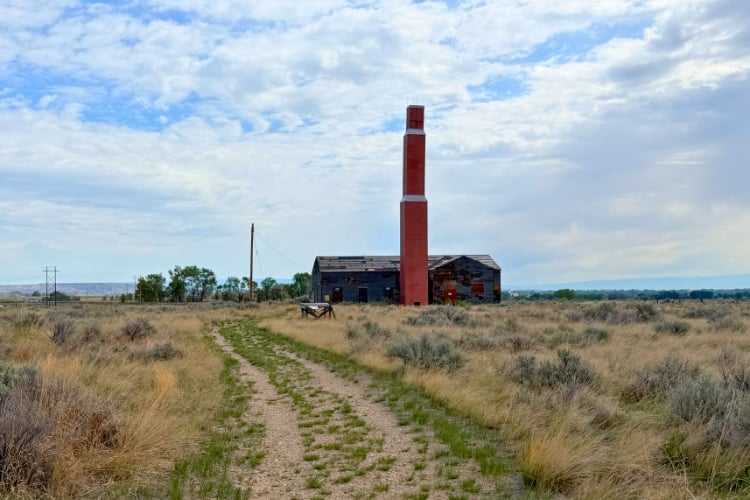
A short drive from Cody, the Heart Mountain WWII Interpretive Center sits on Bighorn Basin land the Crow and Eastern Shoshone called home for thousands of years before it was taken from them and, decades later, used to imprison a different group entirely.
Between 1942 and 1945, the U.S. government incarcerated more than 10,000 Japanese Americans here, on 46,000 acres between Cody and Powell, making it the fourth largest of the ten camps built during World War II.
The museum does a good job of explaining what happened, and original structures still stand on-site, including a restored barrack, a root cellar and the camp hospital.
Classic Wild West Experiences
Beyond learning about the history, the Wild West is brought to life through a variety of exciting experiences throughout Cody.
Fire the Guns That Built the West
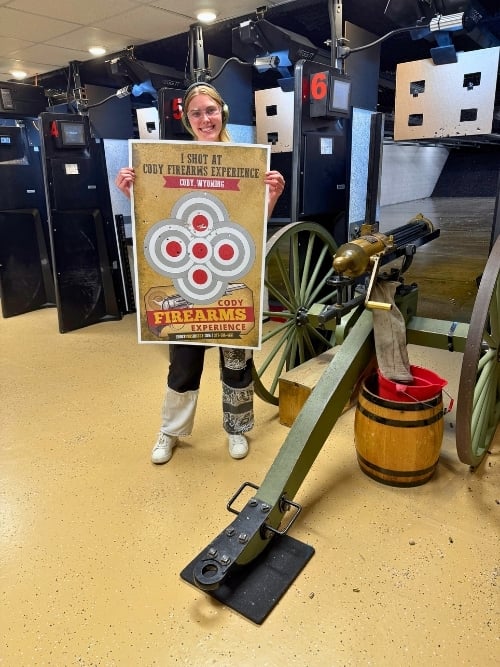
Nothing quite prepares you for turning the crank on a working Gatling gun, a Civil War-era weapon that later saw use out here during the region’s most violent decades of expansion. At Cody Firearms Experience, you get the chance to shoot classic Western guns, the same weapons outlaws, lawmen, and soldiers of that era carried, and plenty of others beyond that.
I also got to shoot a classic cowboy revolver, a Colt 1873 model, the same gun cowboys and outlaws carried well into Cody’s own Wild West years. The trigger is lighter than you’d expect and fast enough that you can suddenly imagine how those shootouts went down.
Holding something built to kill has an intense, undeniable weight. But the instructor stands next to you the entire time, patient and professional, making sure you have a good, safe experience.
Dine at Cowboy at 2 Mules Chuckwagon
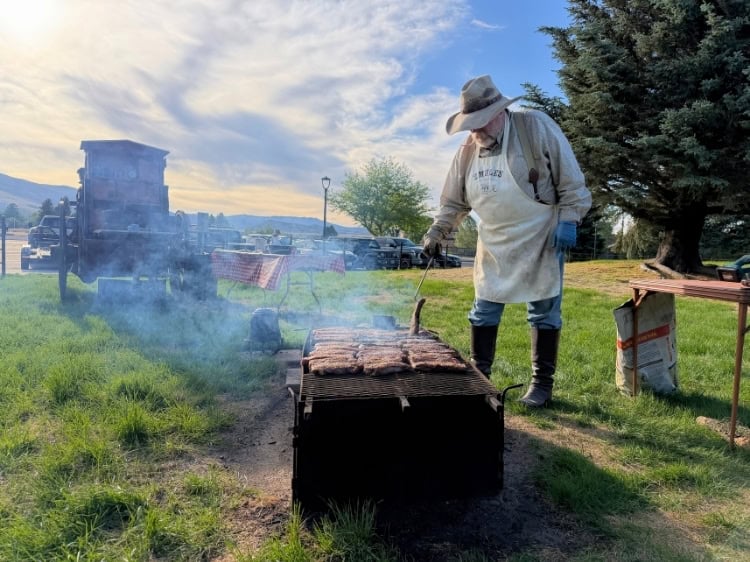
If you want to dine like a cowboy, you have to try 2 Mules Chuckwagon, just a quick walk from the Buffalo Bill Center of the West. Chuckwagons were the mobile kitchens that fed cowboys on cattle drives back in the 1800s, and Rich and Deb Herman brought the tradition back as a retirement project. The couple won the 2025 Cheyenne Frontier Days Chuckwagon Cook-Off.
Be sure to arrive early to watch Rich work the fire, somehow managing 20+ steaks at once, all cooked to order. There are cowboy beans, Dutch oven biscuits and a warm blackberry cobbler. This is the kind of warm, welcoming experience that shows Cody’s true small-town character.
Read More: Why Western Nebraska Will Surprise You: Ancient Fossils, Epic Views and Quirky Adventures
Dinner and a Show at Cody Cattle Company
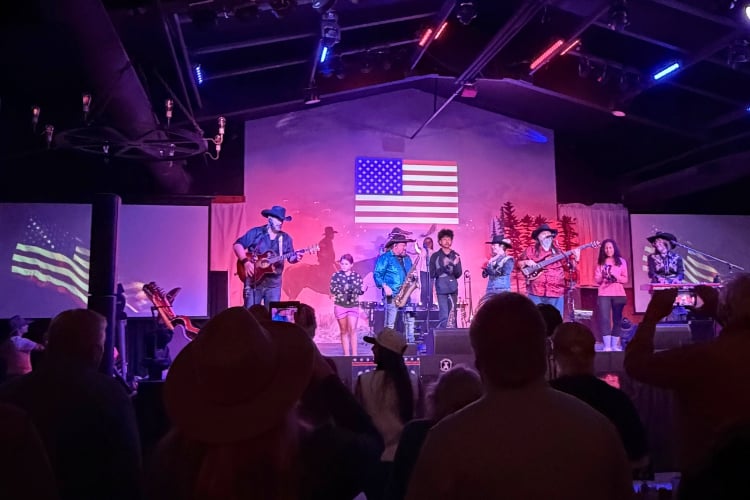
Cody Cattle Company is a legendary, chuckwagon-inspired dinner and show, and one of the most popular evening activities in town. The food alone is great: a buffet with tender chicken, brisket, mac and cheese, cornbread, brownies and any cocktail or beer you’d like.
I didn’t know what to expect from the show itself, but I was captivated from the start. The hyper-talented Ryan Martin and the Triple C Cowboys are top-tier performers, cracking jokes between songs and playing a range of classic Americana tunes, from Johnny Cash’s “Ring of Fire” to an impressive cover of “The Devil Went Down to Georgia.” The room was packed, and the energy was superb.
I’m not even a country fan, but something about that show lured me into a genre I’d never given a real chance. I left with a whole new appreciation for Western and old American country. And the timing works out perfectly: the show ends with just enough time to walk straight to the Cody Nite Rodeo.
A Night at the Rodeo
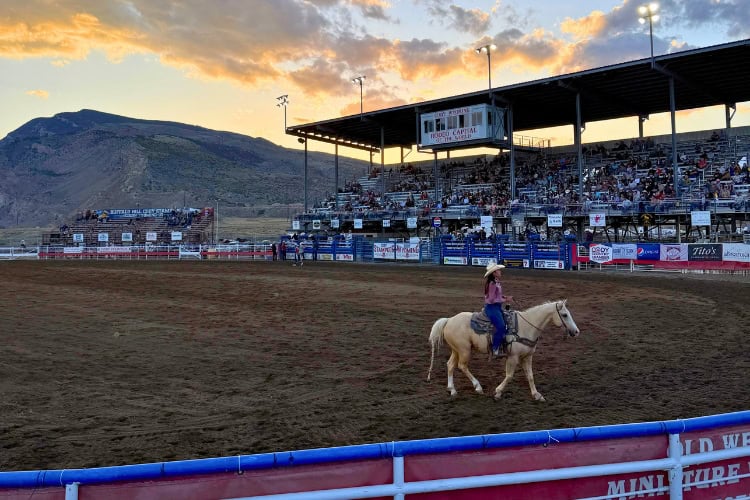
Cody earned its nickname, the Rodeo Capital of the World, because of their Nite Rodeo. A rodeo, at its core, is ranching skills turned into performance: roping, riding, wrangling, done in front of a crowd.
Cody’s version has run every single night from June through August since 1938, making it the longest continuously running nightly rodeo in the world. It started as tryouts behind the Irma Hotel, held by a former Buffalo Bill’s Wild West performer looking for new talent. Nearly 90 years later, they’re still at it.
Gates open at 7 pm and the show starts at 8 pm. Whatever you think of the rodeo, you can’t deny its significance to this town. Half of these people have been coming to watch rodeo since they were kids.
Yellowstone National Park
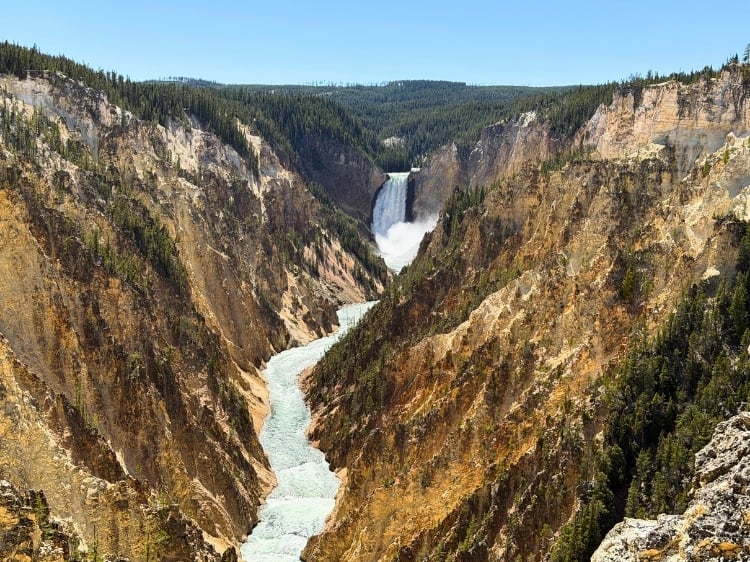
There are some places so visually spectacular, so unfathomably alien, that they make me feel like I’m slipping into a dreamscape, one that shouldn’t be able to exist on Earth. No place does that to me more than Yellowstone National Park. It summoned tears on my first visit when I was nine, and again 16 years later.
The Geothermal Wonders and Wildlife
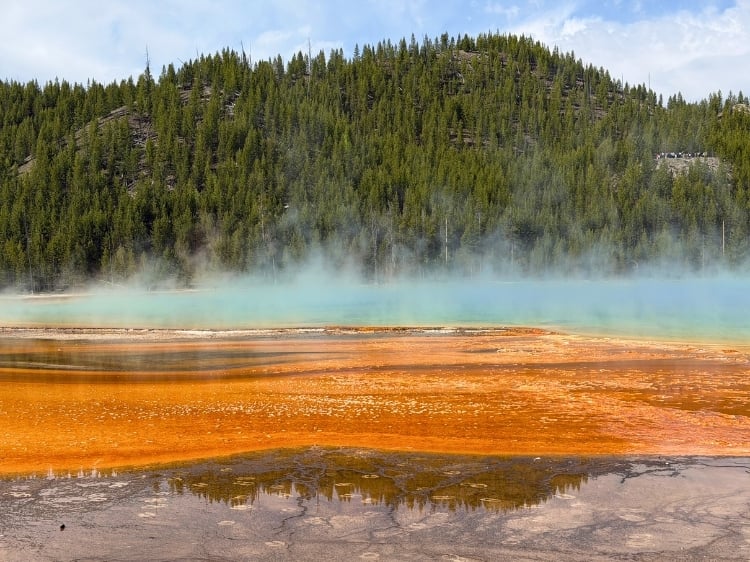
Mammoth Hot Springs greeted me first, tiers of electric blue pools steaming in pockets of powdery white limestone, so ancient and hard to fathom.
Grand Prismatic came next, the largest hot spring in the country, steam hitting my face, a slight smell of sulfur, mesmerized by the orange mineral deposits and incomprehensibly blue springs.
Then Old Faithful, teasing us with little grumbles and splashes before finally erupting, launching hot water 150 feet into the sky, leaving everyone’s mouths agape. This is where I cried, the same geyser I’d watched at age nine, a connection so intense I think it permanently altered my brain chemistry.
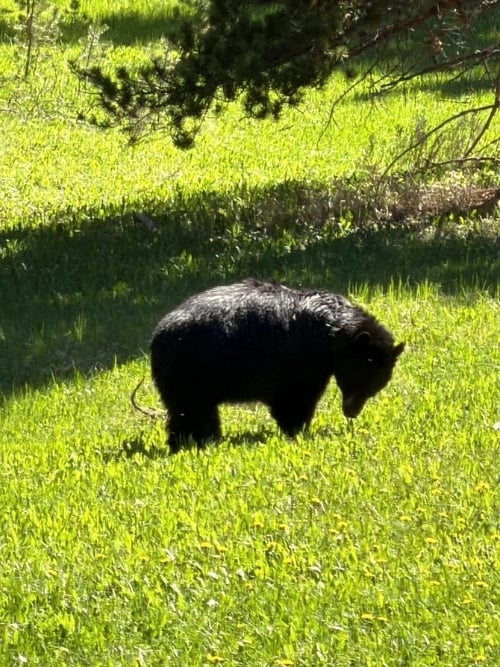
And then the wildlife and landscapes: bears, moose, bison, shifting terrain and temperatures, expansive and wondrous, truly another reality.
Cody’s Quiet Side of the Park
One of the best parts about basing yourself in Cody is proximity to the park’s least crowded entrance. Most visitors head straight for the Old Faithful geyser basin, which is undeniably spectacular, but the east side holds its own quieter gems, worth seeking out precisely because fewer people think to. I recommend a tour with Cody Shuttle Service and Yellowstone Tours, who took us wherever we wanted and packed the day with insight. The tour was fully customized, built around us and led by a Cody local.
I came to Cody for Yellowstone, which will always remain a highlight. But the town itself was such a wonderful surprise. I experienced so much of the town and learned plenty about America’s Wild West roots. I fell in love with a community that is so different than anything I’ve known. Since then, I’ve had ghostly Western ballads echoing in my head, imagining life as a ‘carefree range-ridin’ driftin’ cowpoke.‘ Or perhaps a life as a notorious outlaw with a big iron on my hip.
If You Go
Getting there:
- Fly into Yellowstone Regional Airport in Cody, with year-round service from Denver and seasonal flights from Salt Lake City.
- From Cody, it’s a scenic 60-mile drive to Yellowstone’s East Entrance, passing Yellowstone Lake, the Grand Canyon of the Yellowstone, and Lamar Valley.
Where to stay:
- Buffalo Bill Cabin Village: historic cowboy-era cabins with modern interiors, right in Cody.
- Holiday Inn at Buffalo Bill Village Resort: full-service option with a pool, restaurant, and lounge, also in Cody.
- Lake Yellowstone Hotel & Cabins: inside the park, near Yellowstone Lake.
- Canyon Lodge & Cabins: inside the park, close to the Grand Canyon of the Yellowstone.
Where to eat:
- Sitti’s Table: Middle Eastern and Mediterranean plates built on French technique.
- The Blanca Tatanka: small plates, cocktails, and a patio sunset.
- Pat’s Brewhouse: pub food and fifteen beers on tap.
Best time to visit:
- June through August: full Cody Nite Rodeo season and Yellowstone’s warmest weather, but the biggest crowds, too.
- Late May or September, after Labor Day: fewer crowds without sacrificing good weather.
- Yellowstone’s East Entrance closes to regular vehicles by early November and doesn’t reopen until mid-May, so plan a summer or shoulder-season trip if you want to drive straight in from Cody.
Good to know:
- Wyoming has no state income tax.
- Cody packs more Old West history into a few downtown blocks than almost anywhere else in the country.
- Give yourself more than a day. Between the museum, Old Trail Town, Heart Mountain, and Yellowstone, this isn’t a place to rush.
For more information and trip planning resources, visit Cody Yellowstone’s official tourism website.
Need a hand planning your trip? Here are the sites and services we rely on most, from booking tools to travel products we love.
Inspire your next adventure with our articles below:
- Two National Parks, One Epic Road Trip: Yellowstone and Rocky Mountain
- Ghosts, Wild West History and Cowboy Culture in Cheyenne, Wyoming
Want to discover more hidden gems and helpful travel tips? Join our free newsletter for the latest travel secrets and travel articles.
We are reader-supported and may earn a commission on purchases made through links in this article.

- Skip Oktoberfest: Stuttgart’s Cannstatter Volksfest Is Smaller, Cheaper and Way Less Crowded - September 19, 2026
- Want to Speak Better Spanish on Your Next Trip? Here’s How - September 2, 2026
- Cody, Wyoming: Where the West is Still Wild - August 28, 2026
Planning another trip soon? ✈️
Add GoWorldTravel.com as a preferred source on Google. Click the button below so our local guides, packing hacks, and hidden-gem itineraries always show up first when you search!
Add to Preferred Sources