
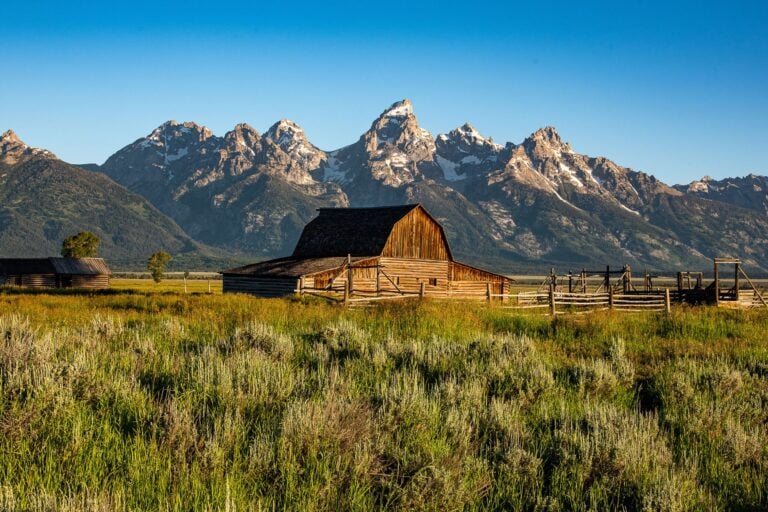
I have no idea how brothers John and T.A. Moulton ever accomplished anything on their homestead. Or, for that matter, how Joe Heninger or any of the families and neighbors of the town of Grovont went about their day.
Upon waking each morning and stepping into their front yards, how were they not transfixed to the spot by the view? How did they put one foot in front of the other and go about their daily chores?
As I stood in front of the ageless buildings of what is now referred to as Mormon Row, it was easy to look past them, the pink house notwithstanding.
My gaze was pulled to the magnificent view beyond. The towering peaks of the Grand Tetons are mesmerizing and not to be ignored. Nor would you want to.
A Scenic Drive
Our day started early on the John D. Rockefeller, Jr. Memorial Parkway, a pleasant road that connects Grand Teton National Park with Yellowstone National Park, where we had been staying.
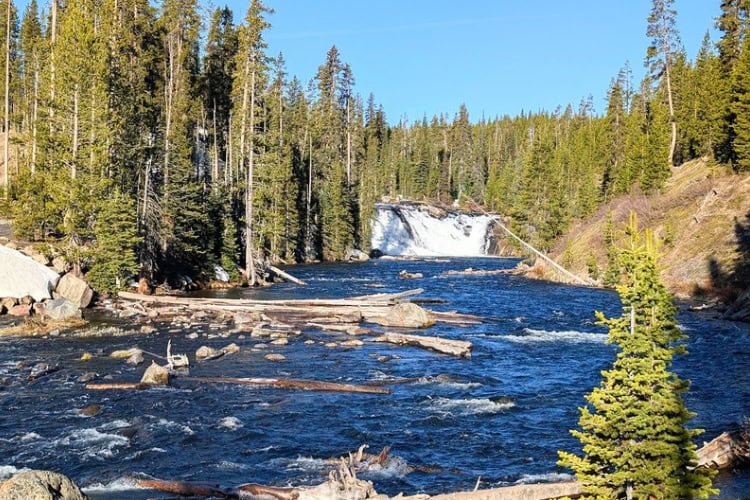
We had left Old Faithful Inn, crossed the Continental Divide (twice), slowed for a herd of elk collected along the roadside, stopped to admire Lewis Falls and headed from the park onto the Memorial Highway.
Roughly midway, we stopped at Flagg Ranch, where we took advantage of gas and bathrooms and wandered the general store. For a few moments, we breathed in the crisp morning air before entering the park.
Soon, we were at the Grand Teton entrance. Forests of lodgepole pines and the morning mists obscured the horizon, providing only occasional, tempting glimpses of the mountain slopes.
At Jackson Lake Junction, we veered left to Colter Bay Visitor Center.
The rangers were just hoisting the flag as we pulled into the parking lot. Kathy was seeking the latest ink stamp for her National Parks passbook, while I enjoyed Native American artwork provided through the Indigenous Arts and Cultural Demonstration Program.
Colter Bay
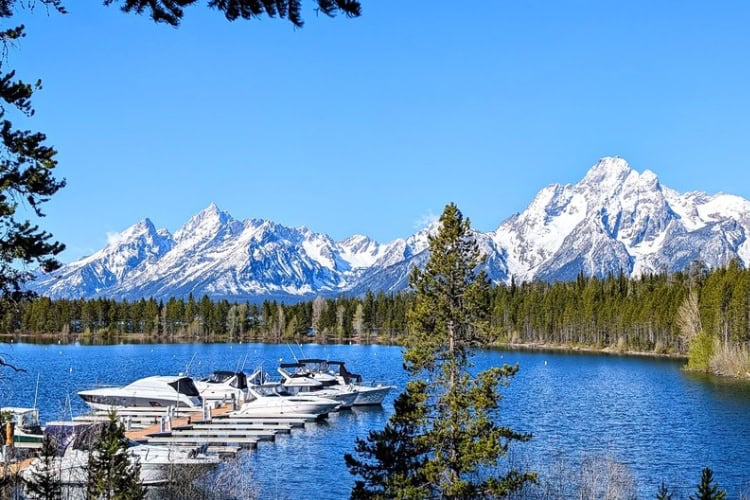
Afterward, with the sun on our backs, we hiked the lakeshore trail of Jackson Lake, past a row of bobbing boats on the glass-like surface and enjoyed our first sweeping views of the incredible northern peaks of the Teton Range.
That Titillating Name
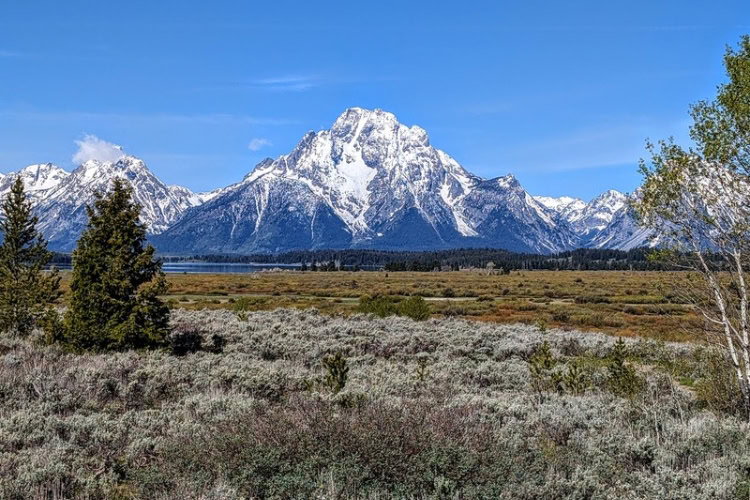
The Teton Range, more specifically, the Grand Tetons, was named by French voyageurs who discovered the string of peaks on the west side of Wyoming.
What primarily interested them were the big three: Grand Teton, coming in at an altitude of 13,775 feet; Middle Teton at 12,804 feet; and South Teton, which measures in at 12,514 feet.
While the Shoshone people, who are believed to have lived in and around the range for as long as 10,000 years, called the range “Teewinot,” which translates to “many pinnacles,” the French had a more worldly name for the dramatic and distinctive peaks.
They called them “Les trois tétons.” I can only surmise that the trappers had been away from home and all that it entails for a very long time.
“Les trois tétons” translates to “The Three Breasts.”
Willow Flats Overlook
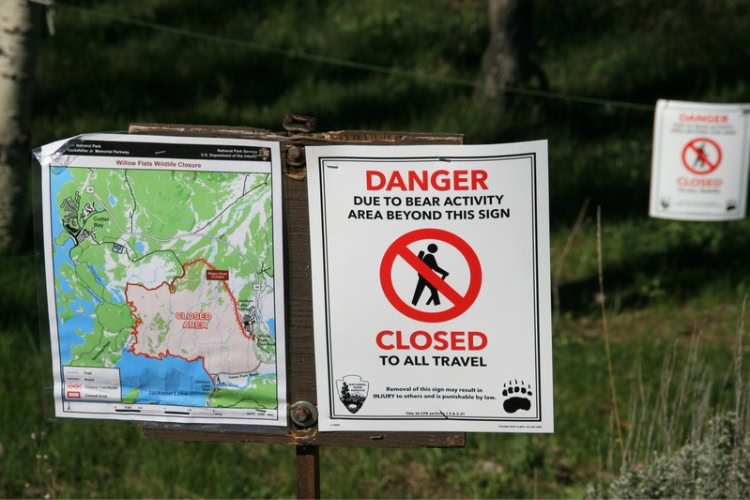
We traveled on to the Willow Flats area, a large, marshy meadow, which tends to harbor an array of wildlife. A myriad of birds and mammals thrive in the wet meadows that lie before us.
As I started off on a path with camera in hand for a herd of elk and their calves, Kathy grabbed my arm and pointed to a nearby sign. Actually, several signs that I had overlooked in my haste.
“Due to Bear activity, all travel is prohibited beyond this sign.” That does tend to stop you in your tracks… especially the part about “Bear activity”.
So, instead, I stood and enjoyed the view, which, beyond the meadow and across the lake, is stunning. Mount Moran is the dominant peak here and commands its surroundings.
Unlike most mountains where foothills obscure the view, the Tetons rise abruptly from the valley floor, enhancing their already imposing appearance.
Snake River Overlook
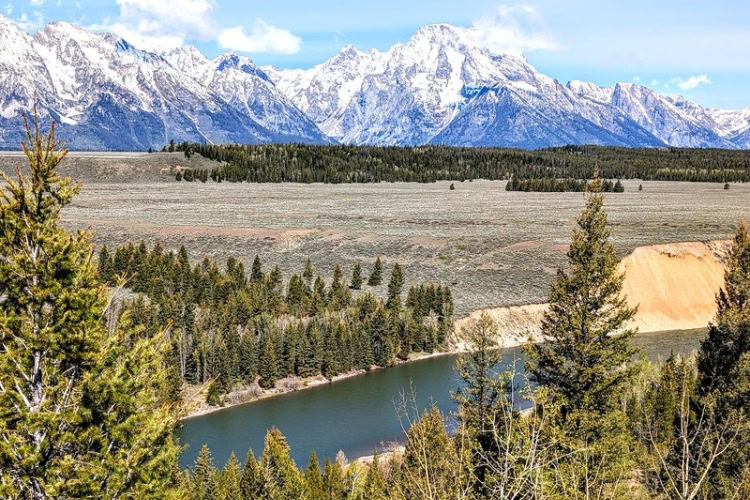
We exited onto Highway 89, which cuts through the eastern border of the park, past the Cunningham cabin. The log cabin was the scene of a shootout between marshals and alleged horse thieves in 1893.
Ahead of us, near Elk Ranch Flats, several cars had pulled over as the occupants enjoyed the sight of a large herd of American bison grazing the fields.
Once a large cattle ranch, today the grasses benefit bison, elk and pronghorn.
Standing at the Snake River Overlook, I was speaking to a man from Ohio, and below us, rafters put into the river, when his daughter casually asked, “Do they call it the Snake because it twists like one?” Clever question.
Beginning in Yellowstone Park, the Snake River winds its way below the high peaks of the Teton Range towering above it, emptying into the Columbia River some 1,000 miles away.
The name comes from a misunderstanding of the Shoshone, an Indigenous tribe: their sign for “salmon” was the same as the Plains Indian common sign for “snake.”
I liked her idea better.
If you have more time, you could indulge in this Scenic River Float experience along the Snake River.
Mormon Row
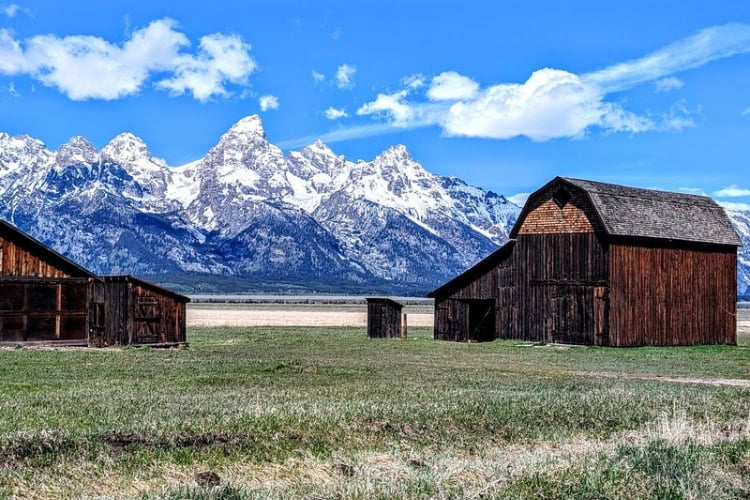
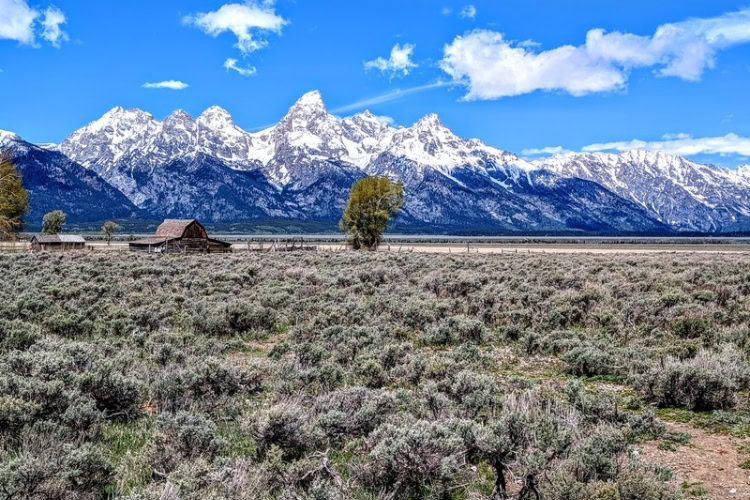
The first Mormon settlers, including John and T.A. Moulton, arrived in the 1890s from Idaho, establishing a community (named Grovont by the U.S. Post Office) below the very heights of the Tetons. Today, what is left of the community is known as “Mormon Row.”
Building ditches and levees, they irrigated their fields, raised their crops and reared their families. All within sight of these magnificent peaks, until the park service came calling and purchased some of their homesteads in the 1950s.
Today, these very picturesque farmsteads, including John’s pink home, not far from the Moose Landing park entrance and found at the end of a dirt road, are among the most photographed locales in the valley.
Beyond the aging buildings, the majestic three, Grand, Middle and South Teton, rise upon the horizon in spectacular glory.
Craig Thomas Discovery & Visitor Center
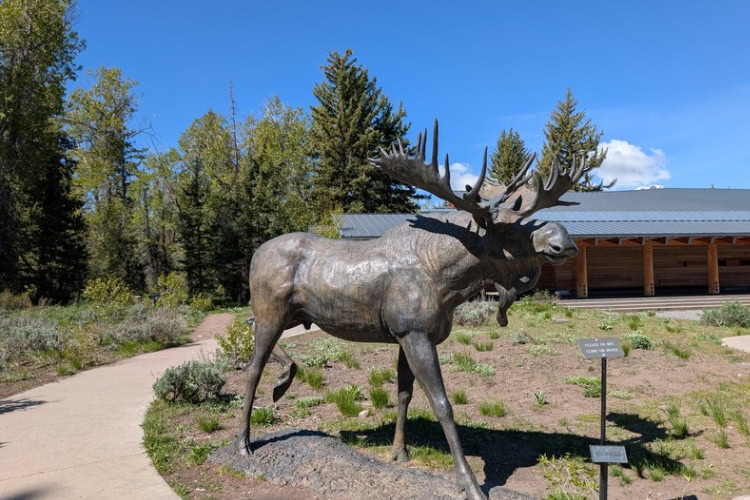
Craig Thomas Discovery & Visitor Center is found at the Moose Entrance station just north of the town of Jackson on US 26/89.
Kathy was in the bookstore while I was admiring some of the life-size human and wildlife sculptures in the gallery that have impacted the park when I was drawn, uninvited, to a demonstration of bear spray by a ranger.
Two adventurous backpackers who had just purchased their backcountry permits were receiving a crucial survival demonstration.
While holding the canister, she began by stating, to me, the obvious. If approached by a menacing bear, do not wait for it to get too close. Aim the canister toward the bear’s face, slightly downward, and spray a short burst. If the bear keeps approaching, spray again.
It was almost humorous if it wasn’t so sobering.
Jenny Lake And Missed Adventures
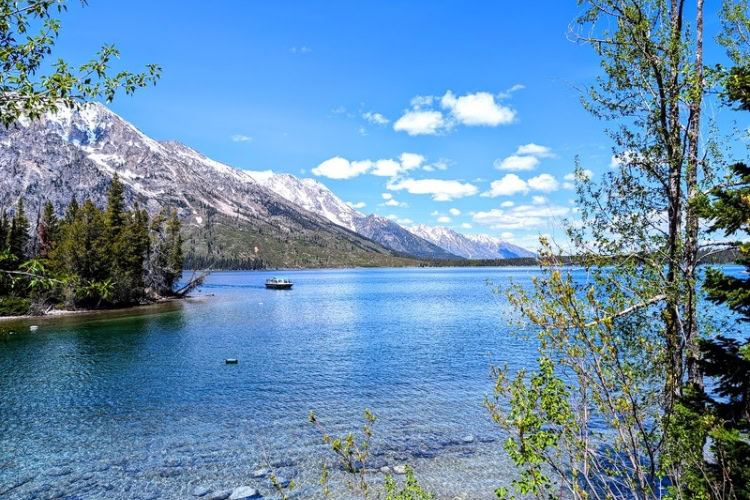
We had been warned that Jenny Lake is one of the most visited areas in Grand Teton National Park. Pulling into the parking lot, wedging our trusty carriage between two buses, I began to question my decision to leave it for last as we worked our way through a stream of visitors.
Named for the Shoshone wife of a trapper, Jenny Lake sits at the base of Cascade Canyon. Tucked away at the base of the Teton Range, the lake is a centerpiece of the park.
Besides the visually stunning lake, one of the great draws to the lake are the hiking trails; if you’re heading out, these pro hiking tips can help you stay safe.
If hiking isn’t quite in your wheelhouse, you can skip it altogether and take in the grand views from a boat. As we stood on the shore, the large ferry glided in over the mirror-like surface, depositing a dozen souls.
For those wanting to stretch their legs, the Jenny Lake trail is a 7-mile loop of spectacular views, such as Inspiration Point and Hidden Falls.
Unfortunately for us, the day was running short with a 2 1/2-hour drive ahead of us. We made it as far as the southern shore and the Moose Ponds. Here, a short spur trail took us to an overlook where moose and beaver are frequently sighted.
Luck was not with us; we had to settle for a bronze likeness near the visitor center.
As we made our way out of the park, to punctuate the end of our trip, a front moved in, bringing with it a mass of clouds.
As if bringing down the curtain on a great performance, the towering peaks disappeared behind a white haze.
We were already regretting not having more time. The strange vanishing act just enhanced our regret. However, even our brief visit had been exhilarating.
Indescribable Beauty
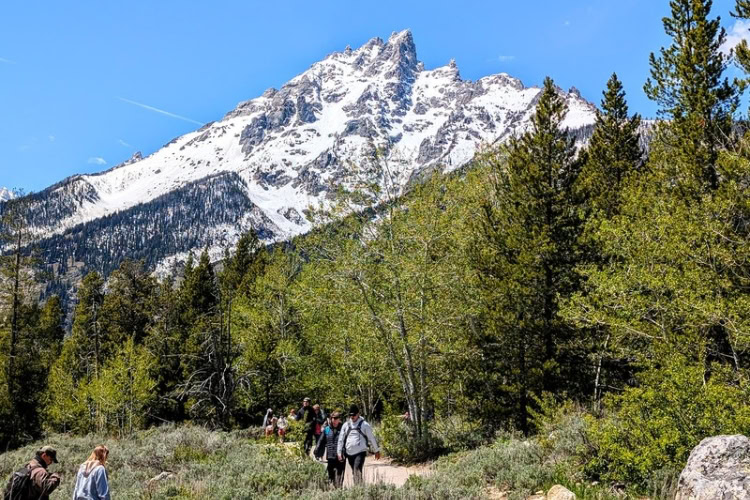
The Tetons are not some remote mountain range that you ignore. They do not sit in silence somewhere in the distance. Jagged peaks draped in wintry white rise dramatically from the valley floor, piercing some of the bluest skies ever seen.
The icy, clear lakes mirror the gorgeous landscape, while the Snake River winds across the landscape. Everywhere, the land is alive with herds of bison and elk, lordly bear and haughty moose.
The Tetons are not a postcard to be discarded, but a destination to be embraced.
To misquote John Muir, the famed naturalist, “The Tetons are calling and I must go…again.”
If You Go
You can reach Grand Teton National Park and the Jackson Hole valley from multiple directions, depending on the season.
From Yellowstone National Park, travel to the South Entrance onto the John D. Rockefeller, Jr. Memorial Parkway.
By car, Salt Lake City, Utah, is approximately 300 miles and about 5–6 hours from the park, and Denver, Colorado, is approximately 550 miles and about 8–10 hours from the park.
The nearest airport is Jackson Hole Airport (JAC), which actually lies within the park’s boundaries.
Entrance Pass
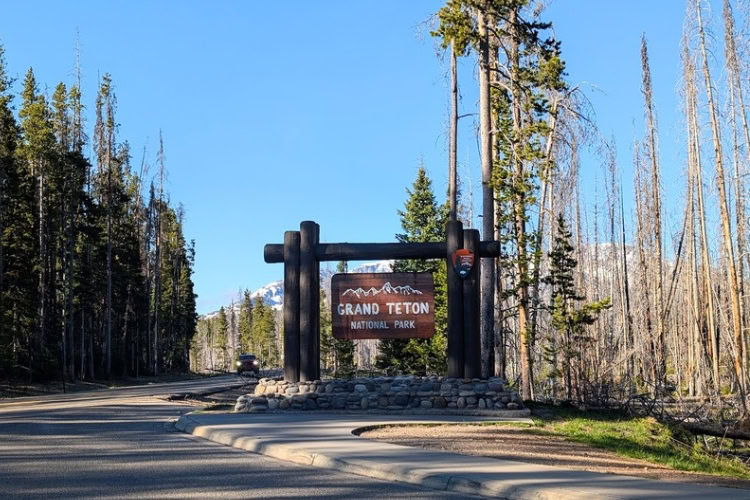
Photo by Kathy Hosek
You may enter the park with a Standard, Annual, or America the Beautiful Pass.
The fee for a Standard entrance pass is $20.00–$35.00.
Non-US residents (16 and over) must pay an additional $100 per person fee unless admitted with an Annual or America the Beautiful Pass.
Need a hand planning your trip? Here are the sites and services we rely on most, from booking tools to travel products we love.
Inspire your next adventure with our articles below:
- Hidden Gems in the American West: Road Tripping Through Canyon Country
- Utah’s Arches National Park: Where Nature Carved Over 2,000 Stone Masterpieces
Author Bio: Frank Hosek relishes traveling with his wife, Kathy. He enjoys discovering new experiences, meeting the people that make those experiences memorable, and sharing their adventures with others. He has written for Go World Travel Magazine, The Daily Journal, News Gazette and Lifestyles magazine. Frank has won awards from NWPA and IWPA for his travel writing. He looks toward the horizon for the next adventure.
Want to discover more hidden gems and helpful travel tips? Join our free newsletter for the latest travel secrets and travel articles.
We are reader-supported and may earn a commission on purchases made through links in this article.

- A Swiss Village, Lakeside Mansions and Door County Bluffs: Fall in Wisconsin - October 3, 2026
- The Sleeping Bear Dunes: Discovering the Splendor of Michigan’s National Lakeshore - September 24, 2026
- A Day On Tybee Island: 5 Things To Do When Exploring Savannah’s Beach - September 22, 2026
Planning another trip soon? ✈️
Add GoWorldTravel.com as a preferred source on Google. Click the button below so our local guides, packing hacks, and hidden-gem itineraries always show up first when you search!
Add to Preferred Sources