

It was never easy to build a railroad in Colorado.
As the highest territory in the continental United States, Colorado was filled with an estimated 4,391 mountain peaks, deep river gorges, severe winter snowfalls, droughts, floods, and steep elevation gains, all making the art of building railroads here a difficult – and treacherous – occupation.
But from a monetary point of view, it was a risk worth taking. Hidden in Colorado’s mountains were trillions of dollars of gold and silver, just waiting for someone to carry them away.
As a result of the risk and the reward, Colorado railroading became legendary.
The first engineering solution in the 1870s was to forgo the standard gauge of tracks 4 feet eight and a half inches apart used everywhere else in the U.S., and instead build narrow gauge railroads with tracks just three feet apart.
This innovation allowed railroads to make tight corners and be built in what had previously been impossible places. Colorado opened the Alpine Tunnel in 1882 as a global sensation — the highest railroad tunnel in the world!
As Colorado’s narrow-gauge railroads spread 2,000 miles of tentacles out across the state, they reached mining destinations that produced trillions of dollars of precious metals and made overnight millionaires.
The romantic, at times dangerous, and always fascinating history of narrow-gauge railroads in Colorado has captured a huge 21st-century rail fan base.
Today, thanks to thousands of volunteers and rail historians who have kept these trains alive, Colorado is one of the top historic railroad destinations in the world.
Colorado’s Railroading Highlights
- Eighteen narrow steam locomotives in operation, with five more undergoing restoration to operating condition, making it the top narrow gauge steam locomotive capital of the Western Hemisphere.
- The Cumbres & Toltec Scenic Railroad, which is the highest and at 64 miles, the longest narrow gauge steam railroad in the U.S.
- The highest cog railroad in the world at the Broadmoor, Manitou & Pikes Peak Railway.
- The fourth-longest railroad tunnel in North America, the Moffat Tunnel, is used by Amtrak’s California Zephyr and the Rocky Mountaineer.
- One of the largest model railroads by size in the U.S. at the Colorado Model Railroad Museum in Greeley.
- And historic trains that have appeared in dozens of classic movies, including Around the World in 80 Days and Butch Cassidy and the Sundance Kid (Durango & Silverton), Indiana Jones and the Last Crusade (Cumbres & Toltec Scenic RR), and Marilyn Monroe’s first film, A Ticket to Tomahawk (Colorado Railroad Museum).
So, all aboard, and here are 10 places to ride and enjoy the railroads of the Centennial State.
Colorado Railroad Museum, Golden, CO
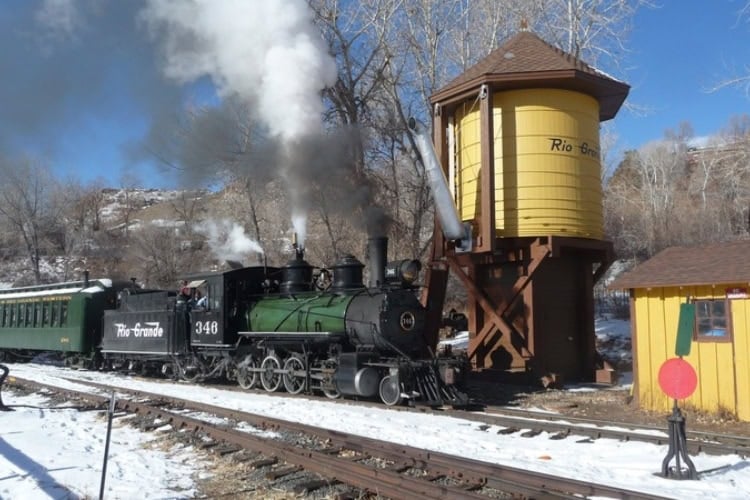
Nestled between high rocky buttes just 12 miles west of Denver in Golden, you’ll find the state’s largest collection of railroad stuff, including locomotives, historic photos, cars, and cabooses.
Most fun of all, the museum has a half-mile circle of narrow-gauge track – like a giant’s model train set – allowing regular “steam-ups” for their fleet of authentic steam locomotives.
On steam days, trains complete the circle three times every hour, providing hundreds of photo opportunities to catch locomotives in action. Annual events include a Polar Express that runs throughout the holiday season and several weekends of Thomas the Tank Engine.

Those Magnificent Galloping Geese
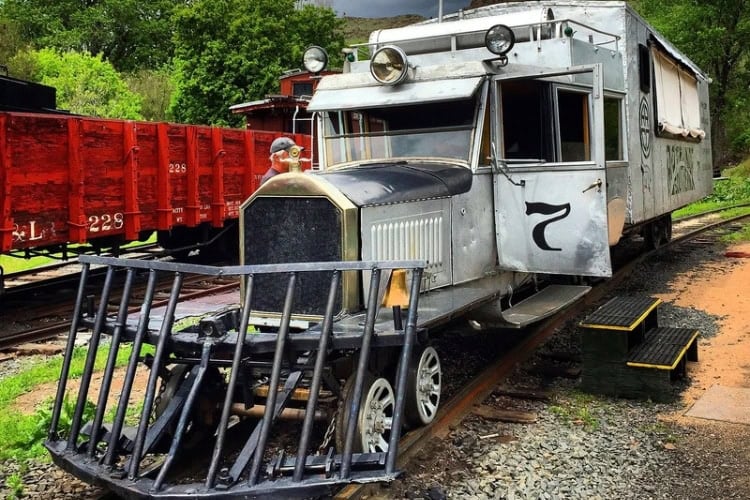
At other times, the museum runs the equally fun Galloping Goose, a crazy contraption of a 1920s Pierce Arrow Limousine on wheels with a bus welded on the back. The museum’s three galloping geese were used to run mail and passengers over Lizard Head Pass near Telluride.
In the basement of the museum is one of Colorado’s largest HO model railroads – more than 20 years of work in an area 45 feet long with a circus, mountain passes, and full cities. A giant outdoor garden railroad offers electric model trains traveling through cultivated forests of miniature trees and buildings.
The Cumbres & Toltec Scenic Railroad, Antonito, CO, and Chama, NM
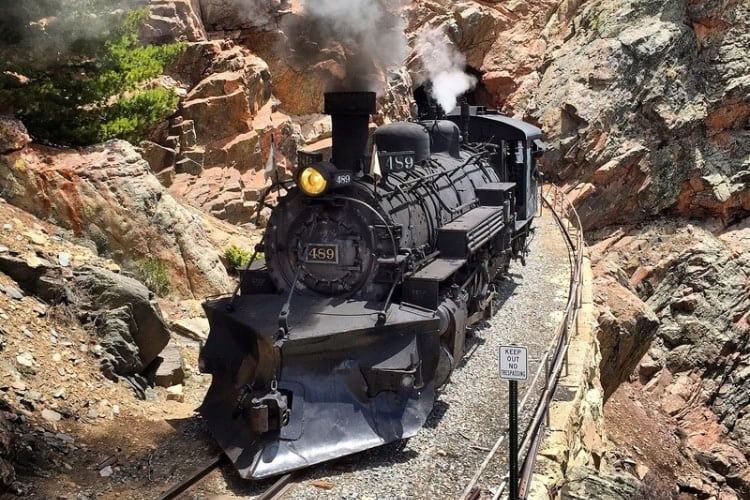
At 64 miles in length, this is the highest, longest, and most authentic coal-fired, narrow gauge steam railroad in the Western Hemisphere, with trains running from late May to October, steaming across trestles, through tunnels, and along the lip of steep canyons.
Trains depart from both Antonito, CO, and Chama, NM, crossing the state border 11 times. This is appropriate since the railroad is owned jointly as a non-profit by the states of Colorado and New Mexico, preserved as a National Historic Landmark that moves.
And move it does, passing through scenery far off the grid where no automobile road goes. All trains move at a slow 12 miles per hour, and you can wander around the train, riding between cars or in an outdoor gondola car, in addition to three classes of seats.
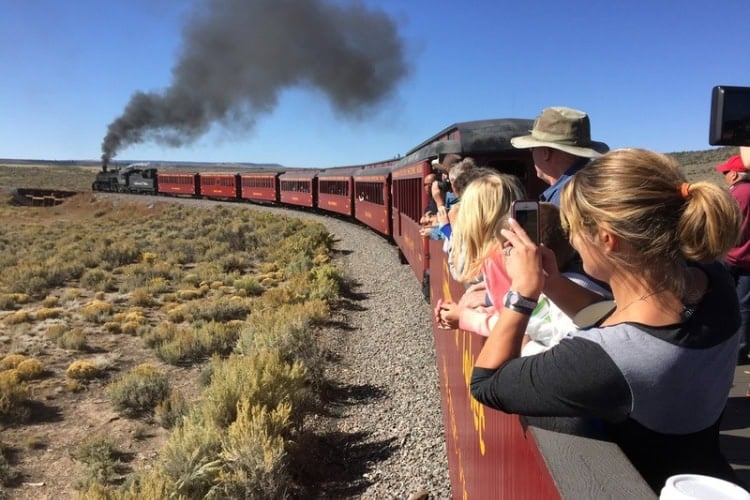
A hot lunch of regional dishes is included on all full-day trips at scenic Osier Station. Leave your cell phones in your pockets – they won’t work out here anyway – and travel back to 1880 when the railroad was built, and Wyatt Earp and Doc Holliday were passengers.
Durango & Silverton Narrow Gauge Railroad
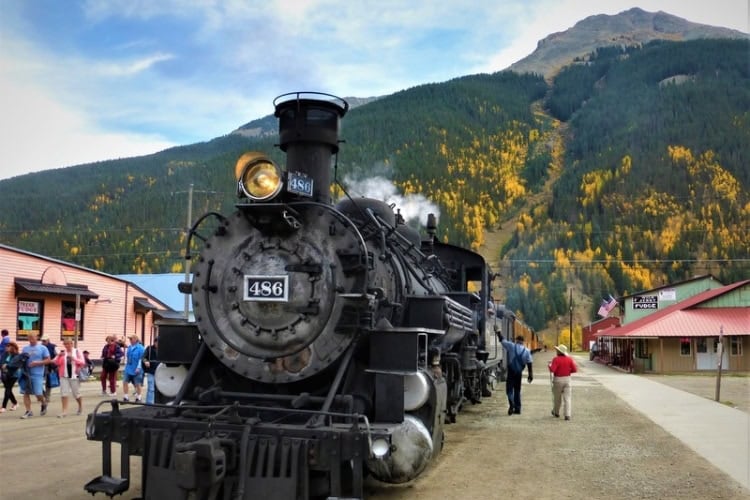
Built in 1882 as part of the Denver & Rio Grande Western, San Juan extension, these trains once carried gold and silver from the mountains down to the town of Durango.
Today, the famous narrow-gauge railroad offers steam and diesel train excursion rides from what is now the popular tourist town of Durango up through the San Juan Mountains along canyon cliffs and beside a roaring river to the old mining town of Silverton. Much of the area is only accessible by train.
There’s a five-hour excursion on the Cascade Canyon Express or the full-day ride to Silverton and back, among other ticketing options. There’s also a winter train that ventures through snow up to Cascade Canyon, and in the holiday season, a Polar Express!
It is even possible to get off the train in Colorado’s backcountry for river rafting, climbing, and hiking 14,000-foot mountains, and then re-board the train days later to come home.
The railroad has been featured in numerous films, and in addition to train rides, there is the free Denver & Silverton Narrow Gauge Railroad Museum, which occupies 8 stalls of a 15-stall roundhouse and is filled with model trains, real locomotives, and other railroad memorabilia.
Read More: Discovering Durango: A Hidden Gem in the Colorado Rockies
The Georgetown Loop Railroad

This is a reconstruction of one of the most famous engineering feats in U.S. railroad history. Originally, in 1877, a railroad ran from Denver 42 miles west to the silver mining town of Georgetown. Because there was more silver just two miles away in Silver Plume, they decided to push the railroad up the valley.
The challenge? Silver Plume was 600 feet higher in elevation. To gain that much altitude that fast, the railroad had to twist and turn four and a half miles, making two and a half complete circles and at one point crossing over itself like a corkscrew on a 90-foot-high trestle – the Devil’s Gate Bridge.
With the collapse of the mining industry, the railroad was closed and, in 1939, torn up for scrap metal. For 35 years, the grade lay abandoned, but then the Colorado Historical Society bought it back, and steam railroading returned to the valley in 1975.
Today, the train can be boarded in Georgetown or Silver Plume and offers panoramic views, often accompanied by a sense of unease, particularly when crossing the bridge.
From the open-air viewing cars, it is possible to see big horn sheep and other wildlife, but it is the sound of the train whistle echoing down the valley that is unforgettable. There are wine trains and an optional tour of the Lebanon Silver Mine along the way.
The Broadmoor Manitou and Pikes Peak Cog Railway
The Broadmoor Manitou and Pikes Peak Cog Railway is both the highest and longest cog railroad in the world and has been carrying passengers to the summit of the 14,115-foot mountain since 1891.
In May of 2021, the railroad completed $100 million of improvements which included three new engines, nine new passenger cars from Stadler Rail in Switzerland, and nine miles of new Strub single rail cog track, not to mention a beautiful new Visitor Center with spectacular views from the top of Pikes Peak, the place that inspired the song, “America the Beautiful.”
So, what is a cog railroad? No traditional train could climb the steep grades from the 6,570-foot-high station in Manitou Springs to the summit of the mountain.
The train’s wheels would just spin on the tracks. Instead, a Cog Train uses a toothed wheel that meshes into a toothed track, so the train has something to “grab” onto as it claws up the mountain.
This cog and gear system also, thankfully, keeps the train from running away on the way down. Today, it takes just one hour and 10 minutes to climb up Pikes Peak in comfort with the new cars offering huge picture windows to take in all the scenery.
Royal Gorge Route Railroad
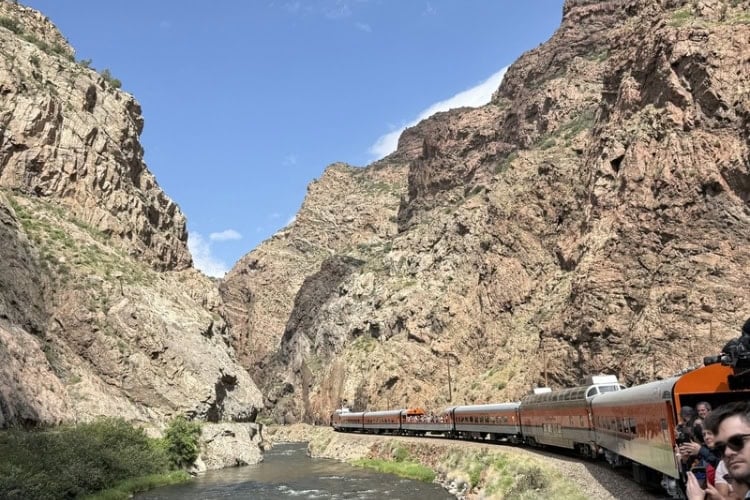
This is unquestionably one of the most spectacular train routes in the world and today offers an unforgettable railroading experience at many different levels. In the 1870s, Leadville, CO, became one of the biggest silver mining sites in history, but they needed a railroad to pull out the valuable ore.
The two railroads closest to the mines were deadly competitors: the Denver & Rio Grande Western and the Santa Fe, both of which had rail terminals nearby in Pueblo. There was one major problem.
The only route from Pueblo to Leadville was along the Arkansas River up through Royal Gorge, where sheer 2,000-foot-high cliffs dropped down to a 30-foot-wide river, not wide enough for one railroad, let alone two.
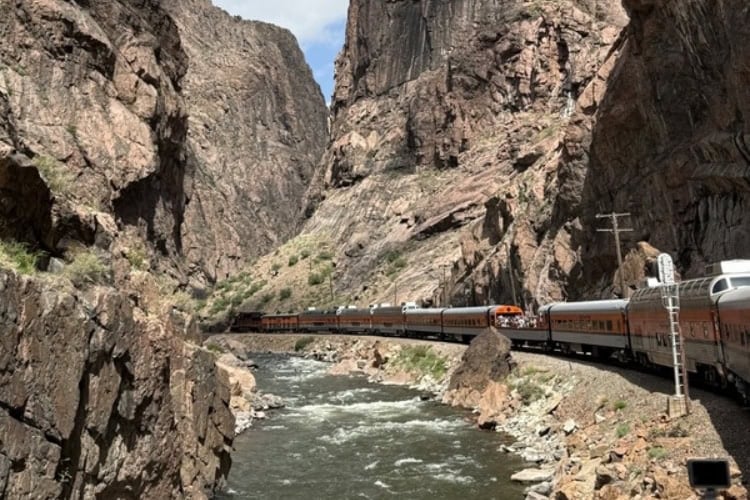
Thus began the Royal Gorge War, where both railroads hired gunslingers and lawyers and fought it out with bullets from hand-made stone forts in the canyon to lawsuits that ended up in the U.S. Supreme Court.
The final outcome doesn’t matter so much today as the fact that in 1998, the historic rail route through this spectacular landscape was taken over by the private Royal Gorge Route with the mission to provide a first-class railroading experience with fine dining, service, and fun while traveling along one of the most beautiful railroad tracks ever built.
Today, there are four daily departures throughout the year, including a Breakfast Train, a Lunch Train, an Afternoon Train, and a Dinner Train as well as seasonal specials where you can book an Afternoon with Santa, a Classic Afternoon Tea at the Royal Gorge Mansion (located just a few blocks from the Depot), or a murder mystery train and more.
While Vista Dome cars provide overhead views of the canyon, inside the coach, you can expect a top-notch menu. My favorite? Ride outdoors in a gondola car where you can practically touch the sheer rock walls. But of course, don’t!
Even at the slow speed of the train, touching anything outside the car is extremely dangerous.
The California Zephyr and the Rocky Mountaineer
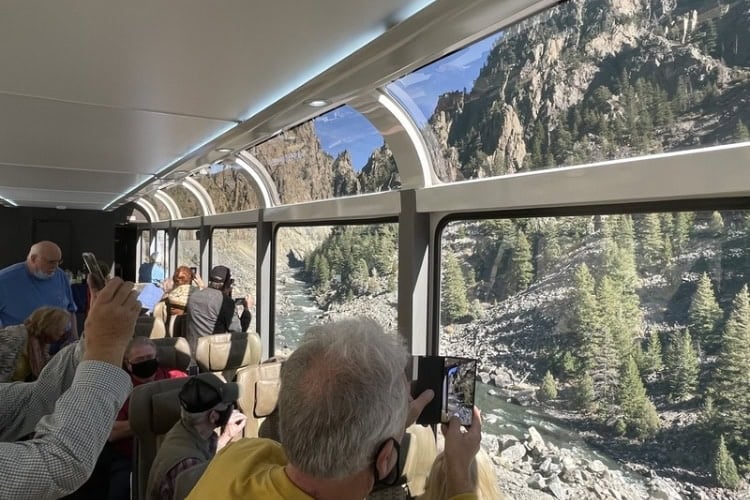
Running 2,438 miles between Chicago and San Francisco, the California Zephyr is Amtrak’s longest daily train. And the most scenic.
The trip takes 51 ½ hours, traveling across the Great Plains to Denver, over the Rocky Mountains, down the Colorado River through canyons, into areas of vast desert, and through the Sierra Nevada Mountains.
In addition to Denver, the train stops at Omaha, Salt Lake City, and Reno, but it pretty much avoids populated areas, traveling instead across immense open, and rugged country – a luxurious city on wheels speeding through the wilderness with two diesel locomotives, a dining car with chef-prepared meals, coach cars, sleeping cars, and a lounge/dome car.
As many as 410,844 people ride the train every year.
Today’s California Zephyr is a luxurious way to see Colorado by train, but if you really want luxury, consider the Rocky Mountaineer. In 1990, Canadian Peter Armstrong created the first Rocky Mountaineer – a luxury two-day rail trip between western Canada and the Canadian Rockies.
The concept was different from other rail travel: the ride was not about getting somewhere; it was about the journey. The train would only travel during daylight hours and would run at a speed of just 30 mph, even slowing down in the most scenic areas.
Passengers would ride in luxury and comfort in dome cars, and they would eat wonderful cuisine and drinks.
The concept was a sensation, and today the Rocky Mountaineer is the largest privately owned luxury railroad in the world, having carried more than 2 million passengers. And now the Rocky Mountaineer is in Colorado!
The Colorado version travels the same Amtrak tracks from Denver’s Union Station through 28 tunnels as it climbs up past snowcapped peaks to burrow under the Continental Divide and come out at the headwaters of the Colorado River.
From here, the tracks follow the river to Glenwood Springs, where passengers depart for dinner and a beautiful evening in the historic town.
Up at dawn, the luxury train passes through one red rock canyon after another, branching off the Amtrak route until ending just seven miles from Moab, Utah, and Arches National Park, a perfect ending for one of the most luxurious trains on the planet.
Colorado Model Railroad Museum
One of the largest and most respected model railroads in the world is in Greeley, Colorado, at the Colorado Model Railroad Museum.
It took five years and 280,000 volunteer hours to create the Oregon, California & Eastern Railway – a gigantic, 5,500 sq. ft., miniature world filled with lakes, rivers, trestles, switching yards, waterfalls, cities, and 28,000 hand-made trees!
There are so many sights to see that visitors need a map to get around because, unlike many model railroads, this is an “open air” design with broad aisles in a twisting maze with no barriers between visitors and the trains.
You can be inches from the scenery as a smoking steam locomotive passes by. There’s even a forest fire with flames, smoke, and fire trucks. Don’t worry, the thrilling three-minute forest fire sequence (which is activated by pushing a button) ends with the fire being put out.
There are more than 500 HO scale locomotives that follow a single track representing 80 scale miles of railroad as they climb and descend up Gearhart Mountain, one of the tallest HO scale mountains in the world.
More than a half-ton of hydrocal plaster was used to create this monster mountain, which also includes real rock from Rist Canyon west of Ft. Collins.
The museum was created by David G. Trussell, who, after a 32-year career in journalism and publishing, devoted seven years to assembling the entire 10,000 sq. ft. facility, which now attracts 20,000 visitors annually from 40-50 countries.
There can be no higher praise than that from Model Railroader Magazine Senior Editor Jim Hediger, who says this is “…the finest model railroad I’ve ever seen.”
Amtrak Winter Park Express

One of the most exciting railroad trips in America has one-way fares that start as low as $19 for a two-hour rail excursion that includes crossing the Continental Divide in the 6.2-mile-long Moffat Tunnel as well as traveling through 28 other tunnels as you gain 4,000 feet in elevation, crossing the Rocky Mountains with breathtaking views at every turn.
It’s the Amtrak Winter Park Express, and while this train is primarily known as a way for skiers to get from Denver to Colorado’s fifth-largest ski area at Winter Park Resort, it is also a snow-filled dream trip for non-skiing rail buffs.
Passengers depart from Denver’s Union Station at 7 a.m., traveling in “Coach Class” on a double-decker Amtrak Superliner train featuring wide, reclining seats with a big picture window, ample legroom, and no middle seat.
On board, you can visit the bi-level Sightseer Lounge, offering panoramic views of the Flatirons above Boulder from upstairs or dine on café service snacks and drinks for sale downstairs.
Or just sit back, relax, and enjoy the train ride as you glide along narrow ledges above ice-crusted rivers, hug mountain cliffs, rush through one tunnel after another, and pass across high alpine valleys before arriving at Winter Park Resort at 9:15 am, just 100 yards from the ski lifts.
The Winter Park Express operates on Thursdays, Fridays, Saturdays, Sundays, and Mondays from January through March 31.
Read More: Mile High Denver: A Guide to Colorado’s Hip Capital
New Service to Fraser, Colorado
New in 2025, Amtrak expanded service by adding a stop in the town of Fraser, five miles west of Winter Park. The new stop in the cute mountain town of Fraser offers brew pubs, the Cozens Ranch history museum, lots of restaurants, and the relaxing (anyone can do it!) Fraser Snow Tubing Hill.
Free shuttle buses run between Fraser, Winter Park downtown and Winter Park Resort so non-skiers can spend the day shopping, eating, drinking, snowshoeing, hiking and visiting the three areas filled with restaurants and shops before, with whistles blowing, the return train departs at 4:05 pm from Fraser (4:35 from Winter Park Resort) full of tired skiers and passengers, who can relax and enjoy large picture windows and a cocktail in the lounge car as the train glides back down from the mountains at twilight to scenic views of all the lights of Metro Denver far below, arriving at 7:05 pm at Union Station.
Read More: Your Ultimate Guide to Affordable Ski Passes in Colorado
If You Go

There are several other operating railroads in Colorado, including Tiny Town, where miniature steam trains circle a tiny town filled with kid-sized buildings, and Cripple Creek, where equally small gauge trains travel from mine to mine above the towns that circled the largest gold strike in history.
For rail buffs, there are more than three dozen preserved historic railroad sites that can be found here.
Whether you climb on board an operating historic railroad, ride a current luxury train, drive or hike an old abandoned railroad route, or visit a historic station and museum, just know that rail fans from all over the world come to Colorado to experience a train experience that cannot be found like this anywhere else on the planet.
In 2025, the Colorado Tourism Office released the fact that their website Colorado.com had more searches for historic railroads than for national parks. All aboard, everyone!
Need a hand planning your trip? Here are the sites and services we rely on most, from booking tools to travel products we love.
Inspire your next adventure with our articles below:
Author Bio: Rich is a member of the Society of American Travel Writers and the North American Travel Journalists Association and was director of communications for Visit Denver for 35 years. His first memory is at the age of five being lifted into the cab of still operating steam locomotive in Montreal, Canada in 1954.
Want to discover more hidden gems and helpful travel tips? Join our free newsletter for the latest travel secrets and travel articles.
We are reader-supported and may earn a commission on purchases made through links in this article.

- 18-Day Colombia Road Trip Itinerary by Bus or Car - September 13, 2026
- Language Learning Travel Guide - September 12, 2026
- Safari Travel Guide - September 12, 2026
Planning another trip soon? ✈️
Add GoWorldTravel.com as a preferred source on Google. Click the button below so our local guides, packing hacks, and hidden-gem itineraries always show up first when you search!
Add to Preferred Sources