

Exploring Denver, Colorado
People are often surprised when they land for the first time at Denver International Airport and discover that it’s located on high, completely treeless, rolling plains, miles from the snow-capped peaks in the distance. It looks like Kansas. Even the skyscrapers of downtown Denver, Colorado, are barely visible on the horizon, 24 miles west.
But even more surprising to new visitors is when they leave the airport, hop on a modern train, and emerge 35 minutes later in what seems to be a completely different place: Union Station, the heart of downtown Denver.
Travel Guide to Denver, Colorado

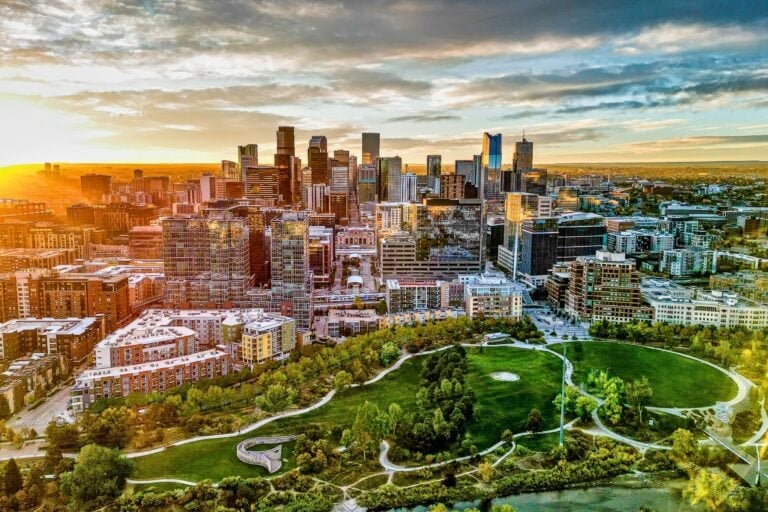
The station is the center of what a recent study said is the second most walkable city in America. Just outside the doors is a lively, pedestrian-oriented, bustling city filled with 100-year-old buildings and green trees.
In 1858, there was literally nothing here. The terrain looked just like the airport, empty and treeless. But when one of the largest gold strikes in history was discovered nearby, Denver exploded. In two years, 100,000 men and women walked here from St. Louis — 851 miles.
And they brought with them the desire to make Denver look exactly like it did back home. So they planted shade trees and bluegrass lawns, laid out parks, created lakes and canals, and transformed the desert into a green oasis.
Why Downtown Denver is Booming with New Young Residents

Today, about 33,000 predominantly young people live downtown, three times the number in 2000, along with 132,000 daily downtown workers. It’s no secret that downtown struggled during the pandemic, with some vacant stores, offices, and homelessness, but a new Denver mayor, a $175 million refurbishing of 16th Street, and some $500 million of incentives have helped turn the corner, and a visitor would never know what the locals were so worried about.
The center of downtown is 16th Street. At a mile long, it is the longest pedestrian street in America, lined with shops and more than three dozen outdoor cafes. The only vehicles allowed are free, electric buses that act like horizontal elevators, stopping on every corner as often as every ninety seconds to whisk passengers from the southern end at the State Capitol to the northern end around Union Station.
Within easy walking distance of 16th Street are 12,000 hotel rooms, five art museums, the second-largest performing arts center in the nation, three major pro sports stadiums, and more than 100 bars and breweries, including bars on rooftops, bars sporting volleyball courts, and live music, and the largest sports bar in the world, an 8,000-seat bar on the rooftop of Coors Field that is exactly 5,280 feet above sea level – one mile high.
16th Street was formerly known as the 16th Street Mall, but don’t call it that today. The city spent $100,000 on a study that said: drop the word “Mall,” although everyone still uses it. Construction is nearly complete on a four-year, $175 million makeover that added three rows of trees, new art, and much wider sidewalks and the Mall (sorry, 16th Street) is back to the beautiful core spine of downtown.
New in 2025, the area around Denver Pavilions (a three-deck shopping and entertainment center) is now licensed so you can get a drink to go at any of the bars here and carry it around with you.
Denver Neighborhoods Circle Downtown

In a circle surrounding the central downtown area of skyscrapers are a series of neighborhoods, each with its own acronym and personality. Most of the energy of Denver is directed toward these new youth-oriented areas, some of which were formerly industrial wastelands.
When the gold mining boomtown of Denver burned to the ground in 1863, the city passed an ordinance that all new buildings had to be built of brick or stone. This stayed in effect until World War II, so Denver has no old wood structures, but the city was happily filled with hundreds and hundreds of brick and stone buildings and warehouses, just waiting to be redeveloped 150 years later as breweries, distilleries, James Beard award-winning restaurants, food halls, one-of-a-kind fashion boutiques, and art galleries. The neighborhoods surrounding the downtown business core include:
LoDo

(short for Lower Downtown) This is the most historic area and includes Union Station. There are more than 100 historic red brick buildings here now filled with bars, cafes, and restaurants and new chic hotels like the Crawford, the Maven, the Oxford, Indigo, Limelight, and the Rally at McGregor Square. Locals will divide the neighborhood into LoDo and Ballpark (the area surrounding Coors Field) but it’s all the same. Rooftop bars are a specialty here because of Denver’s spectacular sunsets and cool evenings that often require a light jacket.
Try the View House filled with sports courts and large rooftop views; Dierks Bentley’s Whiskey Row, built atop the city’s most famous historic bordello; the Rally Hotel with a rooftop swimming pool bar up above and plenty of action at the ground level at McGregor Square with its huge courtyard seating hundreds for a beer under a gigantic TV screen broadcasting local and national sports games.
Then there’s the Pour House and Tap Fourteen, all of which have their rooftop action, but if you’re afraid of heights, check out the Dairy Block Alley, which has night markets of artists selling goods in an alley surrounded by bars, shops, and a food court of high-end specialties.
LoHi

(short for Lower Highlands) is reached by three pedestrian bridges from Union Station, crossing the railroad, I-25, and the South Platte River. The other side of the river from downtown has a completely different vibe. The buildings here are at a lower elevation with more of a neighborhood feeling.
You’ll find the massive REI sports emporium with indoor rock climbing walls, the popular dog-friendly outdoor beer garden at the Denver Beer Company, and an enormous milk can that is home to the local favorite, Little Man Ice Cream. Root Down is located in an old gas station, Avanti offers multiple restaurants with elegant outdoor seating and a downtown view, and Linger is in an old mortuary serving international street food.
The speakeasy (it looks like a bookstore), Williams & Graham, is a center for cocktails, while the Family Jones is one of Colorado’s oldest distilleries and spirit houses, also serving fine dining.
RiNo
(short for River North) is exploding with breweries (at least nine) and food halls. Take a tour of the city’s best murals here with Denver Graffiti Tour. Confusingly, RiNo is one neighborhood that is divided into two by the railroads.
The new hip hotels, rooftop bars, and popular dining are found on the Brighton Blvd. side, especially at The Source. This side also has the Mission Ballroom, a new concert hall billed as an “indoor Red Rocks.” It’s all new on the Brighton side, but there’s not much of a street presence.
On the other side of the tracks dividing RiNo is Larimer Street, which has a funky, urban, old school vibe with murals on nearly every building, the same number of restaurants and breweries, but fewer hotels, although it does have the Ramble Hotel with its popular Death & Co. cocktail bar. Your Uber driver will know how to get you to either or both areas easily and there is a pedestrian bridge at 38th Street.
Uptown
is one of the newer neighborhoods booming with apartments, scooters, and bikes, and a slew of new bars and restaurants. This is where people actually live and play ping pong at Ace, or have a beer at the Bike Café, a bike shop and coffee shop with beer. There are a dozen local taverns and restaurants to chill at if you have friends who live here and know the area.
Capitol Hill
Colfax Ave. runs behind the State Capitol and is the longest business street in America, stretching 26 miles from the eastern plains to the first foothill mountains in the west. Near downtown, you’ll find the famous Fillmore concert hall, fast food, tattoo shops, used bookstores, record stores, and more than a bit of edgy city urban craziness. Strangely, in the midst of this is a massive cathedral, the first Basilica west of the Mississippi, where Pope John Paul once gave a mass in 1993.
Golden Triangle and Baker
Just to the south of downtown Denver are three of the city’s art museums and Denver’s Broadway, a “Brooklyn-like” street that runs for miles with one-of-a-kind little boutiques, Irish bars, pizza shops, bookstores, fine dining, marijuana dispensaries, beer gardens, breweries, and everything else. The Punch Bowl is a 20,000 sq. ft. emporium of beer, bowling, and shuffleboard, and BurnDown Denver has four levels of dining and rooftop views.
The brand new Schoolyard Beer Garden is located at an old schoolhouse just a couple of blocks from the Denver Art Museum and is a shaded, fun gathering place for the neighborhood, while Pints Brewery is an old friend to the neighborhood with the city’s largest collection of single malt Scotch. If you bring a bottle they don’t have, they’ll buy it from you.
The People of Denver Live Outdoors

With abundant sunshine and mountain views, Denver is an outdoorsy place filled with people on bikes, jogging, annoying electric scooters, and skateboards. Every restaurant and bar has outside seating, and most outdoor dining areas are dog-friendly and filled with wagging tails.
Informal doesn’t begin to describe Denver, where shorts are dress down and the good jeans are what you wear going to the symphony. But you have to dress in layers, because while the city can be hot in the day, the cool, dry, high-altitude air can change in a second and become quite cool at night.
It is much debated how many days of sunshine Denver gets, but studies show the sun really does shine for at least one hour, 300 days a year. Does one hour of sun constitute a sunny day? Who cares? This is Denver. Relax and have a beer at one of the city’s 67 breweries. Bottom line: the dry climate energizes people and makes them want to be outdoors.
The Colorado Rockies started the 2025 season at 70 games, setting the worst opening record in the history of Major League Baseball, but the team still fills the stadium because it’s just so pleasant to be out at night for a Rocky Mountain sunset.
Kayaking and Biking in Denver

You can kayak through the heart of downtown on the South Platte River, or jump on one of the thousands of bike shares, electric scooters, or electric bikes and zoom down city streets. The South Platte River off-street bike trail stretches more than 40 miles north and south, from Chatfield Reservoir to Clear Creek, where another off-street bike trail heads 15 miles west to Golden, Coors Brewery, and Clear Creek Canyon.
Or try the Cherry Creek Bike Path, picked by USA Today as one of the top 10 urban bike trails in America, stretching another 40 miles to the southeast through the shopping capital of the city, Cherry Creek North, and on — always along the river – to a huge reservoir with boats and beaches. Metro Denver boasts almost 1,000 miles of paved, off-street bike trails
World-Class Dining in Denver
Denver chefs Alex Seidel (the 2018 James Beard Chef of the Southwest) and Jen Jasinski (winner of the same award in 2013) have, between them, four restaurants in Union Station. Michelin identified 27 restaurants of distinction in Denver (15 of them downtown or in surrounding neighborhoods).
Celebrity chef Frank Bonanno operates ten restaurants in Denver (when he’s not hosting his own show on PBS, “Chef Driven,”) and it’s difficult to keep count of how many eateries local chef legend Troy Guard has. Caroline Glover, co-owner of Annette, won the James Beard award for Best Chef in the Mountain Region in 2022.
Byron Gomex, executive chef at Bruto, a Michelin-starred restaurant, has appeared on Top Chef, and Kelly Whitaker was nominated for Outstanding Restaurateur for the James Beard Awards. Those seeking fine dining in Denver will have little trouble finding it.
Ethnic Foods in Denver

Metro Denver is home to nearly 600 licensed food trucks. You’ll find them parked throughout downtown at breweries or in weekly food-truck roundups, such as the one at lunch in Civic Center Park held Tues.-Thurs. with some 26 food trucks participating each day. It’s hard to imagine an international cuisine that doesn’t have its own food truck, from Argentina to Maine lobster, from Ethiopia to Poland.
In free and wide-open Denver, it’s relatively easy and inexpensive to open restaurants, breweries, and food trucks, which is why the city is bursting with them. Federal Blvd. in Denver is a trip around the world with the north end stuffed with Southwest, Mexican, and Native American eateries, transforming to Asian, Vietnamese, Chinese, and Thai as you travel south of 6th Ave on Federal.
Casual and liberal Denver and next door Aurora have become home to people from every corner of the planet, bringing their food specialties with them. You may not read about these places in Travel & Leisure and they may not win a Michelin star, but Denver has become a welcoming home (President Trump would say, “Too welcoming!”) but nevertheless, a home to people from all over the globe who share their foods and culture freely here.
Breweries in Denver
Metro Denver produces more beer than any city in the world, mostly due to Coors, the largest single brewery outside of China on the planet. Denver’s Great American Beer Festival in September or October holds the Guinness World Record as the largest beer celebration, with more than 3,000 different beers served and judged, and there are five dozen breweries in Denver city limits, including the state’s first brewpub, the Wynkoop, opened by former Denver Mayor, former Colorado Governor, and current U.S. Senator John Hickenlooper, the first brewer to be elected as a state governor since Sam Adams. He likes to say that “Bikes, beer, and bands are what made Colorado the state it is today.”
Today, every place in the nation has craft breweries, but in the late 1980s, Denver was the only city in America to have five craft breweries within walking distance of each other and it became the craft beer center of the nation. If you wanted to be a stage actor, you went to New York. If you wanted to be a craft brewer, you came to Denver, and many of the breweries around America owe their beginnings to the craft beer revolution that started here.
Distilleries in Denver
In 2004, the next-door neighbor of Gonzo journalist Hunter Thompson opened the first legal distillery in Denver since prohibition, Stranahan’s. Today, there are nearly 100 operating distilleries in Colorado, the largest concentration of them in Denver. They supply products to more than two dozen craft-cocktail-centric bars, offering local craft rum, whiskey, vodka, gin, and bourbon.
Denver gin? Yes! And made with all Colorado juniper berries at The Family Jones in LoHi. On Dec. 18, 2024, for the first time in more than 52 years, the U.S. Government added a new type of whiskey to its regulations: American Single Malt Whiskey. This new classified whiskey is as important and distinguished as bourbon.
And where would be the epicenter of this new rebel style of alcohol? Why Colorado, of course. Bourbon will always be associated with Kentucky, but the new idea of an American Single Malt whiskey was distilled in the wilds of Colorado, and just as Scotch became associated with the wild highlands of Scotland, this new style of whiskey is already a mainstay in a dozen Colorado mountain towns.
Art in Denver

Downtown Denver has five separate art museums, all within walking distance. The Denver Art Museum, known for putting together outstanding one-of-a-kind shows like Dior, Yves Saint Laurent, Degas, and Becoming Van Gogh, completed an expansion a few years ago with a new restaurant, rooftop views, and a new showroom for their Native American collection, considered by many as the best in the world.
The nearby Kirkland Museum explores this Denver artist’s work, while next door is a museum devoted solely to the works of an artist you may never have heard of: Clyfford Still. He’s one of America’s greatest impressionists and eccentrics. He refused to sell his work, so few museums have them, and while you may not know him, the museum sold just four of his works for $114 million. They own the premier collection of 2,000 of his paintings, and the profits from the sale paid for a spectacular new museum worth checking out.
Finally, the American Museum of Western Art offers a glimpse at the private collection of local billionaire Philip Anschutz in one of Denver’s most historic buildings, a former brothel and gambling hall with a secret tunnel to the city’s most iconic hotel, the Brown Palace. Check out the art, then have high tea or a cocktail in the Brown’s famous nine-story atrium topped by a stained-glass ceiling.
Live Music in Denver
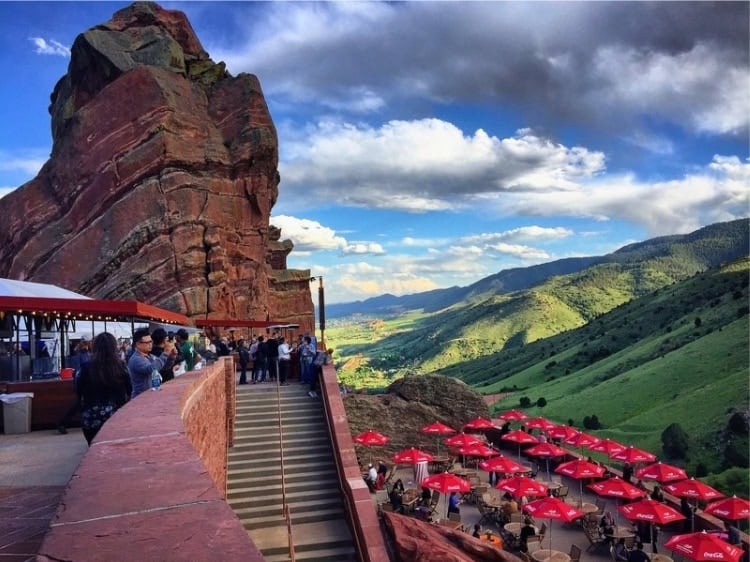
Of course, Denver’s world-famous Red Rocks Amphitheatre has hosted everyone from the Beatles to Bruce Springsteen and is owned and operated by the City of Denver. It’s located just 12 miles from downtown and stages 160 events a year, including concerts, movies, and yoga classes for 9,000 people. It’s so famous and has won the contest for best outdoor concert venue so many times. Red Rocks was finally eliminated from the competition, and instead, the award for best outdoor concert venue was renamed “the Red Rocks Award.”
But downtown Denver is also home to the Fillmore, one of the historic rock palaces of that name (New York and San Francisco had the others). Bob Dylan, when he was really a “complete unknown” in the very early 1960s, used to play at the Satire Lounge just down the block from the Fillmore.
Across the street from the Satire at East High School, he met a young student destined for fame named Judy Collins. In the 1950s, Jack Kerouac and his “On the Road” boys hung out at music clubs all over Denver. With a population of 3 million and a geographic isolation of more than 600 miles from another city, Metro Denver has more concert venues than Nashville or Austin.
One Republic and The Lumineers are local bands. The Ogden and Bluebird are former movie theatres turned concert halls, and the Mission Ballroom is billed as an “indoor Red Rocks” for big-name concerts.
Denver Sports

Denver has the smallest population of any American city to have all seven major professional sports teams. Coors Field, with the MLB Colorado Rockies (the worst team in the history of baseball), is easily walkable from anywhere downtown.
Denver’s Ball Arena, also walkable, is the home of the NBA Denver Nuggets, NHL Colorado Avalanche and Colorado Mammoth Lacrosse. Dick’s Sporting Goods Stadium hosts the Colorado Rapids soccer team, Denver is building a new stadium to open in 2026 for women’s professional soccer, and let’s not forget Coach Prime and the Colorado University Buffaloes.
And then there’s Empower Field at Mile High, the home to the NFL Denver Broncos. When that lease expires in 2030 and with new ownership by the Waltons, Denver is almost certainly looking at a new $2 billion or more stadium that will rank among the world’s greatest. Where? That’s the biggest question in Denver at the moment.
Public Art in Denver

Loving the outdoors in Denver means loving art outside. One percent of all construction projects must go toward public art, and today in downtown, you will find everything from the beloved 40-foot-high Blue Bear peering into the Colorado Convention Center to dozens and dozens of murals, covering nearly every empty brick wall in the city.
Alleys, especially in RiNo and the Arts District on Santa Fe, are an explosion of color. The most haunting public art? The gigantic blue mustang with glowing red eyes you will see entering or leaving Denver International Airport. Known locally as Blucifer, during construction, the head broke off and killed the sculptor, Luis Jimenez. Now that’s haunted!
Denver Parks

When viewed from a distance, downtown Denver looks like it is growing from a forest. Denver loves its parks, and downtown is full of green spaces to jog, relax, enjoy flower gardens, and just breathe fresh Rocky Mountain air. From Commons Park, which stretches along the South Platte River, to Confluence Park with its adjacent REI Super Store, to the flower gardens in Civic Center Park, downtown Denver is devoted to green space.
And Denver has its own, one-of-a-kind, mountain park system – sort of like a miniature National Park system. Red Rocks, Buffalo Bill’s Grave on top of Lookout Mountain, Echo Lake at the base of 14,260-foot-high Mount Evans, and 25 other parks miles away in the mountains are all owned and operated by the City of Denver.
The Mile High City even maintains two buffalo herds and an elk herd. One of the buffalo herds has their tunnel under I-70 so they can be seen on both sides of the highway, all with a snow-capped panorama behind them.
Denver Ski Train
Denver is the only city in the nation where you can take a train from the airport and then get on another train to take you directly to the lifts at a city-owned ski resort. Amtrak’s Ski Train to Winter Park Resort takes two hours and passes through 28 tunnels.
In 2025, it expanded to continue to Fraser, Colorado, and plans call for trains to continue to Granby and Steamboat. The section to Winter Park has been hailed as the most scenic stretch of railroad in Amtrak’s entire system. Once at Winter Park, you literally walk 200 yards from the train to the lifts.
Food Halls in Denver
The newest trend in Denver has been to create food halls, great centers filled with a wide selection of dining choices. Of course, Union Station was first. The once nearly abandoned 1909 station has been filled with new restaurants and bars (order a beer through the old ticket window at the Terminal Bar), and is today considered Denver’s living room, packed with tables and chairs, electrical outlets, games, and people watching.
Nearby, across the South Platte River, is Avanti, a permanent restaurant roundup with eight different cuisines and a wonderful outdoor patio with plush cushions and chairs overlooking the skyline. Denver Central Market has transformed an old industrial building into a food market with a bakery, butcher, candy maker, pizza, ice cream, and fruit stand. The Stanley Market in Aurora did the same thing on a much grander scale.
The Source was an old ironworks factory that now has a brewery, distiller, bakery, Michelin-recognized restaurants, a hotel, shops, and one of Denver’s great outdoor view bars, the rooftop of The Woods. Largest of all is the Milk Market, which has taken cars out of an alley and converted it to a pedestrian path behind an old dairy that now houses bars and restaurants.
What You Need to Know about Marijuana and Denver
And, of course, Denver was the first city in the world to legalize recreational marijuana, and there are currently more than 360 marijuana dispensaries within city limits. It’s not legal to smoke marijuana in public, but you can eat a marijuana gummy, cookie, soda pop, or even marijuana ice cream pretty much wherever you like. Just don’t tell anybody.
And after you do? Meow Wolf is an interactive art museum/experience that is difficult to explain but immensely entertaining to visit. It’s exactly what you would expect to find in the first city in the world to legalize recreational marijuana, but it’s also a terrifically fun outing for kids by day and adults by evening.
The Old Standbys
No account of Denver is complete without mentioning its famous attractions: the U.S. Mint (bring your own pennies, they don’t make them anymore); the home of Unsinkable Molly Brown; the State Capitol (the 13th step on the west side is 5,280 feet above sea level); the Denver Museum of Nature & Science and next door Denver Zoo, which occupy pretty City Park; Washington Park with its swan boats, lakes and gardens; and Casa Bonita, the pink palace brought back to life by metro Denver natives Trey Parker and Matt Stone, the creators of South Park.
For information (on everything except marijuana): visitdenver.com
Inspire your next adventure with our articles below:
Author Bio: Rich worked for 35 years as the director of communications for Visit Denver, the Convention & Visitors Bureau and is the co-author with Irene Rawlings of “100 Things to Do in Denver Before You Die.”
Want to discover more hidden gems and helpful travel tips? Join our free newsletter for the latest travel secrets and travel articles.
We are reader-supported and may earn a commission on purchases made through links in this article.

- 5 Romantic Island Escapes Along British Columbia’s Coast - September 13, 2026
- Inside Hawaii Island’s Lava Tubes: Nāhuku, Kaumana and a Guided Cavern Near Hilo - September 13, 2026
- 18-Day Colombia Road Trip Itinerary by Bus or Car - September 13, 2026
Planning another trip soon? ✈️
Add GoWorldTravel.com as a preferred source on Google. Click the button below so our local guides, packing hacks, and hidden-gem itineraries always show up first when you search!
Add to Preferred Sources
Your itinerary is very good. I’ve lived in Colorado twenty years and I’d only add a side trip to ride the trails in Fruita. Great little town, wonderful trails.