
The wind swirled across the scrub grass, carrying echoes of distant voices long past until it broke upon the crumbling ancient stone walls that encircled the grounds.
I slowly turned around, taking in the vacant courtyard, imagining it filled with a community of industrious people grinding corn, weaving baskets and baking bread.
The emptiness made it difficult. I started towards the most distinctive and intact building on the premises. The mid-morning heat was already telling and all the more stifling with the humidity. The sunbaked ground left no sign of my passing.
Great-tailed grackles voiced their displeasure with our intrusion from their perch in an ancient Live Oak tree. Instinctively, I reached for the handle on the aged door, fully expecting it to be locked. Surprisingly, it easily swung open on well-oiled hinges.
Entering the Mission

My wife and I entered into the relative cool of the brightly lit interior. Somewhere from hidden speakers, a choir gently filled the walls with its refrains.
The narrow nave, with its plastered walls and exposed timber roof beams, directed our eyes towards the Sanctuary, where an altar was backed by three colorfully painted wooden statues.
The central statue on the altar is of St. John Capistran, the patron saint of the mission, and is believed to be of eighteenth-century origin. We had entered the church of the Mission San Juan Capistrano.
As we had walked onto the grounds of the mission, it had all the trimmings of abandonment, so we were totally unprepared to walk into such a beautiful chapel.
However, like the other missions of San Antonio Missions National Historic Park, this is an active parish.
San Antonio Missions UNESCO World Heritage Sites Tour
San Antonio Missions
San Antonio is an area rich in Spanish Colonial history. Its mild climate and resources—the spring-fed San Antonio River, fertile soil, and diverse game animals—were a powerful attraction to the Spaniards, much as they had drawn indigenous peoples to the area for thousands of years before.
Over three centuries ago, Franciscan Friars arrived in the San Antonio River valley to establish what would eventually become five missions in the area.
Today, four of those missions are preserved in various degrees by the National Park System. Kathy and I learned of the San Antonio Missions National Historic Park while visiting the Alamo in San Antonio.
The Alamo was the first mission established in the region and is currently preserved by the State of Texas for altogether different reasons. You may have heard of it…Davy Crockett, Jim Bowie, Colonel Travis, and the Battle of the Alamo. But that’s a different story for another time.
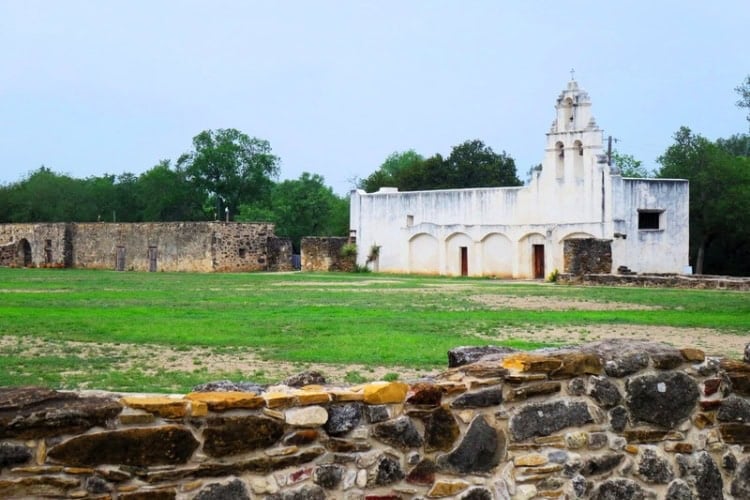
With a brochure in hand and a vague idea of what we might discover, we headed 13 miles south of downtown San Antonio. We found ourselves standing in the serene courtyard of the San Juan Mission, in front of the simple, white stone chapel, which stood tall and elegant in its tranquil surroundings.
The Missions Historic Park tells the story of thriving communities built on faith, industriousness and collaboration that blended two worlds.
Mission San Francisco de la Espada

From Mission San Juan, we drove approximately 2.5 miles to Mission Espada. Established in 1731 along the San Antonio River, the church was completed in 1756. Today, only the chapel remains intact, with the granary and two of the compound walls falling into disrepair.
Mission Espada was unique in the fact that the friars taught the Coahuiltecan (kwa-weel-teken) Indians how to make bricks, which can be seen incorporated into the walls of the chapel.
The morning we arrived, the chapel was locked to visitors. Although it was well-kept with pots of thriving flowers adorning the exterior, the grounds seemed to present a more desultory appearance.
Maybe it was a reflection of its history. Furthest from town, the smallest of the missions was more exposed to Apache and Comanche attacks. In 1826, a devastating fire destroyed many of the buildings. Yet, a few families remained, and today the chapel has an active congregation.
Acequias or How to Get Water Where You Want It

Even before the mission walls or stone churches began to be built, crops had to be planted if the missions were going to survive and thrive.
Growing crops such as corn, beans, squash, and peppers was part of survival, and in this South Texas climate, you need irrigation to grow these crops. Having the San Antonio River nearby was essential, but its waters didn’t always go where it was most needed.
So, the mission inhabitants planned and dug acequias, or irrigation ditches, following the natural paths of the land to allow gravity to move the water from the San Antonio River to the farmlands and then back into the river.
Once the water reached the farmlands, sluice gates would allow for the water to be controlled into the rows of crops.
We found restored and operating acequias at both San Juan & Espada. However, I was most fascinated by the aqueduct that we discovered just north of Mission Espada.
The Espada Aqueduct, built by hand from stone, serves as a bridge for water to be carried from one side of a valley to the other, allowing the acequia to continue flowing to the mission’s farmlands. It is a double-arched structure that, after two centuries, continues to carry water to the fields. It is the oldest remaining Spanish aqueduct in the United States.
Mission San José y San Miguel de Aguayo

Photo by Frank Hosek
After taking a right instead of a left, I eventually got us heading in the right direction towards the third mission.
Known as the “Queen of the Missions,” Mission San José is the largest of the missions and most popular, as evidenced by the row of buses lining the parking lot when we pulled in.
At its height, the community contained some 350 Indian converts, sustained by extensive fields and herds of livestock.
The mission was almost fully restored to its original design in the 1930s by the WPA (Works Progress Administration). Today, Mission San José attempts to capture the community and daily mission life.
We entered the compound past a huge Mesquite tree whose many trunks and limbs reached out like so many tentacles seeking the scarce rainfall.

Nearby, Yuccas with spindly sword-like leaves dotted the grounds. These plants have provided food and fibers to the native inhabitants long before the missions arrived.
We followed a group of elementary school children through stout gates past the towering walls that had protected the inhabitants. The inquisitive students ran in and out through the low doorways of the small quarters that had housed the indigenous peoples, explored the beehive bread ovens and a gristmill.
In the huge granary, they discovered that their voices would echo off the cavernous ceiling.
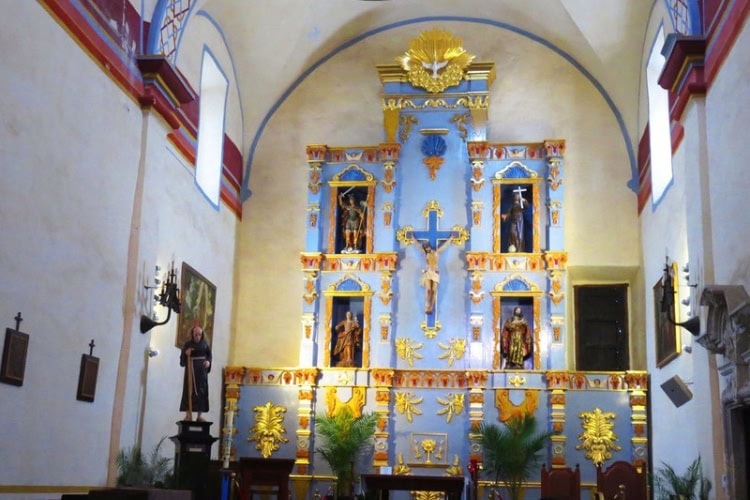
However, their voices became hushed when they entered the chapel, the largest of all the missions. Their eyes, like ours, focused on the sky-blue wall behind the sanctuary.
It was adorned with golden images and a quartet of saints behind the altar, where a large gold-trimmed, blue crucifix hung in the middle.
Several sat in the pews, all seemed to wrestle with inner thoughts.
Visitor Center and the Story of Mission Life

San Antonio Missions National Historical Park’s Visitor Center is also located at San Jose. It offers a gift shop and a museum with artifacts that explain life within the Spanish missions.
While aimlessly looking through the gift shop as Kathy had her National Park book stamped, I overheard and then joined a conversation that a ranger was having with visitors concerning the very reason that the mission came into being: the local indigenous peoples.
The Spanish missions in San Antonio played a significant role in the lives of Indigenous peoples. This was primarily the Coahuiltecans, a broad descriptive name for the several bands of hunter-gatherers who roamed the region at the time. Spain had sought them out to secure Spain’s hold on the area by converting the locals.
Their lives had been governed by the seasons and the availability of natural foodstuffs. The missions offered a more reliable food source and protection from encroaching warrior tribes of the north, such as the Apache.

It was not an easy transition for either the Coahuiltecans or the friars. The natives were expected to abandon their culture, learn a new language, adopt a structured lifestyle, and, above all, accept a new religion.
For their part, the friars never understood the Indians’ reluctance to give up their previous lives entirely or their resistance to the new ways.
Above all else were the diseases. The friars and their accompanying soldiers brought European diseases to which the locals had no immunity. It was a deadly combination, with over half dying from the various illnesses.
Even so, a few stayed in the area, even as the missions fell into decline. Today, there are congregants of the chapels who trace their heritage to the original Coahuiltecans.
Mission Nuestra Señora de la Purisima Concepción de Acuña
I was bent over at the waist, my head bumping up against the brim of Ranger Ken’s Smoky the Bear hat while he was pointing at faint, tiny black dots, all the while enthusiastically explaining the process of fresco painting.
As I followed his tiny, green pointer light, I began to see the outline of the faded pattern that had so vibrantly covered the stone walls at one time. In its glory, long since played out, colorful, geometric designs covered the two-story surface, both inside and out.
However, with Ranger Ken’s infectious explanation and the help of an artist’s interpretation, I was able to visualize what was once a tapestry of colorful four-petal floral designs that had draped the now drab exterior walls.
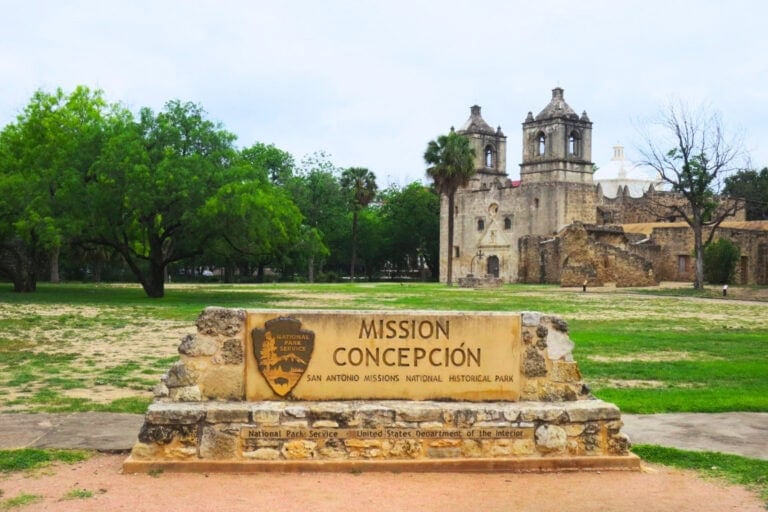
We were standing outside the Mission Concepción, the oldest, best-preserved, unreconstructed stone church in the United States.
It is also the closest mission to downtown San Antonio; as such, where the other Missions of the park retain some semblance of their remoteness, Mission Concepción is surrounded by today’s world.
Yet, the four-foot-thick limestone walls, locally quarried and laid by hand, have withstood the test of time.
I had asked a question about the frescos of Ken. Before I realized it, Ranger Ken was trotting off with the words, “Follow me.” All the while, my wife was texting me, “Where are you?”
The Light of Conception

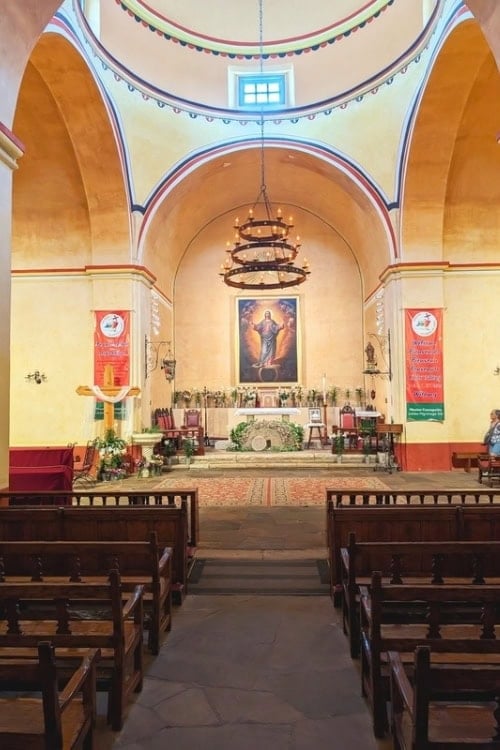
Passing two identical bell towers marking the entrance, we entered through a side portal of the active church. Its overall design is in the shape of a crucifix, and the vaulted roof has a beautifully decorated dome. Above the altar, a portrait of Mother Mary.
Ken explained that the placement of windows was a deliberate attempt to illuminate the portrait on December 8th, the Feast of the Immaculate Conception. He, himself, had attended one of the services, standing room only, and had witnessed the light streaming onto the portrait.
Finally, with Kathy in tow, we were following the quick-stepped ranger into the Library, a room in the Friar quarters. Inside, he pointed at remnants of frescoes that indigenous artisans had painted on the plaster walls.
Pointing ceilingward, Ken showed us one of the best-preserved original frescoes. For decades, the only visible portions had been one eye and several rays. Locals had labeled it the “Eye of God” or “All-Seeing Eye.”
After conservators tediously removed 250 years’ worth of dirt and non-original plaster, a full face with two eyes and a mustache appeared. Historians now believe this was not a religious symbol, but rather a Spanish medallion.
Ken stated that he still liked the idea of the “Eye of God” looking over the preservation of the Missions. I had to agree.
If You Go
San Antonio Missions National Historical Park is located within the city of San Antonio, Texas.
There are four missions in the national park. Each mission is approximately 2.5 miles from the next. It is very easy to drive from mission to mission, and free parking is available at each mission site.
Best Places to Stay in San Antonio
Inspire your next adventure with our articles below:
Author Bio: Frank Hosek relishes traveling with his wife, Kathy. He enjoys discovering new experiences, meeting the people that make those experiences memorable, and sharing their adventures with others. He has written for Go World Travel Magazine, The Daily Journal, News Gazette and Lifestyles magazine. Frank has won awards from IWPA for his travel writing. He looks toward the horizon for the next adventure.
Want to discover more hidden gems and helpful travel tips? Join our free newsletter for the latest travel secrets and travel articles.
We are reader-supported and may earn a commission on purchases made through links in this article.
- The Great Lakes Shipwreck Museum: Honoring the Legend of the Edmund Fitzgerald - September 11, 2026
- Driving I-90 Across South Dakota: Badlands, Wall Drug and Roadside Icons - September 2, 2026
- Gettysburg National Military Park: A Visit to Hallowed Ground - August 31, 2026
Planning another trip soon? ✈️
Add GoWorldTravel.com as a preferred source on Google. Click the button below so our local guides, packing hacks, and hidden-gem itineraries always show up first when you search!
Add to Preferred Sources