
Decades ago, when I heard the song, “Far Away Places with Strange Sounding Names – Calling Me,” I latched onto those words to shape my lifelong journeys to mysterious locations around the world.
I was running out of real estate until a recent visit to faraway, and strange-sounding, Madagascar. Ranked as the world’s fourth-largest island, the country’s landmass split from Africa around 180 million years ago, and from the Indian subcontinent approximately 90 million years ago.
It is anchored in the middle of the Indian Ocean and separated from Africa by the Mozambique Channel. Madagascar’s profound uniqueness has earned it the label of the 8th Continent.
A Land of Contrasts
Gaining its independence from France in 1960, Madagascar remains isolated and underdeveloped. Over 50% of the country’s 30 million people have no access to clean water, and only 30% have access to electricity.
Its people suffer inconceivable poverty, while its terrain offers a wealth of plant and animal species found nowhere else in the world. For me, the contrasts evoked images of the woeful human condition amid natural tropical beauty.
The overused description of ‘Paradise’ never entered my mind, aggravated by travel during the tropical cyclone season. Touring offshore islands amid pounding rain offers a more realistic view of the hardships these people endure than when the sun glistens on the sand and breezes rustle through the palms.
Arrival in Antsiranana
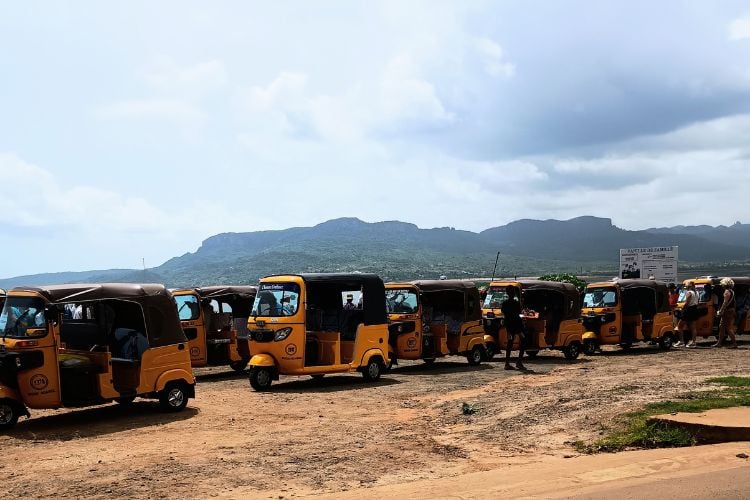
Photo by C Bowman
We first glimpsed this strange land as our small ship docked at the northern port of Antsiranana, the second-largest natural bay in the world.
A slew of faded yellow, tuk-tuk mini-cabs took shore excursion passengers on a bumpy ride through Diego Suarez, the capital city of the district. These open-air, motorized trikes with sheet-metal side and back enclosures and colorful tarpaulin roofs comfortably seat two riders.
However, as we zigzagged through traffic, we faced swaying, three-wheeled transits, stuffed with six Madagascan men.
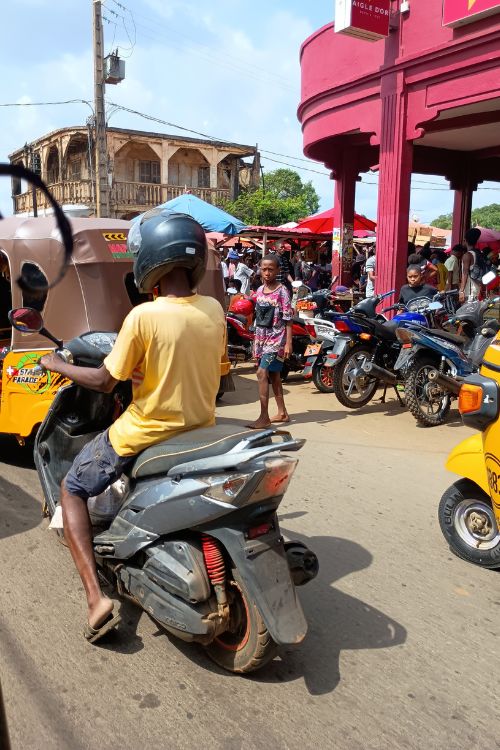
As the parade of ‘cruise’ cabs navigated potholes on the city’s sole paved road, I scanned the market stalls lining the puddle-filled cross streets. Rainy season soakers had turned dusty pathways into rutted tracks.
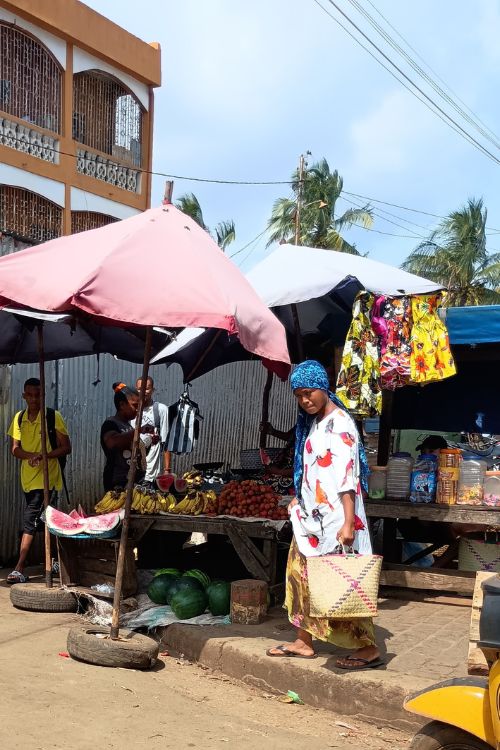
Vendors hawked their unappealing goods of overripe bananas and wilted produce, shriveling in the hot sun. Wearing bright, turban head-wraps, women shoppers slogged through this quagmire in search of food for their families.
Buildings, which once displayed the grandeur of 19th-century French architecture, sagged from disrepair. Faded, peeled paint, and warped, rusty ironwork reflected years of neglect. The despair I saw on people’s faces seemed as universal as the flip-flops every man, woman, and child wore.
The Quest for Lemurs
Our jarring ride progressed from urban sprawl to lush and refreshing expanses along the turquoise Indian Ocean.
My thoughts turned to my obsession with seeing lemurs. The strange primates endemic to Madagascar are now among the world’s most threatened primates due to uncontrolled logging and illegal hunting. It’s reported that rich foodies of the world have developed a taste for the sweet meat of these fruit-eating creatures.
Hoping to spot the unique tree-climbers, I focused on tropical saplings along the road. Our lanky, teenage tuk-tuk driver, in a jumble of English, French, and Malagasy, sputtered out that seeing lemurs might be easier on the Northern, offshore islands, our next port call in Madagascar.
A Marvelous View at Sugarloaf Island
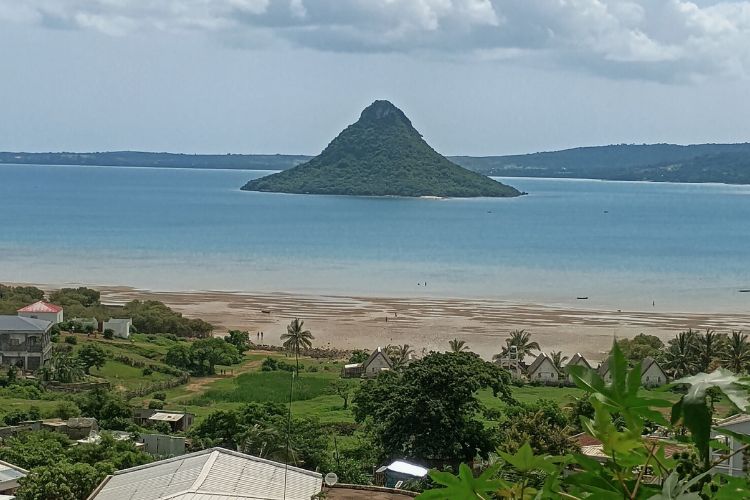
We stopped on the cliffside to view the spectacular, cone-shaped volcanic Sugarloaf Island, situated in the middle of Diego Bay.
Locals believe that death will come to anyone who sets foot on this sacred land, home to the tombs of ancient Sakalava rulers. Swimmers circle the 400 ft. high isle, but no one dares to rest on its shore.
Heading to Nosy Be Island
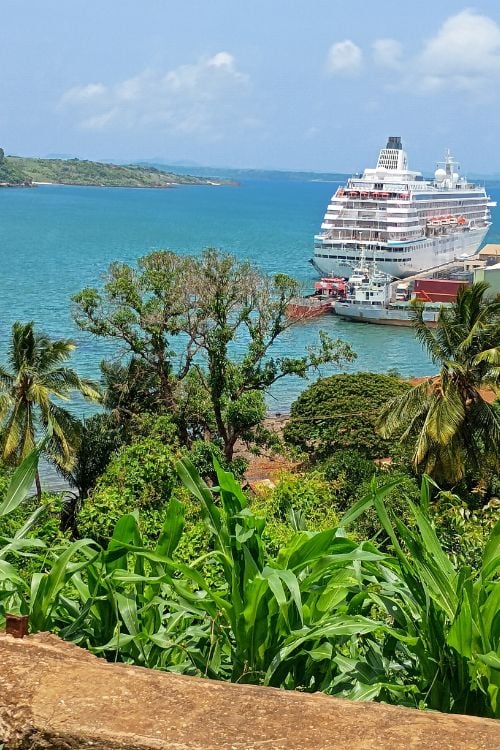
All passengers back on board, we set sail for Nosy Be Island. A tropical cyclone had been chasing the ship, but the captain reported a sufficient distance between the vessel and the storm.
The outer bands of the weather system lashed incessant rain against our suite windows during the night. But by morning, despite overcast, grey skies, the downpour ceased. Cruise guests expressed cautious optimism about their scheduled day trips.
The ship dropped anchor at a 45-minute tender ride to Nosy Be port, the transfer station for boats to other isles. This zone of outer islands, with lush native vegetation, white sand beaches, cobalt seas teeming with marine life, endemic lemurs, chameleons, and reptiles, draws tourists to Madagascar’s tropical respites without the glitz and perhaps, without power.
Exploring Nosy Komba
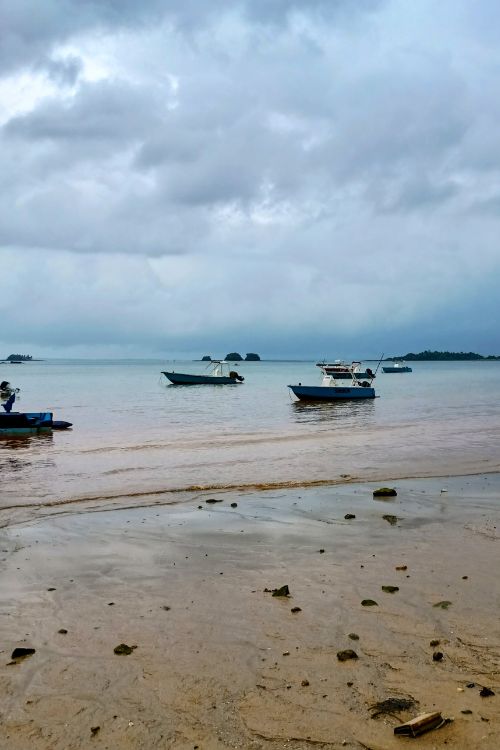
My husband and I were headed to Nosy Komba, also known as Lemur Island. Excitement rose; with a name like that, encounters with the furry primate seemed inevitable.
Fifteen tourmates inched down a steep incline of wet, slippery concrete to board a small, motorized craft with no protective roof. After thirty minutes on the open seas, we anchored near Lemur Island’s largest village, Ampangorina.
A wet landing required us to jump from the boat into calf-high water. We then sloshed our way to the debris-strewn, sandy beach, with deep gulleys carrying last night’s runoff rainwater.
The Rich History of the Island
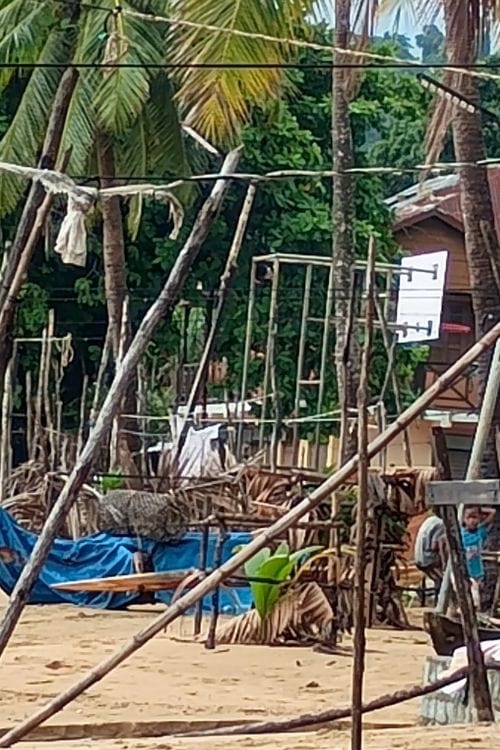
I surveyed the landscape where Sakalava people emigrated from Africa during the 15th to 17th centuries.
In the mid-1800s, France housed imported slaves from Mozambique. The French, suffering from malaria and cholera, convalesced at a rehabilitation center established in 1841.
The Struggles of Village Life
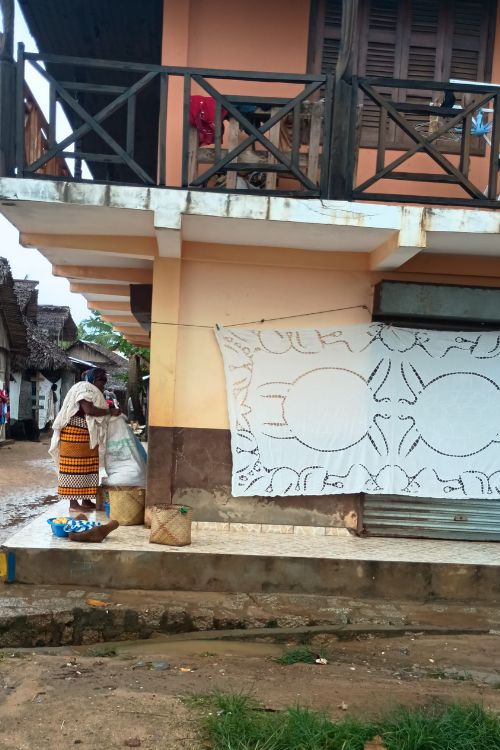
The hillside rose sharply through heavily logged, scrubland and bamboo forests to a flat plateau where foreboding black clouds gathered. Lining the shore, wooden, lean-to structures with corrugated tin roofs, but absent power lines, confirmed a village without electricity.
A little girl, whose mama may have dressed her in a white, ruffled frock to impress cruise visitors, looked down at deep puddles in her path. Women frantically unfolded bundles of Richelieu embroidery tablecloths, hand-crafted here for centuries, eager to snag a sale as tourists trudged through the village’s soggy center pathway.
We passed a small, unoccupied schoolhouse and the medical clinic, its open door swinging, with a pair of red flip-flops left on its doorstep. There was also a thatched-roofed, wooden building with a hand-made ‘Hotel and Restaurant’ sign slapped on the front.
A woman, bent at the waist, washed her hair under the central well’s only spigot. The daily struggles these people faced mounted wherever I looked.
The Climb to Find Lemurs
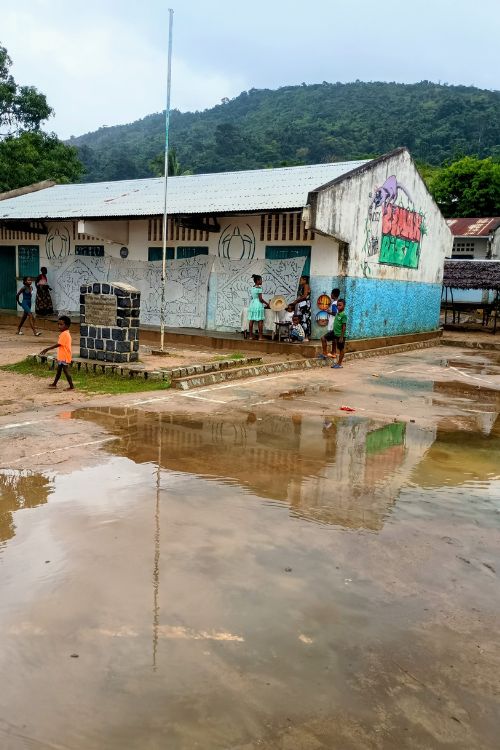
A local guide greeted the group with a bunch of bamboo walking poles, which he insisted everyone use. He knew what was coming. We didn’t.
My water shoes, scratchy wet sand between my toes, proved a poor choice of footwear for the hike up the steep slope into the tropical forest in search of lemurs. Wet basalt, a volcanic rock, served as uneven stepping stones, and with each tread, I feared a slip.
The guide, repeating the guttural sound that lemurs make, attempted to lure the furry primates into the open. But these animals were smarter than this horde of seekers. They sensed an imminent deluge, and staying dry in their comfortable lairs outweighed emerging to enthrall tourists.
We kept climbing, stumbled upon a boa constrictor, lazing in the mud, and a chameleon hiding under a wet leaf, but no lemurs.
My disappointment felt palpable until steady raindrops and an even slicker downward path seized my attention. Women scurried to move wooden carvings, handmade trinkets, and piles of embroidered linens to the back of their dark huts to protect their source of income from ruin.
An Unexpected Encounter
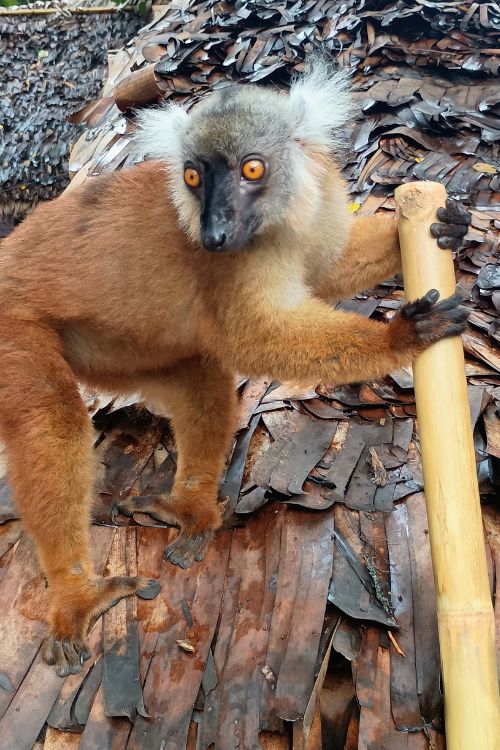
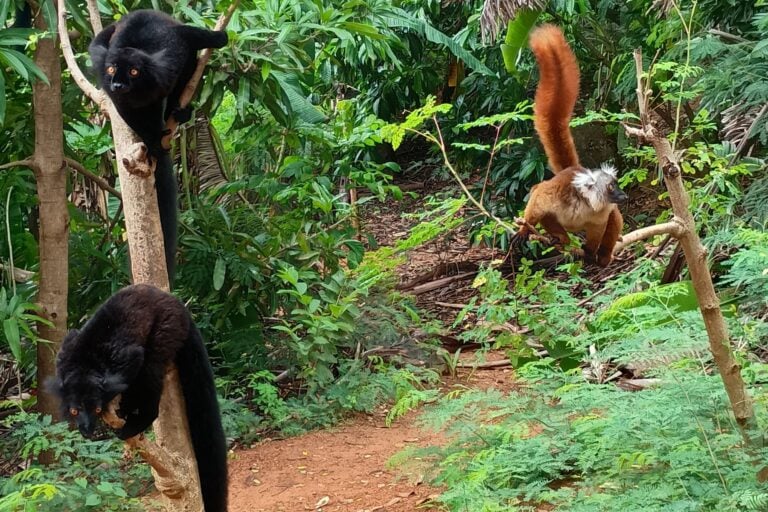
The villagers, aware that tourists pay huge bucks for the privilege of lemur encounters, have a contingency plan. At the end of the trail, an unexpected cluster of lemurs appeared from nowhere.
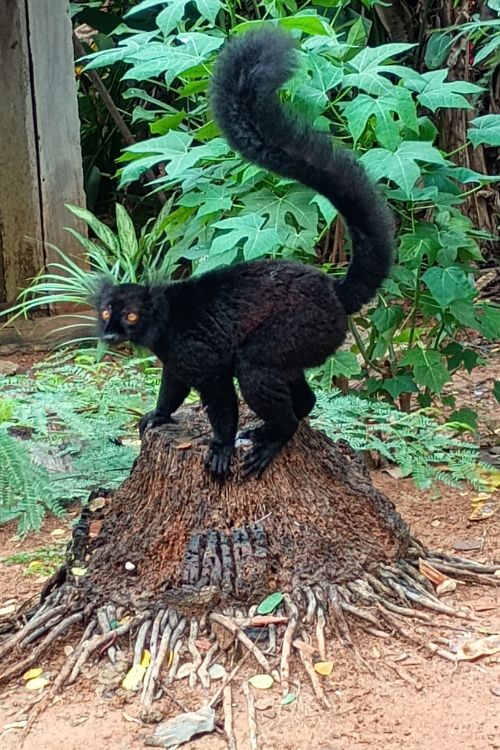
Our leader, bananas in hand, knew when to beckon this convenient, tame group to transform disgruntled tourists into smiley faces.
Black males, with pointy snouts, bewitching, orange eyes, and two-foot-long bushy fur tails, jumped from trees onto the shoulders of startled guests. A brown female leaped onto my bamboo pole and offered up an intense, personal interaction.
The pack of performers scampered onto the heads of fellow travelers, as if on cue. Laughter heard among the group silenced complaints about the rain.
A Successful Mission
Motoring through angry seas and a torrential barrage back to Nosy Be, my mission of experiencing Madagascar lemurs in the wild had been accomplished, when I wasn’t even looking.
A miracle, because the fierce tropical cyclone had ripped the dock away from Mahajanga’s wharf, forcing cancellation of our final port call in Madagascar and ever seeing lemurs again.
Independent travelers making their own way to Nosy Be can book the Full-Day Jungle Trek on Nosy Komba with the Black Lemur Sanctuary on Viator — a six-hour guided climb through the island’s jungle interior, with lemur encounters, chameleon sightings, exotic fruit tastings, and that same steep volcanic terrain. Bring proper hiking shoes.
Need a hand planning your trip? Here are the sites and services we rely on most, from booking tools to travel products we love.
Inspire your next adventure with our articles below:
- 7 Must-Visit National Parks, UNESCO World Heritage Sites and Conservation Areas Around the Globe
- Beyond the Big Five: South Africa’s Spectacular Ocean Safari
Author Bio: Carol has taught English to Mexican adults and disadvantaged local children for the past 20 years. She writes for local, international, online, and print publications. Using her adventures in over 120 countries, she has captured a niche in travel writing, and her stories have been featured in Go World Travel Magazine. A frequent contributor to El Ojo del Lago, the largest English-language magazine in Mexico, she’s won several literary awards from that publication. Her psychiatric field work netted a contribution to the anthology, Tales from the Couch. Recently, she has also been featured in two more anthologies, Insider’s Guide to the Best of Mexican Holidays, and Bravados, Life, Love and Living in Lake Chapala, Mexico, all available on amazon.com.
Want to discover more hidden gems and helpful travel tips? Join our free newsletter for the latest travel secrets and travel articles.
We are reader-supported and may earn a commission on purchases made through links in this article.

- A Guide to Noodles in Vietnam: How to Slurp Like a Local - October 14, 2026
- Just Moved Overseas? Beat the Three-Month Culture Shock Wall - October 14, 2026
- How to Find ‘Travel Dupes’ for Switzerland’s Popular Panoramic Trains - October 14, 2026
Planning another trip soon? ✈️
Add GoWorldTravel.com as a preferred source on Google. Click the button below so our local guides, packing hacks, and hidden-gem itineraries always show up first when you search!
Add to Preferred Sources