
‘And that, my friends, is … the Sunda Colugo…’ whispered our nocturnal forest guide. I tried to rerun the words, but none of them made any sense to me.
Looking around, I realised that I was not the only ignoramus. The guide had a smile on his face as well, it seemed like a regular drill for him, and he went on to enlighten us.
‘The Sunda Colugo is more popularly called the flying lemur…’ Now, he was starting to talk English.
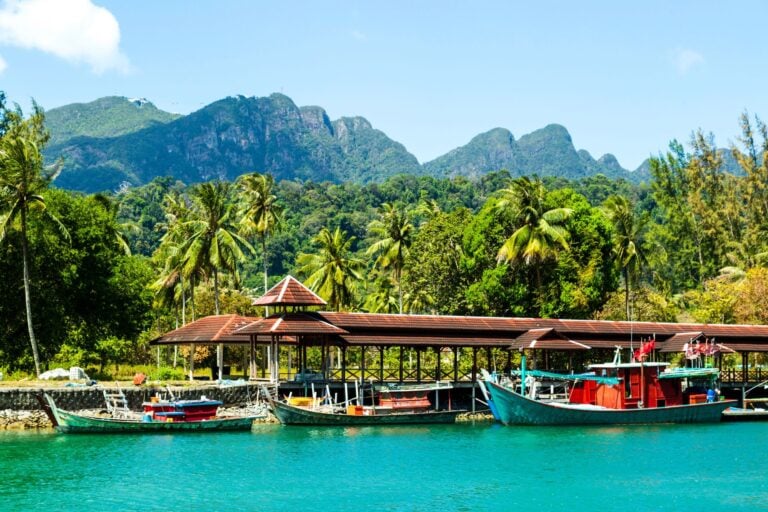
I was in Sundaland, on the island of Langkawi, off the western coast of Malaysia, and was enjoying an unforgettable stay in the protected rainforests to the west of the island. This hidden paradise brings together rainforest, golden beaches and tropical seas.
But First, Where is Langkawi?

Cradled in the blue waters of the Andaman Sea, Langkawi is a lush Malaysian archipelago made up of nearly a hundred islands. Only a handful are occupied, including the main and largest island, also called Langkawi.
It’s a place where emerald rainforests tumble into turquoise seas, eagles soar above limestone cliffs and the rhythm of life flows to the soft sway of waves.
Only an hour’s flight from Kuala Lumpur, Langkawi feels worlds away, an idyllic escape that balances wild natural beauty with a touch of modern indulgence.
It was only in the 1990s that the then Prime Minister of Malaysia decided to develop tourism on this beautiful island, thereby laying the groundwork for its growth.
Today, the island receives over 3 million visitors annually and yet remains less crowded than many Southeast Asian tourism hotspots. But its proximity to the mainland, particularly Kuala Lumpur, has ensured a steady and increasing flow of tourists to this island.
Akin to Thailand’s Koh Samui and Vietnam’s Phu Quoc, it is only a matter of time before tourism picks up in massive numbers. Another of countless reasons why this might be a good time to visit the veritable paradise.
Where to Stay

Quickly growing, Langkawi today has accommodation for all budgets. It has also attracted a large number of big hospitality names, including the Ritz-Carlton, Taj, Four Seasons, Westin, and St. Regis, among others.
Most of these are concentrated on the western coast of the island (where the airport is), though other parts are also opening up, creating even more offbeat experiences.
A large part of the island is still protected rainforest, and if you get an opportunity to stay in the handful of places that operate within the rainforest (such as ‘The Datai Langkawi’ or ‘The Andaman’), don’t think twice.
You will love the blend of wildlife and luxury here, combining ancient rainforests with coral-rich waters of the Andaman Sea, beachfront villas, and infinity pools overlooking the sea.
The tourist brochure will promise you an amazing stay. It is only when you read the fine print that you will realise that you may get to see oriental pied hornbills above the swimming pool. Or, as in our case, get to see colugos sweeping over your head as you dine outdoors at night.
Read More: A Reset in Phuket: Finding Stillness on Thailand’s Andaman Coast
Getting Back to Colugos in the Rainforest

It was at the Andaman that I had signed up for a nocturnal forest walk with their in-house zoologist, who enlightened us with facts from the rainforest.
‘The Sunda Colugo is more popularly called the flying lemur…though it neither flies nor is a lemur. It is one of only two gliding colugos, its other cousin found far away in the Philippines.’
The colugo in front of us seemed to get out of its stupor, and in the bat of an eyelid jumped off the trunk and glided as a silhouette, merging with the shadows.
I was fascinated, just like the others; it is not every day you see a new species you had never heard of, even though a single sighting would cover 50% of an entire zoological order.
Yet, the facts were not all covered, and I asked the guide, ‘What about Sunda?’ That part-of-the-drill-smile again.
What Comprises Sundaland?

He was glad I asked and continued, “Sunda, or Sundaland, is a large biogeographical region of Southeast Asia, including Thailand, Malaysia, and the Indonesian islands of Borneo, Sumatra and Java.
Once upon a time, at the peak of the last Ice Age, when the sea levels were low, these lands were joined together to create Sundaland.
Beyond Sundaland lies a group of islands, such as Sulawesi and Lombok, called Wallacea. It was named after Alfred Wallace, the great biologist who had independently propounded the theory of evolution, while Darwin walked away with the prizes.
Even beyond lies another region called Sahul, formed of Papua New Guinea, Australia and Tasmania, fused as well in the last ice age.
Sunda and Sahul were always separated by the seas, which is why kangaroos hopped onto New Guinea but not beyond. And this is why colugos are found in the Philippines and Langkawi, but not in Australia.”
For a 15-minute walk, the amount of knowledge dispensed that evening was overwhelming. Our guide was an extremely erudite scholar who knew his Wallace lines and Lydekker lines like the back of his hand.
He went on to show us cicadas, fruit bats, plantain squirrels, and even coral reefs raised in the local nursery. The colugo was, nonetheless, the star of the show.
Pantai Cenang: The Beating Heart of Langkawi
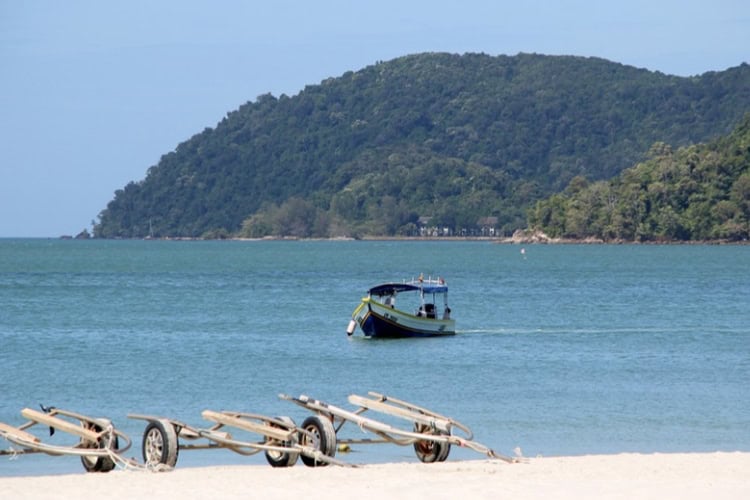
There is much, much more to Langkawi, for all ages, beyond flying animals and forests. Beaches abound, and no visit to Langkawi is complete without a stroll along Pantai Cenang (Pantai means Beach in the local language), the island’s liveliest stretch of sand.
Though replete with stalls, you can find stretches of sand all to yourself. I loved the mix of peacefulness and commoditisation, while also realising that Pantai Cenang has it all to become Bali’s Kuta or Jimbaran with increasing tourism in the days to come.
This sun-kissed beach is lined with cafés, beach bars, boutique shops and seafood grills that come alive as the sun dips into the horizon.
By day, Pantai Cenang is a paradise for sunbathers and swimmers; by night, it transforms into a buzzing hub of music, laughter, and island flavour.
For families, the Underwater World Aquarium, one of the largest in Malaysia, is very close and offers a fascinating window into marine life. It features everything from penguins to giant stingrays and groupers. A must-visit if you are traveling with kids.
Eagle Square and the Spirit of Langkawi

Eagle Square, or Dataran Lang, is one of Langkawi’s most iconic landmarks, located in Kuah Town along the waterfront. And there is a reason for that: the red and white Brahminy eagle, very commonly seen here, has also lent its name to the island.
Not surprisingly, then, the centrepiece of Eagle Square is a towering 12-metre statue of the brahminy eagle poised for flight.
The name Langkawi is widely believed to come from two Malay words: ‘helang’, meaning eagle, and ‘kawi’, referring to a reddish-brown stone or colour. Combined, they imply that Langkawi is the island of the reddish-brown eagle.
The Eagle Square, in a way, symbolises both the bird and the eponymous island, making it one of those must-have Instagrams from your trip.
It also features wide-open plazas, fountains, bridges and sweeping views over the Andaman Sea, making it a favourite spot for photos, particularly around sunset.
Take a long walk on the promenade, sip deliciously refreshing coconut water and get your stash of holiday memorabilia from the stalls here. And yes, don’t forget to take your selfie with the ‘I Love Langkawi’ signage here.
Kilim Karst Geoforest Park

Kilim Karst Geoforest Park is part of the Langkawi UNESCO Global Geopark, the first in Southeast Asia, recognised for its extraordinary geological heritage.
UNESCO’s Geoparks focus on geodiversity, community engagement, and sustainable development. Meanwhile, their World Heritage Sites have a broader focus on the exceptional universal value of a site.
The park showcases over 480 million years of geological history, including ancient limestone formations, fossil beds, mangrove ecosystems, sea stacks, and dramatic karst landscapes sculpted by time, tides and tectonic shifts.
Visitors to Kilim Karst need to take a guided cruise. They can explore winding mangrove forests, hidden limestone caves like Bat Cave and Crocodile Cave, soaring cliffs of karst (landscape formed by the erosion of soft rocks such as limestone) and quiet blue lagoons.
There is also thriving wildlife, including kingfishers, eagles, macaques, otters, and even dolphins on lucky days. The boat tours through narrow waterways offer a cinematic experience of towering rock formations and untouched nature.
It is interesting to note that this landscape is part of a broader pattern across Southeast Asia, a region shaped by similar geological processes that produced iconic karst wonders such as Halong Bay in Vietnam, Phang Nga Bay in Thailand, and Gunung Mulu in Borneo.
Kilim Karst stands among these because the tropics, heavy rainfall, and tectonic uplift create perfect conditions for dramatic limestone erosion. This makes Southeast Asia one of the world’s richest regions for spectacular karst formations.
Riding the Sky: Langkawi Cable Car
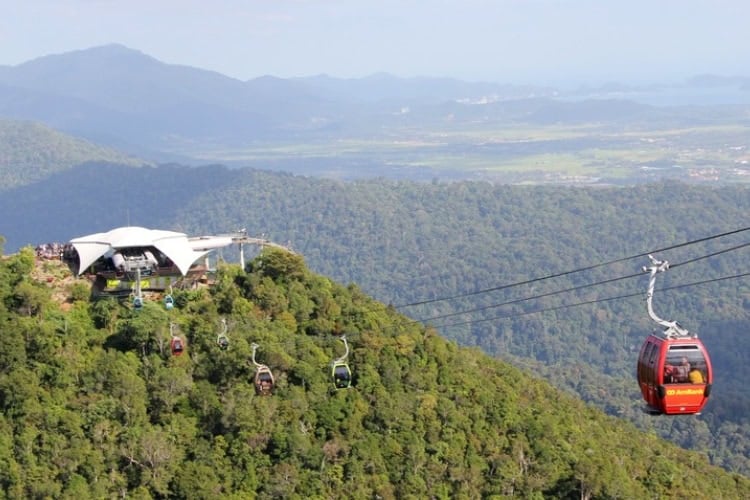
The Langkawi Cable Car, also known as the SkyCab, is remarkable for its bold engineering, carrying visitors up the steep slopes of Gunung Machinchang, one of the world’s oldest mountain ranges.
A ride on the cable car is one of the must-dos here, offering breathtaking views of the archipelago from the mountain top.
It is also an engineering marvel, holding the record for the steepest cable car in the world with a gradient of up to 42 degrees. In addition, holds the Guinness World Record for the longest free span for a mono-cable car in the world, with a single span of 950 meters.
With 360-degree view-enabled gondolas, and you can change quite a few of these, at various altitudes, the SkyCab will be perhaps your most memorable moment on the island.

Building it required minimising disturbance to the ancient forest below, making it both a technical and ecological achievement.
At the top, the ride opens into sweeping, cinematic views of Langkawi’s archipelago, the emerald rainforest canopy and the Andaman Sea stretching toward Thailand.
The upper station connects to the SkyBridge, a dramatic, curved pedestrian bridge suspended between mountain peaks, offering a surreal floating effect above the mist and cliffs.
Along the way, you can spot geological formations, waterfalls in the wet season, and a vivid contrast of jungle, ocean, and distant islands.
The journey itself is as memorable as the summit. Each gondola ascent reveals new panoramas, making the cable car not just transportation but one of Langkawi’s signature scenic experiences.
For a fully guided experience that includes both the famed Sky Bridge and the cable car, consider the Private Tour in Langkawi with Sky Bridge and Langkawi Cable Car.
Other Sights in Langkawi

- Tanjung Rhu – Pristine, quiet, and postcard-perfect beach, with shallow, turquoise waters, white sand, and views of karst islands in the distance. A great alternative to busy Cenang.
- Telaga Tujuh (Seven Wells Waterfall) – A series of natural pools connected by seven cascades on the slopes of Mat Cincang. You can swim at the lower falls or hike to the upper levels for jungle views.
- Langkawi Wildlife Park & Bird Paradise – A surprisingly engaging attraction with walk-in aviaries, close-up feeding encounters, and tropical birds. Great for families.
- Mahsuri’s Tomb & Cultural Centre – Tells the folklore of Mahsuri, a central figure in Langkawi’s history, a blend of culture, legend, and traditional Malay architecture.
- Pulau Payar Marine Park – The best snorkeling spot near Langkawi. Clear waters, coral gardens, reef fish, and sometimes baby sharks. Usually visited as part of a day trip.
- Langkawi’s Night Markets – Different location each night. Best for local food, snacks, fresh juices, and handmade items. A very authentic island experience.
- Langkawi Crocodile Adventureland – One of Malaysia’s largest crocodile farms, with over 4,000 crocodiles and alligators, including rare species and massive adults weighing several hundred kilos.
- If you have an insatiable appetite for islands, then you can easily take a 3-hour ferry to Penang Island to the south or to Koh Lipe Island to the west. Koh Tarutao is yet another option, to the north, but it is relatively difficult to get to.
Alternatively, do nothing. Just relax on the beach, enjoy the tropical seas at one of Malaysia’s most idyllic islands.
Is Langkawi For You?

Langkawi is more than a tropical getaway; it’s a balance between luxury and wilderness, leisure and discovery. Whether you’re sipping cocktails at the beach, exploring mangrove labyrinths, or simply watching the eagles wheel across a golden sky, Langkawi leaves you with a rare sense of calm and wonder, like a secret whispered by the sea.
Do note that this island does not have a testosterone-fueled nightlife, unlike its nearby neighbors, but it is also this silence that makes it so special.
Need a hand planning your trip? Here are the sites and services we rely on most, from booking tools to travel products we love.
Inspire your next adventure with our articles below:
- Experience Tranquil Simplicity on the Island of Koh Lanta, Thailand
- Pot Holes and Paradise: Adventures in the Solomon Islands
Author Bio: Ayan Adak loves travelling, writing, and photography; he has travelled to over 30 countries and has published multiple books on travel and poetry.
Want to discover more hidden gems and helpful travel tips? Join our free newsletter for the latest travel secrets and travel articles.
We are reader-supported and may earn a commission on purchases made through links in this article.

- What to Do in Bordeaux: A Wine Lovers’ Guide to One of the World’s Most Prestigious Wine Regions - October 1, 2026
- The Ultimate Gift for Travelers Who Don’t Want More Stuff: 10 Epic Experiences in the US - October 1, 2026
- Walking the Camino de Santiago de Compostela After 65: 10 Tips for Baby Boomers - October 1, 2026
Planning another trip soon? ✈️
Add GoWorldTravel.com as a preferred source on Google. Click the button below so our local guides, packing hacks, and hidden-gem itineraries always show up first when you search!
Add to Preferred Sources