
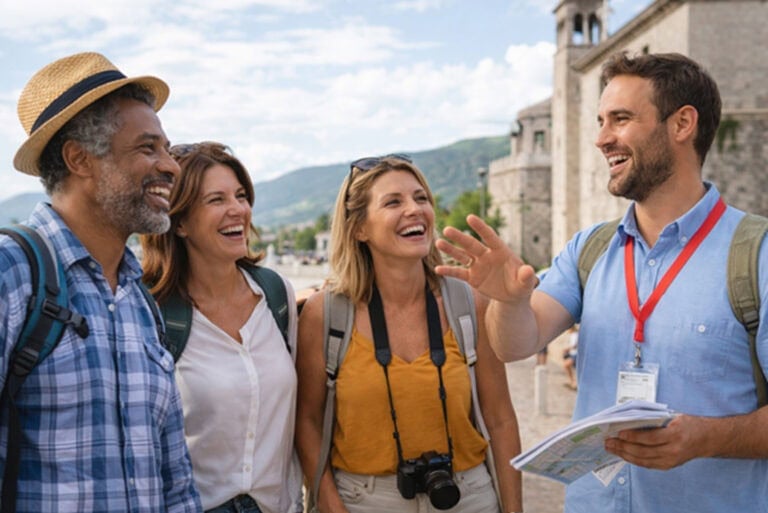
Some visitors arrive in this corner of Europe with a simple wish: to see as much as possible in as little time as possible. For them, the meeting point of Italy, Slovenia, and Croatia is one of the most rewarding regions in Europe. You will not see only different points of interest, but also three different countries.
A Three-Country Sprint
Because Venice is closed to large cruise ships, many cruise operators now use the Port of Trieste instead. For travelers, that creates an ideal opportunity.
Trieste is not only a fascinating city in its own right, but also an excellent starting point for a three-day journey through Italy, Slovenia, and Croatia. This tour is also ideal for travelers visiting Venice who want to discover what else is nearby.
Few areas offer so much variety within such a short distance. In the space of three days, it is possible to stand in a grand Italian square with echoes of Venice and Vienna, walk beside a Slovenian lake or through a cave system of almost unreal proportions.
And end the journey on the Croatian coast, where stone towns and the Adriatic light create the sort of scenes travelers usually associate with much longer holidays.
Since 2012, guiding guests through this region has shown me one clear truth: when time is limited, success depends less on how many kilometers you cover and more on choosing the right sequence.
For travelers arriving in Trieste or continuing from Venice toward Slovenia, transport also matters. Guests who need a private transfer, minibus or coach rental service can book transport on our website, whether for pickup from Trieste Port or for a comfortable journey from Venice to Slovenia.
Start in Trieste
In Trieste, the first stop is almost always Piazza Unità d’Italia, one of the largest sea-facing squares in Europe. From there, the city explains itself at a glance. Austro-Hungarian façades, Italian civic grandeur, and the open sea all meet in one frame.
A short walk through the old streets reveals Roman traces, literary cafés, and the layered identity that makes the city so distinctive.
Travelers who have imagined Italy only through the lens of Rome, Florence, or Venice are often surprised here. Trieste feels more intimate, more local, and in many ways more authentic for a short visit.

If time allows, Miramare Castle adds a different dimension to the Italian chapter of the journey. Set above the sea, it offers one of those views that remain with people long after the trip is over.
Yet even without it, Trieste is enough to give visitors a strong sense of Italy before the road turns eastward toward Slovenia.
Slovenia in a Day
The advantage of this region is that Slovenia is easily accessible. Within a relatively short drive, the mood changes from Italian urban elegance to something greener, calmer, and more intimate.
Slovenia is a country that often surprises first-time visitors. It is clean, accessible, scenic, and remarkably easy to appreciate even on a tight schedule.

If travelers want the most iconic Slovenian image in the shortest time, Lake Bled is the obvious recommendation.
Some destinations become famous for good reason, and Bled is one of them. The lake, the island church, the cliff-top castle, and the Alpine backdrop form a scene so complete that even brief visits feel satisfying.
Guests who come with cameras leave with postcard views almost immediately. A walk along the lake, a traditional cream cake, and a viewpoint stop can tell the story of Slovenian tourism in a single afternoon.
Postojna Cave is equally compelling, perhaps even more so for travelers interested in this contrast. After the open piazzas of Italy, descending into one of Europe’s most famous karst cave systems feels like entering another world.
The scale of the underground halls, the silence, and the strange limestone formations make it one of the most efficient “wow” experiences in the region.

Nearby Predjama Castle, dramatically built into a rock face, adds exactly the kind of image that stays in conversation afterward.

Ljubljana, Slovenia’s capital, can also fit into the same day as a shorter stop. Its pedestrian old town, riverside cafés, bridges, and hilltop castle make it one of Europe’s most pleasant small capitals.
It does not demand much time to make an impression. A few hours are often enough to understand why so many visitors leave calling it one of their favorite towns in all of Europe.
The choice between Bled and Postojna depends on the traveler. Bled is for those who want natural beauty with easy walking and classic views.
Postojna and Predjama suit those who want something more unusual and dramatic. TuamV Travel Agency can advise you at every step, helping you choose the private tour that best matches your interests, pace, and travel style.
Day Three: Croatia’s Istria
By day three, Croatia provides the final shift in tone. Here, the landscapes become distinctly Adriatic, and the towns wear their history in stone. For the most efficient Croatian experience in a short itinerary, Istria is the right choice.
It lies close enough to Slovenia to make sense logistically, yet feels unmistakably Croatian in atmosphere.

Rovinj is often the strongest recommendation for travelers who want one memorable Croatian coastal town rather than a checklist of stops. Its old town rises from the sea in a cluster of narrow lanes, shutters, church towers, and polished stone streets.
There is beauty here, but also texture: laundry above alleyways, fishing boats in the harbor, cafés tucked into old corners. For guests with little time, Rovinj delivers quickly and generously. It is the kind of place where even an unplanned hour becomes a highlight.

Poreč offers a slightly different appeal, especially for visitors interested in history, with its Euphrasian Basilica and compact old center. Motovun, inland on a hill, introduces a more rural Istrian character of views, truffles, vineyards, and medieval walls.
But for a first three-day encounter with Croatia, Rovinj tends to win because it combines atmosphere, accessibility, and that unmistakable Adriatic sense of arrival.
Why This Route Works
What makes this three-country journey so effective is not only the number of places visited, but the rhythm between them. Italy provides grandeur and cultural layering. Slovenia offers nature, order, and compact charm. Croatia concludes with coastal warmth and old Mediterranean character.
In just three days, travelers do not merely cross borders; they experience genuine shifts in identity.
Of course, this kind of trip requires discipline. The common mistake is to try to include Venice, Bled, Ljubljana, Postojna, Piran, Rovinj, Plitvice, and Zagreb all at once. On paper, it sounds ambitious. In reality, it produces fatigue and blurred memories. The best short journeys are edited journeys.
They leave enough room for a long coffee in Trieste, a lakeside pause in Bled, or a sunset walk in Rovinj. Those moments often matter more than another rushed stop.
After guiding travelers since 2012, I have seen that the most satisfied guests are rarely those who “saw everything.” They are the ones who felt each place, even briefly. They remember the sea air in Trieste, the bell tower above Bled, the cool darkness of the cave and the first glimpse of Croatia’s stone coast.
Three days will never be enough for Italy, Slovenia, and Croatia in full. But three days are enough to understand why people return. And that, perhaps, is the real success of a short journey through this region. It does not pretend to finish the story. It opens it well.
Inspire your next adventure with our articles below:
Want to discover more hidden gems and helpful travel tips? Join our free newsletter for the latest travel secrets and travel articles.
We are reader-supported and may earn a commission on purchases made through links in this article.

- What to Do in Bordeaux: A Wine Lovers’ Guide to One of the World’s Most Prestigious Wine Regions - October 1, 2026
- The Ultimate Gift for Travelers Who Don’t Want More Stuff: 10 Epic Experiences in the US - October 1, 2026
- Walking the Camino de Santiago de Compostela After 65: 10 Tips for Baby Boomers - October 1, 2026
Planning another trip soon? ✈️
Add GoWorldTravel.com as a preferred source on Google. Click the button below so our local guides, packing hacks, and hidden-gem itineraries always show up first when you search!
Add to Preferred Sources