
Positioned in a remote corner of Italy against the Slovenian border, Trieste is far from the traditional tourist hubs of Rome or Florence.
Many visitors opt for nearby Venice instead, leaving Trieste quieter, less discovered, and all the more rewarding for it.
Formerly the main port of the Austro-Hungarian Empire, Trieste offers a blend of Italian warmth and Central European elegance. There is neoclassical architecture, Viennese-style cafés and stunning Adriatic coastal views.
A Border City with a Dual Soul
Walking through the streets of Trieste, you gaze in wonder at classical facades alongside ornate piazzas and grand old theatres, ever-present reminders of its days as the former empire’s main port.
The city’s layered history is felt everywhere, from the echo of footsteps on marble floors to the lingering aroma of coffee in its historic cafés, where locals still linger over espresso in true Italian fashion.
I visited in October and was surprised by how much life and warmth remained as the season shifted. Golden sunshine bathed the Adriatic, sparkling along the marina, and café tables spilled onto the pavements, allowing people to savour the outdoors long after summer had passed.
Trieste’s charm isn’t loud or showy. It’s in the everyday beauty of the place, where history and coastal life merge, and where the city rewards those who come to explore its depths.
Getting to Trieste

Trieste is remarkably easy to reach by air, land, or sea. The main train station sits within walking distance of the historic centre, with direct connections from Venice, Ljubljana and beyond.
Buses from nearby Italian, Croatian and Slovenian cities drop travellers just steps from cafés and piazzas, making day trips effortless.
For those arriving by sea, ferries and cruise ships dock along the waterfront, offering an entirely different perspective of the city’s elegant skyline against the Adriatic.
We left Rijeka in bright sunshine, which followed us overhead as we travelled by FlixBus, a good omen for the day ahead.
We’d ended up in Rijeka almost by accident, but we were very pleased to discover it was only 90 minutes by road to Trieste. Stepping off the bus, we were set down right in the centre of the city. First things first: coffee.
Castles, Piazzas, and Hidden Streets

Photo by Jessica Holmes
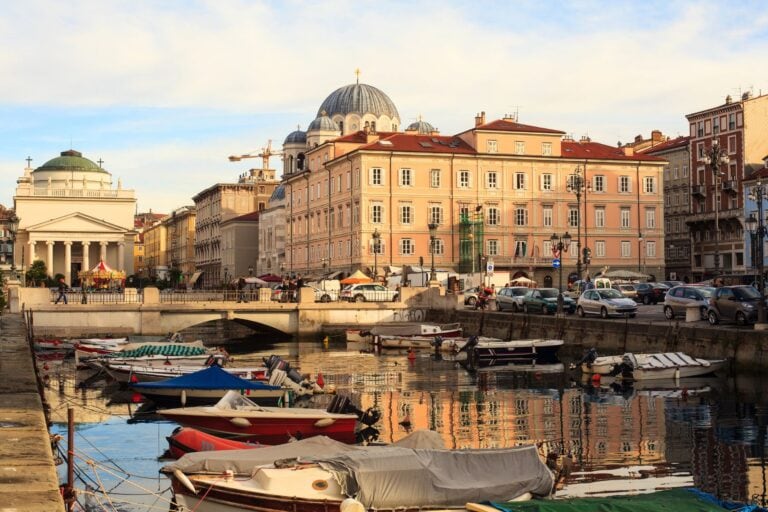
We started our morning with coffee and brunch on Trieste’s Grand Canal at 040 Social Food. Aside from both being in Italy, it’s nothing like Venice. Trieste is quieter, calmer, and far less crowded, but it’s still undeniably Italian and utterly charming.
The canal reflected the bright sunshine, and the cafés spilling onto the pavement made it feel as if the city were welcoming us rather than overwhelming us.
Over cappuccinos and freshly baked pastries, I felt that familiar excitement of arriving somewhere new that blends history, culture and local life.
Afterwards, we wandered through the main city streets, past designer flagship stores and boutique shops, marveling at the incredible architecture on every corner. We ended up on winding pedestrianised streets that snaked upwards toward Castello di San Giusto.
Along the way, we passed beautiful monuments, ruins of ancient columns and statues tucked into corners. We even glimpsed the well-maintained remains of a Roman amphitheatre. Each turn revealed another layer of Trieste’s history, from Roman monuments to Habsburg elegance.
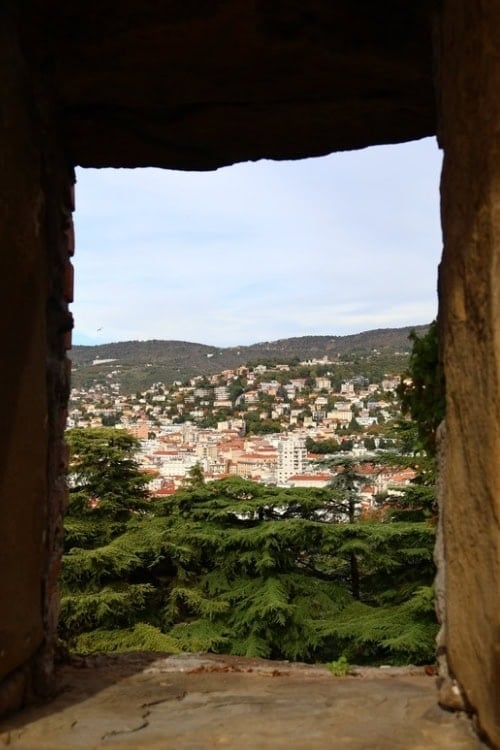
Reaching the top at Castello di San Giusto, the city unfurled beneath us like a living map. Red-tiled rooftops, ancient facades, and winding streets stretched down toward the sparkling Adriatic, which caught the sun like a glittering blue ribbon.
From up high, you could see how Trieste holds its layered identities together. The Italian cafés and piazzas, the classical-era buildings, the nods to its Slovenian neighbours, are all held together by that cobalt coastline.
Why Trieste Beats Venice for Calm

Descending back into the streets, we followed narrow lanes toward the seafront, letting the sound of lapping waves and seagulls guide us.
Each piazza offered a surprise: a tucked-away statue, a fountain glinting in the sun, or a bar full of people enjoying aperitivo.
Unlike Venice, where every narrow street and canal can feel crowded with tourists and selfie sticks, Trieste moves at an unhurried pace.
Cafés are full of locals enjoying a chat rather than posing for photos. Piazzas feel spacious even at midday and you can wander without bumping into a single tour group.
There’s time to pause, watch the light shift on a building, or follow the sound of the sea without feeling rushed.
This slow rhythm makes Trieste perfect for lingering and discovering hidden corners. Winding streets reveal monuments, statues, and viewpoints, while the seafront invites long, reflective walks in the sunshine.
Food, Wine, and Adriatic Tables

In the early afternoon, before an Aperol Spritz back at 040 Social Food, we wandered through the Mercato Coperto Trieste.
Vibrant arrangements of fresh vegetables, meat and Adriatic seafood, including shrimp, clams and countless varieties of fish, competed for our attention. Their colours so bright they could only come from the freshest produce.
Evening brought us to Trattoria Nerodiseppia, a small seafood restaurant just one street back from the sea. Over a plate of squid ink risotto and a glass of crisp Italian white, I felt the city slow down and exhale.
Waiters chatted casually with locals, everyone seemed to know each other, and the sun dipped behind rooftops, turning the city to molten gold.
We brought our wine glasses together with a “Saluti,” took a deliciously crisp sip, and pinched ourselves that we were lucky enough to have stumbled upon this gem of a city.
A City Where History Lives in Every Corner

Everywhere I looked, Trieste’s Austro-Hungarian past lingered seamlessly alongside modern life. Kids played on the Medaglie d’Oro staircase and suited office workers swept through the Piazza della Borsa.
Meanwhile, vespas hummed along Via del Teatro Romano, the ancient road leading to the amphitheatre.
Walking through the impressive Piazza Unità d’Italia, I imagined merchants and traders negotiating deals under the same sky I now stood beneath.
By the time I watched the sun set over the Adriatic, boats bobbing against a lilac sky, I understood how history shapes Trieste’s modern rhythm. It’s a city where the past isn’t a relic, but a lens through which its people live, eat and breathe.
If You Go:

- Enjoy a coffee or an Aperol Spritz on the Grand Canal at 040 Social Food
- Have a look at the fresh produce at Mercato Coperto Trieste
- Hike uphill to the Castello di San Giusto for sweeping views of the city and the Adriatic
- Ogle over history at the Roman Amphitheater
- Try squid ink risotto, a specialty dish, at Trattoria Nerodiseppia
- If you’ve got more time, head 20 minutes up the coast to beautiful Miramare Castle
Looking for a place to stay? Browse hotels in Trieste and vacation rentals to find the right base for your visit.
Inspire your next adventure with our articles below:
- The 15 Best Places to Visit in Italy for History, Art and Endless Beauty
- Get Off the Beaten Track With This Guide of Things to Do in Sardinia, Italy
Author Bio: Jessica Holmes is a writer and digital nomad who swapped her career as a police investigator for a life of sustainable travel through housesitting. After years of backpacking and van life, she sought a greener way to explore the world. Her book about her journey so far, The Housesitter’s Guide to the Galaxy, is available on Amazon and Barnes & Noble. Her blog www.hitchedandhiking.com documents her travels. Follow her on Instagram
Want to discover more hidden gems and helpful travel tips? Join our free newsletter for the latest travel secrets and travel articles.
We are reader-supported and may earn a commission on purchases made through links in this article.

- El Nido, Philippines: The Islands I Came For, the People Who Made Me Stay - September 30, 2026
- A Guide to Noodles in Vietnam: How to Slurp Like a Local - September 30, 2026
- Travel Guide to Japan - September 29, 2026
Planning another trip soon? ✈️
Add GoWorldTravel.com as a preferred source on Google. Click the button below so our local guides, packing hacks, and hidden-gem itineraries always show up first when you search!
Add to Preferred Sources