
We wind our way along the narrow, twisting roads through the hilly, wooded countryside in the heart of Slovenia.
Roadside signs warn of the brown bears that live here. There are said to be between 500 and 800 of them in a country half the size of Switzerland, 60 percent of which is covered by forest.
Our destination is Janez Medved’s farm, situated just outside the village of Dole pri Litiji. ‘Medved’ means ‘bear’ in Slovenian. We received the address two days earlier from Gertrud Wieser, one of Austria’s last charcoal burners.
At the turn-off for Dole pri Litiji, a sign indicates that we are now in the ‘Land of Charcoal’. In front of Janez’s house stands a life-size wooden bear. We seem to be at the right place.
Janez, in his early sixties, is sitting outside the house with one of his grandsons on his lap. His daughter, who has been called over, speaks English. We are given a warm welcome and immediately led to the charcoal kiln site 300 metres away at the edge of the forest.
A Huge Charcoal Kiln
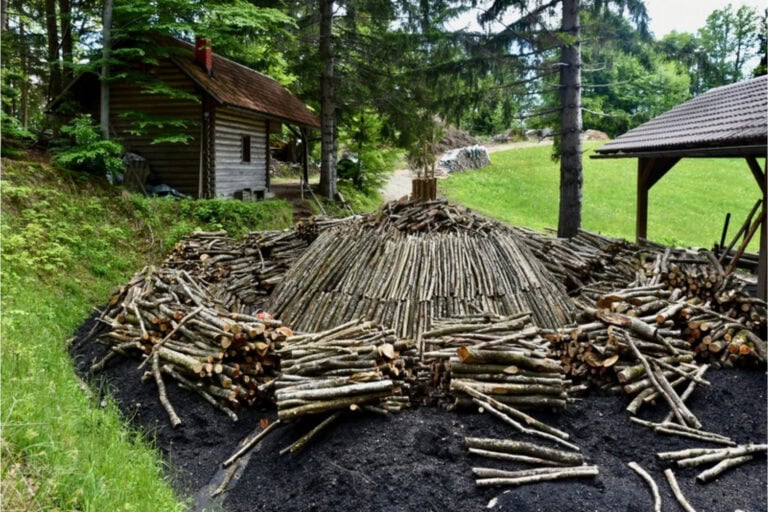
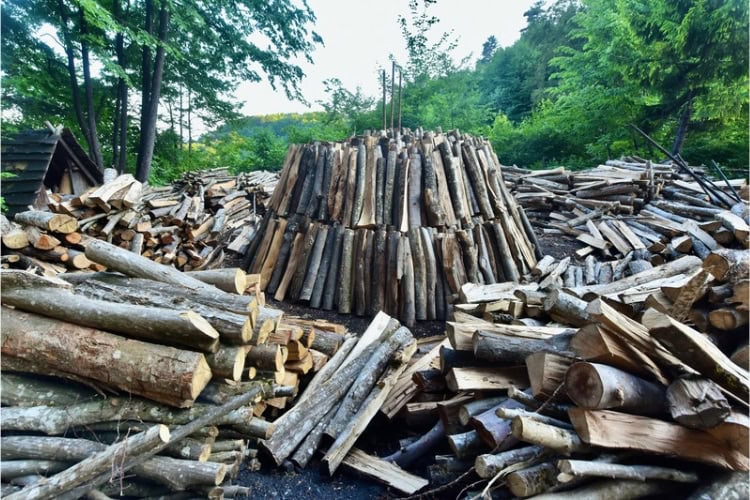
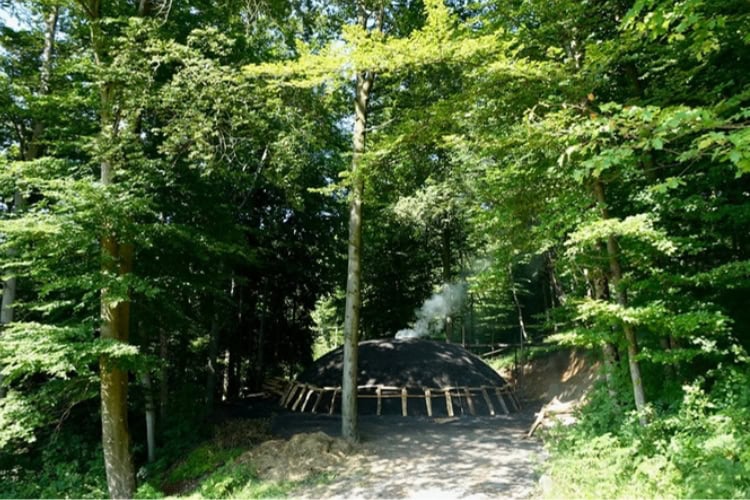
Not without a touch of pride, Janez shows us his newly completed round charcoal kiln, completely covered in black charcoal fines. It is huge. With around 200 ster of wood, it is the largest we have seen so far.
In 2021, he built one with 300 ster. That was a European record and attracted a great deal of attention far beyond Slovenia’s borders. Not all his charcoal kilns are as big as these two. It depends on how much wood he has available at the time.
He usually makes four, sometimes five kilns a year. That’s a lot, considering that Janez is first and foremost a farmer who keeps livestock and produces milk, manages 40 hectares of woodland, makes red wine from his own vineyard and distills his own slivovitz.
However, he has now handed the farm over to his son and has more time for charcoal burning, carving wooden bowls and enjoying his grandchildren.
We are impressed and want to know when he will be lighting the charcoal kiln. He will light it in four days’ time, on the eve of their national holiday, combined with a small celebration featuring speeches, music and refreshments at his farm. If we are able, we should come along. We are warmly invited.
Kiln Firing Ceremony
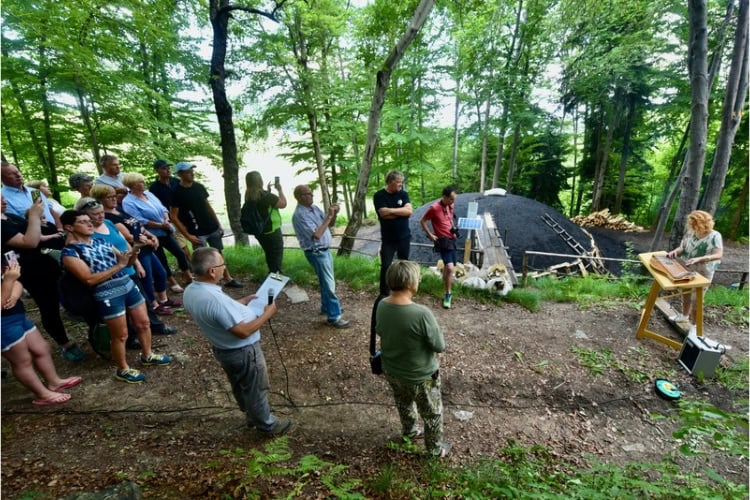
Four days later, a good fifty guests have already gathered above the charcoal kiln, most of them from the neighborhood and often charcoal burners themselves. In the ‘Land of Charcoal’ around Dole pri Litiji, there are currently said to be 16 charcoal kiln sites.
To put us in the mood, Jasmina Levičar, a zither player well-known in Slovenia, plays a tune. This is followed by enthusiastic welcoming speeches from Jože Prah, president of the Slovenian Charcoal Burners’ Association; Marija Imperl, the designated vice-president of the European Charcoal Burners’ Association; and his wife, Bernarda Medved.
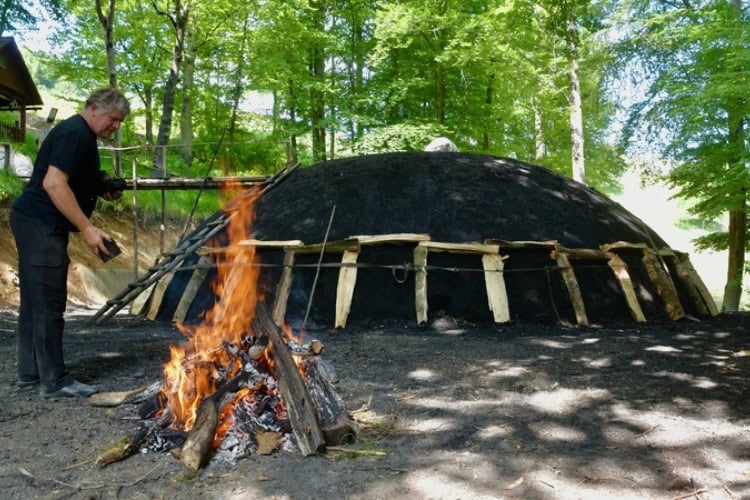
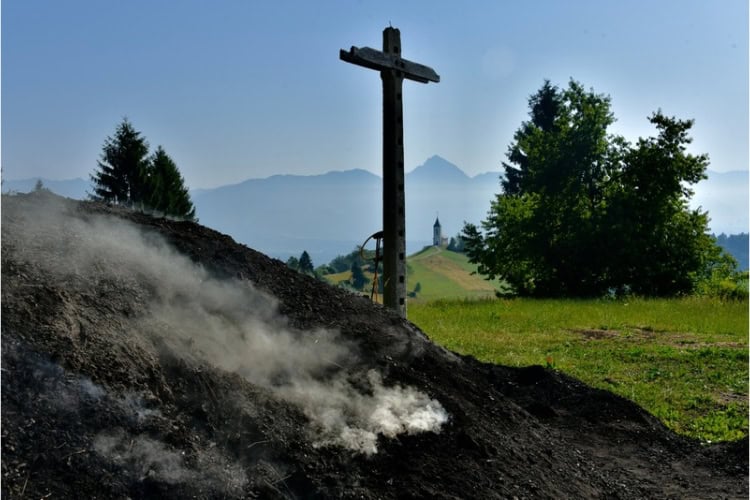
Black charcoal bread and herbal liqueur, both homemade, are served alongside the speeches. And then the moment arrives: the charcoal kiln is lit, in keeping with tradition, by a woman. The honour falls to the delicate, reddish-blonde Jasmina Levičar. With her childlike gaze, one might mistake her for a forest elf.
BBQ Procession
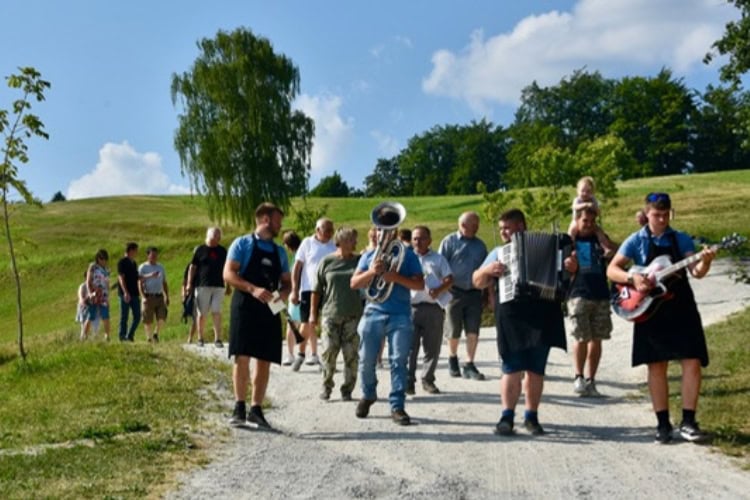
Led by four musicians, the party moves over to the courtyard, where we are served Ćevapčići straight from the barbecue and the farm’s own red wine. We take our seats with Jože Prah and Marija Imperl.
Jože, in his mid-fifties and full of energy, works as a forester for the Slovenian Forest Service, where he is an adviser on wood biomass and tourism development in forest areas. As well as chairing the Slovenian Charcoal Burners’ Association, he is also vice-president of the Slovenian Tourist Board.
When he talks about charcoal burning, his eyes light up with enthusiasm. He encourages us to visit the charcoal burners in the Selca area and notes down Janez Pegam’s address for us.
A Common Goal
Jože has a close ally in Marija. An economist, she heads the Treelogy Institute, whose aim is to create a world in which people live in harmony with nature. Together, they successfully lobby authorities and politicians for the continued existence and promotion of the charcoal-burning craft, in a way we have not seen in any other country to date.
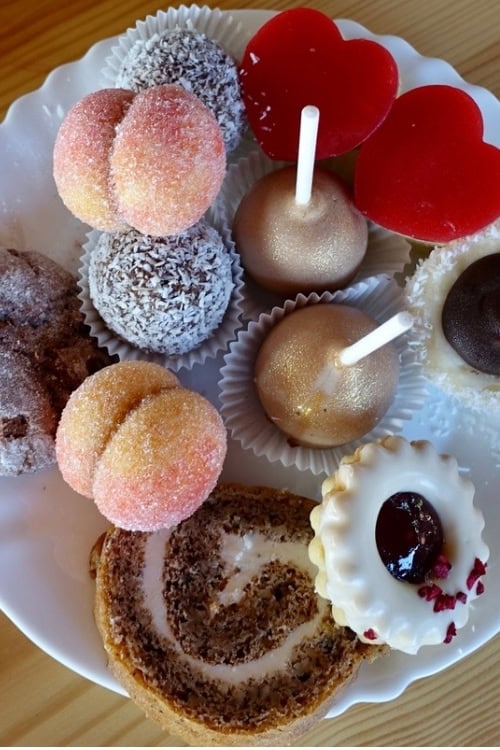
For dessert, we are served delicious pastries, made by one of Janez’s daughters, who trained as a pastry chef. One of the guests tells us that he saw a bear that morning not far from the charcoal kiln; another invites us to visit his charcoal kiln site. He has just started building a new one.
Once there, the neighbour’s son, Tom, arrives on his moped and invites us to come with him to his family’s charcoal kiln, which is already at a more advanced stage of construction. He is studying timber construction at the university of applied sciences, but is currently spending his semester break working as a mountain hut warden.
Journey to Selca
As the national holiday is to be spent with the family, we set off for Selca the next morning with a bottle of slivovitz as a parting gift.
It lies in the hills above Bled, which, with its deep-blue lake, is one of Slovenia’s biggest tourist attractions. Selca, too, is accessible only via a narrow, winding road. On the way, we spend the night near the church at Jamnik, perched on a rocky outcrop with a breathtaking view of the Steiner Alps.
When the owner of the campsite finds out what has brought us here, he happily tells us that his neighbour, 500 metres away, has a charcoal kiln “cooking”, as the Slovenians say. It, too, is beautifully nestled in the landscape.
Charcoal Burners of Selca
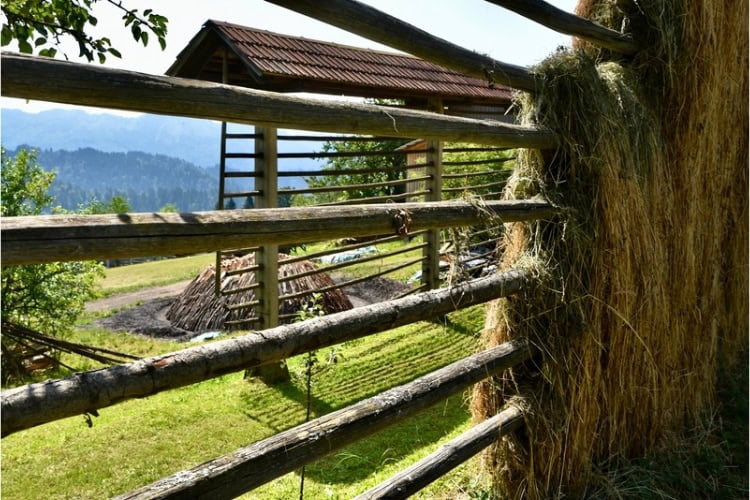
Janez Pegam’s farm lies above Selca. On the way there, we stop at one of the many hayracks typical of this area and discover an uncovered charcoal kiln behind it. A woman working in the neighbouring garden types into Google Translate on her mobile: “I’ll take you to the owner.”
We meet Marko Klemenčič in his mechanical workshop, equipped with state-of-the-art CNC-controlled machines. When he hears what we’re looking for, he switches off the machines, puts us in his van and takes us to three more charcoal kilns hidden in the woods. One of them belongs to Janez Pegam.
We find him, tall, burly, in his late thirties with a good-natured smile, in the barn with his two sons. His farm is small, he tells us in the kitchen. He has 25 hectares of woodland, 8 hectares of meadow and 10 cows.
He burns three to four charcoal kilns a year, which provides a good bit of extra income. His neighbours do the same, he says, so the region produces a total of 50 tonnes of charcoal each year.
Our conversation is interrupted. Janez Pegam’s mobile rings. It’s Jože Prah on the other end, wondering if we’ve found him. Janez then remarks: “Jože is a small man, but a great person!”
Clearing Out the Kiln
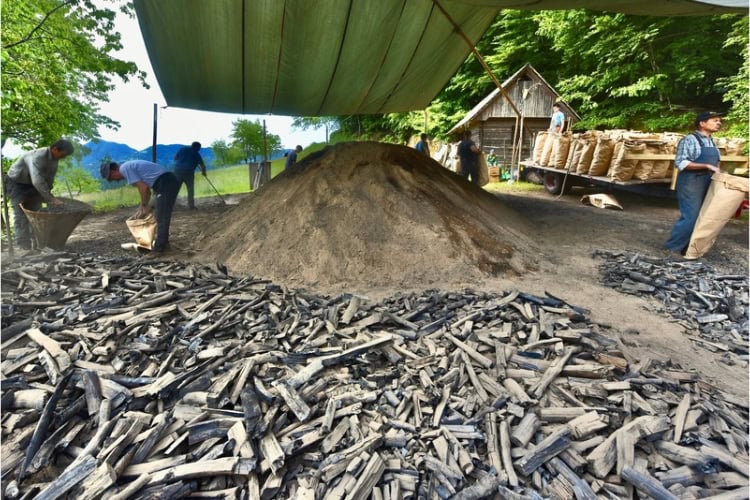
We’re able to stay the night at his farm. The view of the countryside is magnificent. The next morning, he takes us to the charcoal-burning site belonging to his brother-in-law, Pavel Rovtar.
Since early that morning, a dozen men have been busy clearing out the charcoal kiln and bagging the charcoal. This is done in layers, like onion skins.
First, the top layer of charcoal is removed from the kiln with a pitchfork and spread out in a two-metre-wide ring around the kiln to check that there are no embers left anywhere. If there are, one of the two lads from the youngest generation of charcoal burners rushes over with a watering can.
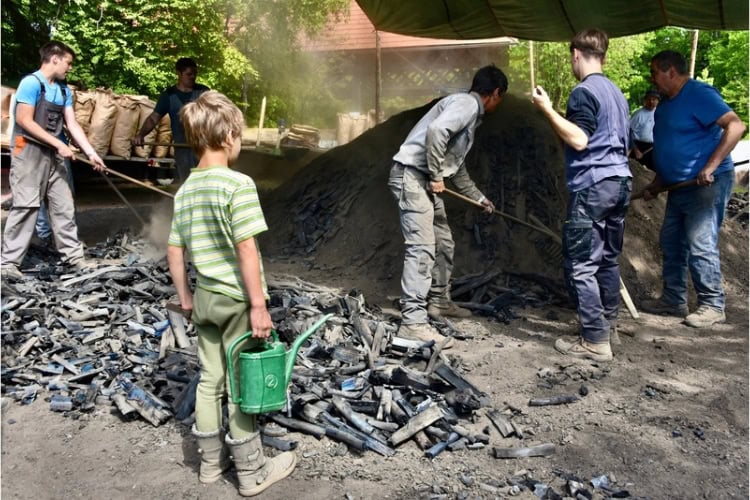
Now the men, working in pairs, begin to fill 20-kg paper sacks with the charcoal using large baskets, before loading them onto a trailer parked nearby.
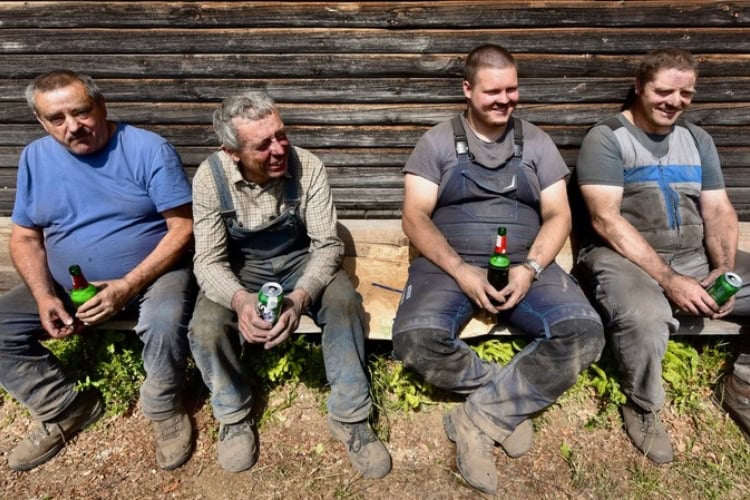
Once they’ve finished, the whole process starts again from the beginning and the next layer of the kiln is cleared away. By the fourth round, it is already midday and time for the men, all of whom are farmers from the neighbourhood, to settle down on the bench in front of the charcoal burner’s hut and treat themselves to a beer.
It does not take long before Pavel’s wife brings the men their well-deserved meal. Their faces, blackened by charcoal dust, are beaming.
If You Go
Getting There and Around
This region is reached only by narrow, winding roads through the hills southeast of Ljubljana, so a rental car is essential for finding farms like Janez Medved’s near Dole pri Litiji or the kilns above Selca. Reserve one through Discover Cars.
Where to Stay
Ljubljana works well as a base, with the City Hotel Ljubljana sitting a few minutes from the castle and Dragon Bridge. For a night by the water, the Grand Hotel Toplice sits directly on Lake Bled with a private beach.
Where to Go
Ljubljana is a beautiful and lively city. Bled Lake and Bled Castle are Slovenia’s main tourist attractions and are accordingly very crowded, though a half day tour to Lake Bled from Ljubljana makes it simple to fit in. It is quieter on Velika Planina, a mountain pasture accessible by cable car, with its unique shingle-roofed alpine huts. From Novo Mesto, follow the River Krka, which is fed by karst springs and winds its way through picturesque gorges. In the neighbouring village of Dole pri Litiji, there is an open-air museum featuring the hay racks so typical of this region, known as kozolec.
Need a hand planning your trip? Here are the sites and services we rely on most, from booking tools to travel products we love.
Inspire your next adventure with our articles below:
- Beyond Western Europe: The Balkans Are Calling
- Secrets of the Bay of Kotor: Montenegro’s Most Dramatic Coastline
Author Bio: Sylvia Furrer & Holger Hoffmann are Swiss freelance travel and documentary journalists who have traveled to over 100 countries. They are particularly fascinated by the customs and daily life of people who have preserved their traditional culture. They have published numerous travel and photo reports in various magazines.
Want to discover more hidden gems and helpful travel tips? Join our free newsletter for the latest travel secrets and travel articles.
We are reader-supported and may earn a commission on purchases made through links in this article.

- Canadian Rockies in 10 Days: Glacial Lakes, Wildlife and First Nations Culture from Vancouver to Calgary - October 18, 2026
- One Day in Malta, From Valletta’s Golden Streets to Temples Older Than the Pyramids - October 18, 2026
- Skiing Above Santa Fe: Powder, Glades and the Family Who Thins Them by Hand - October 18, 2026
Planning another trip soon? ✈️
Add GoWorldTravel.com as a preferred source on Google. Click the button below so our local guides, packing hacks, and hidden-gem itineraries always show up first when you search!
Add to Preferred Sources
Hvala za čudovit zapis. Oglje je črno zlato!