
There’s not much to the battered white stones that mark the border between Italy and Slovenia. “Italy—1947” is cut into one side. “Slovenia—1947” is carved into the other. After World War II, labored negotiations over the Treaty of Paris determined this precise location.
Today it’s mainly a place for selfies and a water break for cyclists. One attractive young woman waved a selfie stick and kept waiting for people to get out of her shots. I think she was a Slovenian influencer.
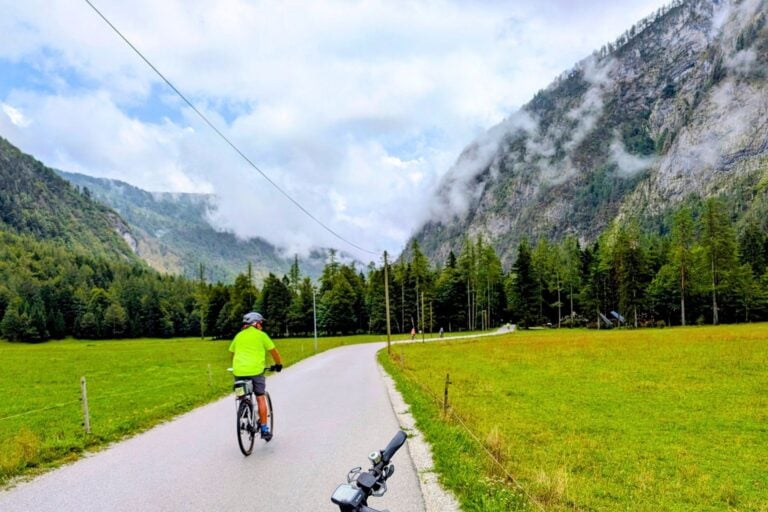
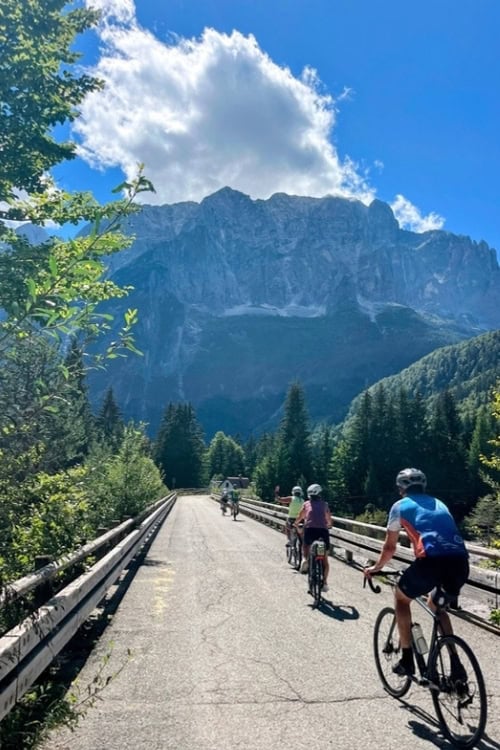
My wife and I came across the stones one sunny afternoon as we skimmed along a converted railway line on a biking trip organized by VBT/Country Walkers. We were ingeniously routed through a tightly clustered network of Alpine valleys that knit together Europe’s three distinct cultures: the Romantic (Italy), the Slavic (Slovenia), and the Germanic (Austria).
Nowhere else in the world do these three come together in such close proximity. It’s Western Civ ground zero.
Vivid Connections
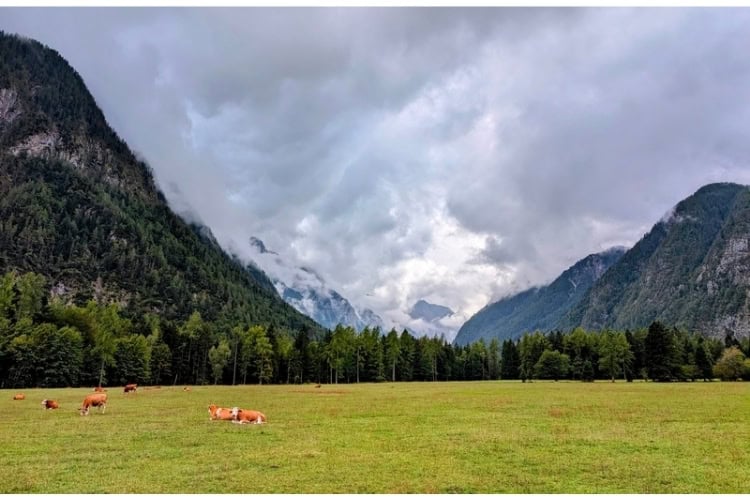
Photo by Craig Stoltz
Within a 35-mile-wide circle, the span of a forgettable daily commute, the VBT itinerary connected us to these places in vivid ways.
I dipped in a river as blue as a Caribbean lagoon and ate a dumpling draped in minced lard. I sweated in a nude, co-ed sauna with a floor-to-ceiling window and drank wine that smelled like diesel fuel. In addition, I rode a gondola to the top of a World Cup ski run that disappeared into the clouds.
More unusual activities included visiting casually presented mummies preserved by a rare fungus and watching as a waiter in a mountaintop restaurant pushed goats out of the outdoor dining room with a wooden staff.
We also stayed in an Italian spa, a Slovenian ski resort and an Austrian castle.
Detours Without Borders
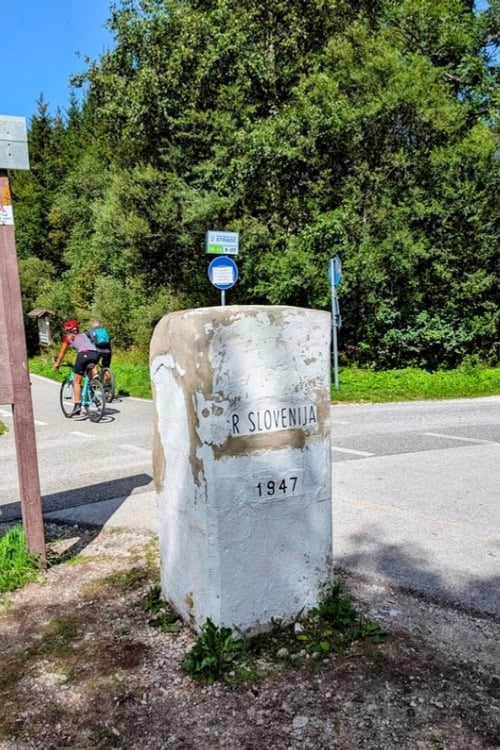
Photo by Craig Stoltz
In all three countries, we zipped along on e-bikes through valleys with views that looked like jigsaw-puzzle pictures. Lazy cows grazed in fields of brilliant flowers, ridges of toothy pine rose in the middle ground and high limestone peaks cut ruggedly into cumulus skies beyond.
We crossed from Slovenia into Italy, Italy into Slovenia, Slovenia into Italy and Italy into Austria. In the end, the border markers themselves felt irrelevant. But each culture along the way was hard to forget.
Sweet, Little Ljubljana
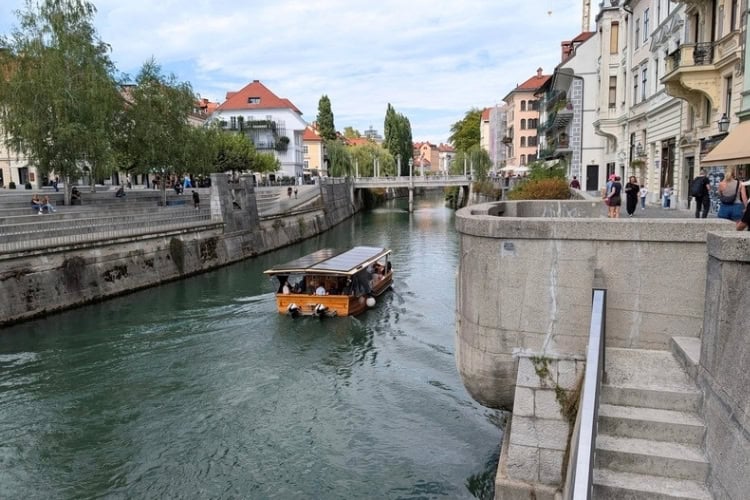
Before we hit the tiny three-culture zone, we spent a few days in Slovenia’s sweet, pocket-sized capital, Ljubljana. Three primary architectural types popped up everywhere: Roman-influenced Baroque, Germanic-inflected Art Nouveau and the Slavic modernism of architect and urban designer Jože Plečnik.
Some say Plečnik is to Ljubljana what Antoni Gaudí is to Barcelona. Gaudí was the genius who shaped how the city feels and how people engage with it.
Plečniks National and University Library building in the downtown core is magnificent. Its windows are designed to suggest open books, and its stone is salvaged from demolished structures around Ljubljana.
The blocks along the Ljubljanica River, lined with pastel buildings in various stages of preservation, renovation and neglect, are a boulevardier’s treat.
On the river promenades and surrounding streets, I came across only two stores representing international brands, H&M and The North Face. The rest were small local shops, restaurants, bakeries, bars, and other enterprises.
The market stalls displayed a profusion of frilled chanterelles and obscure, vividly colored fruits and berries. English is spoken everywhere, even in the off-the-map niche where I got lost on the way to the Plečnik House museum.
Slovenia: On The Cusp
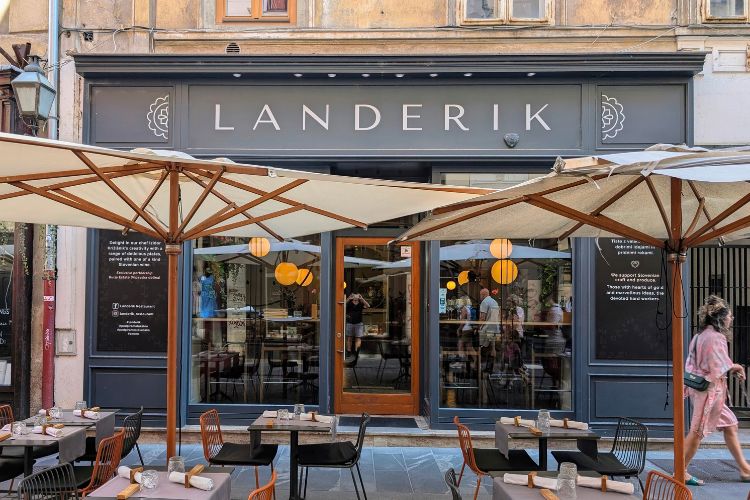
Slovenia has one restaurant with a Michelin star, and seventeen eateries in Ljubljana get mentions in the Michelin guide. My wife and I ate at one of the latter, Landerik.
The five-course tasting meal was as craftily cooked and artfully presented as any we’ve had. All the ingredients were derived from local farms.
The wines, most from grapes we were hearing about for the first time, tasted so fresh you’d think they flowed from mountain streams. Just about none of the wine is exported. You want to drink Slovenian wine, you go to Slovenia, where this small-group food and wine walk through Ljubljana pours four local wines alongside traditional dishes, with a look at Plečnik’s architecture between stops.
You have the sense that Slovenia is today what Croatia was 15 years ago. Possibly the next European destination for travelers avoiding the crowds of places like Italy or Greece (or, now, Croatia).
It’s the sort of place you want to visit soon, before too many people read stories like this one and book a flight.
Friuli-Venezia Giulia
We started our proper Europe-three-ways biking adventure near Valbruna, Italy. Our route followed handsome bike paths through a valley of pale limestone peaks and pine-stitched slopes to Tarvisio. This is a hectic little town a short ride from both Austria and Slovenia.
Tarvisio is in the semi-autonomous Friuli-Venezia Giulia region of Italy. It embraces its layered heritage so thoroughly that road signs are in four languages: Italian, German, Slovenian, and Friulian.
The last of these is the language of the stubbornly independent pocket of far-northeast Italy that has clung to its culture and heritage even as the Romans, Austrians and finally the Italians nominally ruled from remote capital cities.
Drinking In Friuli
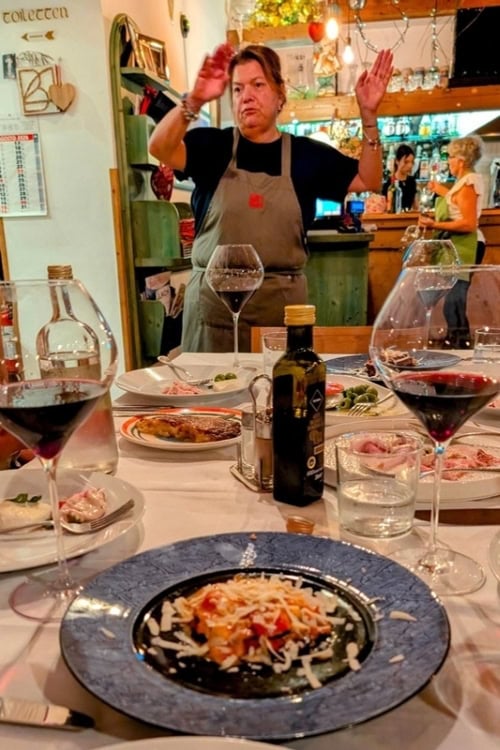
Photo by Craig Stoltz
The payoff came when we tasted Friulian wines one evening, presented by Anna. A chef and sommelier, she explained, in labored English, that the closest vineyards of the region are about 80 miles south.
Those wine lands produce the renowned Friulano wine, which was dry and had a lovely complexity, both floral and herbal. One of them, on the first sip, produced a razor bite of sour apple.
Our group was nearly overwhelmed by the freshness and exotic beauty of the one red wine we were offered. It came from the utterly obscure Schioppettino grape, grown almost exclusively in Friuli. People took photos of the bottle and looked it up. Sadly, none of that winery’s products are exported.
Dinner followed, and I had my first encounter with calamarata pasta, named because its thick, loose rings resemble sliced calamari. The noodle was served perfectly al dente and draped in a light cream sauce flecked with bits of delicate veal sausage.
We ordered a bottle of the precious Schioppettino.
A River Beyond Blue
Our ride carried us along a historic railroad line turned bike route, tunnels threading us through the mountains. The railway’s vital bridges and stations were bombed heavily during World War II.
It’s startling to think how this formidable alpine terrain, with no major cities or even sizable villages to fight over, with rugged views that stun you to silence, was a front line in such intense battles in the 20th century.
The mountain passes were the prizes: they offered vital pathways for troops and supplies, and they were bitterly contested.
Most people think about Hemingway’s A Farewell to Arms as a book about the First World War in Italy. However, the disastrous Italian retreat the book documents took place in what’s now Slovenia. The bloody fight raged just across the high ridge from where we took in sunny mountain views from our e-bikes.
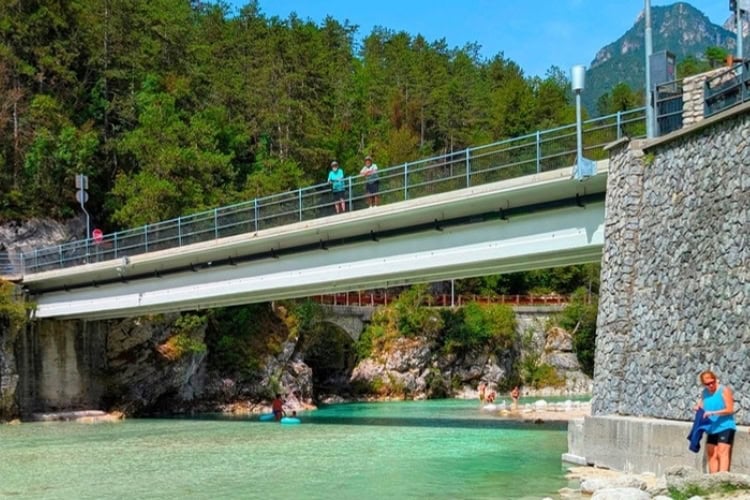
One afternoon we stopped for a dip in a stream, its water a clear, luminous aquamarine. The glacial water suspends particles of the karst limestone that flicker down from the towering alabaster peaks of the surrounding Julian Alps.
In the bright sun, the water looks like liquefied jade. I’ve never seen anything like it.
To be surrounded by it, in the Italian sun, even for a quick dip, was unforgettable. Meanwhile, our biking companions waited impatiently for my wife and me to get out of the water.
The Great Mountains Of Slovenia
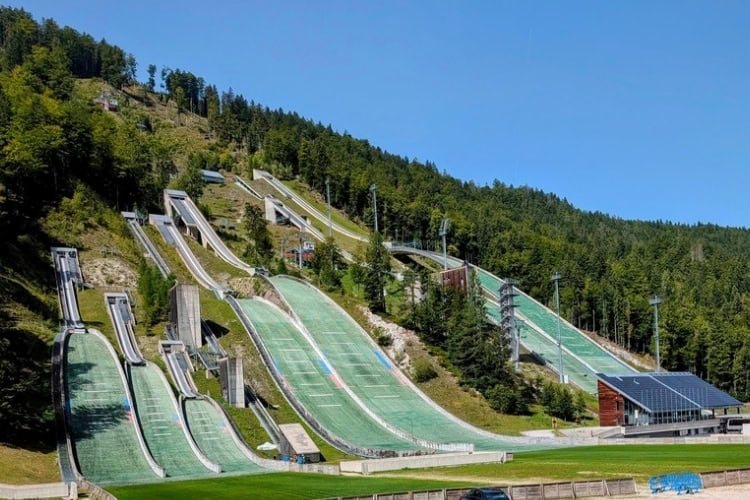
The Slovenians love their mountains. And we loved Slovenia’s mountains. We learned this in a variety of ways during our trip, but especially when we visited the Planica Nordic Center. This is the heart of ski jumping, the cradle of that sport’s supersized and fearsome offspring, “ski flying.” It is the undisputed heart of Slovenian national pride.
Anchored by eight soaring ramps, this world-class arena has birthed dozens of world records and shaped legends. These include Olympic ski jumping champions Peter and Nika Prevc and Primož Roglič, a former ski jumper who survived a horrific crash at Planica and went on to become one of the most successful racing cyclists of all time.
For Slovenians, Planica proves their outsized presence on the world stage. It’s an emblem of daring where the country’s own athletes train to fly farther than anyone thought possible.
The amazing stuff doesn’t happen only in winter, as we discovered on our midday diversion to the center.
Perched in the afternoon glare, a jumper settled into a starting gate at the top of one of the looming ski ramps. It was a brilliant feat of summer engineering, a track made of smooth, grooved porcelain.
As the athlete released from the gate, the skis glided down the watered channel, building the kind of velocity usually achieved on winter ice. They then launched and cut through the August mountain air in a silent, aerodynamic V.
The skier thumped down on a specialized, irrigated green plastic matting, the sound echoing across the parking lot.
Krapi and Sour Milk
Slovenians also love their mountaineers. The next day, we rode through the peaceful Radovna Valley, surrounded by small farms framed by even more looming Alps. We wheeled up to a kmečki turizem, or tourist farm.
We met Janko. He was a big man with gray hair, large hands and a body that had clearly done serious work for years, like his father before him. He hauled food and supplies up the nearby mountain, on horses, to the mountaineers’ huts.
This he did six days a week. In 1995, he and others who did this were replaced by helicopters.
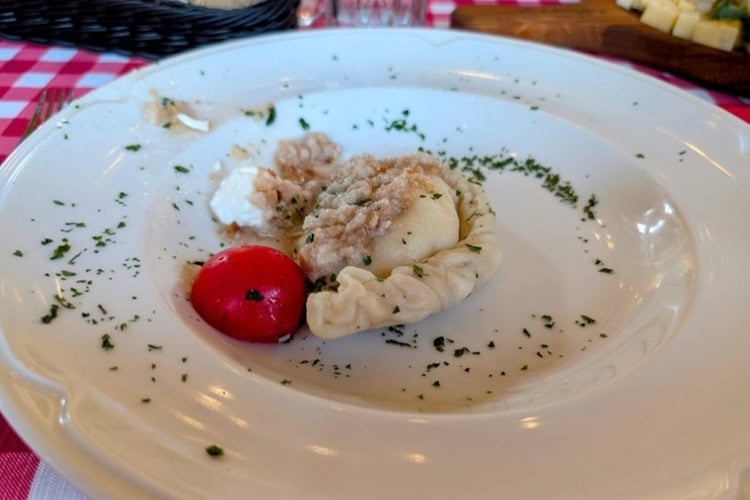
Today Janko and his wife run the farm. They serve food to cyclists, hikers and travelers in the Slovenian landscape. We were served krapi, the ubiquitous Slovenian cheese-filled dumplings, dusted with cracklings and presented with a bowl of sour milk.
Many in our group turned up their noses, literally, at the sour milk. But it’s simply a lightly fermented dairy product, sort of yogurt-adjacent, gelatinous on the spoon. It tastes like sour cream with an attitude.
For more, read Inside Slovenia’s Charcoal Country: Kilns, Forest Villages and a Living Craft.
Lake Bled
I don’t know if Slovenians love their lakes as much as they love their mountains. But they do visit one of them a great deal.
I refer to Lake Bled. Yes, it has a medieval castle full of shops and eateries, and you can reach it via a steep path that’ll take about 15 minutes to climb.
Yes, you can be rowed out to the famed mid-lake island in a pletna to visit the Pilgrimage Church of the Assumption of Mary.
And yes, the lake perimeter has a broad promenade full of thick crowds of tourists doing exactly what you’re doing.
But forget all that. Go to Bled for the cream cake.
Two Words: Cream Cake
![Lake Bled's famed cream cake is four layers of miraculous pastry making packed into 343 cubic centimeters. Photo by [Author's Name]](https://www.goworldtravel.com/wp-content/uploads/2026/09/Lake-Bled-Cream-Cake.jpg)
Photo by Craig Stoltz
I’ve been to a lot of places that have special foods “you won’t find anywhere else” and “you just have to try” and “the best one of its kind you’ll ever eat.” Most are disappointing.
This was not true of Lake Bled’s blejska kremšnita. You won’t find it anywhere else. You just have to try it, and it’s the best one of its kind you’ll ever eat.
When the pristine, seven-centimeter square was set before my wife and me at Kavarna Park restaurant overlooking the lake, it exhibited the tantalizing “wobble” it’s been known for since 1953. It jiggled lightly without losing its architectural dignity.
Pressing a fork through the crown, the top layer of sugar-dusted butter pastry shattered lightly, slicing easily through a cloud of fresh mountain cream and plunging into the deep, airy yellow custard below.
I lifted a bite that somehow held all four layers in balance. The warm scent of vanilla met the cooling silk of the dairy and the crisp, salty bite of the dough. It’s a small culinary masterpiece in 343 cubic centimeters.
Sharing it there overlooking the water, Pamela and I ate and didn’t speak for a moment.
For more, read Why So Many Travelers Are Flocking to Lake Bled in Slovenia.
Wait, I Thought We Were In Slovenia
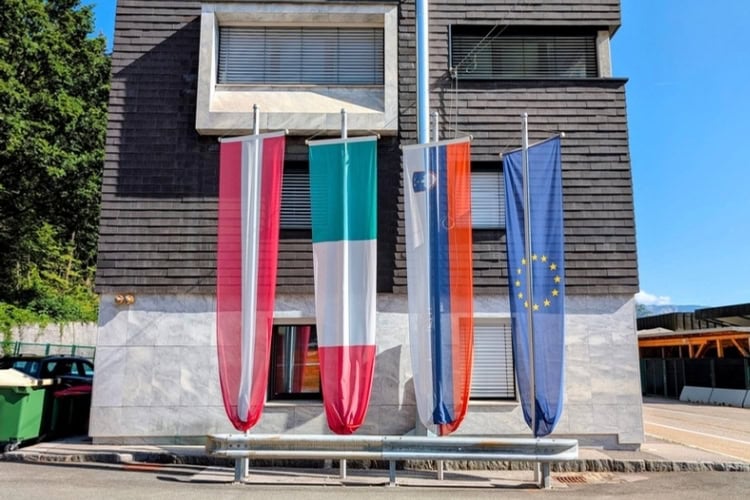
After we passed through some brutally downcutting forestland trails and wheeled up to another border crossing, we found four faded banners drooping in a wan breeze. There was one each for Slovenia, Austria, Italy and the European Union.
A defunct guard house behind us bore a sign reading “Italia.” I had been pretty sure we were riding in Slovenia. But apparently we’d somehow sliced into a bit of Italy without notice. It’s odd to not know what country you’re in, but this is one of those places on the globe where borders just don’t matter much.
It didn’t take long, however, for Germanic culture to vividly assert itself.
We were just a few minutes into the Republic of Austria when we attempted to bike through a handsome neighborhood of modernist chalets with Audis in the driveway.
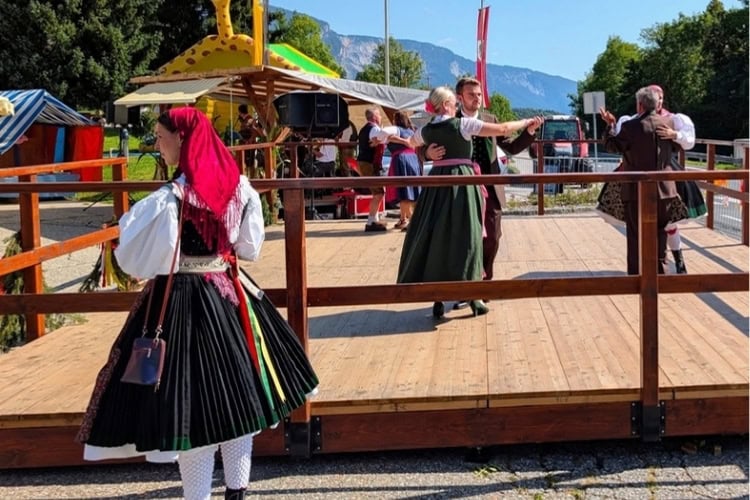
There, blocking our way, wedged between a gas station and the parking lot of a boarded-up restaurant, rose a heady Teutonic celebration in high gear. It was an oompah band. Costumed dancers in swirling skirts and lederhosen, and locals lined up at picnic tables under tents, took in their sausage and beer.
The shift from mystical Italian (or was it Slavic?) woodland to full-on Germanfest, happening within firing range of a high-powered trebuchet, may have been the most dramatic cultural transition of our trip.
We passed by the street party quickly and joined a biking path along a busy highway. The music faded as we rode deeper into Austria.
For more, read A Cow Parade in Tyrol: Inside Austria’s Almabtrieb.
Three Cultures Followed Us To Bed
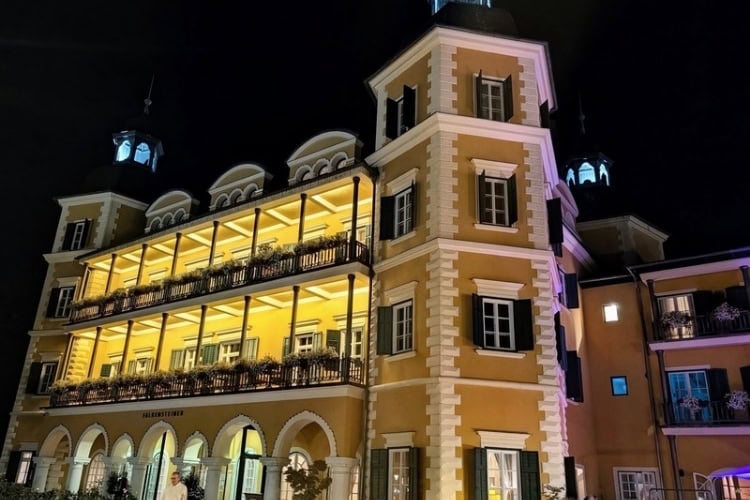
It turns out that, long before it earned a place on Condé Nast Traveler’s Hot List, our last hotel, the Falkensteiner Schlosshotel in Velden, Austria, hard by the shore of Lake Wörthersee, had been quietly rehearsing this trip’s three-country theme for about two thousand years.
The property that today features three pools and a eucalyptus steam room stands on what was once a stop on a Roman road. It was part of the same network that moved legions and traders between Italy and the Alps.
By the Middle Ages, the lake and the surrounding villages had Slovene names as well as German ones, Wörthersee doubling as Vrbsko jezero. Those names still appear on some local signage, the Slavic thread persisting.
Then, in 1590, a Habsburg nobleman with the magnificently misspellable name of Barthelmä Khevenhüller built an actual castle on the spot. The Germanic thread arrived in the form of turrets.
It burned, was rebuilt, became an inn, and in 1890 it was reborn as a hotel. This is the version we arrived at, tired and happy, the VBT guides racking our bikes.
We hadn’t expected to end our three-country ride in a place that had, on its own, already hosted all three cultures over the centuries. It just worked out that way.
Pam’s and my room was in the old castle section of the hotel. Our chamber was vast, the bathroom a marble refuge, the sheets cool and silent against the skin. The drapes opened and closed via a touch screen on the wall.
Lolling Like A European Aristocrat
If I were a proud man, I’d deny that I declined our final day of cycling. I wouldn’t admit that I chose instead to dally over a genuinely Continental breakfast and prowl around the castle’s copious public rooms.
I also chose to sweat in a variety of interesting ways in the spa (including that co-ed nude sauna with the floor-to-ceiling window). Additionally, I took in the sharp Austrian sun and lolled like a European aristocrat in the resplendent waters of Lake Wörthersee.
I would lie and say that I dutifully spent the last day of our trip in the saddle, pedaling along another bike path with a sore butt.
But I am not a proud man. So I confess. And I have no regrets.
That night my wife, three new friends, and I went to a restaurant across from Velden’s casino. We simply asked the waiter to have the chef send out some things he loved to cook.
Out came two enormous platters of seafood, including a type of Austrian lake fish whose name I didn’t catch. But it was rich and delicious. We also all agreed that we had the best scallops ever, each served on a shell the size of an open palm.
When we raved, the chef sent out five more. We drank many glasses of Austria’s signature white wine, Grüner Veltliner.
The trip had to end somewhere, sometime, and here, on the shore of Austria’s Lake Wörthersee, where the Romans, Slavs, and Germanic people all had gathered before us, seemed as fitting a spot as any.
If You Go
This little spit of Europe doesn’t get explored much, because there aren’t any big cities or major tourist attractions right nearby. But that’s part of its beauty.
If you’re an active traveler, VBT’s Slovenia Bike Tour Through Alpine Valleys pulls the experience together neatly. It also includes bookend visits to Ljubljana and Salzburg, Austria.
The tour offers e-bikes, and most guests choose them, so you don’t need to be a well-trained or even particularly skilled cyclist.
If you want to go at it yourself, here’s the country-by-country breakdown:
Slovenia
The walkable, wonderful little capital city of Ljubljana isn’t too close to the three-country borderland, but it’s a great place to get started.
Stay right in town if you can; most hotel rooms in prime locations can be had for 200 Euros or less. You’ll be close to a lot of restaurants, historic architecture, the morning markets, and a castle you can reach via a switchback walking path or funicular.
Lake Bled is Slovenia’s biggest straight-on tourist attraction, and it’s close to the borderland. Kranjska Gora, a winter resort town, is near the Planica Nordic Centre (zip-line the ski-jump!) and has a few good restaurants where you can get both traditional and updated Slovenian food.
Austria
Salzburg is the closest major city, and it’s a manageable, right-sized place to visit too. It’s more heavily touristed than Ljubljana, largely because it’s Mozartville.
You can visit his birthplace and many other themed attractions; expect a lot of inauthentic music-history-adjacent hubbub. That said, friends we were traveling with were able to locate, with no pre-planning, a small piano concert.
The city also has a castle, Fortress Hohensalzburg, that looms over the city like an ancient threat; I enjoyed the puppet museum immensely. The pricey Hotel Goldener Hirsch on tourist row was a treat, with a full traditional feel but some impressive modern updates.
When you step out of your bed at night, a light under the nightstand quietly illuminates. Those wily Austrians.
Italy
Italy’s Friuli Venezia Giulia borderland may be the best base for a three-country drive-around. The region known as Tarvisiano is certified as a sustainable tourism center, and draws in bikers, hikers, and people exploring the confluence of the three nations plus Friuli, which has its own culture, language, and history.
We stayed in the worthy Hotel Edelhof, which had not only a Germanic name but a Germanic feel too. I had to keep reminding myself I was in Italy.
Need a hand planning your trip? Here are the sites and services we rely on most, from booking tools to travel products we love.
Inspire your next adventure with our articles below:
- Plitvice Lakes: Your Guide to Croatia’s Most Spectacular National Park
- A Perfect Weekend in Lucerne: Lakeside Charm and Alpine Views
Author Bio: Craig Stoltz, a former editor of the Washington Post travel section, is a freelance journalist covering travel, food, and drink. A frequent contributor to GoWorld Travel, he’s also written for Fodor’s, Frommer’s, the Saturday Evening Review, and others.
Want to discover more hidden gems and helpful travel tips? Join our free newsletter for the latest travel secrets and travel articles.
We are reader-supported and may earn a commission on purchases made through links in this article.

- A Two-Day Itinerary for Mesa Verde’s Cliff Dwellings and Ancestral Pueblo Heritage - October 5, 2026
- E-Biking the Julian Alps Across Italy, Slovenia and Austria - October 5, 2026
- Tales of the Savannah: A Front-Row Journey Through the Masai Mara - October 5, 2026
Planning another trip soon? ✈️
Add GoWorldTravel.com as a preferred source on Google. Click the button below so our local guides, packing hacks, and hidden-gem itineraries always show up first when you search!
Add to Preferred Sources