
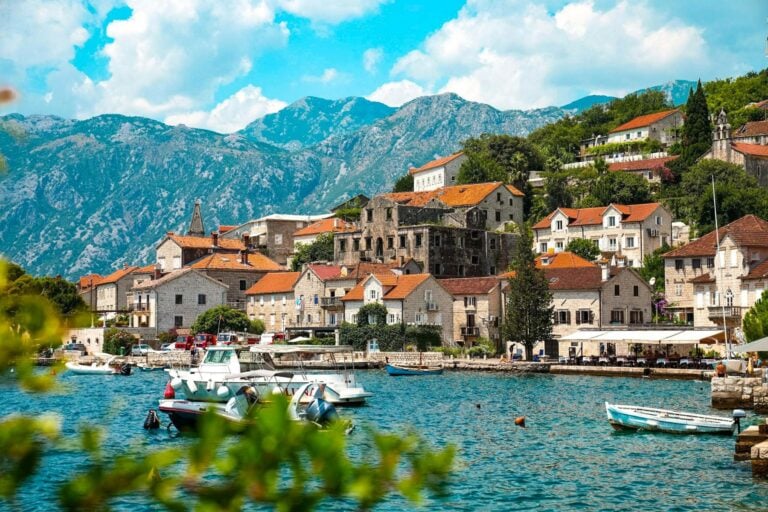
Tucked away on the north coast of Montenegro, just a short drive from Dubrovnik’s famous stone walls, lies a landscape that feels almost otherworldly. The Bay of Kotor, known locally as Boka, is a dramatic, butterfly-shaped inlet where the peaks of the Dinaric Alps plunge directly into the glass-like waters of the Adriatic Sea.
Arriving here feels like stepping into a Norwegian fjord that has been magically transported to Southern Europe, complete with warm breezes and terracotta-roofed villages.
Along this UNESCO-protected coastline, you can discover Perast, lined with Baroque stone palaces. From here, you can boat out to an artificial island built from stone and centuries of sunken shipwrecks.
In nearby Risan, ancient Roman mosaics depict the god of sleep, while modern Tivat parks luxury superyachts.
At the heart of it all, Kotor’s majestic defensive walls shield a medieval labyrinth ruled by street cats. It is a rare corner of the world where ancient empires, modern luxury, and untamed nature sit shoulder to shoulder.
A Bird’s-Eye Boka
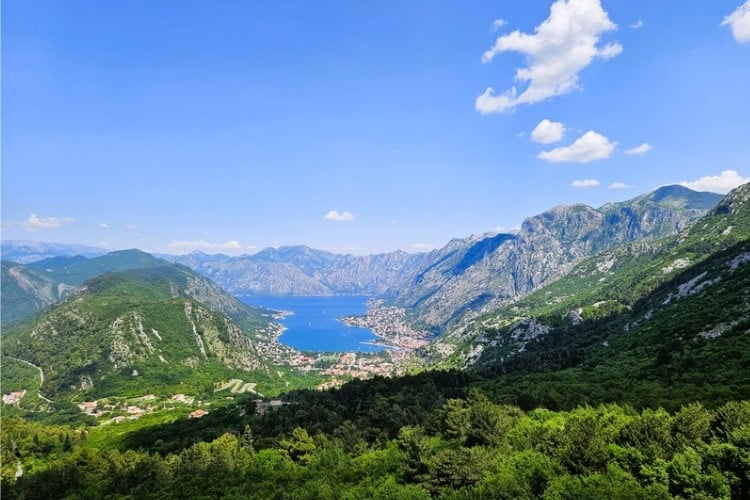
Rather than a fjord, the Bay of Kotor is an ancient river canyon drowned by the rising Adriatic Sea. Locals call it Boka (mouth), a name coined by Venetian sailors for its narrow entrance gaping between the cliffs.
This dramatic landscape, combined with centuries of medieval Venetian architecture, earned the entire bay dual UNESCO protection for both its natural beauty and cultural heritage.
The best way to comprehend the scale of the bay is to view it from high above. The cable car from the coast to Mount Lovćen takes just eleven minutes, transforming a massive seascape into a perfect blueprint below you.
Gliding up to 4,265 feet, the dense beech forests and hiking trails of the protected national park open up beneath the cabin. At the summit, you can leap from dining to high-speed adventure.
Right on the ridge sits Forza Kuk, a sleek restaurant serving traditional delicacies. Just steps away, the Alpine Coaster lets you zoom down the cliffside on a mountain track with the entire bay rushing past below.
A Love Letter Written In the Landscape
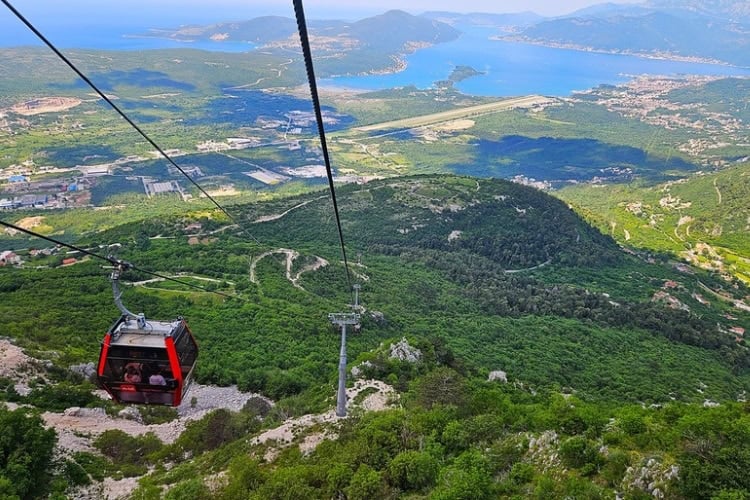
This panoramic view of the bay was famously loved by Princess Milena, who later became Montenegro’s first and only queen consort.
Following the 1878 Congress of Berlin, an independent Montenegro desperately needed infrastructure. Prince Nikola I hired Croatian architect Josip Slade to build a road connecting coastal Kotor to the mountain capital of Cetinje.
Completed in 1884, Slade’s masterclass of engineering resulted in 25 dramatic switchbacks scaling a near-vertical cliff.
“Slade was hopelessly in love with Princess Milena, the wife of Prince Nikola I,” local guide Alen says as the cable car descends. He points down at three seemingly unnecessary, sweeping loops in the road that form a perfect capital letter M.
“A public declaration of love meant execution, so he engineered those curves for no logistical reason other than to engrave her initial into the landscape. We are lucky he fell in love with Milena. If her name were Olga, we’d still be driving in circles today.”
Whispers Of Queen Teuta In Risan
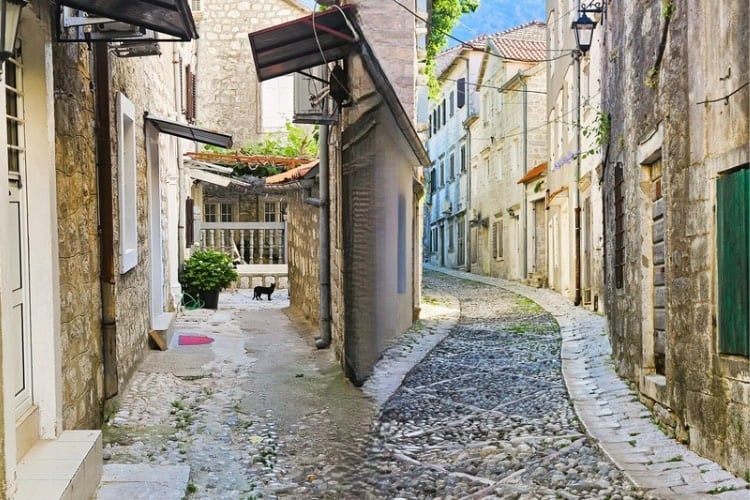
Leaving Mount Lovćen behind, a winding road leads toward the northernmost tip of the bay, revealing a town that time forgot.
Stepping into Risan means escaping the cruise-ship bustle of the Adriatic and slipping into a quiet antiquity. Long before the Venetians arrived and renamed this region, the entire body of water was known as the Bay of Risan.
Today, the town moves at a beautifully slow pace. Its old soul survives entirely along Gabela, a narrow street paved with large, worn stones and lined with centuries-old stone houses. However, many were destroyed in the big 1979 earthquake.
As you walk this ancient path, the only true locals you are likely to encounter are the community cats lazily trailing behind your footsteps.
Sunken Riches And The God Of Sleep
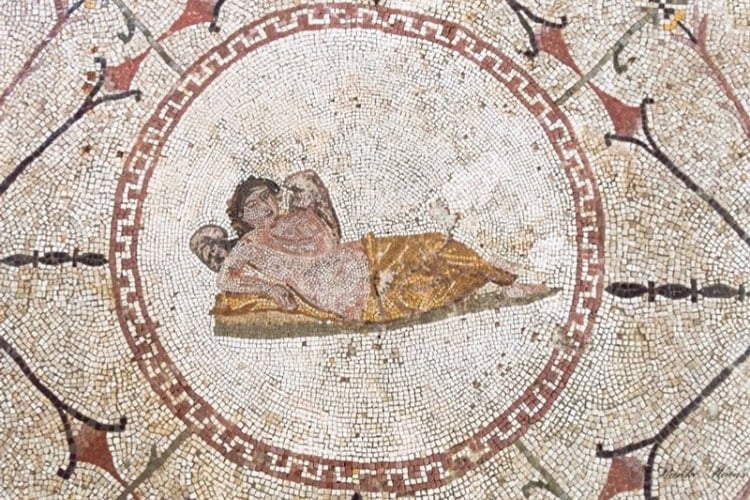
Yet beneath this sleepy exterior lies the ghost of a defiant empire. In the second century BC, Risan was the capital of the Illyrian Kingdom, ruled by the legendary pirate queen, Teuta.
Teuta was known for her fierce intellect and an army that terrorized Roman merchant ships. She retreated to her castle on the cliffs above Risan when Rome declared war. Legend says that rather than surrender, she plunged off the mountains into a subterranean lake, taking her massive royal fortune with her.
“Locals still believe this treasure remains hidden in the flooded caverns of the mountain,” Alexandra explains. During the heavy winter rains, the water pressure inside the Sopot cave forces a waterfall to erupt from the rocks. It occasionally flushes ancient artifacts into the sea.
When the Romans eventually conquered the city, they built a luxurious villa over the Illyrian ruins, leaving behind Risan’s ultimate prize. Discovered in the 1930s, these excavated floors hide the world’s only Roman mosaic of Hypnos, the Greek god of sleep. It was placed on the bedroom floor to bring peaceful dreams to the master of the house.
An Island Born Stone By Stone
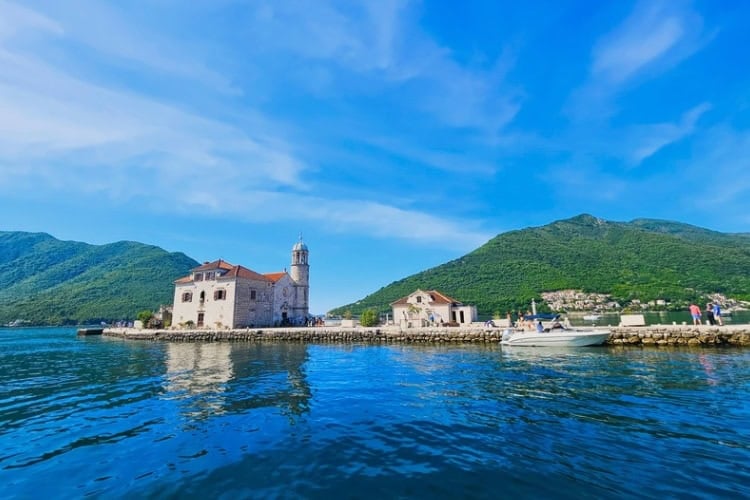
Photo by Zuzana Zimmermannova
No trip to the Bay of Kotor is truly complete without experiencing it from the water. Pushing off from the stone piers of Risan, the boat glides into the deep blue. Before long, two iconic islets appear on the horizon.
The first, Our Lady of the Rocks, is a sunlit sanctuary born entirely of human devotion. After two brothers found an icon of the Virgin Mary on a reef here in 1452, locals spent two centuries building an artificial island around it, tossing stones and sinking old ships to create a foundation.
The church they built was burned by pirates, but the icon miraculously survived. Rebuilt by 1630, the church stands today as one of Montenegro’s most sacred pilgrimage sites, revered by all faiths.
Inside, the walls are covered by 68 masterworks by Baroque artist Tripo Kokolja. “We call it the Sistine Chapel of Boka Bay,” Alen notes.
Yet the most moving details are the 2,000 silver tablets lining the interior. “Whenever sailors encountered bad weather, they made a vow to the Virgin Mary,” Alen explains. “If they returned safely, they donated a silver plaque.”
This ancient bond with the island is still alive. Every July 22nd, during the Fašinada, a convoy of local boats, tied together and laden with rocks, rows out to the islet to song and cheer. There, residents throw stones into the water, reinforcing the foundations of the sanctuary.
The Island Of Dead Captains
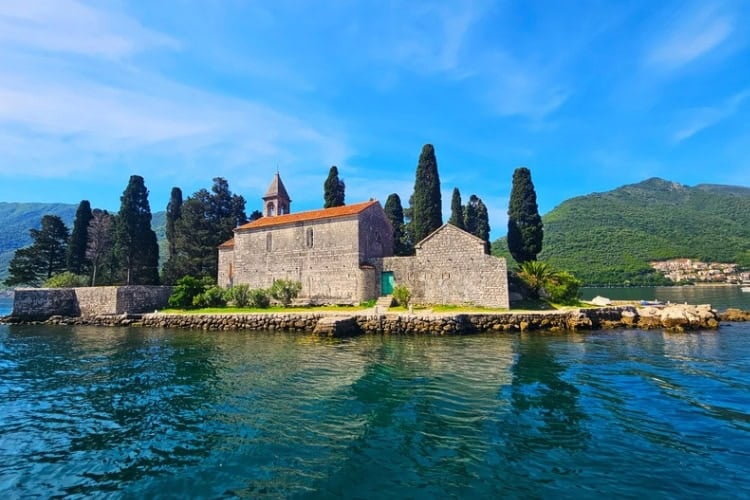
Right next to it sits St. George. This natural island, cloaked in dark cypress trees, is home to a 12th-century monastery and graveyard. “Only the most prominent citizens from Perast were allowed to be buried there, most commonly the wealthy sea captains,” says local guide Alen. This is why the restricted island earned the nickname, “The Island of the Dead Captains.”
Fading into the distance, the islets give way to the mainland on the right. Here, the monumental, dome-topped Our Lady’s Temple in Prčanj stands guard.
We pass by Tivat, a young, glamorous hub where the traditional Adriatic rhythm gives way to Porto Montenegro. It’s a palm-fringed playground packed with world-class mega-yachts and chic waterfront boutiques.
Across the water, we catch sight of Herceg Novi, a historic fortress town cascading down the hillside in a maze of stone stairs and exotic botanical gardens.
The Shore Of Golden Ducats
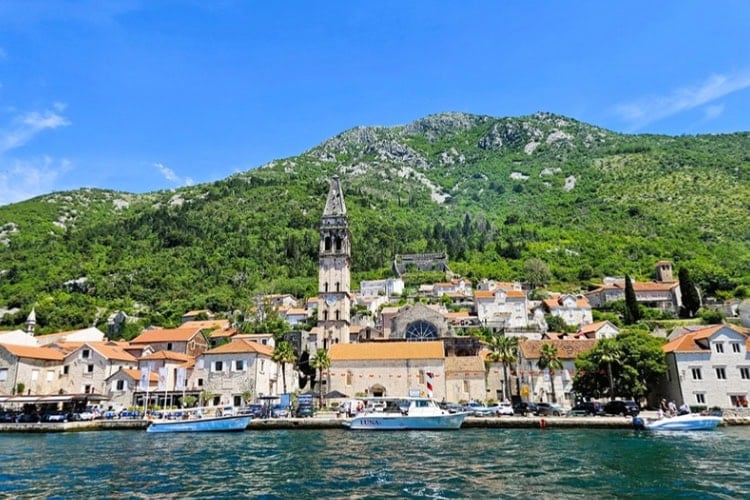
The boat finally nudges against the stone docks of Perast, a town that feels like a Baroque painting come to life. Free of cars, its single waterfront promenade is lined with nineteen elegant stone palaces and seventeen churches, all built during a golden age under Venetian rule.
These grand villas, with their weathered coats of arms and ornate balconies, speak of a time when Perast’s wealthy sea captains and merchants commanded the Adriatic.
Dominating the skyline is the bell tower of St. Nicholas Church. Rising 180 feet into the sky, it is the highest belfry on the eastern Adriatic coast. Built in 1691, the tower was paid for by the citizens of Perast, who paid an astonishing 55,000 Venetian ducats for its construction. They demanded a tower so grand it would stand as a symbol of their triumph over the Ottoman threat for miles.
The Feline Fortress
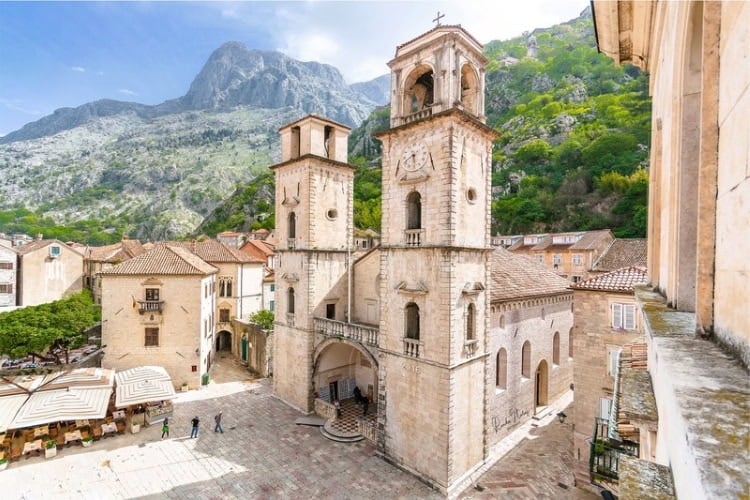
At the absolute end of the bay lies the fortified marvel of Kotor. As a major cruise hub, this tiny medieval town floods quickly, so checking arrival schedules beforehand is essential.
Once inside the thick stone fortifications, visitors enter a labyrinth explicitly designed to confuse invaders. Wandering through the maze, it becomes clear that humans are vastly outnumbered by the city’s true rulers: hundreds of community cats lounging on ancient window sills.
Yet Kotor’s deep spiritual history is equally present in its architecture. “St. Tryphon Cathedral, built in 1166, is the beating Catholic heart of our city,” notes local guide Ivan. “But just a short walk away, the dual-altar Church of St. Luke stands as a symbol of peace, where Catholics and Orthodox Christians shared the exact same space for centuries.”
The most staggering sight, however, lies directly above. Looking up, one sees an impossible, zigzagging ribbon of ancient defensive walls, up to 65 feet tall, stretching for 2.8 miles. They climb up the steep, vertical cliffs to the San Giovanni Fortress, which sits high above the sea.
The Coast Of Contrasts
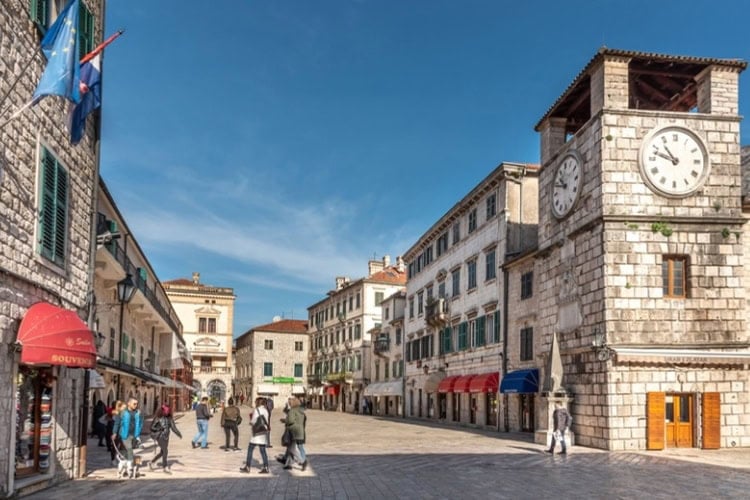
Photo courtesy of Kotor TO
Ultimately, this is the magic of the Bay of Kotor, a landscape defined by striking contrasts. Here, the silent melancholy of an island graveyard sits just a few knots away from a glittering superyacht marina, and raw limestone cliffs plunge straight into a turquoise sea.
Bound by ancient sailors’ vows and Venetian fortifications, these waters hold the Adriatic’s most unforgettable secrets.
Yet this is only half of Montenegro’s story. Further south along the Ulcinj Riviera, these dramatic fjords give way to sweeping sand dunes and an entirely different, Ottoman-influenced world.
Where To Stay
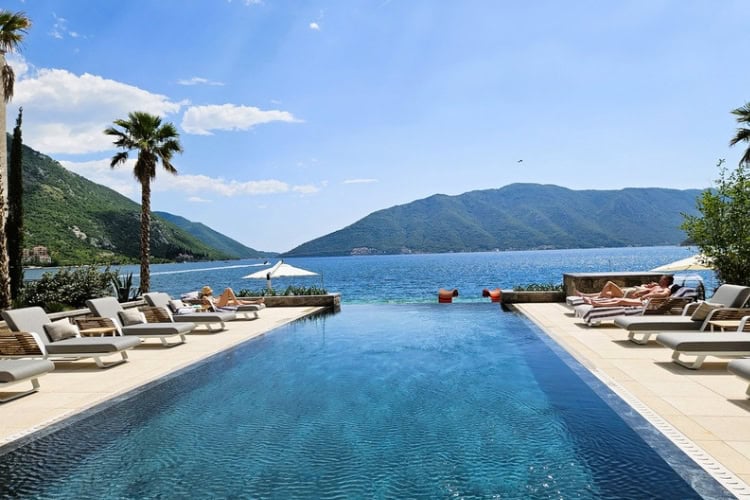
Mövenpick Hotel & Residences Teuta Kotor Bay: Escape Kotor’s crowds for the authentic village of Risan, 30 minutes west. Named after a legendary Illyrian queen, the 5-star resort features a private beach, a sea-view infinity pool, a massive spa, and waterfront terraces, complete with Mövenpick’s daily chocolate hour.
Where To Eat
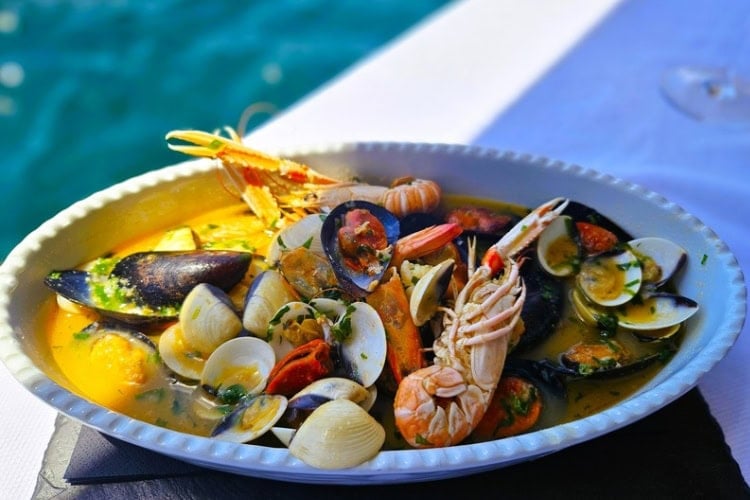
Photo by Zuzana Zimmermannova
Restaurant Forza Kuk: Perched atop Mount Lovćen at the cable car summit, pairing modern Mediterranean dining with bird’s-eye views across the entire bay.
Restaurant Đardin: A waterfront spot in Perast specializing in fresh, local seafood served on a romantic terrace overlooking the twin islands.
Konoba Scala Santa: The bay’s oldest traditional tavern, hidden in a medieval Kotor square, serving authentic seafood classics in a rustic stone setting.
Need a hand planning your trip? Here are the sites and services we rely on most, from booking tools to travel products we love.
Inspire your next adventure with our articles below:
- Inside Kotor: Montenegro’s Walled Medieval City That Still Feels Like a Secret
- Discovering the Splendor of Montenegro’s Beaches: A Guide to the Best Coastal Gems
Author Bio: Zuzana Zimmermannova is a globally experienced freelance journalist with a passion for storytelling who shares her perspective through articles in magazines, newspapers, and online publications. With a portfolio built across 50+ countries, she delivers compelling travel stories, in-depth interviews, and insightful reports. Her work has appeared in Forbes, GEO, Go World Travel Magazine and other leading publications. She loves uncovering authentic local stories through food, culture, and adventure.
Want to discover more hidden gems and helpful travel tips? Join our free newsletter for the latest travel secrets and travel articles.
We are reader-supported and may earn a commission on purchases made through links in this article.

- Darwin, Australia’s Northernmost Capital, Combines Vibrant Markets, Waterfront Life and Access to Kakadu and Litchfield - October 25, 2026
- Paarl: South Africa’s Secret Winelands Escape Where You Can Stay in Historic Wine Tanks - October 25, 2026
- A Quest for the Best Frango Assado in Portugal’s Algarve - October 24, 2026
Planning another trip soon? ✈️
Add GoWorldTravel.com as a preferred source on Google. Click the button below so our local guides, packing hacks, and hidden-gem itineraries always show up first when you search!
Add to Preferred Sources