
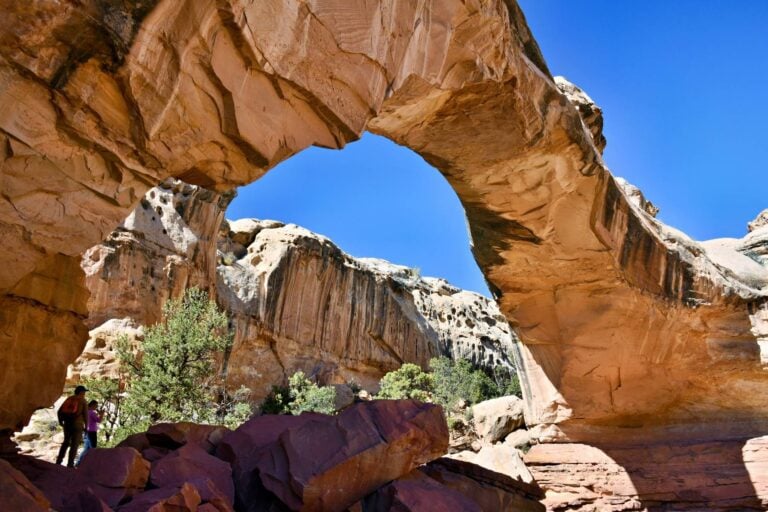
Capitol Reef National Park in Utah is a geological anomaly known as a “waterpocket fold.” In plain speak, this is one long, beautiful geological wrinkle on Earth.
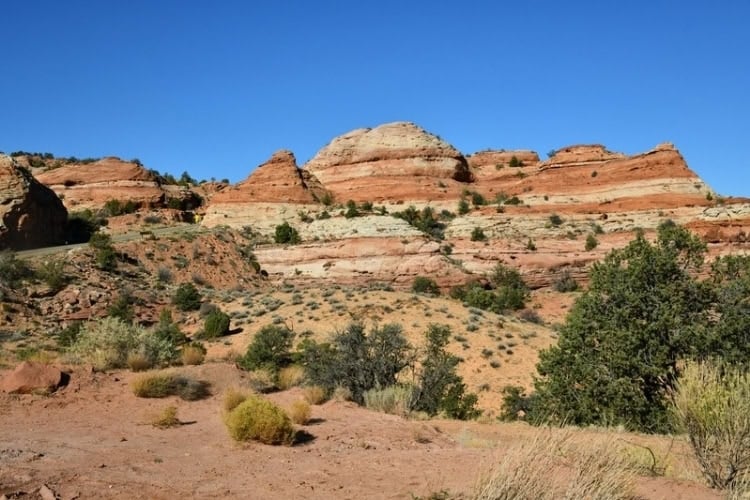
This wrinkle exposes rock up to 270 million years old. Here you will see countless layers of pretty red, orange, and white in its domes, arches, slot canyons, and cliffs.
For geology fans, read about a waterpocket fold here.
The park also features easily accessible petroglyphs dating from 700 to 1,700 years ago.
Location And Access
Due to its remote location, the park is considered the least visited of Utah’s “Mighty Five” national parks.
The park is located 3.5 hours south of Salt Lake City, and about 2.5 hours from Bryce Canyon and Arches National Parks. It is so remote that the nearest traffic light is 78 miles away.
Park Layout And Roads
Capitol Reef National Park is long and narrow, covering 241,904 acres. It is 60 miles north to south and averages 6 miles wide east to west, all within the 100-mile Waterpocket Fold.
Visitors arriving by car are limited to 17 miles of passenger roads. This includes the 10-mile east–west crossing of the park and the one-way eight-mile road going south called the Scenic Drive.
Off these two main roads are hiking trails that can get you a few miles inside the park. To get deeper into the park, there are 100 miles of off-road trails suitable for an SUV with decent tires.
Exploring Capitol Reef
We spent 2½ days getting to know Capitol Reef National Park by dirt road and easy hiking trails. A good starting point is the visitor center located 11 miles from Torrey, the nearest town.
Here you can view a video about the park’s history and geology, learn about ranger-led programs, and buy the usual souvenirs.
Hiking In Capitol Reef

Hiking in the park can go from mild to wild. Where you hike depends on your physical condition and the time you have.
I recommend downloading this trail link and discussing it with rangers or volunteers at the visitor center. They will help pick a trail based on your ability and time.
Hickman Bridge Trail
If you are in average condition, I recommend the Hickman Bridge trail. This two-mile round-trip hike gains only 400 feet in elevation.
During your walk, you will encounter valley views and a variety of sights to make it interesting. At the end of the trail, you will see a large, beautiful natural bridge that you will hike under and around.
This is a popular hike, so get here early in the day or late in the afternoon. To make the hike interesting, take the one-page guide at the entrance for a small fee or take a cell shot of it to read at each numbered post.
Capitol Gorge And Beyond

Capitol Gorge is an easy hike that starts at the end of the Scenic Drive. It is a two-mile flat round-trip walk along a wash.
It is also a good hike in the middle of the day because the towering walls on each side of this narrow gorge keep you in the shade. During your hike, you will see 100-year-old graffiti.
While here, consider taking the Golden Throne trail if you want more of a challenge. This hike is 2 miles long and gains 730 feet in elevation. You are rewarded with views of the gorge and the surrounding area.
Do not attempt to hike into the gorge if there is rain in the region. Dry washes flood fast. Having the sun above you does not necessarily mean you are safe if there are heavy rains miles up the wash.
Hikers should seek safety at the first signs of water, even if it is a trickle.
Scenic View Strolls

Two short strolls for the views should include a walk to Goosenecks to peer down into the canyon and its layers of rock.
The other one should be at Sunset Point.
SUV Adventure In Cathedral Valley
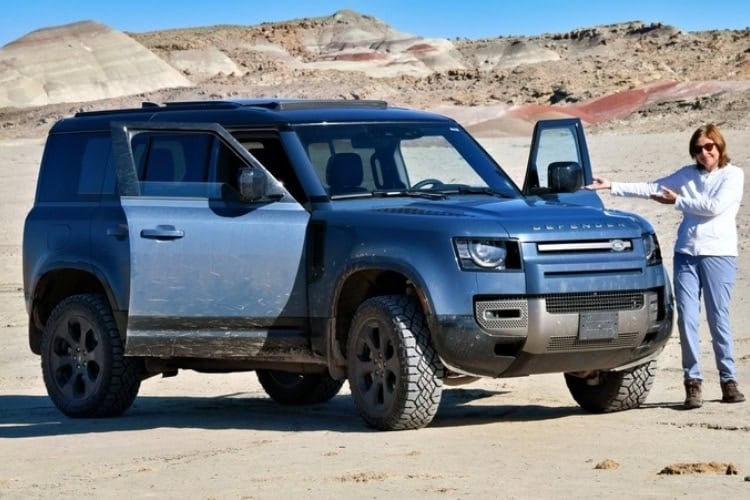
Anyone with a sense of adventure and the right vehicle with good tires can explore Cathedral Valley. Before taking the loop, check the road conditions at the visitor center and tell the rangers what you are driving.
They have a sense of what will work that day based on conditions. The Cathedral Valley Loop is a 58-mile dirt road that takes you to the remote, scenic backcountry of Cathedral Valley.
Less than 1% of park visitors go there. Venturing down this road will take 6 to 8 hours. During our drive, we took in three short hikes and a picnic lunch.
Before starting, get a map from the visitor center and check the conditions. The map will feature different points of interest.
Start your loop 12 miles east of the visitor center on Hartnet Road. Here you will cross a river, usually about a foot deep. (The average SUV has a water height between 16 and 30 inches.)

If you are unsure about its depth, cross it on foot first if conditions allow. During our crossing, there were three SUVs, and we were unsure of what to do. Once I crossed, the others followed.
Do not cross if the water is fast or flowing over the banks.
Key Stops On The Loop

Cathedral Valley Loop has several stops that are highlighted below. Of these stops, do not miss the Upper South Desert, Upper Cathedral Valley, and Lower South Desert overlooks. Each overlook has an awe-inspiring view.
Water Well Oasis
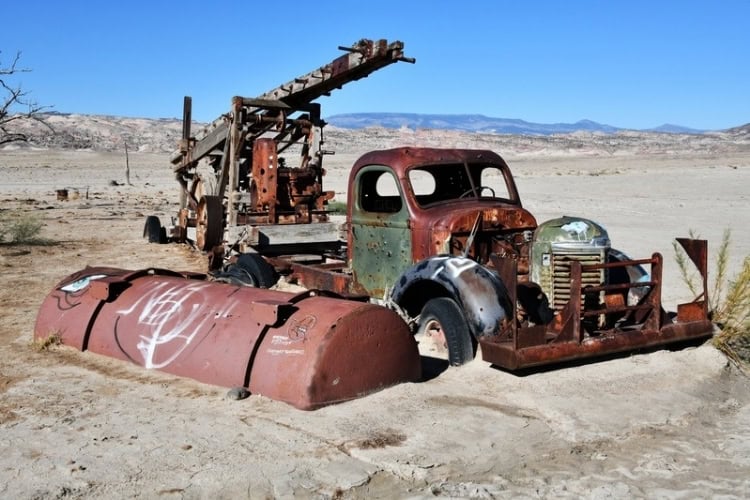
The Water Well Oasis is six miles into the drive. This is a colorful stop because you see the bright, rusted-out colors of an old truck and a drilling rig contrasting nicely with the sand-colored desert.
This is also the only water source in Cathedral Valley that is used by grazing cows in the fall.
At Morrell Cabin, get out and stretch for the half-mile round-trip walk. This rustic cabin was moved to this spot in the 1930s.
For the next 40 years, cowboys used it as a place to bunk down each summer and winter when moving the herd. Looking inside it, it is hard to believe it slept eight. The cabin is a reminder of the ways of the West.
The Gypsum Sinkhole
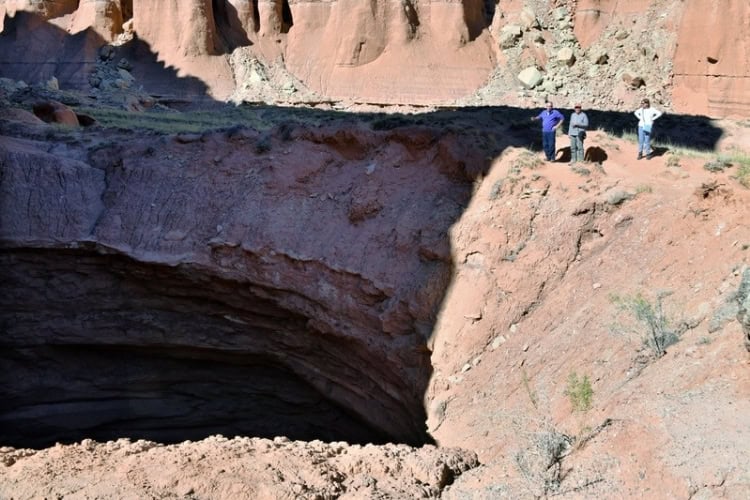
The Gypsum Sinkhole makes another interesting stop. Near the parking lot is a massive 200-foot hole surrounded by cliffs and a nearby slot canyon. It was formed when water dissolved a large gypsum layer, causing the overlying rock to collapse.
Keep kids close to you here.
Temples of the Sun and Moon
A highlight of the drive is taking the spur to the Temples of the Sun and Moon. Here, you can walk around two massive sandstone monoliths. They are the most popular formations in the valley.
One of the most unusual geological features I have seen is Glass Mountain. This 15-foot bump is made up of large gypsum crystals. The mound sparkles in the sun.
If you pick up a flaked-off piece on the ground and hold it up to the sun, you will see it shine bright.
Don’t have a suitable vehicle or simply want an expert along for the ride? This highly rated private tour out of Torrey takes you directly to the Temples of the Sun, Moon, and Stars, along with Glass Mountain, with a knowledgeable local guide handling all the off-road logistics. Book the Temples of the Sun & Moon private tour here.
Driving The Loop Safely

Currently, the SUV market accounts for 60% of passenger vehicles. That means more than half our readers can drive the Cathedral Valley Loop. The need for an SUV stems from road clearance.
Cars, on average, clear the ground by five inches, while mid-size and full-size SUVs have at least eight inches. (Compact SUV specifications need to be checked, as they vary.) With bumps and dips, higher clearance is needed to avoid bottoming out.
SUVs also have an all-wheel-drive or 4×4 system that can be helpful when road conditions change.
Drive the loop clockwise. This will have you enter the road at the Fremont River crossing, 20 minutes east of the visitor center.
If the river is high, drive 10 miles east and take the entrance at Caineville. Doing this will allow you to drive half the loop and return the same way.
For this kind of desert road trip, you must pack extra water and food. The only services here are pit toilets at the camping areas.
Make sure your tires are in good condition, and you have a spare tire or a tire repair kit (we had both). If you break down, it may take a while for another car to pass you, depending on the season. There is no cell service here.
During our October visit, we came across only a dozen other SUVs. If you are prepared, you will have a fun and scenic day.
For complete information on the park, visit the official national park site.
If You Go To Torrey
Capitol Reef is a bit different than other national parks. There is no gateway town with a busy main street lined with souvenir shops, hotels, and dozens of restaurants as you would see at Arches or Rocky Mountain National Park.
As mentioned earlier, this place is remote. Torrey is a small town with a population of 250 people, west of the park entrance.
It has one small market with limited goods, a few shops, and several places to eat scattered about. The Capitol Reef Country website lists 20 mostly two- to three-star motels, RV parks, and two B&Bs.
There are also several places to camp. For more information on lodging and food, click here.
With 50 or so VRBO/Airbnb listings, we opted for a charming two-bedroom home in the smaller village of Teasdale nearby.
Where To Eat In Torrey

Our favorite restaurant in Torrey was Hunt and Gather. This is Torrey’s only upscale dining establishment. We found the food here to be the best in town.
The Broken Spur is the place for a basic steak dinner. It also serves fish, ribs, burgers, and salads.
Chak Balem is a family-owned Mexican restaurant. The service was friendly, and the food was flavorful. Skip the margaritas and stay with beer here.
Gifford Homestead is located just past the park’s visitor center. People here get up early for their pies and cinnamon rolls. We picked up their peach, apple, and mixed berry pie for a picnic in Cathedral Valley.
Starry Night Skies
With no evening entertainment around, the one must-do thing here is stargazing. In 2015, Capitol Reef National Park was designated a “Gold Tier” dark-sky park due to its remote location and lack of artificial light.
To view the stars, drive to Sunset Point an hour after sunset.
Road Trip Tip
TIP: If coming from Bryce, drive directly to the Kiva Coffee House, which is on the way. Here you can get sandwiches, pastries, and good coffee at what may be the West’s most scenic and unusually designed coffee shop.
Need a hand planning your trip? Here are the sites and services we rely on most, from booking tools to travel products we love.
Inspire your next adventure with our articles below:
- Conquering Fear and Finding Magic in Yosemite’s Granite Cathedral
- Hidden Gems in the American West: Road Tripping Through Canyon Country
Author Bio: After 30 years in the business world, Tab Hauser reinvented himself as a journalist and professional photographer. His travels have taken him to seven continents and 100 countries or unique locations. He is an Explorers Club Friend, a member of the New York Press Association, a diver, and a U.S. Coast Guard Licensed Captain. This native New Yorker now calls Colorado home. Follow on Facebook https://www.facebook.com/tab.hauser/, https://www.instagram.com/tabhauser/ and www.tabhauser.com
Want to discover more hidden gems and helpful travel tips? Join our free newsletter for the latest travel secrets and travel articles.
We are reader-supported and may earn a commission on purchases made through links in this article.

- Exploring Nanjing, China: 48-Hour Trip That Changed My Perspective - October 13, 2026
- Buzzing into Sustainability: How Hotels Are Embracing Beekeeping Initiatives - October 13, 2026
- The Perfect Bay Area Day Trip: Why Sausalito Should Be Your Next Weekend Escape - October 13, 2026
Planning another trip soon? ✈️
Add GoWorldTravel.com as a preferred source on Google. Click the button below so our local guides, packing hacks, and hidden-gem itineraries always show up first when you search!
Add to Preferred Sources
Thanks for the detailed itinerary. Your articles always suggest such wonderful locations to stop. It is clear that hours of research go into your trips and articles.
Thank you to the author for this informative article on capital reef national Park. There’s a lot of great information in the article on where to go , how to get there , SUV’ing, safety tips and essentials like places to stop and hiking information/tips. The article helps the reader visualize what to say within the timeframe available to the visitor. Way to go, and bring on the next one.! GL
Tab, thanks for sharing another great story. I never thought about taking something like a Ford Explorer off roading. I always thought you needed a fancy Jeep of some sort. Glad you found a new home at goworldtravel.com.
What a great story about a beautiful place! The photos are spectacular. I hope to be able to visit it and take advantage of your great ideas.
I will be heading to Utah soon and didn’t know much about Capital Reef. I am so glad I came across this informative article.
Great ideas to get off the beaten path! I particularly liked the clear directions about how to enjoy the lesser visited areas of the park. Safety tips were helpful as well!
What an idea packed story with stuff you’d otherwise not think of trying. The photos really bring things to life. Nice to see another Houser story.
We haven’t explored this beautiful destination yet but with all of Tab’s photos and thorough information, we will be putting this on our list! Tab doesn’t leave anything out in his articles and he’s always right on point! We look forward to your next featured destination!!
Thanks Tab for this wonderful peek into a little-known part of the US. It’s a privilege nowadays to go somewhere away from the crowds and experience something authentic and your article is a brilliant guide.
A Magical trip!!!! Thanks for sharing all the details. We love alll you articles Tab.