

Listen, my children, and you shall hear
Of the midnight ride of Paul Revere,……
The American Revolution did not begin at Boston, Massachusetts’s Old North Church, but with two lanterns shining from its steeple on April 18, 1775, it certainly lit the way for the Colonies’ separation from England and eventual independence.
The stark white 175-foot-tall, three-tiered spire steeple contrasts sharply with its red brick base. It rises high above the surrounding neighborhood and in its shadow, protected by a canopy of poplar trees, stands the equestrian statue of Paul Revere.
“One if by land, and two if by sea,” a line made famous by Henry Wadsworth Longfellow in his poem, “Paul Revere’s Ride,” commemorates the signal that sent Mr. Revere and two companions through the countryside as they warned local Patriots of the approach of British troops prior to the battles of Lexington and Concord.
As I stood in the nave of the church, which was built in 1723 and is the oldest standing church building in the city, I wondered at the difficulties of placing those two beacons.
The church sexton, Robert Newman, had to squeeze behind the church organ, entering a small door leading into the steeple.
Then he climbed a winding staircase and then stepped onto several ladders that led up eight stories in complete darkness until reaching the windows, where he lit two lanterns to indicate the British were approaching by sea.
Far below the steeple, we learned of the many occupants of the distinctive box pews, including the British General Thomas Gage, who, during Boston’s occupation, worshiped at the very church whose signal lanterns foiled his plans.
Following The Freedom Trail

A distinctively marked path of red bricks, known as the Freedom Trail, had led us to the Old North Church. Implanted into its sidewalks and streets, the 2.5-mile trail is the perfect excuse to walk your way through Boston’s narrow, winding streets and into its past.
Boston, located in the northeastern United States along the Atlantic coast, is often labeled the “birthplace of the American Revolution,” and the epicenter of colonial resistance.
The Freedom Trail honors the evolution of that resistance and the new nation’s early growth. It is a splendid way to learn and embrace its history.
The trail that winds through Boston’s historic neighborhoods leads you from one significant event to the next. From the Old North Church to Faneuil Hall, and through resonant burial grounds, it took us to the shrines and landmarks of the Revolutionary Era.
If you’d rather let someone else do the navigating, this Freedom Trail History Small Group Walking Tour is a great way to take in the highlights with an expert guide doing the storytelling.
Exploring Old Ironsides

We began our exploration at the north end of the trail in the Charlestown Naval Yard, where the oldest commissioned United States naval ship resides, USS Constitution.
Charlestown is the oldest neighborhood in Boston. Originally a city in its own right, Charlestown was annexed to Boston in 1874.
Nicknamed “Old Ironsides” due to the propensity for cannon balls to bounce off its sides, the USS Constitution was built in Boston and launched in 1797. Walking the oak decks of this magnificent ship with its towering spars, miles of rope lines, black cannons, and its beautiful brass bell had us all in awe.
At the nearby USS Constitution Museum, located just across the pier from “Old Ironsides,” we learned the history of the grand sailing ship and the endeavors made to preserve it. A wealth of artifacts and engaging exhibits highlighted the ship’s storied past and its pivotal role in the War of 1812, another conflict with the British.
Planning your visit? Book a hotel in Boston’s North End or Charlestown waterfront to put yourself steps from the trail’s start. Browse options on TripAdvisor — the neighborhood has solid choices at every budget.
Climbing The Bunker Hill Monument

From the naval yard, we walked just a few hundred yards to the Bunker Hill Monument, which commemorates one of the earliest clashes between the colonists and the English.
The battle was a victory for the British, but it was a sobering experience. The British sustained twice as many casualties as the Americans. It proved the colonists could stand and fight against one of the best-trained armies in the world.
Legend has it that as the Redcoats advanced, the colonial officer William Prescott cautioned his men not to waste their powder, exclaiming, “Don’t fire until you see the whites of their eyes.”
The towering 221-foot granite obelisk is located atop Breed’s Hill, where the battle actually took place. With a little effort, I climbed the 294 steps to the top for commanding views of Boston, the harbor, and the surrounding neighborhoods.
Copp’s Hill Burying Ground

We followed the redbrick trail across the Charlestown Bridge into Boston’s North End, where we found Copp’s Hill Burying Ground.
It has a decidedly Halloweenish atmosphere, what with its spindly, dark Gothic headstones haphazardly laid out. Their macabre look is enhanced with the adornment of images of winged death on many of the stones.
During the war, the British established a battery of cannon in the cemetery. Legend has it that British troops used gravestones for target practice.
Notables interred here are Edmund Hartt, the builder of the USS Constitution, and Robert Newman, the sexton at the Old North Church in 1775.
Inside The Paul Revere House

Our next stop seemed decidedly out of place. Shoehorned between 18th- and 19th-century brick row houses, the grayish, dark brown Elizabethan Tudor-style home stands in stark contrast.
Built around 1680, the Paul Revere House is the oldest remaining structure in downtown Boston. It was from here that its famous occupant set out for the midnight ride. It features a steep gabled roof, wooden clapboards, and a prominent overhang with carved pendants.
The silversmith and patriot lived here for nearly 30 years.
Ninety percent of the structure is original, with its heavy, hand-hewn beams, the oversized fireplaces, and many Revere family possessions. A large bell that was cast by the Revere foundry stands in memoriam in the courtyard.
Voices At Faneuil Hall

Onward through the canyons of brownstone townhouses, we came upon a cupola-topped, 4-story red brick edifice known as the “Cradle of Liberty.”
The Sons of Liberty, a not-so-secret Patriot political organization, so often declared their opposition to the king and his taxes between its imposing brick walls.
Opened in 1742 as a marketplace, its second-floor meeting hall soon became a popular venue to rail against the Crown’s attempts to legislate their lives.
Just outside of the hall, erect with arms crossed in defiant opposition, stands a statue of Samuel Adams, the patron saint of rebellion.
Old State House And Revolution

Boston’s Town House, now known as the Old State House, sits like a dowager countess in downtown Boston, her classic and formal presence standing incongruously amongst multi-story high-rises.
Through massacre, revolution, and fire, the Old State House stands as the oldest surviving public building in Boston. Built in 1713, the building served as the center of civic, political, and business life. Today, it houses a museum dedicated to the preservation of the American struggle to create and sustain a free nation.
Just outside the State House, we stood in a bronze-encircled cobblestone ring embedded in the sidewalk to mark an infamous act.
On a cold March night in 1770, a beleaguered squadron of British soldiers opened fire in front of this royal building, killing five individuals and wounding many others.
The Boston Massacre, as it became known, was brought on by long-standing unrest due to the 1768 occupation of Boston by 2,000 British troops sent to enforce unpopular taxes.

Paul Revere created an engraving that depicted the British regulars blatantly firing on the protesters. This image was one of the massacre’s most circulated interpretations. The incident further inflamed sentiment against King George III.
John Adams wrote that the “foundation of American independence was laid” on March 5, 1770.
Rallying At Old South Meeting House

The Old South Meeting House is appealingly elegant in its plainness. It’s not completely unadorned, with Doric columns supporting the galleries that run the length of the interior, but arched windows stream light onto simple whitewashed walls that extend far above the refined box pews and pulpit.
However, its simplicity belies the fiery oratory that engulfed its walls.
On December 16, 1773, over 5,000 men filled its pews, packed its galleries, and crowded the aisles to discuss the controversial tea tax. After much heated debate, Samuel Adams gave the signal that started the Boston Tea Party.
The Sons of Liberty led the way to the harbor, where they dumped 342 chests of tea into the frigid waters.
In 1877, the building was opened to the public as a museum and meeting place by the Old South Association, making it one of the country’s first museums of American history.
Legends In Granary Burying Ground

On the warmish spring day, we found a shaded, quiet respite from the city in the 366-year-old Granary Burying Ground. Boston’s third-oldest cemetery, it may be the richest of all in history. Some of Boston’s most notable citizens rest here.
The final resting place of three signers of the Declaration of Independence: John Hancock, Robert Treat Paine, and Samuel Adams, whose grave is marked by a large rock with a simple brass plaque.
Near the center of the grounds stands a 25-foot-tall obelisk. It was placed there by Benjamin Franklin to commemorate the tomb of his parents.
We also discovered the stones of Paul Revere, and the simple, unadorned headstone that honors five victims of the Boston Massacre and a youth whose death 11 days earlier had added to the growing discontent of the populace.
From State House To Common
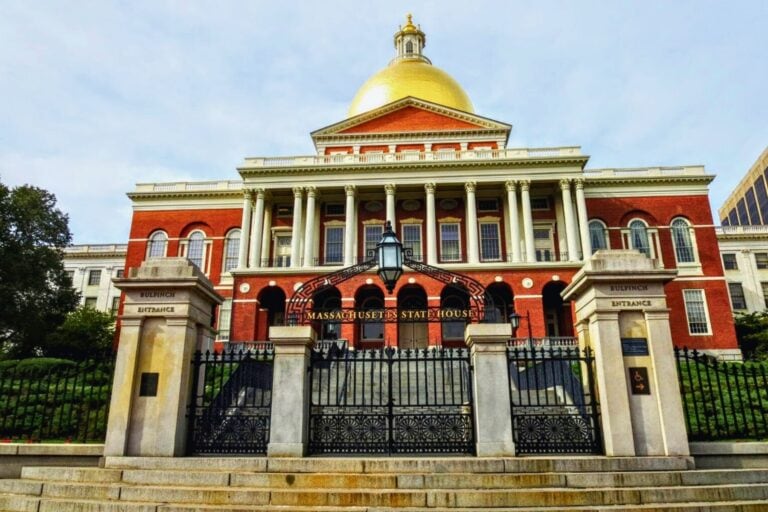
Nearby stands the Massachusetts State House with its stunning golden dome, which is gilded in 23-karat gold leaf. It was completed in January 1798, seven years after the United States gained its independence from England.
It was from these stately halls that Sam Adams governed Massachusetts for four terms.
The trail ends in the Boston Common. America’s oldest public park, its 44 acres evolved from a field for grazing cattle and hanging pirates to a convivial green space for all to enjoy.
Walking along the Trail, we experienced the rich and eclectic neighborhoods of Boston and Charlestown’s waterfront. All told, there are 16 historical stops on the trail. Each one delving into the powerful history of Boston and the American Revolution.
To celebrate Boston and America’s independence, we strolled a few blocks south of the Common to an iconic Beacon Hill tavern, Cheers, famously the inspiration of a beloved TV show. It seemed only appropriate to doff a couple of pints in honor of freedom with one of Boston’s own brews, Sam Adams.
Read More: From Settlers to Revolutionaries: A Journey Through Jamestown, Williamsburg and Yorktown
If You Go: Boston’s Freedom Trail

Getting There: Logan International Airport is 20 minutes from downtown Boston and well-served by major carriers. If you’re renting a car, Discover Cars is worth checking for competitive rates, though Boston’s walkable neighborhoods mean you may not need one once you’ve arrived.
Getting Around: The Freedom Trail is a self-guided walk of about 2.5 miles. The Freedom Trail Foundation offers maps, ranger-led tours, and a useful trip planner on their website. If you’d prefer a guided experience, both Viator and GetYourGuide list a range of walking tours, including evening lantern tours that tell the story with a little more atmosphere.
Where to Stay: Staying in the North End or near Beacon Hill puts you within easy walking distance of nearly every stop on the trail. Browse Boston hotels on TripAdvisor to compare options across neighborhoods and budgets.
Key Sites
- USS Constitution — Free admission. Open Wednesday through Sunday; check the NPS site for seasonal hours.
- Freedom Trail — Self-guided maps are free; ranger-led tours run April through November.
- Visiting Boston — The city’s official visitor guide with event listings, neighborhood info, and transportation tips.
Need a hand planning your trip? Here are the sites and services we rely on most, from booking tools to travel products we love.
Inspire your next adventure with our articles below:
- Remember Fort Mose: The First Free African Settlement in North America
- New Bern: North Carolina’s Historic Waterfront Town You’ve Never Heard Of
Want to discover more hidden gems and helpful travel tips? Join our free newsletter for the latest travel secrets and travel articles.
We are reader-supported and may earn a commission on purchases made through links in this article.

- 36 Hours in Milwaukee: Harley History, German Flavors and Lakefront Walks - October 25, 2026
- Yellowstone Digital Detox: A Week Off the Grid - October 15, 2026
- A Swiss Village, Lakeside Mansions and Door County Bluffs: Fall in Wisconsin - October 3, 2026
Planning another trip soon? ✈️
Add GoWorldTravel.com as a preferred source on Google. Click the button below so our local guides, packing hacks, and hidden-gem itineraries always show up first when you search!
Add to Preferred Sources