
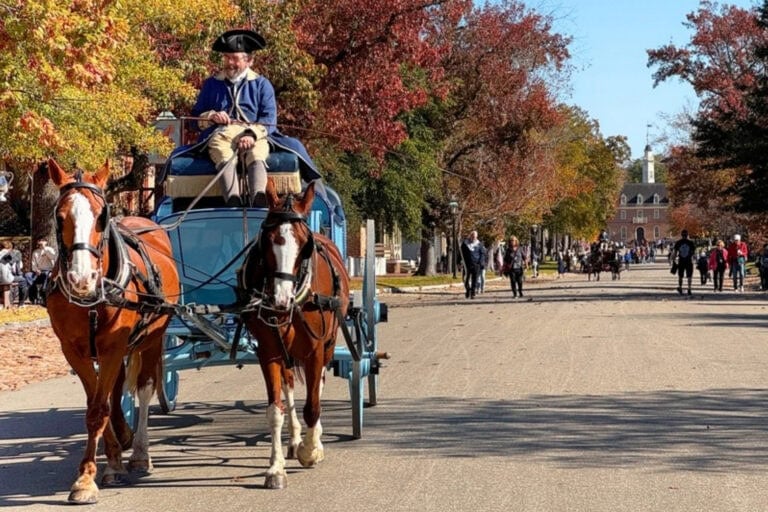

A Journey Through America’s Historic Triangle
Most stories celebrating America’s birthday start in the 1770s, as if the Revolution sprang from a couple of years of grumbling by colonists and wrapped itself up by the end of the decade. Yet, the path to independence was longer, rougher, and far more tangled than that.
During America’s 250th anniversary celebration, one of the best places to trace America’s European origins is the America’s Historic Triangle — Jamestowne, Colonial Williamsburg, and Yorktown in southeastern Virginia, near Norfolk. Visitors can journey through nearly two centuries of colonial history, starting with the first permanent English settlement and continuing to the site of Washington’s victory over Cornwallis at Yorktown, effectively ending the Revolutionary War.
Start at Jamestowne in Jamestown, Virginia

Jamestowne is the first permanent English colony in North America. Originally, the colony was spelled “Jamestowne” with an “e,” reflecting early 17th‑century English spelling conventions. Over time, as English spelling standardized, the “e” was dropped in common usage, so the modern town and general references use “Jamestown,” while the historic site and some institutions deliberately keep “Jamestowne.”
If the spelling of the site’s names isn’t confusing enough, there are actually three different sites to visit, all with separate admissions.
- The National Park Service operates Historic Jamestowne along the banks of the James River, including the main visitor center, interpretive galleries, and exhibits about the site’s history, the glasshouse demonstration nearby, nature trails, and much of the island’s grounds.
- If you want to discover the remains of the James Fort site and see an active archaeological dig, walk through the national park to the Jamestown Rediscovery, which is operated by Preservation Virginia. If you’ve come this far, it’s worth the extra money to buy the combo ticket for both sites. Make sure to visit the church tower still standing from the 1600s along with the memorial church built in 1907 to commemorate the 300th anniversary of Jamestown.
- Jamestown Settlement Museum — Just down the road from Jamestowne is the kid-friendly Jamestown Settlement Museum. For my money, this is the most comprehensive and interesting museum to trace Jamestown’s beginnings in England through the first century of Virginia colony life. The museum gives plenty of credence to the experience of the Powhatan Indians and the West Central Africans as the English established dominance in the area.
Beyond the 30,000-square-foot exhibits and galleries, go outside where kids will love stepping aboard full-sized replicas of the three ships — Susan Constant, Godspeed, and Discovery — to sense the magnitude of the Atlantic crossing made by 144 English hopefuls. Explore life-size recreations of a 17th-century fort and a Native American town and meet historical interpreters who demonstrate daily life in the 17th century.
If you want to see Jamestown and Yorktown in one day without juggling tickets or logistics, this full-day Historic Guided Tour covers the Historic Triangle in chronological order, includes transportation, expert commentary, and a Colonial-style lunch.
Click here to book the Historic Guided Tour.
Move with Virginians to Middle Plantation, Renamed to Williamsburg, Now Known as Colonial Williamsburg, Virginia

In 1698, after a fire burned the Jamestown State House, the Virginia General Assembly voted to relocate the capital to Middle Plantation. Although farther away from the Atlantic Ocean, the town was already well established with a church and businesses, along with the new College of William & Mary. The town, renamed to Williamsburg in honor of King William III, offered higher ground and a healthier environment away from a marshy site with mosquitoes.
Williamsburg served as Virginia’s colonial capital until the seat of government moved to Richmond in 1779.
At the initiation of Reverend W. A. R. Goodwin and millions of dollars from John D. Rockefeller Jr, Colonial Williamsburg came back to life in the early 20th century. They purchased, demolished, and restored buildings in the old section of Williamsburg, reconstructing lost structures such as the Capitol and Governor’s Palace, preserving surviving ones along Duke of Gloucester Street, and creating a non-profit organization that boasts the restored town as the world’s largest living history museum.
Unlike an amusement park or museum, there is no gated entrance, and people can freely access the city streets. Here’s what to do in Colonial Williamsburg:
Free Activities

- Stroll cobbled streets such as Duke of Gloucester Street, admire historic buildings and gardens from outside, and watch interpreters in period dress going about their day.
- Visit the Art Museums of Colonial Williamsburg (Abby Aldrich Rockefeller Folk Art Museum and DeWitt Wallace Decorative Arts Museum) for exhibits on folk art, decorative arts, historic clothing, archaeology, and early American music—no ticket needed.
- Catch public street performances, including a daily 18th-century Fifes & Drums March.
- The taverns and restaurants are open to the public without an admission ticket.
Kid and Young Adult Friendly (show admission ticket at each venue)

- Witness a remarkable array of historic trades by skilled artisans using authentic 18th-century tools and techniques in working shops that include a blacksmith, a wigmaker, a bookbinder, a carpenter, and others.
- Interact with historical interpreters portraying bakers, merchants, and tradespeople.
- Explore a variety of restored 18th-century buildings such as a jail, a school, churches, colonial homes, and shops.
- Visit the camp of an American Indian delegation, who regularly came to Williamsburg to discuss trade, warfare, and diplomacy.
- Throughout the area, witness more than 100 breeds of animals, including chickens, sheep, horses, and oxen.
Adult Oriented
- Tour the State Capitol building, designed by Thomas Jefferson. Seminal debates on American Independence took place here.
- Visit the Governor’s Palace, once home to royal governors and early elected leaders like Patrick Henry and Thomas Jefferson. Visitors can enjoy guided tours throughout the day, exploring more than 60 rooms filled with period furnishings, grand woodwork, and personal artifacts. Be sure to spend time walking through the Palace’s beautiful gardens and intricate maze.
- Listen to speeches at town meetings by so-called Nation Builders from Virginia, such as Patrick Henry, stirring crowds with cries for liberty, or James Madison debating constitutional visions. Visitors are welcome to ask questions of the actors who stay in character.
- Engage with Williamsburg citizens of the era, such as midwives, tavern owners, enslaved people working in trades, women navigating new roles, and artisans debating independence, war anxieties, and the roots of American freedom. Like the Nation Builders, remain in character.
- Tour the Williamsburg home of John D. Rockefeller Jr. and wife, Abby Aldrich Rockefeller. Explore rooms furnished with Mrs. Rockefeller’s folk art, 18th-century antiques, and 20th-century accessories.
Last Stop: The American Revolution at Yorktown in Yorktown, Virginia

Now that you’ve followed the English settlers in 17th-century Jamestown and met everyday citizens in 18th-century Williamsburg, it’s time to explore the colonists’ uprising against King George III and the English crown at Yorktown.
American Revolution Museum at Yorktown
Begin at the American Revolution Museum at Yorktown, where indoor galleries and outdoor living-history areas work together to tell the story of how a revolt led to the birth of a nation.
- Start with “Liberty Fever”, an introductory film that uses sound, special effects, and personal narratives to set the emotional stakes of the war.
- Spend time with the museum’s documents and interpretive panels that highlight the Declaration of Independence. See the rare 1833 Force printing of the Declaration of Independence.
- Walk through galleries that trace the escalating conflict between the colonies and Britain with artifacts, immersive media, and battlefield vignettes leading up to the Siege of Yorktown.
- Step outside to the Continental Army encampment, an outdoor living museum where interpreters demonstrate 18th-century military life, from artillery drills and musket firings to cooking over open fires and tending to the sick.
- Continue to the Revolution-era farm, complete with fields, a tobacco barn, and reconstructed slave quarters that show how the war touched planters, tenant farmers, enslaved people, and free Black communities.
Yorktown National Historical Park

Finish nearby at Yorktown National Historical Park, where the British surrender effectively sealed American independence.
- Drive or walk the battlefield routes to see the earthworks, redoubts, and artillery positions that shaped the final confrontation between British troops, Continental soldiers, and their French allies.
- Join ranger talks or guided walks that explain battlefield tactics, diplomacy, and the global impact of Cornwallis’s surrender.
Together, the museum and park turn Yorktown from a mere “final battle” into a place where visitors can see, hear, and feel how revolutionary ideals—and the Declaration that expressed them—were tested on real ground and in real lives.
If You Go

How to Get to America’s History Triangle in Southeastern Virginia
All the attractions at America’s Historic Triangle are located right off I-64, east of Richmond and just west of Newport News and Hampton.
Ticket Options for America’s Historic Triangle
Admission prices for each attraction in Virginia’s Historic Triangle vary, with single-site standard adult tickets typically ranging from $30 to $35 for places such as Colonial Williamsburg, Jamestown Settlement, and the American Revolution Museum at Yorktown. For maximum value, consider the America’s Historic Triangle Ticket, a multi-day ticket that includes most of the museums and attractions. Click on this link for more information: America’s Historic Triangle Ticket
Sail250 as part of America’s 250th Anniversary Celebration
As the 250th anniversary festivities fill Virginia with patriotic energy, don’t miss the chance to witness history on land and water—especially when more than 60 tall ships from across the globe sail into Norfolk and Hampton Roads this June for Sail250 Virginia, the nation’s signature Parade of Sail. In this milestone year, the Historic Triangle stands at the crossroads of past and present, inviting new generations to celebrate America’s journey where it first began and where its independence was won.
Need a hand planning your trip? Here are the sites and services we rely on most, from booking tools to travel products we love.
Inspire your next adventure with our articles below:
- Gettysburg National Military Park: A Visit to Hallowed Ground
- Fort Pulaski National Monument: Civil War Engineering on Georgia’s Coast
Author Bio: For more than 40 years, R.C. Staab has been a tourism and culture expert who has been quoted by and had photos published in numerous publications, including the New York Times, USA Today, the Wall Street Journal, the LA Times and CNN, and is a frequent contributor other than New Jersey Monthly magazine. He wrote 100 Things to Do at the Jersey Shore Before You Die, now in its second printing, and New York City Scavenger: The Ultimate Search for New York City’s Hidden Treasures. He has traveled the world and visited 49 of the 50 states seeking adventure, admiring museums, culture and history and climbing sand dunes from Namibia to Idaho. He has snorkeled with killer whales in Norway, sperm whales in Dominica and humpback whales in Turks & Caicos, viewed polar bears up close on the Hudson Bay, hiked the Amazon in Ecuador, trekked Machu Pichu, climbed up 10,000 feet to the Tiger’s Nest in Bhutan, hiked through rain, snow and sunshine on New Zealand’s best one-day hike and hung out with black bears at the Alaska Bear Camp. He lives in New York his wife, Valari, and dog, Skye.
Want to discover more hidden gems and helpful travel tips? Join our free newsletter for the latest travel secrets and travel articles.
We are reader-supported and may earn a commission on purchases made through links in this article.

- Kagawa, Japan Is the Udon Capital—Where to Eat Sanuki Noodles and How to Get There - September 28, 2026
- I Went to Istanbul for Five Days. I Am Still Not Over It. - September 28, 2026
- Inside Hawaii Island’s Lava Tubes: Nāhuku, Kaumana and a Guided Cavern Near Hilo - September 27, 2026
Planning another trip soon? ✈️
Add GoWorldTravel.com as a preferred source on Google. Click the button below so our local guides, packing hacks, and hidden-gem itineraries always show up first when you search!
Add to Preferred Sources