
The First Underground Railroad for Escaped Slaves Didn’t Go North, It Went South to Florida
In the 1730s, it was a terrifying experience to be a runaway slave. That’s the first thought you have when walking the “Flight to Freedom Trail” at Fort Mose State Park in St. Augustine, Florida. The quarter-mile trail tries to simulate the horrors and difficulties of escaping bondage.
At this time, thousands of enslaved men and women in South Carolina and Georgia had been abducted from West Africa and transported in chains to a strange continent where they did not speak the language. It might have been easy for them to slip away from a plantation in the dead of night, but then what?
You couldn’t travel by road in daylight because slave catchers with dogs would be on your tail. Capture meant a whipping or worse. Without maps or a compass, what direction to head? Food and shelter would be difficult, if not impossible, and the terrain was terrible… humid swamps and dense hammocks with biting insects, snakes, and alligators.
But to many, the reward was worth the risk because at the end of the journey was Fort Mose (pronounced Moh-say), a little settlement and stockade two miles north of St. Augustine, Florida. Tales of this wonderful place spread throughout the enslaved communities of the South because Fort Mose was unlike anywhere else. It was the first legally sanctioned free African settlement in North America.
How Fort Mose Became Free
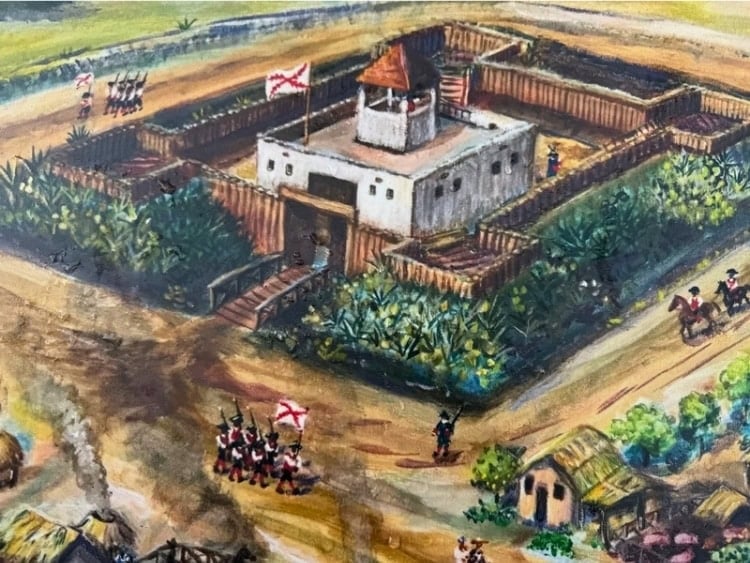
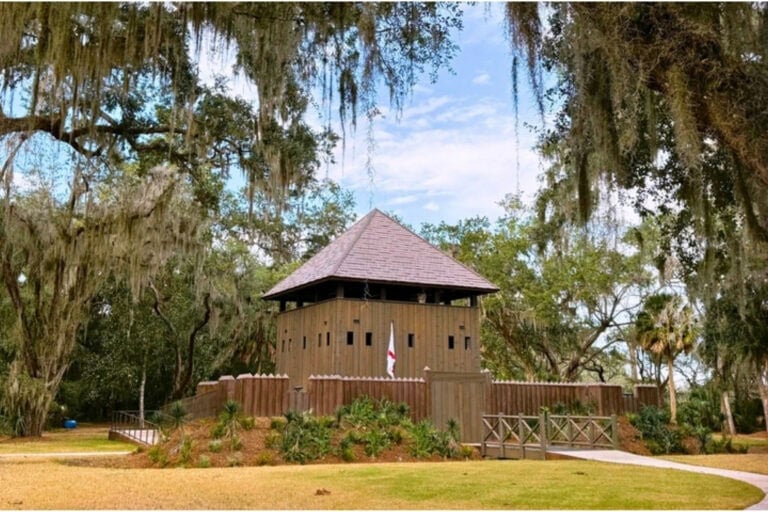
The almost forgotten story of Fort Mose is brought to life at Fort Mose State Park. The actual location of the fort and settlement is now mostly underwater or on small islands that can be seen from a wooden walkway. However, a short distance from the real site, a fantastic replica of the fort has been built with a blockhouse and wood stockade brimming with small swivel cannons. Kids love the fort and can imagine standing on the ramparts beside freed slaves fighting off pirates, Native Americans, and British redcoats, all of which happened here.
The nearby museum has a film and exhibits that tell the remarkable story of the fort, which is an important part of African American history. The first Underground Railroad for escaped slaves didn’t go north; it went south and ended here. In the year of America’s 250th anniversary, this is a piece of history that needs to be remembered.
As a bonus, the fort is located just minutes from colonial St. Augustine, which makes a wonderful base with its other massive fortress and brick pedestrian streets lined with taverns, restaurants, and hotels.
The Oldest European Town in America: St. Augustine

The story of Fort Mose begins in 1565 when Spain had a problem. Cortez had conquered and looted Mexico, filling huge treasure ships with gold and silver bound for Europe. However, these ships had to sail up the coast of Florida to catch the Gulf Stream that would carry them to Spain. And wherever there was treasure, there were also pirates! To fight these buccaneers, in 1565, Spain sent an expedition of 800 men and women under Don Pedro Menendez de Aviles to lay out what was destined to become the oldest continually inhabited city in North America.
In the beginning, life in St. Augustine was hard. It was nearly impossible to grow food and the first nine wood forts were all destroyed by pirates. The infamous Sir Francis Drake burned the town in 1586, 34 years before the Pilgrims landed at Plymouth Rock.
Finally, in 1672, Spain had enough with wood forts and construction started on the Castillo de San Marcos – the oldest and best-preserved stone fortress in the U.S. Today, the huge diamond-shaped citadel is a National Monument. You can walk along the top of 28-foot-tall walls, defend the drawbridge, climb out on the bastions for a view of the harbor, and watch cannons being fired by re-enactors in blue Spanish uniforms with officers yelling orders in Spanish.
The fort was built of coquina, a soft local stone made of compressed shells. When the British attacked in 1702, the soft stone absorbed the cannonballs without crumbling, and the fort held out for 50 days. The fort was never captured.
Read More: America’s Oldest City: Top 10 Things To Do in St. Augustine, Florida
Slavery in St. Augustine

Among the people who built the Castillo were many enslaved Africans. Spain allowed slavery, and there had been enslaved Africans in the first expedition to Florida in 1565. Slavery in Spain differed from other European countries and was less about race, as Black, White, and Indian people could be enslaved but also had the opportunity to buy their freedom or earn it by accepting the Catholic Church and serving in the military for two years.
This was different than the British system in the 13 colonies, where slaves were treated as property (chattel), and anyone born of a female slave was also enslaved. In total, the British transported an estimated 3.4 million enslaved Africans to the Americas, about a quarter of the 12.5 million enslaved ultimately taken from Africa by England and other nations.
It’s no wonder the freer enslaved system in Florida was appealing to the enslaved in Georgia and South Carolina and the first escaped slaves arrived in St. Augustine in 1687. The newly freed slaves adopted Spanish names and customs, but with an African flair.
Just as Native Americans regarded themselves as members of different tribes, freed enslaved in Fort Mose did not think of themselves as African, but rather as members of four distinct ethnic and linguistic groups from where they came: Mandinga, Carabali, Congo, and Mina.
In gratitude for the contributions freed slaves made to Spain, in 1738, the Spanish Governor of St. Augustine, Manuel de Montiano, offered freedom to all enslaved who escaped from English colonies and created a town for them called Garcia Real de Santa Teresa de Mose, or Fort Mose for short.
The small community was self-sufficient and independent, with thatched huts around a fort. When 19 slaves escaped from English Jamaica and came to Fort Mose, their previous “owner” went to St. Augustine and demanded their return. He was shocked when Spanish authorities not only refused, but his formerly enslaved workers laughed at him during his efforts.
The fort was under the civic and military leadership of Captain Francisco Menendez, a remarkable man of Mandinkan descent. Born on the Gambia River, he was captured and sold to South Carolina, where he escaped, fought the British, and migrated to Florida. He spoke Spanish and led the Fort Mose Militia, a tough regiment of freed slaves clad in the blue uniforms of the Spanish.
War Comes to Fort Mose

By 1739, the majority of people living in South Carolina were enslaved Africans. Inspired by stories of freedom in Florida, a literate enslaved man named Jemmy from the Kingdom of Kongo started a slave revolt with the intent to reach freedom at Fort Mose. What came to be called the Stono Rebellion was the largest slave uprising of the colonial period, in which possibly 40 colonists and 50 African slaves were killed or executed. Only a few of the runaways made it to Florida.
In retaliation, in 1740, a British naval force attacked St. Augustine. Recognizing the strategic importance of Fort Mose, which guarded the northern entrance to the bay, a land force of 170 British and Scottish Highland troops attacked and captured the fort, forcing the Black inhabitants to flee to the much larger citadel in St. Augustine for protection.
But not for long. On June 14, 1740, in a surprise attack two hours before dawn, 300 Spanish troops and a force of Black Militia and Seminole Indian Auxiliaries under the command of Captain Menendez stormed the British force and, in dreadful hand-to-hand combat of swords and bayonets, almost annihilated the enemy, killing 75 and capturing 34. The defeat caused the English to retreat to Georgia.
Menendez was a hero….to the Spanish. To the British? Well, of course, they considered him a pirate! The thrilling battle is re-enacted every year with troops in authentic uniforms; the next one takes place on June 27, 2026.
After the Battle of Bloody Mose

The fort was destroyed in the battle that came to be called Bloody Mose and the town was abandoned. A year later, in July 1741, Menendez was sailing on a Spanish ship to Havana to be rewarded for his bravery when a British privateer called The Revenge captured him.
At first, the British wanted to castrate the pirate Menendez and he was tied to a gun to await punishment, but many of the white Spanish crew came to his defense. In the end, the British gave him 200 lashes and “pickled” him, that is, they ran salt and vinegar onto his wounded back to increase the pain. He was brought to the Bahamas and sold as a slave.
No one knows exactly what happened to him for the next 11 years. He definitely escaped and might have been a pirate, but certainly once again showed up in St. Augustine in 1752, where he rebuilt Fort Mose. A second Black community was established here and thrived with 3,000 residents, three-fourths of them escaped enslaved.
Then in 1763, tragedy struck. In a peace treaty to settle European wars, Florida was traded from the Spanish to the English. This would have meant a return to slavery for the inhabitants of Fort Mose, so instead, in one of the great ironies of history, they fled to a place where they could still be free. Cuba.

Fort Mose was abandoned and slowly faded back into the swamp. In 1821, Florida became a territory of the United States and a slave state. A public slave market was built in the center of St. Augustine in 1824, where slaves could now be sold.
A hundred years later, in the 1960s, this slave market became a focal point of demonstrations during the Civil Rights movement. On the evening of May 28, 1964, while Dr. Martin Luther King was staying in town, a team of his supporters, including Andrew Young, led a march of some 400 people to the site of the Old Slave Market in the town square. Upon arrival, they were attacked by 250 whites wielding bike chains and tire irons. The cops looked on but did not act.
St. Augustine Today

Amazingly, after surviving centuries of hurricanes, bloody warfare, and racial strife, the settlement of St. Augustine, originally located in the middle of nowhere on the edge of swamps filled with mosquitoes, has grown into one of the loveliest and most beautiful cities in the New World.
It is a place of incredible charm with brick pedestrian streets lined with quiet plazas and outdoor cafes shaded by palm trees. There is a European feel, highlighted by something rare in North America – the great stone citadel that sits squarely in the center of the town.
There are cute little shops and art galleries. Spanish moss hangs from the trees and dozens of 100- and 200-year-old buildings that have been repurposed into museums, antique stores, pubs with jazz and live music, and candlelit restaurants. It’s like Williamsburg with bars. But don’t forget, this is St. Augustine. Which means even the oldest buildings can only date back to 1702. That’s the last time pirates sacked the city and burned it to the ground.
St. Augustine Pirate & Treasure Museum

After you’ve toured Fort Mose, head two miles into town to the St. Augustine Pirate & Treasure Museum. This is the largest and most authentic collection of pirate artifacts ever displayed under one roof. Of course, there are not many pirate artifacts. Most of the pirates were hanged or killed in battle (Blackbeard went down with five bullet holes and 20 sword cuts, and they sliced off his head for good measure).
But the museum is a lot of fun and you can see Blackbeard’s blunderbuss, one of the three remaining “Jolly Roger” pirate flags, the world’s oldest wanted poster, and Captain Thomas Tew’s original treasure chest – the only known authentic pirate chest in existence.
There’s also lots of gold and silver recovered from wrecks. Kids can fire a cannon and stare at the actual sword used by Captain Jack Sparrow in the movie Pirates of the Caribbean. The sword spins in a special case with dramatic lighting as if it were a priceless relic, and maybe it is.
Pirates had no color barrier, and both Black and White people served equally side by side on pirate ships, sharing in the booty and in the punishments. Captain Menendez is treated as a pirate here since the British considered him one. Blackbeard’s chief lieutenant was Black Caesar, a gigantic African chief who was enslaved and later became a pirate. He was captured during Blackbeard’s last battle and hanged in Williamsburg, Virginia.
St. George Street, the cobblestone, car-free main street of St. Augustine, looks like the setting of every pirate movie, with colonial buildings, pubs with wood signs, swaying palm trees, balconies, and rustic old lanterns. Yes, it’s a bit touristy, but much of it is authentic, and it’s certainly beautiful at night with the lanterns glowing and candles flickering in many of the windows.
Learn more about planning this trip at the Florida’s Historic Coast’s official website.
Need a hand planning your trip? Here are the sites and services we rely on most, from booking tools to travel products we love.
Inspire your next adventure with our articles below:
- A Rare Journey Into Mali: West Africa’s Time-Forgotten Kingdom
- Fort Pulaski National Monument: Civil War Engineering on Georgia’s Coast
Author Bio: Rich Grant is a member of the Society of American Travel Writers and the North American Travel Journalists Association and has been writing travel and history stories for four decades. He is always happiest when checking the box that says, “I am not a Robot.”
Want to discover more hidden gems and helpful travel tips? Join our free newsletter for the latest travel secrets and travel articles.
We are reader-supported and may earn a commission on purchases made through links in this article.

- Slow Down on Prince Edward Island: A Relaxed Four-Day Itinerary of Dunes, Seafood and Seaside Inns - September 25, 2026
- Two Sides of Cape Town: Table Mountain Trails, Winelands Dawn and Township Voices - September 25, 2026
- St. Pierre and Miquelon: Visit France Without Leaving North America - September 25, 2026
Planning another trip soon? ✈️
Add GoWorldTravel.com as a preferred source on Google. Click the button below so our local guides, packing hacks, and hidden-gem itineraries always show up first when you search!
Add to Preferred Sources
Damn, Rich, you made me feel that I really screwed up in not going on this tour.
Good work. Thanks.
Well done. Find yourself a classroom!