
It’s an old, ¾-of-a-century-old photo (actually a 35mm slide) of a 20-year-old sailor. Clad in service dress whites, he stands at parade rest on a rocky ledge.
His feet firmly planted, hands at the small of his back, and his “dixie” cap sitting jauntily with a slight slant toward the left eyebrow in youthful cockiness.
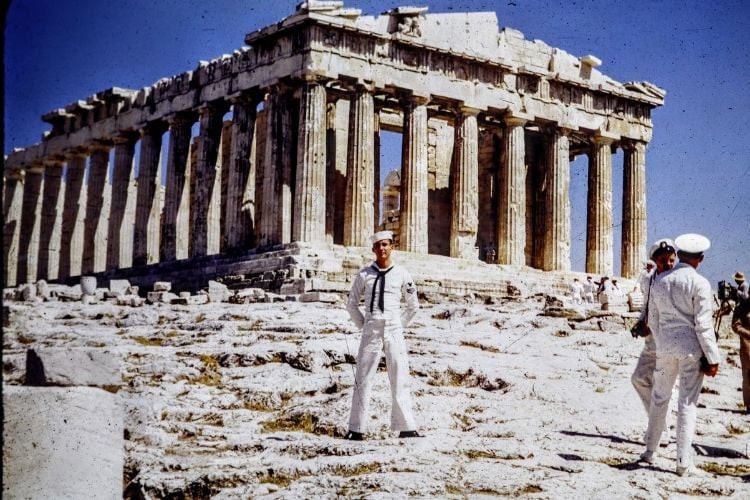
A hardboiled youthfulness framed by the Great Depression and a world at war. He looks unflinchingly at the camera. What catches my eye, though, is what monumentally towers up behind him, the Parthenon of Athens, Greece.
The Parthenon
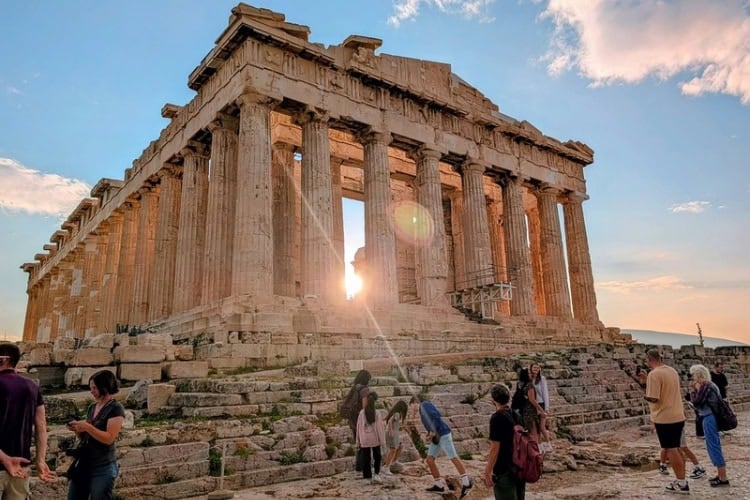
The Parthenon sits atop the Acropolis, which means “high city,” and stands as one of the most enduring symbols of ancient Greece and Western democracy. Athens’ most iconic monument has over 3 centuries of history.
The ancient heights it sits upon weren’t just a home to its religious center; it was a powerful symbol of Athens itself.
Perched high above the modern metropolis, the Parthenon has witnessed centuries of dramatic change, surviving occupations by Mycenaeans, ancient Athenians, Romans, Ottomans, and, briefly, even the forces of Nazi Germany.
Dedicated to the city’s patron, the goddess Athena, the temple was completed in 438 BCE. Constructed entirely of marble, the Parthenon represents architectural excellence—even in its reduced state today, it’s a zenith of Hellenic accomplishment.
Discovering a Shared Experience
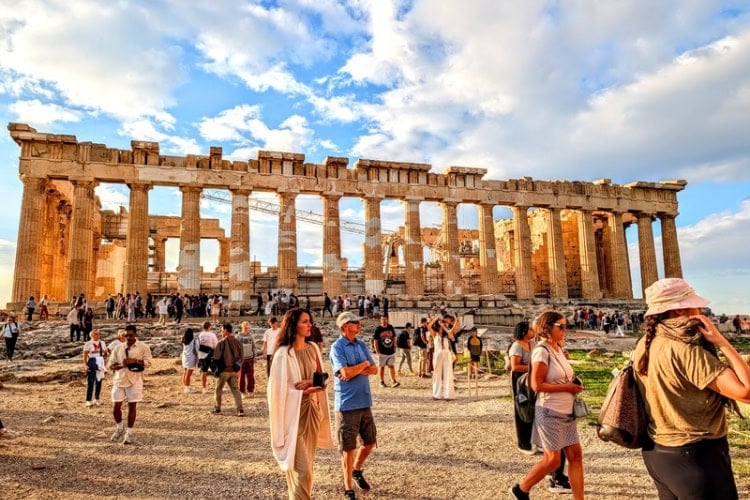
What I did not know is that this young man, a gentleman who I would not meet for another decade after the photo had been snapped, had stood on the very slopes of this citadel that I, myself, had stood upon.
It startled me, this image of washed-out colors framed in 2×2-inch cardboard. It represented a shared experience with a man who had so much impact on my young life, but one I could never question him about.
A Lost Link to My Past
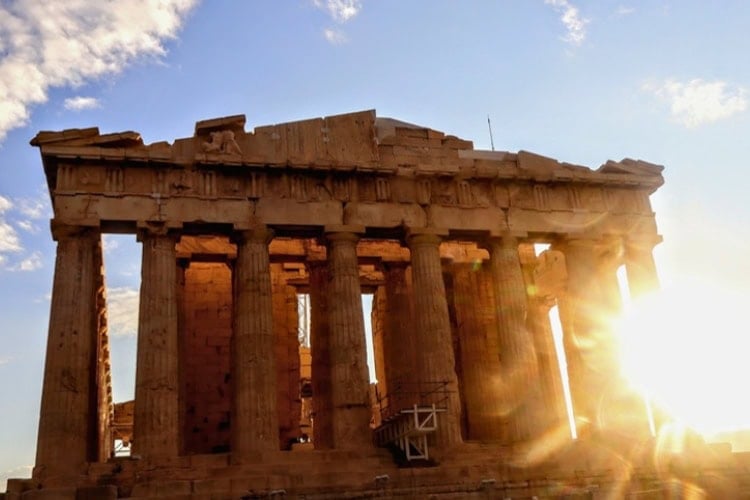
After one of those milestone moments in my life, I found time to dig into an ancient sea chest and its dusty contents.
In a wooden cigar box, I found a stack of photographic slides that had long been forgotten.
Beyond the dozens of photos that had little meaning to me, I found the instantly recognizable sailor upon his equally recognizable Grecian stage. It roused memories that assailed me.
The Sailor
He’d had a rich baritone that would rise above the dissonance of a room. A forceful personality that could unexpectedly drop a pun into that same room with the ease of a comedian, punctuated with a wicked grin.
He could be charming when he chose; he was thin, whip-cord tough, and handsome, but with a temper that could frighten like a lightning bolt out of a clear sky. And he was my father.
The picture was of a much more youthful version. Not as tight-lipped nor as weary as the man I knew, but definitely him.
I have other pictures, but this one of him standing on the steps of the Parthenon, the very one I had so recently stood before, was of an event I had known nothing of. What other adventures did John Donald Hosek have that I knew nothing of—what ones could we have shared?
First Visit to the Acropolis
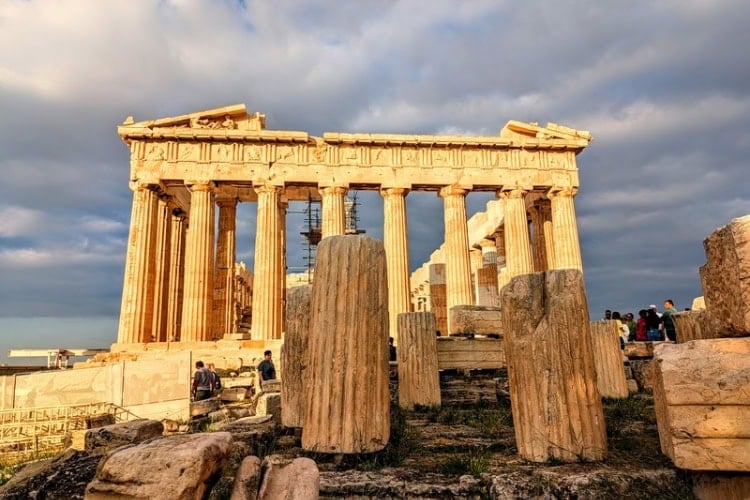
My wife and I visited Athens on a warm autumn day that saw the heights of the Acropolis bathed in sunshine.
Raised on American Midwest vacations of state park tent-camping out of the trunk of a Chevy sedan, in my ignorance, I thought we were the first in our families to see the great Parthenon.
This was a first stop on a much-anticipated Mediterranean cruise, partly to celebrate my retirement. Seeing the Parthenon was a must for me.
This massive ode to symmetry, created by utilizing non-symmetrical illusions, had captivated my mind since the earliest of my school days, in which a colorful, slightly curled photo hung from my second-grade bulletin board.
It sits tallest among a complex of temples that were the vision of Pericles (495–429 BC), the great Athenian statesman who oversaw the creation of most of the site’s exquisite structures.
The Parthenon is remarkable even in its reduced state. The weathered fragments scattered around it are being meticulously cataloged as efforts continue in its restoration.
It was reportedly the largest and, it is said, the most extravagant temple that Greece had ever seen. In its time, it housed a great gold and ivory statue of Athena.
Climbing to the Top
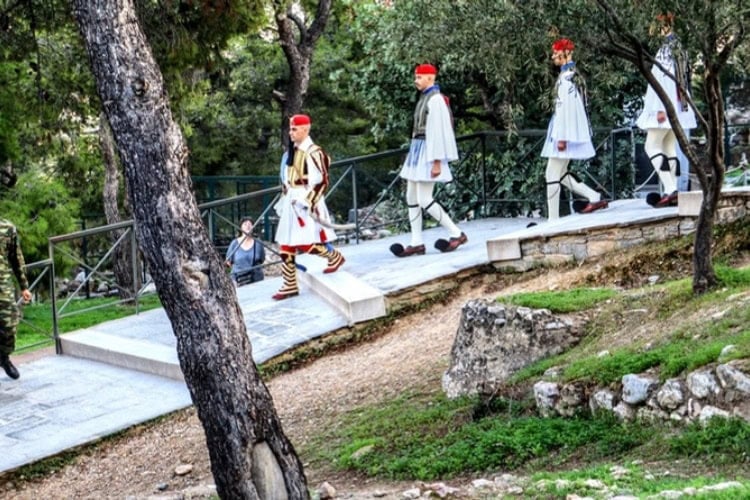
It’s early, the sun has yet to break across the Acropolis’s plateau, and we’re already surrounded by other tour groups as we all make our way upward on a steep trail toward the Propylaea, the massive entrance to the Acropolis.
Herded along in our newly assimilated packs, accompanied by the discordant tones of a myriad of languages, we stop abruptly.
Soon, the reason for the halt marches into view: a squad of the colorfully clad palace guard marching down the trail past us. They are returning from the morning ritual of raising the national flag atop the Acropolis.
Shortly, the herds are moving again, led on by their shepherds who, each in hand, hold aloft a placard, a pennant, or, in our case, an umbrella—a guidon for us to follow like so many scouts on the trail to another badge.
Greece’s Most Visited Site
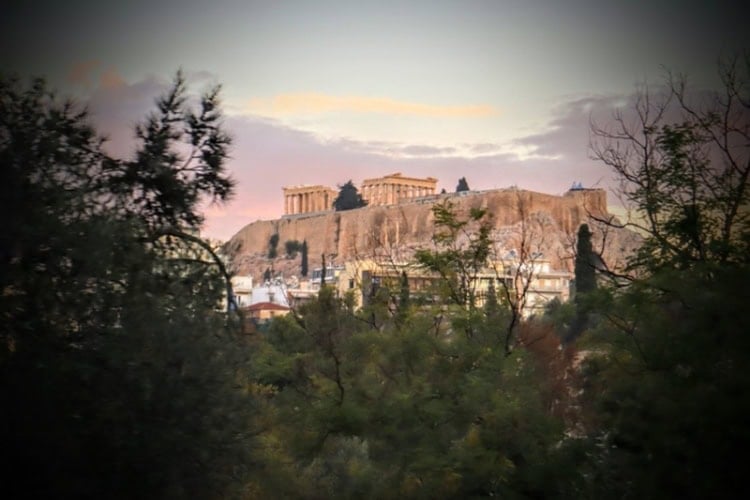
Impatient, I circle around our flock, leaving behind my understanding wife and friends. I bound up the massive steps and into the central hall of the Propylaea, with its columned wings extending on either side.
Its magnificent architecture and rich history continue to amaze visitors. Over 4.5 million people visited in 2024, with peak days seeing over 20,000 guests.
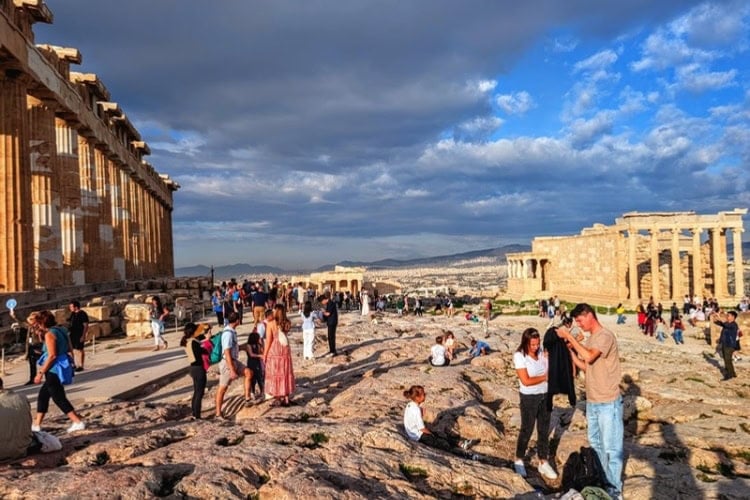
Exiting through the magnificent pillars of the Propylaia, following in ancient footsteps, my view is momentarily blinded by the mob around me before my eyes settle upon the massive Doric columns rising above their heads. I step off the path for a better view.
I am totally transfixed by an amazing vision! I am also totally dumbfounded, after the fact, to learn that another in my family had seen this remarkable sight.
A Different Time
My father was in the final year of his enlistment when he climbed to the top of the Acropolis.
Assigned to the USS Siboney, an escort aircraft carrier of WWII vintage, as an Aerographer’s Mate, they had sailed to Turkey to deliver a load of aircraft in the spring of 1948.
He seldom went into depth about his service years, nor did I press him on it, but I was broadly aware of his brief trip to the Med. However, I have no recollection of him mentioning a stop in the Port of Athens.
This could be due to the fact that Greece was in the midst of a post-WWII civil war pitting pro-government forces against communist-backed guerrillas.
Although the conflict had moved outside of Athens and into the interior, it was still a country in flux.
Yet he and several of his shipmates had made their way to this dynamic symbolism of democracy. Did his idealism reach that far, or did he simply view them as the deteriorating ruins of an ancient civilization? I wish I could ask that question and a host of others.
We had lost my father due to heart issues when I was 14, an age when I was beginning to seek a more in-depth knowledge of the loved ones in my life. Unfortunately, his story will always be incomplete to me.
My Dad’s View
In 1948, the Parthenon was still dealing with the effects of poorly executed 19th-century restorations and over two centuries of decay. However, many of the surviving friezes and sculptures would have still been in place.
There were no construction cranes or scaffolding engulfing the monument. He would have been able to climb the marble steps and enter the open-air interior.
He would have seen far more disorder scattered across the grounds—disassembled and fallen columns, blocks of marble, and stones. Concerted efforts of restoration were decades away.
On the other hand, unlike us or anyone else visiting on any given day this century, he did not have to deal with the crowds. Other than a few of his shipmates and one lone painter with an easel, there is no one else in the photograph.
The Caryatids
On the day that we climbed the summit, as I slowly eased my way through the crowds, the pinnacle came more fully into view.
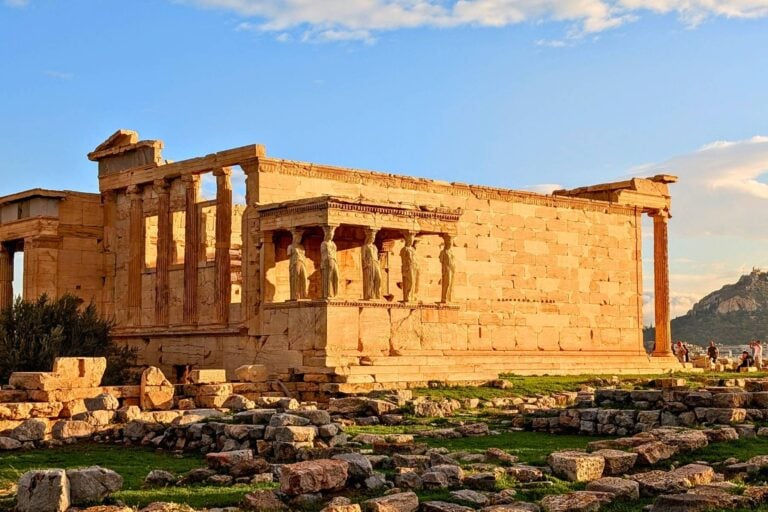
Before me stood the diaphanous-clad female figures of the famed Porch of the Caryatids. What I was looking upon were replicas; the originals had long since been removed to the Acropolis Museum for preservation.
Dad would have seen the original six marble maidens, who take the place of columns in supporting the upper moldings of the Erechtheion, the ancient temple on the north side of the Acropolis that honors Poseidon’s struggle with Athena for domination over Athens.
He may have noticed the centuries of physical deterioration due to weather and pollution. Did he notice the stoic suffering etched on their marble faces brought on by the burden they shouldered?
For us, the morning sun lifted the temple out of the shadows of the night, painting the marble in bright illumination, bringing life to the venerable blocks.
The Flag
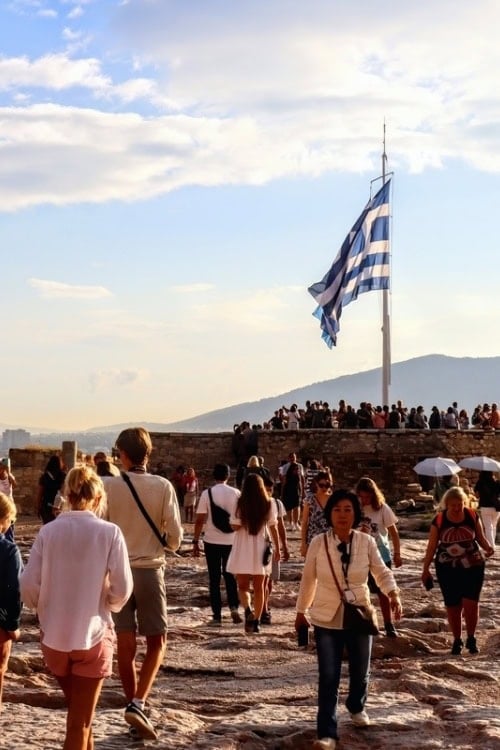
I wonder if he gazed upon the Greek flag that flies above the remains of a tower built during the medieval period of the Acropolis. If he did, was he aware of its unique history?
The flagpole holds a significant place in the hearts of Greeks.
It was here in 1941 that two teenaged Athenians scaled the Acropolis at night through an ancient passageway and tore down the swastika flag. The empty flagpole became one of the first and most famous acts of resistance against the occupying forces.
Shared Footsteps
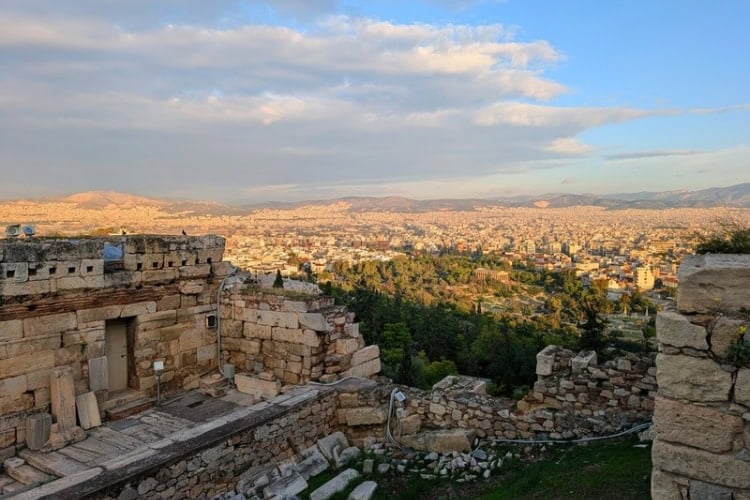
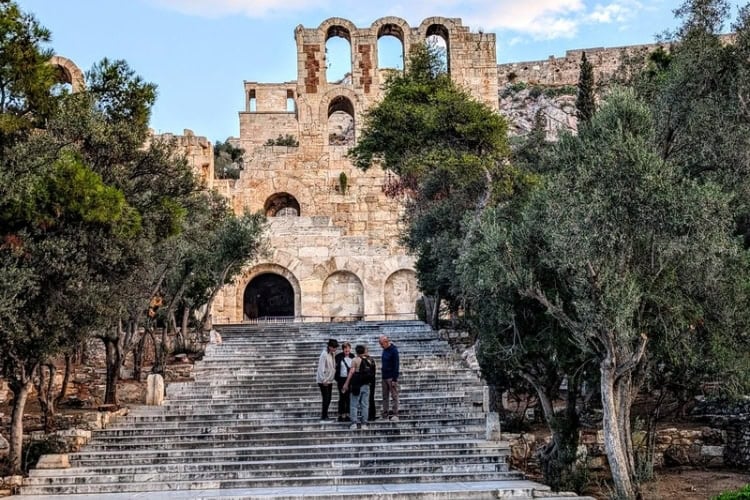
At the end of the day, I stood looking down upon the lower slope of the Acropolis at the Odeon of Herodes Atticus, a Greco-Roman amphitheater used for musical performances even today.
Behind me, the Parthenon, with its massive columns carrying the weight of Western democratic symbolism.
Athens was laid out in panoramic splendor all around us, a modern, bustling metropolis.
Was I standing on stone beneath my running shoes that my father’s leather-soled oxfords had touched? Did his thoughts lead him to the philosophical teachings of Socrates, Plato, and Aristotle? Or was he simply thinking about finding a cold beer in the Plaka below?
I wish I knew. Sometimes it’s those moments, the most surprising and unpredictable ones, that create the most profound thoughts.
The magnificent ruins had transfixed me; how had they affected the youthful sailor?
I will never be able to share the wonders of our travels with my father, but simply knowing that we may have walked the same path, seen the same mesmerizing beauty, gives me that emotional bond that I didn’t realize I still craved.
Read More: Go Off the Beaten Path to the Magical Island of Chios, Greece
If You Go
The Acropolis is open daily, with hours varying by season — generally 8 AM to 8 PM in summer and shorter in winter. Check the official site for current hours and to book timed-entry tickets in advance. Adult admission is €30; booking online ahead of your visit is strongly recommended, especially during peak season.
Guided Tours: A licensed guide makes an enormous difference at the Acropolis. The Acropolis and Parthenon Guided Walking Tour on Viator covers the Parthenon, Propylaia, Temple of Athena Nike, and more with skip-the-line access. For a deeper dive, the Acropolis and Acropolis Museum Half-Day Tour pairs the site with the museum, putting the sculptures and friezes in full context.
Need a hand planning your trip? Here are the sites and services we rely on most, from booking tools to travel products we love.
Inspire your next adventure with our articles below:
- Turning 70 on a Mediterranean Cruise Changed How I Think About Getting Older
- Six Countries, One Cruise: Exploring the British Isles with Viking
Want to discover more hidden gems and helpful travel tips? Join our free newsletter for the latest travel secrets and travel articles.
We are reader-supported and may earn a commission on purchases made through links in this article.

- The Great Lakes Shipwreck Museum: Honoring the Legend of the Edmund Fitzgerald - September 11, 2026
- Driving I-90 Across South Dakota: Badlands, Wall Drug and Roadside Icons - September 2, 2026
- Gettysburg National Military Park: A Visit to Hallowed Ground - August 31, 2026
Planning another trip soon? ✈️
Add GoWorldTravel.com as a preferred source on Google. Click the button below so our local guides, packing hacks, and hidden-gem itineraries always show up first when you search!
Add to Preferred Sources