
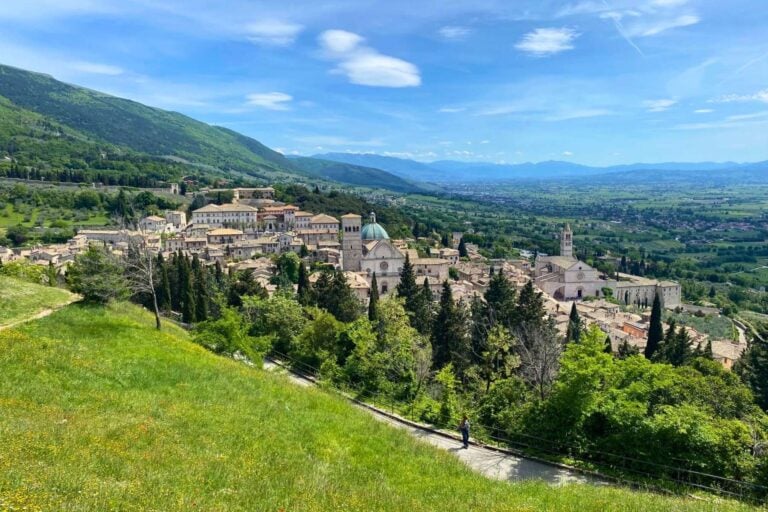
The small train station looked like something out of a Giuseppe Tornatore movie, with a tastefully subdued one-room bar/restaurant where a sojourner could immediately sit down and let the stress of getting somewhere slip away.
As soon as I arrived in Assisi, I could feel the alluring appeal of the place, as if the air itself had a relaxed texture to it, like a nice sofa one could comfortably sink into.
After sitting with a beer absorbing the place, I walked out into the quiet street, found a taxi driver, and showed him the address of Hotel Donnini.
“Only 10-minute walk. Go under bridge… there,” pointing, “and straight for Basilica di Santa Maria degli Angeli. Ten minutes.” With a pleasant smile, he made a walking gesture with his fingers.
When I came through the hotel doors, it was obvious “Jesepa” had been expecting me as she immediately tried to pronounce my last name from the computer screen before I even said a word.
Santa Maria Degli Angeli
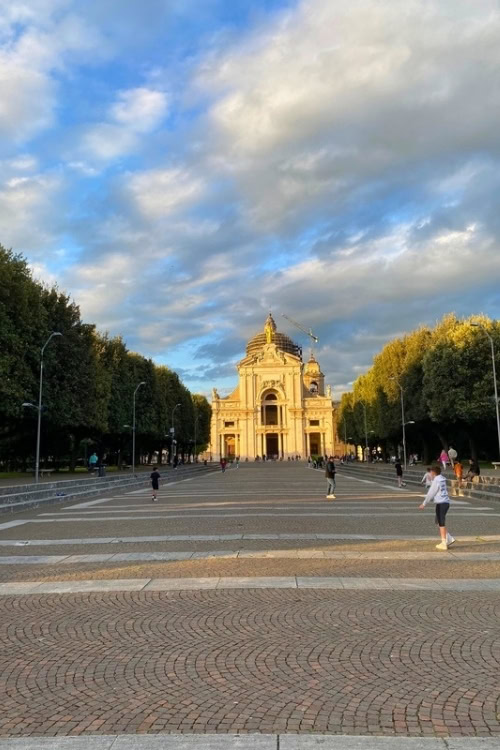
Santa Maria degli Angeli, located 15 kilometers (roughly 9 miles) below the medieval walls of Assisi proper, and where I would stay for two nights, is a frazione hamlet replete with local eateries and shops on small tree-lined streets.
After a short nap, I strolled back looking for dinner along the Viale Patrono d’Italia. I chose the Per Colpa di Eva restaurant, whose modest front didn’t prepare me for the exceptional meal I was about to have.
As it turned out, Per Colpa di Eva was a family restaurant with a proud history of serving good food, instilled in Tatiana and her husband by her parents and grandparents. I couldn’t resist coming back the following night.
A Saint’s Legacy Begins
I resolved to take a foray up to Assisi before my brother’s family arrived the next day. “It’s easy. Just take the C-Link bus. There’s a stop just on the other side of the train tracks,” Jesepa had told me at the hotel desk.
On the way, I decided to check out the Basilica di Santa Maria degli Angeli. Built in the 16th century, the basilica itself is impressive, but what I wanted to see was the small, simple structure inside.
This is the actual church Saint Francis built with his own hands in the 12th century, which began his legacy within Roman Catholicism. I could only picture the deeply forested backwater St. Francis labored in to build his church before the suburban environment it was now.
Stepping Into A Medieval Oasis
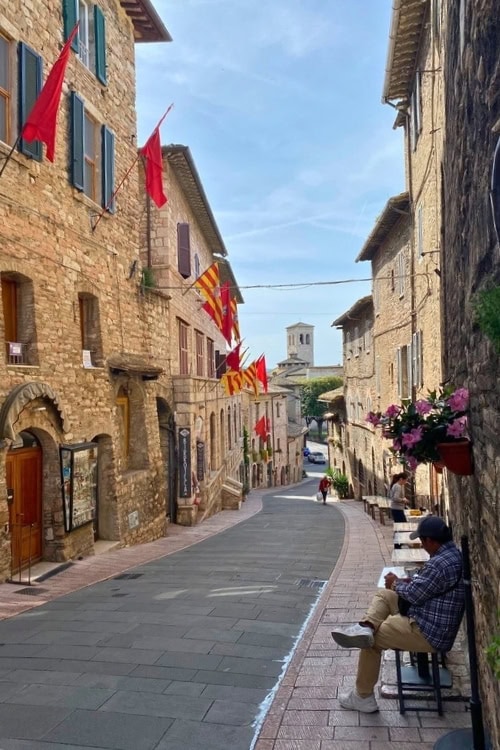
The bus up to Assisi dropped me off near the arched Porta San Pietro gate of the walled old town. I made my way up Via Fontebella. The street was full of every type of place: restaurants, cafés/bars, leather goods, art galleries, and quaint curio shops.
Life Behind Flower-Draped Doors
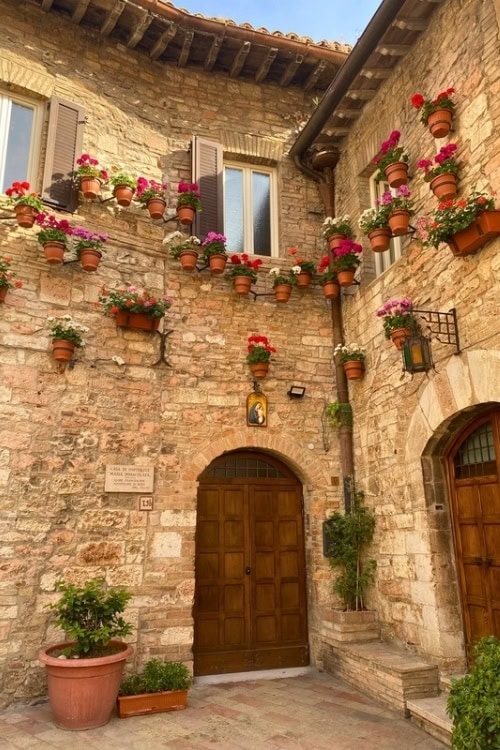
The old wooden doors of people’s homes who still reside in this medieval holdout were enough to make you pause and admire their sturdy artisan appeal.
I stopped at a street-side shop for a beer and a panino of wild boar salami and cheese. These popular sandwiches come in a cornucopia of varieties: pork neck, cheese, and truffle; bacon, cheese, and potato; ham and mozzarella; Umbrian salami, cheese, and arugula pesto; salami truffle and, of course, uninspiring vegetarian.
The epicurean version of fast food, they were always good to eat any given time I needed something to keep me going throughout the day.
A Glass of Stravecchio
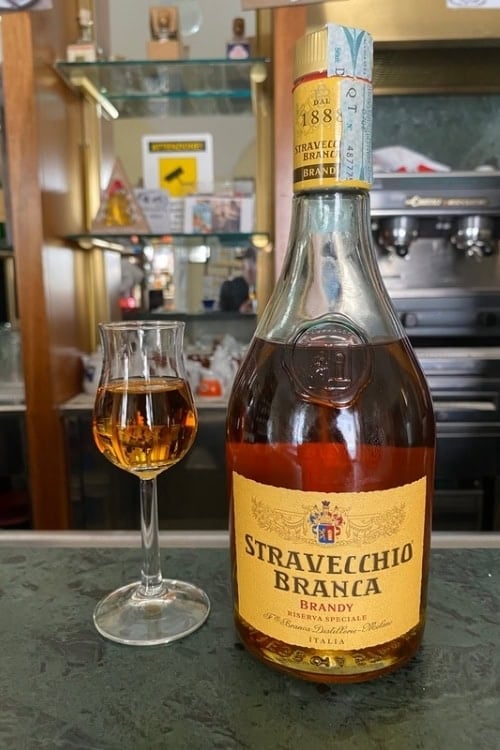
I stopped in a bar where I couldn’t help notice the Italianate spirits on the shelf. The owner recommended a glass of Stravecchio brandy. I sat outside and savored it as if it were a soprano aria sung by Tiziana Scandaletti.
Further on, one of the leather shops caught my eye. If you’re looking for the best quality leather, you go to either Italy or Spain… in that order. I walked out sporting a new belt that added a bit of local sartorial style to my waistline: handmade Assisi luxury at its finest.
Rocca Maggiore
It wasn’t long before I eventually found myself at the very top of Assisi, where the view from the citadel-fortress of Rocca Maggiore dominates over the Assisi Valley as it has for more than 800 years.
Actually composed of two fortresses, the Maggiore and the Minore, the formidable structure was the stomping ground to a historical cavalcade of kings, queens, emperors, dukes, duchesses, cardinals, and popes over the centuries, as well as used with cinematic panache by Italian director Franco Zeffirelli for one of his films.
A Move Into 15th-Century Luxury
It was time to relocate into the walled old town of Assisi itself. On the way, I saw a poster announcing the Calendimaggio festival that was set to begin the following day.
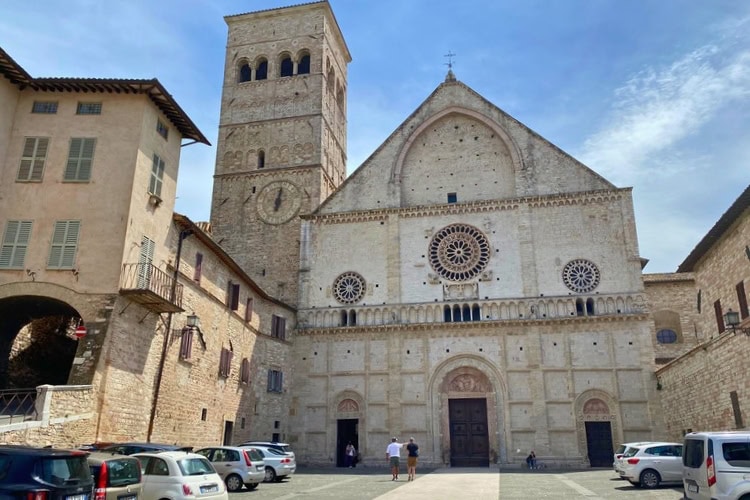
My brother and his family had rented a place in the upper part of the old city. It was a stunning 15th-century palazzo with four bedrooms and a spacious living room area with a view of the Duomo di San Rufino plaza and church where St. Francis himself had been baptized.
The glass doors of the nicely furnished kitchen led up to a terraced garden with a view of the upper town’s surrounding rooftops punctuated by San Rufino’s medieval dome. These were accommodations with historically elegant appeal.
It was apparently owned by a wealthy Italian family, whose roots in Assisi span generations, but who prefer to live in more fashionable Monaco. As such, their leftover meal was our feast.
When Assisi Comes Alive
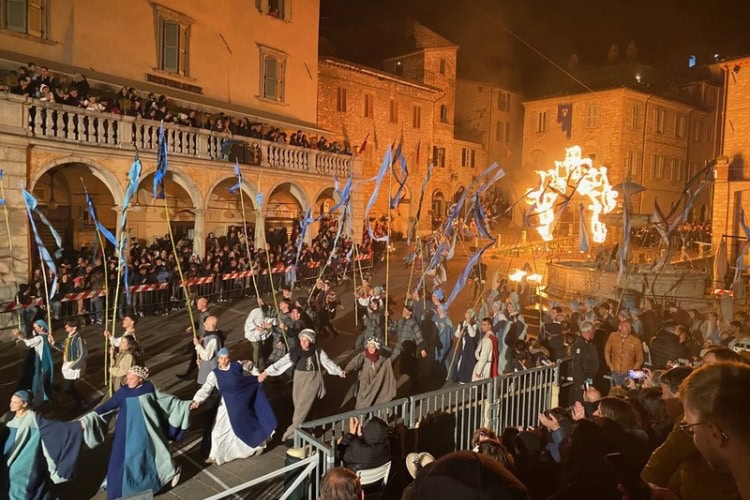
The Calendimaggio festival was to kick off late afternoon, so my brother and I took the morning and headed to Mount Subasio, where the thickly wooded sanctuary of St. Francis’ hermitage was located about 4 km from Assisi.
It was here that Francis and his devout companions withdrew for contemplation and a more austere life of intense prayer. As we explored the austere, but solidly built, layout of the monastery, we marveled at the spartan quarters where Francis himself resided.
It was on the trail grounds surrounding the hermitage complex that we felt the allure of this place. It was easy to see how this reclusive sanctuary in the forested hills above Assisi enlightened Francis’ mind to the Earth’s sacredness.
The birdsong was like water throughout the trees. The Merlin app on my phone identified the voices in the air: Eurasian Blackbird, European Robin, Eurasian Blackcap, Common Chaffinch, Common Redstart, Western House Martin, Great Tit, European Serin, Common Swift.
Descendants of the same species of birds that Francis and his cohorts would have listened to centuries before.
Read More: Walking the Via Francigena in Southern Italy: The Trail You’ve Never Heard Of
The Calendimaggio Festival
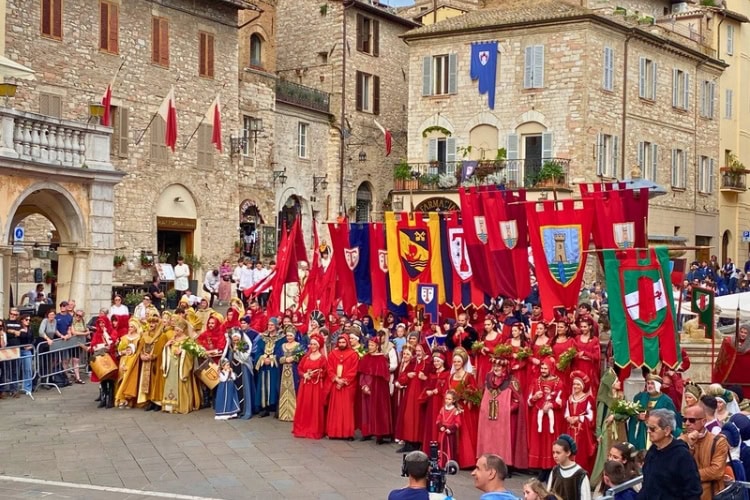
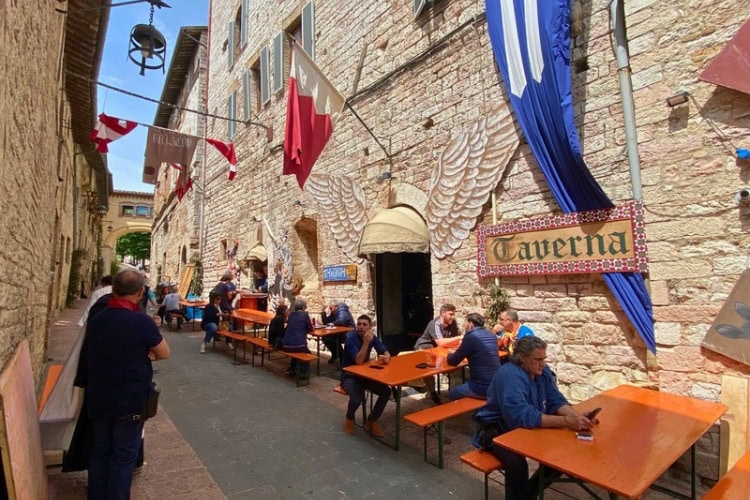
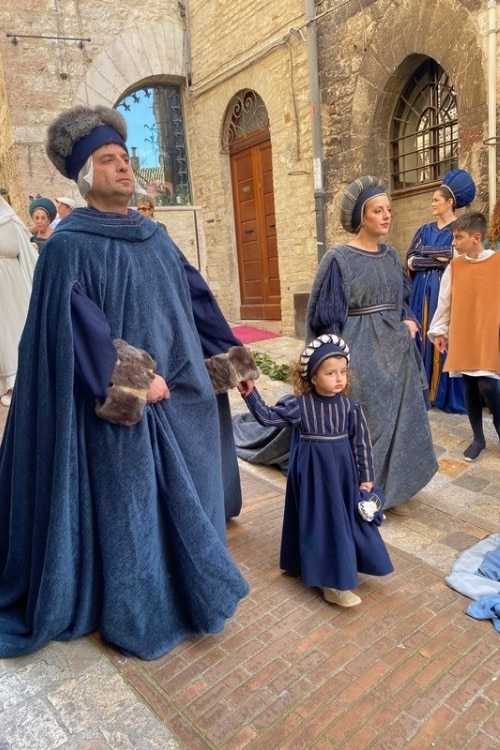
Later in the day, I found myself a world away from the tranquility of Mount Subasio. I was pinned on a small street, packed with a horde of characters in medieval costume: Sopra residents of Upper Assisi.
I was trying to get to the Piazza del Comune square, a mere twenty-five yards away from where I was stuck. The Calendimaggio Festival had begun, and the streets were ruled by an energy exhumed from the 13th century.
A cacophony of drumbeats hammered the air and bounced off the houses lining the narrow street. Eventually, the crowd began to move, and I, along with it, as if caught in a slow landslide.
This annual gala lasts three days and is an event that the residents of Assisi prepare for all year long. This is no extravaganza put together for tourists, but has become a cultural characteristic of Assisi’s identity with regard to its local history.
Over the course of a few days, the atmosphere of Assisi is transformed to its medieval past, resplendent with the sights and sounds, flair and pageantry of the Middle Ages.
The festival’s theme ultimately centers around the long-ago rivalry between two districts of the town, the upper Sopra and the lower Sotto, with the winning party decided by a jury made up of internationally renowned experts of history and the arts.
Once the victor is announced, the conclusion of the festival is a loud and sleepless all-night celebration, where the next morning dawns with the quiet and empty streets cluttered with the debris of revelry.
Basilica of San Francesco
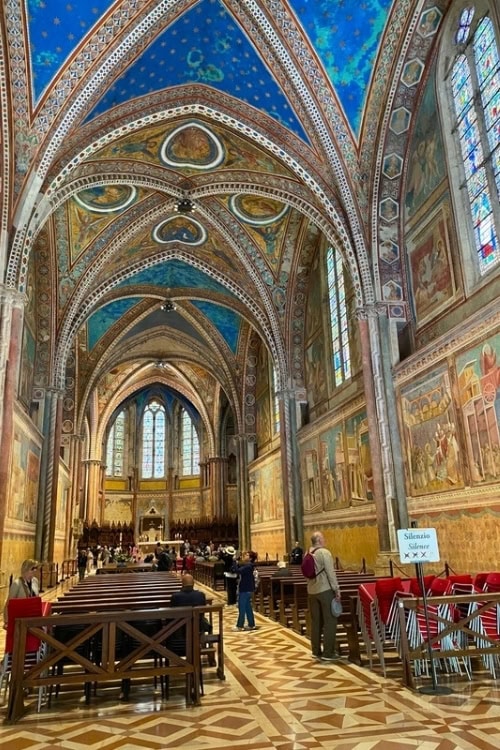
There is, of course, more to do and see in this medieval town amid the days of the Calendimaggio. Beyond the flavors, sights, and sounds, Assisi is about everything Saint Francis, and a visit to the San Francesco Basilica, where he still rests to this day, is certainly a must.
This massive church attracts both the faithful and the secular in the thousands every year. A World Heritage Site since 2000, it’s among the most visited artistic and religious monuments in Europe.
The walls and ceiling were adorned with captivating frescoes by the likes of the greatest painters of the time: Cimabue, Giotto, Simone Martini, Pietro Lorenzetti, and Cavallini.
Despite the artistic appeal of the basilica, the destination for everyone who comes to its sacred ground is the tomb of St. Francis himself. Pilgrims quietly sat in reflection of this great figure of the Christian Church, of history, and of humanity itself.
One man knelt before the tomb to say a prayer, crossing himself before quietly leaving with tears in his eyes.
Winding Down in Assisi
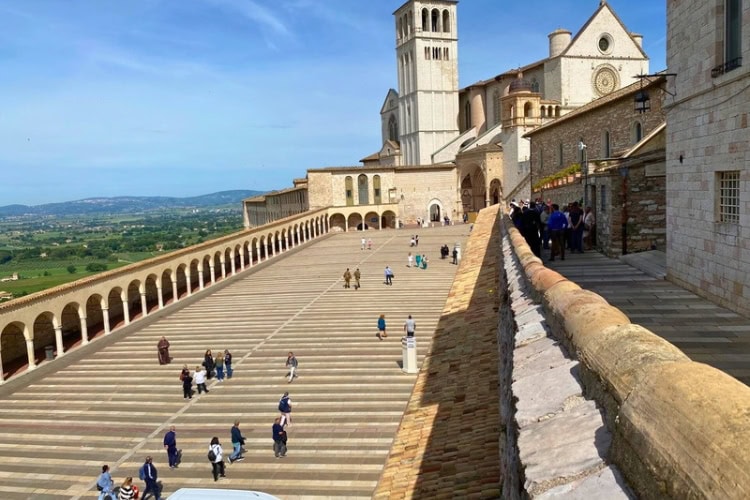
There was little left to do in this wonderfully small medieval town other than eat more, drink more, saunter about, and further enjoy its flavorful ambiance.
It had been a stunning, full-course week in Assisi, a place that offers the best of Italy’s past and present. Its history and fashionably present-day, small-town appeal is a combination that will bring people back, like a good meal they can never forget.
If You Go
Getting There
Flights to Florence or Rome are available on British Airways, Delta, Air France, and KLM — Florence is the easier arrival, with a calmer atmosphere than Rome. Search fares on CheapOair.
Rent a car at the airport through Discover Cars — the drive from either city to Assisi takes about 3 hours. Daily trains from Florence and Rome also run regularly and cost anywhere from 10€ to 26€, though Rome trains take almost an hour longer given more frequent stops.
Where to Stay
Hotel Donnini — From 55€–80€/night in Santa Maria degli Angeli, just below Assisi, with excellent restaurants and a fine small-town feel nearby.
Hotel Il Palazzo — From approx. 125€/night, set inside a 16th-century building right on Via San Francesco in the heart of the old town.
Asisium Boutique Hotel — From 150€/night, a renovated 13th-century property between Piazza del Comune and the Basilica of St. Clare.
Airbnb also has plenty of apartments available within Assisi proper.
Where to Eat
Pizzeria Per Colpa di Eva: A small, family-run spot in Santa Maria degli Angeli with excellent service and some of the best pizza around. 20€–30€.
Osteria Pozzo della Mensa: Pastas are the specialty here: lasagna, ravioli, spaghetti, plus beef and lamb dishes. 20€–30€.
La Lanterna: Seafood-focused, with standout tuna fillet and lobster strangozzi. 25€–50€.
Ristorante La Fortezza: Local pasta and pork dishes; the gnocchi is especially good. 30€–60€.
Tours
Anne’s Italy does remarkable Assisi tours. Check out her website here.
eSIM
Pick up an Italy eSIM through Airalo before you leave home.
Travel Insurance
Compare plans on Squaremouth or SafetyWing.
For More Information: visit-assisi.it
Need a hand planning your trip? Here are the sites and services we rely on most, from booking tools to travel products we love.
Inspire your next adventure with our articles below:
- Green Travel in Europe: The Joy of Traveling by Train
- Walking Pompeii’s Ancient Streets, from Theaters to the Plaster Casts of 79 AD
Author Bio: Avery is a writer and traveler who has lived and worked in a variety of countries around the world over the past 20 years. He permanently settled in Portugal 14 years ago. His published articles can be found on his website.
Want to discover more hidden gems and helpful travel tips? Join our free newsletter for the latest travel secrets and travel articles.
We are reader-supported and may earn a commission on purchases made through links in this article.

- Slow Down on Prince Edward Island: A Relaxed Four-Day Itinerary of Dunes, Seafood and Seaside Inns - September 25, 2026
- Two Sides of Cape Town: Table Mountain Trails, Winelands Dawn and Township Voices - September 25, 2026
- St. Pierre and Miquelon: Visit France Without Leaving North America - September 25, 2026
Planning another trip soon? ✈️
Add GoWorldTravel.com as a preferred source on Google. Click the button below so our local guides, packing hacks, and hidden-gem itineraries always show up first when you search!
Add to Preferred Sources
Excellent article and photographs!