

It appears to be a young woman with her hair in a bun. She is face down, her head is resting on her right arm, and her left hand appears to be trying to cover her mouth. The folds of her clothing appear to have risen onto her back either in her haste, falling to the ground, or by some supernatural force.
The irony of the ash-gray coloring of the prostrate figure is not lost on me. Like a terrifying photograph, the 3-dimensional plaster cast before us has captured the final, agonizing moments of life for the young Pompeian.
Before us is one of 100 casts of citizens of Pompeii, Italy, who perished in the horrific volcanic eruption of Mount Vesuvius nearly 2,000 years ago.
The Eruption of 79 AD
The very word “Pompeii” has come to embody catastrophe. It resonates even when people do not fully understand the circumstances.
In the late summer of 79 AD, Mount Vesuvius sent a mushroom cloud of ash, dust, and rocks 12 miles into the sky.
It was described by Gaius Plinius, known as Pliny the Younger, in the only known written account of the event. “…its general appearance can best be expressed as being like a pine tree, for it rose to a great height on a sort of trunk and then split off into branches.”
It spewed for a reported 18 hours straight, with the cloud settling over the city. A grayish-white ash fell upon Pompeii like a heavy snowstorm. Many of Pompeii’s residents had fled at the outset, but some 2,000, or many more—it’s still disputed—stayed behind.
The final blow came as a dense, fast-moving flow of solidified lava pieces, volcanic ash, and hot gases at temperatures exceeding 1,000 degrees struck Pompeii, instantly killing anyone who remained and burying the city under 30 feet of volcanic debris.
“…it was daylight now elsewhere in the world, but there (Pompeii) the darkness was darker and thicker than any night.”
When my wife and I finally committed to a trip to Italy and the surrounding Mediterranean basin, visiting Pompeii, for me, was a must. In my mind, it was one of those distant, ethereal destinations whose historical account pulled at me. A walk in Pompeii instantly became part of our itinerary.
Located just south of Naples, Pompeii was a short 25-mile bus ride for us, some 30 other interested fellow Pompeii devotees, and our guide.
Gladiators of Pompeii

We made our entry into this otherworldly ancient metropolis through the Piazza Esedra. This entrance, located on the southwestern side of the city, took us into the quadrangular portico, now referred to as the Gladiator Barracks.
The courtyard is located behind the stage of the Large Theatre of Pompeii. The courtyard was originally designed as a space for the audience to stroll during intervals of the theatre shows.
Eventually, the building changed its function and was turned into barracks for the city’s gladiators. It was surrounded by a portico supported by stone Doric columns and contained small bedrooms. Each one could accommodate two warriors.
The stark quarters remind us that these were not highly compensated footballers, but slaves and prisoners forced into the brutal games. During excavations, several skeletal remains were found alongside artifacts, including intricately decorated helmets, armor, and swords.
Our guide explains that among the dead discovered during excavation was a woman who was adorned with jewelry, fueling speculation about a scandalous affair with a gladiatorial lover. As titillating as that story is, many now believe she belonged to a group of fugitives trying to escape the volcanic eruption.
The gladiators performed their savage sport in the local amphitheater, one of the earliest ever built in the Roman Empire. It could hold as many as 20,000 bloodthirsty citizens.
Gentler Entertainment in Pompeii

Beyond the central courtyard, we can see the semicircular, terraced seating of the Large Theatre. One of the first structures completely freed of its volcanic blanket, the theatre was designed to hold 5,000 spectators. This acoustically designed masterpiece let voices reach the upper seats.
Close by is the Odeon. A smaller, one-time covered theater built around 80 BC, it was used for more intimate musical performances, recitals, and mime. Its smallness also provides a better view of the skilled construction involved.
We exited onto one of the major roads that traverse the city, the Via dell’Abbondanza. Roman engineering prowess is well displayed in the creation of this thoroughfare.
Paved with large, smooth lava stones, a noticeable feature is the series of large, raised stones placed in key locations creating convenient crosswalks. Spaced wide enough so that carriage and chariot wheels could pass through, they let Pompeiians cross streets often rain- and sewage-filled.
Ancient Fast Food Scene
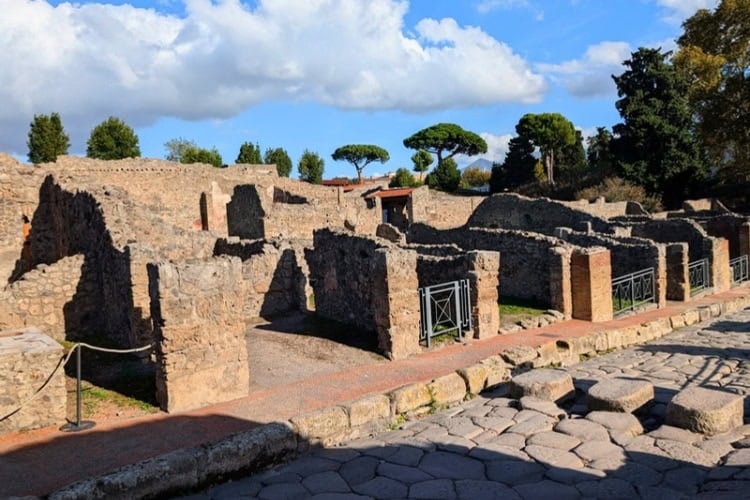
Unlike many ancient ruins, Pompeii is not a field of tumbled-down structures hardly recognizable. It is immediately identifiable as a city. Although some buildings are the worse for wear, with many missing roofs, most are readily identifiable.
Several working homes line the street. They were designed so that the lower level allowed for commercial activity while the upper level was reserved for family life.
The major draw for archaeologists and tourists alike is the snapshot of daily life. The destruction of Pompeii was not a gradual deterioration of a society, but an instantaneous halt of a living, breathing city.

We’re reminded of this as we enter a thermopolium, ancient Pompeii’s version of a fast-food emporium. At the front of the ground floor, an L-shaped counter remains with several large circular holes in its surface. In these hollows would have been placed terracotta jars containing food and wine.
Skewers of meats, bubbling legumes, seasonal fruits, and sweets were all on the menu. There were over 80 such eateries throughout the city. Remnants and residue of the various foods prepared the day of the eruption have been found in the pots.
The Bread of Pompeii

Bread was the staple of Pompeii’s diet. Only the wealthier homes had their own ovens. Buying fresh-baked bread in their world was as common as it is today. Three dozen bakeries of various sizes have been found throughout the city.
A few of the larger ones had their own millstones for grinding grain from the countryside. The suddenness of the eruption is shown by the fact that over 80 loaves, that day’s production, were still in the ovens of one bakery and carbonized by the intense heat.
The Racier Side of Pompeii

Pompeii was a characteristically conventional Roman town. Its 20,000 residents were made up of a small class of wealthy citizens, an up-and-coming group of merchants and entrepreneurs, and the working poor and slaves.
A port city at the time of the eruption, besides the eateries and bakeries, the city boasted several public water fountains, latrines, and baths. It also had brothels.
We were led into an ancient house of ill repute, which elicited several grins, smirks, and a lot of curiosity. The corner property is a two-story affair with ten very small, stark cubicles. The curio that received the most interest was a series of erotic paintings.
Used to advertise the “options” offered, the colorful, fairly graphic frescoes leave no doubt as to the goings-on in this house.
Paradoxically, our guide states, the building appears more frequented now than it was in its heyday.
Do the Walls Have Stories?
Slipping away from the crowds, I find myself down a narrow street peering through a locked gateway. On the other side is a highly decorative mosaic entry that leads to what appears to be an inner courtyard.
I imagine a Roman family enjoying a late summer day, relaxing with little concern. A breeze rustles a strand of my hair. Is some apparition trying to whisper their story?
It’s exactly these little images of life that intrigue both scientists and ourselves. I’m fascinated by the homes on display. Extravagant villas to small, two-room abodes for the least affluent. How did they live?
Inside The House Of Ceii

One such home is the House of the Ceii. The house, thought to have been owned by a local magistrate, opens directly onto the street.
The front door led us into the atrium, a large central hall with an opening in the roof that allowed both light and rain in. Rain collected in a small pool below, which subsequently emptied into a cistern beneath.
Around and through the four-columned atrium, the other rooms of the house were located: the bedrooms, the servants’ quarters, and the dining area. Like many of Pompeii’s buildings, the exterior walls were covered in brilliant white ground-marble stucco, making it an impressive sight.
Like most of the homes, rooms are richly decorated with mosaic floors of geometric shapes inserted between multicolored marble tiles. Most striking are the decorations on the walls, which are adorned with a rich tapestry of fresco paintings.

The garden walls are particularly striking. They depict colorful scenes of wild beasts hunting: wolves chasing wild boars, a leopard chasing two goats, and a lion pursuing a bull.
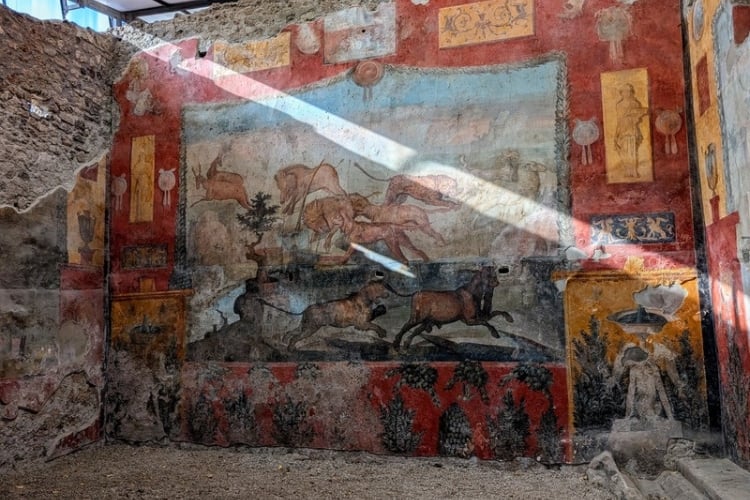
It was even discovered that the upper level was being remodeled, with buckets of paint and brushes being dropped midstroke.
Rediscovering Pompeii Through Excavation

After being buried and nearly forgotten for centuries, Pompeii was accidentally rediscovered in 1599 during the construction of a canal.
Serious excavations began in 1748 and are still ongoing, making Pompeii the longest continually excavated site in the world. Well over a third has yet to be excavated. Spanning over 170 acres, Pompeii isn’t something you can see in half a day, but it’s a beginning.
Ironically, the very thing that destroyed Pompeii—the tons of ash—also ensured its preservation, leaving it frozen in time. Because of this, its ghostly ruins offer the best look at life in an ancient Roman town.
The Antiquarium of Pompeii, its museum, displays artifacts that illustrate life in the city. Items of everyday life include small heating braziers, several amphorae, bits and pieces of tableware, furniture, statuettes of deities, and wall decorations.
It reminds one of an estate sale made up of forlorn, forgotten items once valued and esteemed, now abandoned by long-departed owners.
Then there are the true “ghosts” of Pompeii. The most compelling visuals in Pompeii are the resident castings.
The Specter of the Final Day
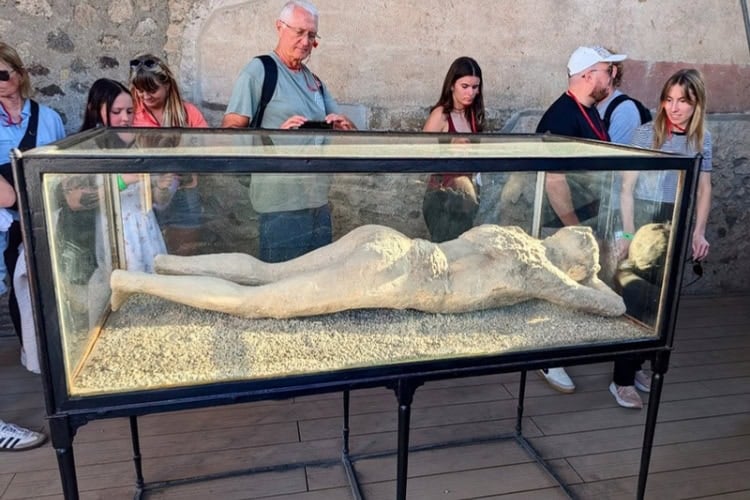
While excavating, archaeologists identified hollow spaces in the volcanic layers that were created when victims’ bodies decomposed. Using the voids as molds, they gently filled in the holes with plaster, producing 3-D creations of their last terrifying moments.
The folds of their togas, the frozen expressions of their faces, and their contortions are all captured in grisly detail. Pompeii is a national archaeological site, an open-air museum that is still telling its tales.
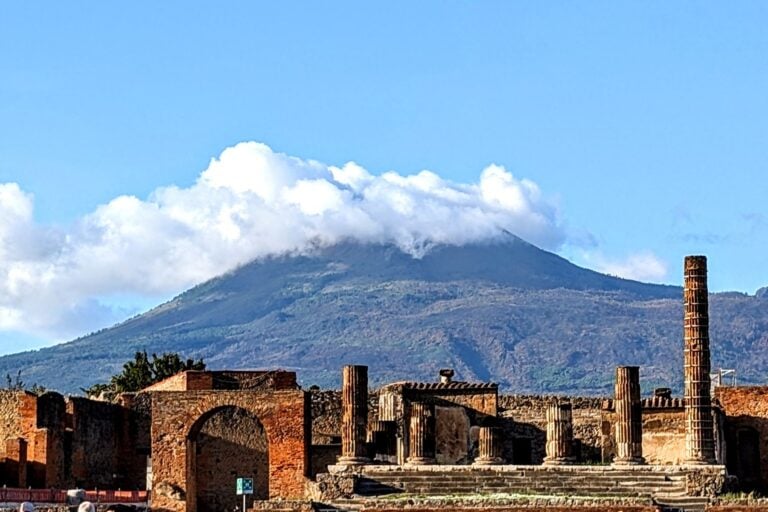
Near the end of the day, we stood in the Pompeii Forum, a large public square where its citizens celebrated politics, trade, and religion. It was the cultural center. Dozens of visitors milled about the plaza, some in excited discussions, many admiring the buildings, and a few glued to their phones.
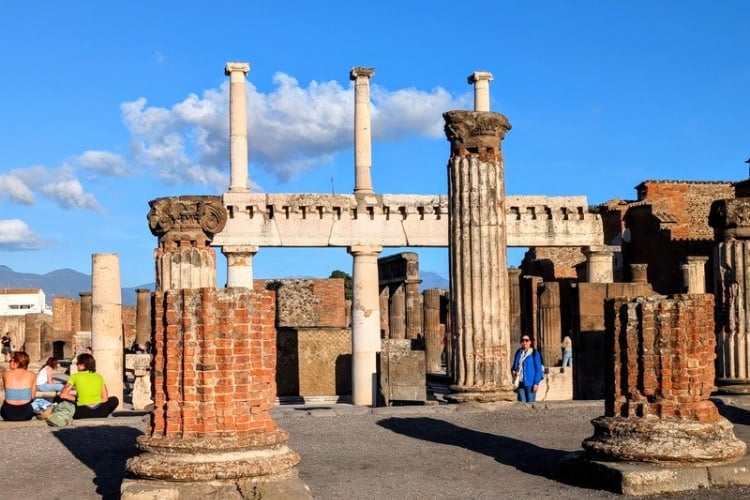
At the north end, the forum is dominated by Mount Vesuvius, still an active volcano, in the distance. Ironically, on this day, the peak is surrounded by clouds looking eerily like smoke.
I wonder if that’s what it looked like that fateful day in 79 AD.
Read More: The 15 Best Places to Visit in Italy for History, Art and Endless Beauty
If You Go
Pompeii is a 30-minute drive from Naples, Italy, and easily reached by train or bus via the Circumvesuviana line. Learn more at the official Pompeii tourism site.
Several excellent guided tours include round-trip transportation from Naples, entrance fees, and an expert guide. For a deep archaeology focus, the Pompeii Small Group Tour with an Archaeologist on Viator keeps groups to 15 or fewer with skip-the-line access.
If you want to make a full day of it, the Pompeii and Herculaneum Small Group Tour on GetYourGuide pairs both sites in one trip — Herculaneum is smaller but remarkably preserved, and seeing them together puts the eruption of 79 AD in vivid perspective.
Need a hand planning your trip? Here are the sites and services we rely on most, from booking tools to travel products we love.
Inspire your next adventure with our articles below:
- Architectural Sightseeing Tours in Rome by Charter Bus Services
- Inside Kutná Hora: The Czech Town Built on Silver and Bone
Want to discover more hidden gems and helpful travel tips? Join our free newsletter for the latest travel secrets and travel articles.
We are reader-supported and may earn a commission on purchases made through links in this article.

- Yellowstone Digital Detox: A Week Off the Grid - October 15, 2026
- A Swiss Village, Lakeside Mansions and Door County Bluffs: Fall in Wisconsin - October 3, 2026
- The Sleeping Bear Dunes: Discovering the Splendor of Michigan’s National Lakeshore - September 24, 2026
Planning another trip soon? ✈️
Add GoWorldTravel.com as a preferred source on Google. Click the button below so our local guides, packing hacks, and hidden-gem itineraries always show up first when you search!
Add to Preferred Sources