

For years, I treated travel days as something to get through rather than fully enjoy. Airports, baggage limitations, endless queues, exhaustion and the strange feeling of landing somewhere new without any sense of the distance you’ve traveled. Flying was fast, efficient, and forgettable. I told myself it was the price of modern travel.
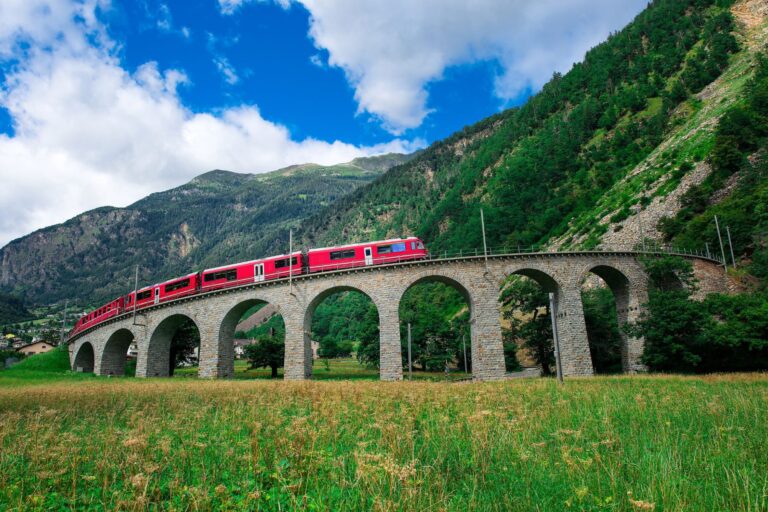
Taking the train across Europe from the UK changed my mindset entirely. Moving through landscapes instead of over them and watching countries unfold mile by mile, I realised that slower travel doesn’t subtract from adventure, it enhances it.
By the time I reached Switzerland 11 days later, I’d traveled through 8 countries, and the journey had become the story, not just the means of getting there.
From the UK to Switzerland, One Train at a Time

We decided to travel by train because we had a rare pocket of time between housesits: one ending in the UK, another starting in Switzerland two weeks later.
As full-time house and pet sitters, annual leave doesn’t look the same for us, and this gap felt both precious and awkward. It was a little too short for a long-haul adventure, but far too generous to waste.
Whilst we were weighing our options, Interrail (Eurail) passes went on sale at 25% off, which felt like fate nudging us in a greener, slower direction.
Tom suggested something wildly unlike us: no fixed route, no booked stops, just deciding day by day where we’d end up. It would mean pricier accommodation and a little uncertainty, but it also promised freedom, spontaneity and the kind of adventure we dreamt of, so I said yes.
We left the UK under a curtain of October drizzle, boarding a train to London and then a Eurostar to Brussels, which was the only train we’d booked in advance, knowing how quickly they sell out.
Brussels made sense as a launch point; central, well-connected, and full of onward possibilities. When we arrived, we spotted a direct overnight train to Berlin and, after a swift Belgian beer to seal the decision, we jumped on.
Over the next eleven days, we crossed eight countries on thirteen trains, covering 3,020 kilometres.
We lingered in Berlin for two nights, wound our way south to Slovenia with stops in Lake Bled and Ljubljana, dipped into Croatia for a stay in Rijeka, followed the coast to Izola, soaked up a few days in Venice, and finally rolled into Geneva.
We were tired but exhilarated, and perfectly placed for our next housesit.
Why Europe’s Rail Revival Matters

Europe’s rail revival isn’t just about nostalgia or romance; it’s a practical response to the way we need to travel now. Trains produce significantly fewer emissions than short-haul flights, link city centres directly, and remove much of the friction that makes travel exhausting.
Instead of baggage limits, security queues and far-flung airports, rail travel offers the continuity of landscapes unfolding through the window, countries blurring gently into one another, and a sense of movement that feels enjoyable rather than rushed.
Trains invite a slower relationship with each place, encouraging travelers to stop, linger and explore beyond headline destinations. This supports smaller cities and regions, spreads tourism more evenly, and makes travel feel less extractive and more connected.
Europe’s expanding rail network is reviving how we move and reshaping how we experience the continent, reminding us that the journey itself can be as meaningful as the destination.
Interrail: A Slower, Greener Way Across Europe

Photo by Jessica Holmes
Travelling by train reframes movement as something flexible rather than fixed. Without flights dictating departure times or destinations, the journey opens up possibilities: staying an extra night if you like the place, changing direction on a whim, or following a recommendation from someone you meet on board.
Europe begins to feel smaller, not because distances shrink, but because borders are crossed by land.
Packing light becomes a sort of discipline when you’re moving often, carrying everything yourself, and stepping on and off trains frequently. You learn fast what you actually need, and how little that is (although no matter how lightly I pack, I always need to put a few things in my husband’s bag).
With fewer possessions and fewer scheduled plans, there’s a huge capacity for extra mental space that makes train travel feel restorative rather than tiring.
Trains also provide relative comfort. There’s room to stretch, walk, work, read, charge devices and often restaurant and bar cars to purchase hot food and drinks.
You can watch the world pass by, read a good book, or play card games, all whilst being whisked directly into the heart of cities, rather than landing on their outskirts and needing to navigate metros, buses or taxis. This ease and comfort make long journeys feel sustainable and even more relaxing.
There’s also the carbon question, which can’t be separated from any conversation about travel anymore. Choosing rail over short-haul flights is one of the most effective ways an individual traveler can reduce their carbon footprint without giving up movement or travel.
It’s not about perfection, but about traveling in a way that matches the values many of us naturally hold.
Trains also create connections. You share tables, corridors and glances with people moving through their own lives: commuters, families, backpackers, business travelers, and other holidaymakers.
Conversations spark, routes are compared, and snacks are shared. In the motion of train travel, Europe reveals itself as a very interconnected place, and moving through it slowly feels like a real treat.
How Slower Travel Changes Your Mindset

Slower travel can shift your relationship with movement itself. When borders are crossed by train rather than plane, the transitions feel natural as the sense of distance becomes more real. You know exactly how many kilometres there are between Berlin and Lake Bled because you’ve traveled each of them.
Europe’s open borders make this feel effortless, too; you can pass from one country to the next without announcements, visa checks, or queues, often realising you’ve crossed a border after it happens.
With the ease of train travel comes a different mindset. Travel is no longer about maximising destinations or ticking places off a list. It’s about being in the present moment by lingering over coffee, staying an extra night and saying yes to detours.
Practical Tips for Travelling by Train

If you’re used to flying, European train travel can feel refreshingly simple, but a little preparation goes a long way. Here are some practical tips to make your rail journey smoother, cheaper, and more enjoyable.
Planning & Tickets
- Consider an Interrail/Eurail pass if you’re visiting multiple countries. They offer flexibility and can work out cheaper than individual tickets, especially if you buy the passes on sale.
- Check seat reservations early, as some high-speed and international routes (Eurostar, TGV, Frecciarossa, and more) require them, and they can sell out.
- Use apps like Rail Planner or Trainline to check routes, platforms, and delays in real time.
- Be flexible where possible and remember that regional trains rarely need reservations and give you more freedom to change plans.
Read More: How to Use Eurail to Travel Across Europe: A Eurail Guide
Packing & Luggage

- Pack lighter than you think. You’ll be lifting bags on and off trains, and storing them overhead or at carriage ends.
- Bring a small daypack for snacks, water, chargers and documents so you don’t need to access your main bag constantly.
- No liquid limits means you can travel with water bottles, toiletries, and food without hassle. Bottle of red for the journey, anyone?
On the Train
- Arrive early for international connections and note that platforms can change at the last minute.
- Sit on the correct carriage if you have a seat reservation; platform displays usually show carriage order.
- Bring snacks and refillable water bottles, especially on longer routes or regional lines.
- Charge devices when you can, as not all trains have sockets, and some only work intermittently. Don’t forget your adaptor.
Border Crossings & Practicalities
- Carry your passport even in Schengen countries, as spot checks do happen.
- Check station names carefully, as some cities have multiple stations.
- Download offline maps for arrivals in case of poor signal (use an app like Maps.me).
- Allow additional time when planning connections, especially in unfamiliar cities.
Mindset
- Expect small delays and treat them as part of the experience, not a frustration.
- Build in rest days to avoid travel fatigue.
- Let the journey be part of the destination. Some of the best moments happen between places.
When the Journey Becomes the Adventure

Photo by Jessica Holmes
Travelling by train changed the way I experience Europe. Without the frenzy of airports or the rush of going somewhere new for just a few days, I had time to notice the transitions: languages and accents, the shift of landscapes, and cultures blending and changing slowly.
The journey itself became a space to think, write, watch the world pass by, and properly arrive in each place rather than crash-land into it.
Now, whenever I can, I choose the train: not just because it’s greener or more comfortable, but because it gives travel its soul back. If you’re willing to slow down and trade speed for immersion, you might find that the most meaningful part of the trip isn’t where you end up, it’s everything in between.
Need a hand planning your trip? Here are the sites and services we rely on most, from booking tools to travel products we love.
Inspire your next adventure with our articles below:
- Why I Chose to Travel Europe by Bus
- How to Find ‘Travel Dupes’ for Switzerland’s Popular Panoramic Trains
Author Bio: Jessica Holmes is a writer and digital nomad who swapped her career as a police investigator for a life of sustainable travel through housesitting. After years of backpacking and van life, she sought a greener way to explore the world. Her book about her journey so far, The Housesitter’s Guide to the Galaxy, and Barnes & Noble. Her blog www.hitchedandhiking.com documents her travels. Follow her on Instagram @hitchedhikingandhousesitting.
Want to discover more hidden gems and helpful travel tips? Join our free newsletter for the latest travel secrets and travel articles.
We are reader-supported and may earn a commission on purchases made through links in this article.

- Izola, Slovenia: Slow Days and Seaside Strolls on the Adriatic - April 16, 2026
- Fukuoka, Japan: The Coastal City Where Tonkotsu Ramen Was Born and Slow Travel Thrives - March 24, 2026
- Green Travel in Europe: The Joy of Traveling by Train - March 23, 2026
Planning another trip soon? ✈️
Add GoWorldTravel.com as a preferred source on Google. Click the button below so our local guides, packing hacks, and hidden-gem itineraries always show up first when you search!
Add to Preferred Sources