
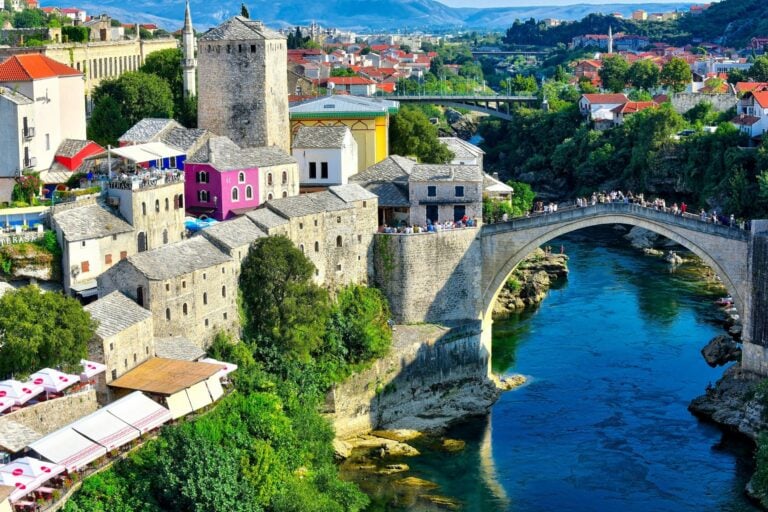
I held my breath, anxious with excitement. Alongside a few other wide-eyed spectators, I craned my neck to get a solid view of the dizzying plunge from the Stari Most bridge’s arch into the Neretva below.
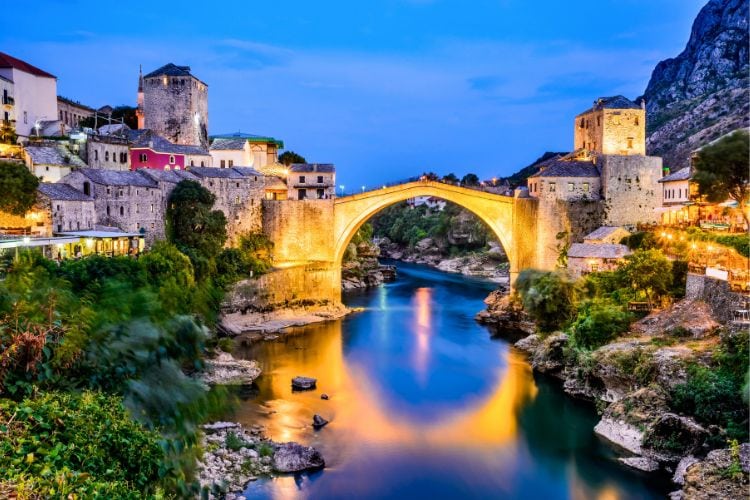
In Mostar, Bosnia and Herzegovina, this risky diving spot in the heart of town is one of the country’s most picturesque points. It’s also a reconstructed 16th-century Ottoman bridge and UNESCO World Heritage site.
This spectacle above the rushing Neretva River has become a symbol of resilience and unity among Mostar’s communities, home to a diverse mix of Croats, Bosniaks, and Serbs. A community re-built with fortitude and still finding its identity today, Mostar shines bright with a lust for adventure.
History of the Stari Most
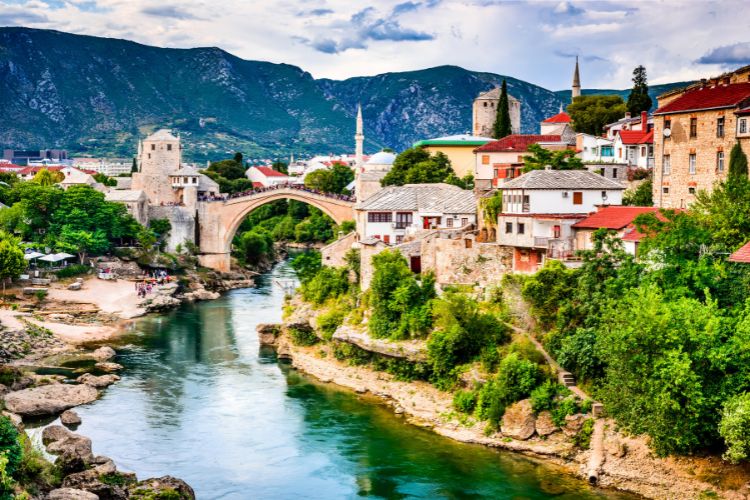
The Stari Most, simply meaning “old bridge” in Bosnian, has anchored the city since its original completion in 1566. Commissioned by the longest reigning Sultan of the Ottoman Empire, Suleiman the Magnificent, the Stari Most stood as one of the most impressive single-arch stone bridges of its era.
In 1993, Stari Most was deliberately destroyed during the Siege of Mostar, one of the Bosnian War’s most brutal conflicts. Reopened in 2004, the Stari Most was rebuilt using chunks of the original stone that had fallen into the river.
Standing on top of the bridge, the history feels palpable. As you climb up the Eastern side after entering the city, the limestone is steeper (and more slippery) than you’d think from photos.
It’s impossible not to pause and gaze down towards the tiny boats whizzing beneath you, evoking a stomach-flip (at least for me) at the sheer height.
This meaningful landmark, built anew, still fosters local traditions ingrained in time. Most notably and also most treacherously, is recreational bridge jumping.
The Legend and the Jump
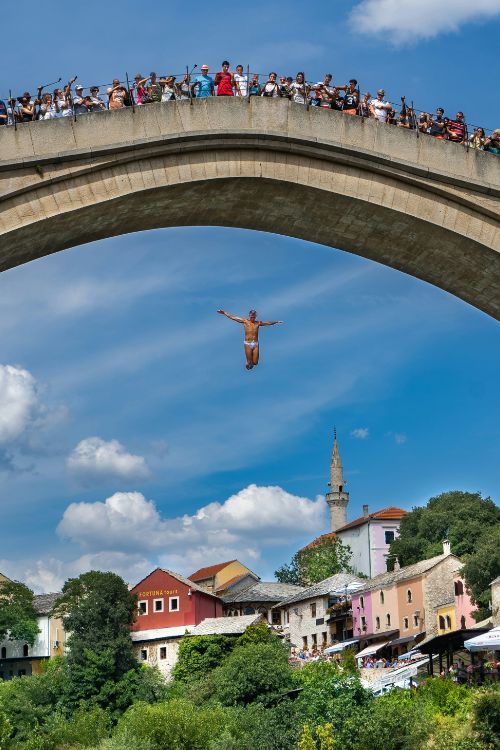
Ancient Bosnian legend claims that for a boy to prove himself as a man, it is his rite of passage to make the eight-story jump off the bridge. Throughout the centuries, this legend has expanded into deliberate thrill-seeking acts and organized diving groups. Even some brave tourists are taking the plummet.
The Stari Most is even a stop on the Red Bull Cliff Diving World Series. This is an annual event where extreme divers compete in unique settings across the world. The Stari Most was introduced to the tour in 2015, bringing in international spectators to view this snapshot of history.
Read More: Exploring Bosnia’s Rich and Troubled History
The Mostarski Icari
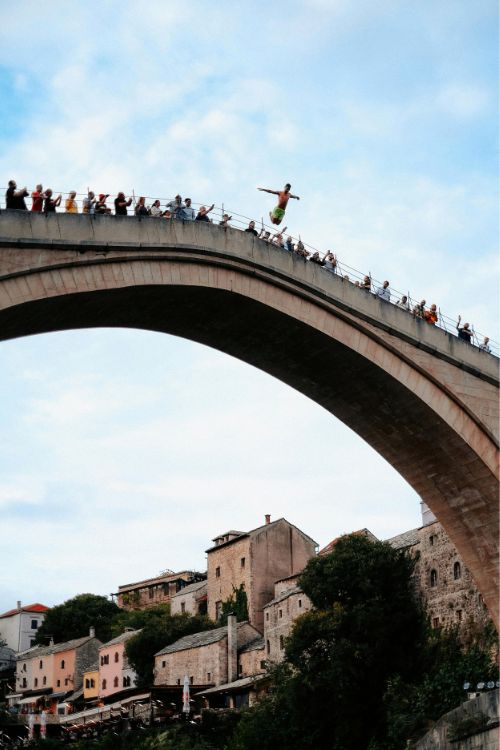
Named quite fittingly after the Greek myth of Icarus, the Mostarski Icari have elevated bridge jumping from a schoolyard dare into a legitimate, monetized institution.
Members of this diving club treat the ritual like clockwork. Their toes are curled over the edge and their eyes are on the water, patrolling for boats. Most importantly, they wait until the tips reach at least 50 euros before making the jump.
As seasoned professionals, they also work to keep the practice as safe as it can be, given the circumstances. Brave outsiders are welcome to join in the thrill, and working alongside the group under its instruction is strongly encouraged.
While most divers go feet-first with a clean pencil dive, the real showstopper is watching someone dive lasta, the Bosnian word for “swallow.” This headfirst dive, mirroring the arc of a bird from such a fatal height, is as captivating as it is dangerous.
Group members perform multiple dives per day, finding themselves especially busy in Mostar’s high tourist season from June to August. The men have no problem with waiting for a crowd if there isn’t already one.
When I visited, it took over thirty minutes to see a jump after the initial tease-up. I wonder, does their heart still skip a beat as they fall?
The Mostarski Icari also hold a log of over 1,500 completed jumps, leaving their legacy of bravery and exhibition in Mostar for years to come.
Walking the Streets of Mostar
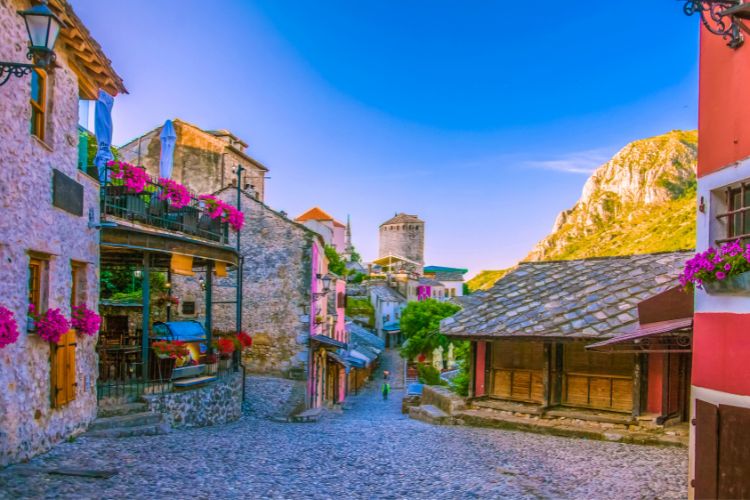
The traditional Ottoman architecture doesn’t stop after you cross over the bridge, as spires tower high into the sky and light the horizon against the lush Prenj mountain range. Quaint streets hold handfuls of colorful shops and restaurants that make for an idyllic afternoon stroll.
Mostar is extremely hot in the summer with average temperatures between 87 and 91 degrees, often reaching higher. Good thing the refreshing breeze off the river and the shade found in Restoran Labirint are sure to keep you cool.
While this spot initially caught our eyes with the classic picnic-style tablecloths, the restaurant, more importantly, has the best view of the bridge to witness any jumps that might happen.
We were lucky to witness such a show, complementing our meal, with portions doubled for what we could realistically eat. My first bite of ćevapi, a traditional Bosnian dish made from minced beef and lamb was bursting with flavor here.
If you’re looking for shopping, the collection of handmade, one-of-a-kind treasures found along the Kujundžiluk path was remarkable. I could have spent hours admiring each storefront: glass mosaic depictions of the simple houses along the river, real bullet casings from the war transformed into something new, and impressive oil paintings.
Each shop owner was visibly enthusiastic and proud of their work, taking time to share the stories behind each piece. I connected most deeply with a woman running a wood-working shop filled with endless treasures.
As I perused her collection, she told me about her daughter, who had just moved to New York, and away from Mostar for the first time. Of course, she misses her daughter dearly, but she was also excited for her to experience something so new.
I resonated with that feeling past our conversation: the complexity of leaving home, the mix of excitement and ache that comes with distance from everything known.
This moment was a reminder that despite having vastly different lives, there are certain experiences and emotions that cut across borders.
Adventure Continues Past Mostar
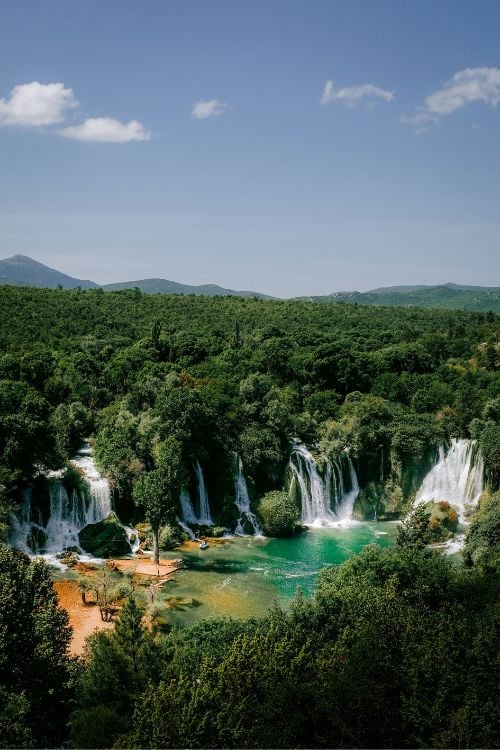
Mostar also serves as an excellent jumping-off point to experience the natural beauty of Bosnia and Herzegovina. In a country known for its mountainous landscape, there are countless waterfalls, lakes, and hilltop towns that are worthy of a day trip.
A 45-minute drive from Mostar leads to the Kravica Waterfall, where a short downhill walk suddenly opens into something close to paradise.
The loud roar of the falls hits you before you see them, then suddenly, a curtain of white water tumbles into a shimmering oasis. The water is shockingly cold, but floating belly-up in this sanctuary is the kind of moment you don’t forget.
Alternatively, spend a day in Počitelj, a medieval hilltop settlement with Ottoman-era stone towers and a flourishing population of pomegranate trees; or drive just 20 minutes South to the Blagaj Tekke Monastery, which seems to defy gravity, floating on water.
For history and nature buffs alike, the possibilities in Mostar’s surroundings are truly endless.
Reflections Across History
Traveling through the Balkans, my time in Mostar and the feelings I took home with me were the most surprising elements of the trip. This city was such an unexpected highlight, and I couldn’t help but share in the city-wide excitement I felt.
Mostar had a rough recovery period after the tragedy of the Bosnian War of the early 1990s; its land was hit hard. The conflict itself devastated whole cities, tearing classic architecture, tradition, and spirits to the ground.
Even though I was not born yet, generations still carry a stigma around Bosnia being dangerous, a more uncharted territory than popular Western European destinations.
Western media also portrayed the Bosnian war as especially catastrophic, but what they’ve kept quiet for years is the regrowth and build-up from within that followed.
Locals are eager to open up their city once again and share its beauty. Mostar proves itself to be one of the best-kept secrets of the Balkans. It’s a place special for travelers who appreciate nature, architecture and artistry, but more importantly, resilience.
If You Go
- If you’re coming from the United States, I would recommend starting your trip in Dubrovnik or another nearby city and crossing the border on wheels. The rolling hills provide for a beautiful entrance to the country, and if you rent a car, you also have the freedom to explore the nearby towns.
- I would recommend visiting Mostar in the shoulder seasons around summer to avoid rising temperatures and the over-congestion of the city’s narrow alleyways.
- If you aren’t able to stay overnight and fully explore the city, it’s still worth it to visit with the time you have in the Balkans. Browse Get Your Guide for day trips to Mostar from Dubrovnik, Split, Trogir, or Sarajevo. It’s doable and affordable, plus this takes care of transportation.
Need a hand planning your trip? Here are the sites and services we rely on most, from booking tools to travel products we love.
Inspire your next adventure with our articles below:
- Tuzla, Bosnia-Herzegovina Offers Something No Other European City Can
- Top 5 Balkan Countries to Visit: Where to Go for Culture, Nature & History
Author Bio: Monique Evdokiou is a freelance travel journalist based in San Francisco, CA. She is currently focusing on travel, as well as food and wine. A natural, spontaneous soul and adventure-lover, her writing is guided by firsthand experiences, focusing on personal interactions and unique aspects of travel around the world.
Want to discover more hidden gems and helpful travel tips? Join our free newsletter for the latest travel secrets and travel articles.
We are reader-supported and may earn a commission on purchases made through links in this article.

- Slow Down on Prince Edward Island: A Relaxed Four-Day Itinerary of Dunes, Seafood and Seaside Inns - September 25, 2026
- Two Sides of Cape Town: Table Mountain Trails, Winelands Dawn and Township Voices - September 25, 2026
- St. Pierre and Miquelon: Visit France Without Leaving North America - September 25, 2026
Planning another trip soon? ✈️
Add GoWorldTravel.com as a preferred source on Google. Click the button below so our local guides, packing hacks, and hidden-gem itineraries always show up first when you search!
Add to Preferred Sources