
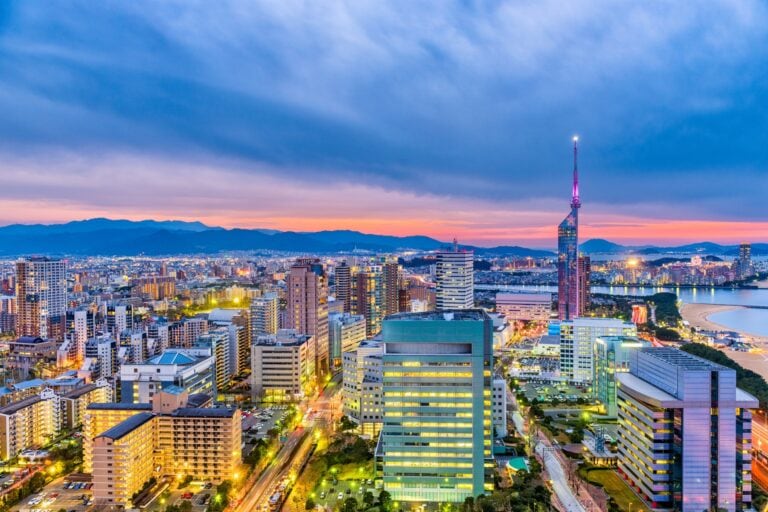

I arrived in Fukuoka on a crisp September morning, the city waking slowly along its sparkling coastal edge.
I felt tired from my exploits in Tokyo and Kyoto, and still slightly disoriented due to this being my first trip to Japan, but I was starting to get the hang of the country, and if I’m honest, it had already slipped under my skin.
I stepped off the Shinkansen that had whisked me there from Kyoto that afternoon, feeling that rare sense of a city that is immediately approachable, yet layered with history, culture, and a rhythm of its own.
Here, in this compact, sunlit corner of Kyushu, I realised why I had come: to slow down, wander, eat, and let the city unfold around me.
Getting to Fukuoka, Japan’s Coastal Gateway

Reaching Fukuoka is refreshingly straightforward, even by Japanese standards.
The city is served by Fukuoka Airport, one of the most conveniently located airports in the country, sitting just a few minutes from the city centre by subway.
It’s a major international gateway to Asia, with direct flights from cities across East and Southeast Asia, and smooth onward connections via Tokyo or Osaka for travellers arriving from further afield.
For those already travelling within Japan, arriving by train is a pleasure in itself.
The Shinkansen connects Fukuoka’s Hakata Station with Kyoto, Osaka, Hiroshima, and Tokyo, making it an easy and scenic journey across the country.
Hakata Station doubles as a transport hub and a destination in its own right, with shopping, food halls, and direct links to buses, subways, and regional trains.
However you arrive, Fukuoka makes a strong first impression: accessible, welcoming, and perfectly positioned for travellers who want to explore Japan at a slower, more enjoyable pace.
If you’re planning a trip to Japan, check out our Japan Travel Guide, where you’ll find a curated selection of articles to inspire you and help plan your trip.
A City for Nomads

Fukuoka is consistently ranked as one of Japan’s most liveable cities, and it doesn’t take long to understand why.
Its compact size, mild climate, and emphasis on community-led urban design make it especially appealing for tourists, digital nomads, and long-term travellers looking for balance rather than burnout.
As part of my 2025 visit, I attended Colive Fukuoka and quickly realised this was a city designed for living, not just passing through.
During my stay, workdays flowed easily into city life.
I spent mornings working from WeWork Tenjin Brick Cross, right in the city centre, with coffee close at hand and a hum of creative energy around me.
On other days at SALT, the ocean stretched out in front of my laptop and productivity felt almost effortless.
Fukuoka understands that good work happens when people are given space, light, and connection to their surroundings.
Historic Streets, Temples & Urban Nature

What struck me most about Fukuoka is how seamlessly its past and present coexist.
One moment you’re wandering the quiet grounds of Shofukuji Temple, Japan’s first Zen temple, and the next you’re swept into the modern spectacle of Canal City, where water features, glass architecture, and everyday life spill into one another.
It feels more multifaceted than I’d imagined it could.
The city’s relationship with nature is equally generous.
Ohori Park became a regular stop for me, especially in the early mornings when elderly locals practise tai chi beside the lake, the city skyline reflected in the still water, and ghostly silver koi carp glinting through the milky waters in the sunshine.
Add in the easy access to beaches along the coast, and Fukuoka offers rare opportunities to reconnect with the elements without ever leaving the city.
Compact and Livable: Why Fukuoka Wins for Slow Travel

Fukuoka’s scale is one of its greatest strengths.
Most neighbourhoods are walkable, public transport is efficient, and nothing ever feels too far away, which encourages lingering rather than rushing.
I found myself exploring without an agenda, dipping into the vast Tenjin Underground Mall, a European-inspired network of subterranean avenues filled with shops, cafés, and quiet corners to escape the heat or rain.
It feels more like walking through an arcade in Paris than anywhere in Japan.
Food, inevitably, becomes part of the rhythm of daily life here.
Some of the best sushi I ate in Japan was at Hakata Toyoichi, where the fish arrives so close to the water it’s almost like tasting the sea.
When the day wound down, I’d head to the Bay bar at the Ritz-Carlton, watching the sun sink over the coast from the rooftop, understanding exactly why Fukuoka is a city people come to visit and decide to return to again and again.
Fukuoka Tells Its Story Through Food

Food in Fukuoka isn’t just good, it’s fundamental to the city’s identity.
This is the birthplace of tonkotsu ramen, where pork bones are simmered for hours into a rich, milky broth that feels both indulgent and deeply comforting.
The scent of it drifts through the streets in the evenings, especially along the rivers and main avenues, where open-air yatai stalls line up like a living, breathing dining room.
Stools scrape against the pavement, steam rises into the night air, and conversations flow easily between strangers, cooks, and regulars.
The food is fast, unfussy, and exceptional, rooted in local produce and shaped by Fukuoka’s long history as a trading port where ideas, ingredients, and cultures have always met.
One evening, after a long day at the Colive Fukuoka event, I found myself perched on a narrow stool at a yatai stall with people I’d only met days earlier.
Bowls of freshly cooked ramen were placed in front of us, chopsticks clinked, laughter spilled into the street, and the city carried on around us.
As I ate, I realised how rare that feeling was: to arrive somewhere unknown and feel so immediately welcome, grounded, and at ease.
That is what makes Fukuoka special.
It doesn’t demand your attention or overwhelm you with spectacle; it draws you in slowly, through food shared with strangers, streets that invite wandering, and a rhythm that makes space for connection.
Under the soft glow of paper lanterns and streetlights, it became clear that this is a city that rewards curiosity and presence, and one that stays with you long after you leave.
For the full yatai experience without the guesswork, the Fukuoka Nakasu Food Stall Private Guided Tour on GetYourGuide is one of the highest-rated food experiences in the city. A local guide walks you through authentic riverside stalls, handles the language barrier, and steers you well clear of the tourist traps.
If You Go

- Sunset drinks at the Ritz-Carlton Bay Bar
- Fresh sushi at Hakata Toyoichi
- Morning walk through Ohori Park and the Sumiyoshi Shrine
- Rainy day escape: the Tenjin Underground Mall
- Yatai stall hopping with a local guide: Fukuoka Nakasu Food Stall Tour (GetYourGuide)
- Remote workers: grab a desk at SALT or WeWork Tenjin Brick Cross
Plan Ahead
- Stay connected with an Airalo eSIM — download your Japan data plan before you land
- Digital nomad insurance: SafetyWing
- Compare trip-specific policies: SquareMouth
Need a hand planning your trip? Here are the sites and services we rely on most, from booking tools to travel products we love.
Inspire your next adventure with our articles below:
- Mount Koya’s Kongobuji: Japan’s Most Mysterious Temple Complex
- 10 Fascinating Facts About Japan That Most Travelers Miss
Want to discover more hidden gems and helpful travel tips? Join our free newsletter for the latest travel secrets and travel articles.
We are reader-supported and may earn a commission on purchases made through links in this article.

- Izola, Slovenia: Slow Days and Seaside Strolls on the Adriatic - April 16, 2026
- Fukuoka, Japan: The Coastal City Where Tonkotsu Ramen Was Born and Slow Travel Thrives - March 24, 2026
- Green Travel in Europe: The Joy of Traveling by Train - March 23, 2026
Planning another trip soon? ✈️
Add GoWorldTravel.com as a preferred source on Google. Click the button below so our local guides, packing hacks, and hidden-gem itineraries always show up first when you search!
Add to Preferred Sources