
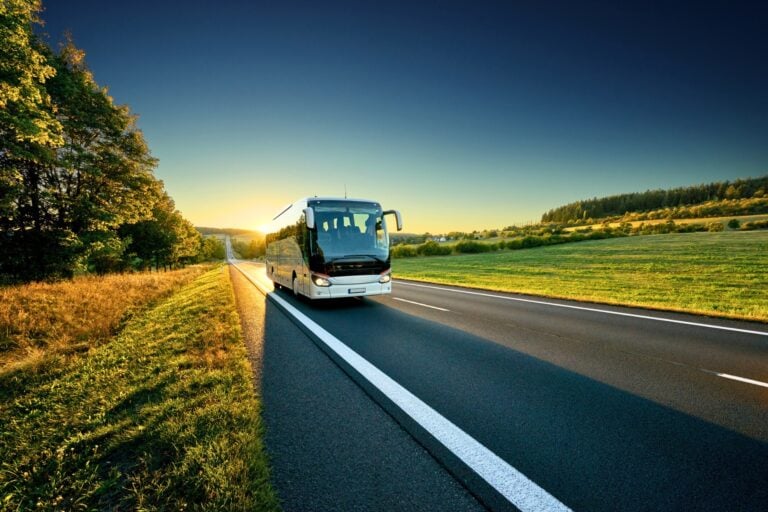
In the summer, I went to Europe and spent some time traveling around the continent. I decided that the best way would be to travel mainly by coach (or bus, as North Americans call it). The price of train tickets is simply too high now to rely solely on the rail networks.
In the six weeks I was away, I took six coaches and spent about 22 hours in them across six different countries. The rest of the time, I traveled by train.
Traveling by Bus in Europe
The experience of bus travel (coach travel) in Europe is one worth noting. More and more people may well choose coach travel in Europe for the obvious financial benefits. But it is quite a unique mode of travel, altogether different from train travel.
How Bus Travel in Europe Differs Between East and West

There is, however, quite a marked difference between East and West Europe when it comes to coach travel. In my experience, traveling by bus in countries like Poland and the Czech Republic was, on the whole, far more pleasant than traveling by coach in France and Germany.
First Experience: Paris Bercy Coach Station
My first taste of coach life (for traveling by coach eventually turns into a kind of lifestyle after a certain amount of time, rather than just a mere means of getting from one location to another) was at the Paris Bercy coach station, and it was a horrendous introduction. I began to have serious doubts about whether I could continue traveling this way for very long.
In the first place, the station itself was basically a concrete bunker, and when I arrived, it was a hot day in August and the air was so stuffy that it felt like trying to breathe through hot soup. It was entirely different from the underground stations I would later see in Wroclaw and Bratislava, which were immaculate, air-conditioned, and not stuffy at all.
In the second place, considering it was the main coach station in Paris, it was absolutely tiny. There were what seemed like thousands of people waiting in the waiting room, sleeping on benches, sitting on the floor with their bags propped against the walls.
The board where they usually advertised the arrival times and departure times of the coaches was broken, and so everyone had to download the app on their phones in order to get the coach times, which meant that the people who did not have a phone or whose phones were out of battery had to go around asking other people where their coach was. It was chaos.
There were no uniformed officials whom you could ask for help as there usually are in train stations. There was just one man at a counter in the waiting room, but to get to him, you had to join a queue that was practically snaking out of the door.
Read More: Top 20 Things to See and Do in Paris
A Typical Coach Boarding Experience
When my coach arrived, a skinny driver with glasses and his sleeves rolled up stepped off the bus and lit a cigarette. Those of us waiting to get on the coach watched him as he casually walked over to the vending machine by the wall and bought a can of Coke, a cigarette dangling from his lips.
The hurried crowds did not seem to shake him whatsoever. He cracked open the can, took a sip, and then ambled back to the coach. He opened up the luggage compartment on the side of the coach so that people could start loading their suitcases. He stood by the door and scanned each person’s ticket as they stepped onto the coach.
After I left my rucksack in the luggage compartment, I showed him the ticket on my phone, which he scanned and then gruffly said, ‘Merci.’ I found my seat at the front, just behind the driver, and settled in for the ride.
Differences Between Coach and Train Travel

This procedure was the same all across the continent, no matter what country I found myself in. Although the experience of coach travel can sometimes be unpleasant, depending on which country you’re in, it is a decidedly more personalised experience compared to traveling by train. Unlike on trains, the driver checks your ticket before you get onto the coach and sometimes even directs you to your seat.
Some of them will take your luggage from you and load it into the coach for you. I met quite a few coach drivers during my journey who had terrific personalities and they would crack jokes and speak to people on the coach.
Why Bus Travel in Europe Feels More Social Than Trains
The close quarters of coach travel – whether it is on the coach itself or in the station – also seems to make people more sociable with each other. It is quite possible to travel through entire countries by train and never have to interact with a single soul. The chances of you having to speak to somebody when traveling by coach, however, are far higher.
I spoke to many people on coaches and in coach stations all over Europe while I was traveling. I do not really know why people are more willing to engage with their fellow travelers when on a coach as opposed to being on a train, except that it must have something to do with the fact that you are forced to squeeze up close with complete strangers when you wait at coach stations or sit down on a coach.
Train carriages are always more spacious, and this seems to be the reason why so many people who use trains tend to be far less talkative than those who use coaches.
The awkwardness of having to sit in a cramped coach is more easily broken if you smile and introduce yourself to whoever may be sitting next to you. I met a lovely American lady who sat next to me on a coach I boarded in Nuremberg. She sat down and looked at me with a beaming smile. ‘Hey!’ she said. ‘I’m Sarah.’
‘Hi,’ I said.
‘Nice to meetcha. Where ya from?’
‘England,’ I replied. ‘You?’
‘I’m American. San Francisco.’
For the rest of the journey, despite the fact that the coach was full, I felt more relaxed and at ease than most of the train journeys I have been on. Sometimes, the lady sitting next to me would point something out to me through the window, and other times I would offer her some of my lunch, which I had packed for the journey.
Cigarette Breaks and Social Interactions
On longer journeys – like this one coach I was traveling on which was going over the Polish-Czech border – the driver may stop for cigarette breaks and everybody on the coach who smokes will also jump off for a smoke and suddenly begin talking to each other, even though they are complete strangers.
Why I Prefer Coach Travel

For me, traveling by coach turned out to be much better than traveling by train simply because I was traveling by myself and it made the trip that bit more sociable. The experience of traveling by train can often feel rather impersonal. The driver is locked away in a secret compartment that nobody can see at the front of the train.
Whereas on coaches, there is nothing separating passengers from the driver. This also means you get a much better view of the country because you can look through the front windows as well as the windows at the side of the coach. I always booked a seat close to the front of the coach for this very reason. You had to pay three to four pounds extra for the privilege, but compared to the price of a train ticket, it was definitely worth it.
A Journey from Munich to Nuremberg
One time, I was traveling from Munich to Nuremberg. The driver was an outgoing character from Bulgaria or somewhere like that, and he didn’t separate himself from the passengers at all. One girl who was sitting by herself at the front of the coach occasionally spoke to the driver in their language, and the driver himself often turned around to hand out sweets to the passengers behind him.
The Democratic Feeling of Coach Travel
In other words, there’s no rigid hierarchy on a coach. Ken Kesey once said that the experience of traveling across America by bus in the 1960s was like traveling together in one giant pumpkin. It’s a funny image, but I understand what he meant.
There is something slightly more democratic about a coach than there is about a train. There are no separate carriages and there is nothing really separating the drivers from the passengers. Everybody shares the same space.
More Travel Options on Coaches

The other thing is that coaches seemed to offer more travel options than trains did. Some of the destinations I saw advertised on the front of coaches during my journey included Kiev, Odessa, Budapest, Malmo, Warsaw, Sofia, and Bucharest. Just seeing these places printed on the front of a coach, which is standing in front of you at the station, getting ready to leave, has a psychological effect.
One feels the real possibility of traveling to places one had not thought of before. And these are direct coach journeys as well. I do not know if it was always the case, but traveling by train these days often involves having to transfer two, three, four times just to get to your destination. On a coach, by contrast, it is possible to travel hundreds of miles across several countries without having to change coaches once. And it costs less money.
Eastern European Coach Stations
As I mentioned earlier, though, there is a noticeable difference between a coach station in France and a coach station in Poland. The Poles, for whatever reason, seem to take more pride in their coach stations. The station in Wroclaw, for example, is immaculately clean. The one in Krakow is slightly more standard, but it was still a hell of a lot nicer on the eye than the one in Munich or the one in Paris.
This could be due to a number of reasons. I suspect one reason may be that fewer people are using the coaches in Poland than they do in France, where tourism is more prevalent and where the population is almost double that of Poland. It may also be that the Eastern Europeans take public hygiene and cleanliness more seriously than they do elsewhere.
The underground coach station in Bratislava, the way it was so well-maintained and looked-after and orderly compared to France, makes me suspect that it is something more than just the fact that there are fewer people in Bratislava than there are in Paris. The history of Eastern Europe may have influenced the cleaner and more orderly way that their public stations are presented.
A Cost-Effective Option

If I found myself traveling through France again, I would probably think twice about taking a coach. But if I were back in Poland or Slovakia, I would not hesitate. It is a fine way to go for the lonely traveler who is looking to save some money.
Recommended Platforms for Bus Travel in Europe
If you are considering bus travel in Europe, these platforms can help you compare routes, prices, and schedules across multiple countries.
Busbud
Busbud focuses specifically on bus travel in Europe and beyond, making it a solid choice for finding long-distance routes and cross-border journeys. It is particularly helpful for reaching smaller cities that are not always well connected by rail.
Omio
Omio is especially useful for planning longer trips, as it allows you to compare bus travel in Europe alongside trains and flights in one place. It is ideal for figuring out when traveling by bus makes more sense than taking the train.
Klook
Klook is best known for tours and activities, but it also offers bus tickets on select European routes. It can be a convenient option if you are already using the platform to book experiences and want to keep your travel plans in one place.
Need a hand planning your trip? Here are the sites and services we rely on most, from booking tools to travel products we love.
Inspire your next adventure with our articles below:
- How to Use Eurail to Travel Across Europe: A Eurail Guide
- 9 Ways To Save Money On Your Next Trip – The Ultimate Guide
Author Bio: Sebastian Sanders is a writer from Manchester.
Want to discover more hidden gems and helpful travel tips? Join our free newsletter for the latest travel secrets and travel articles.
We are reader-supported and may earn a commission on purchases made through links in this article.

- Bukhara, Uzbekistan: The Silk Road City Where History and Art Thrive - October 20, 2026
- Hoi An, Vietnam: A Local’s Guide to the Ancient Town, An Bang Beach and Must-Try Dishes - October 20, 2026
- Why Cape Town’s Kloof Street Was Ranked the Coolest Street in Africa - October 20, 2026
Planning another trip soon? ✈️
Add GoWorldTravel.com as a preferred source on Google. Click the button below so our local guides, packing hacks, and hidden-gem itineraries always show up first when you search!
Add to Preferred Sources