
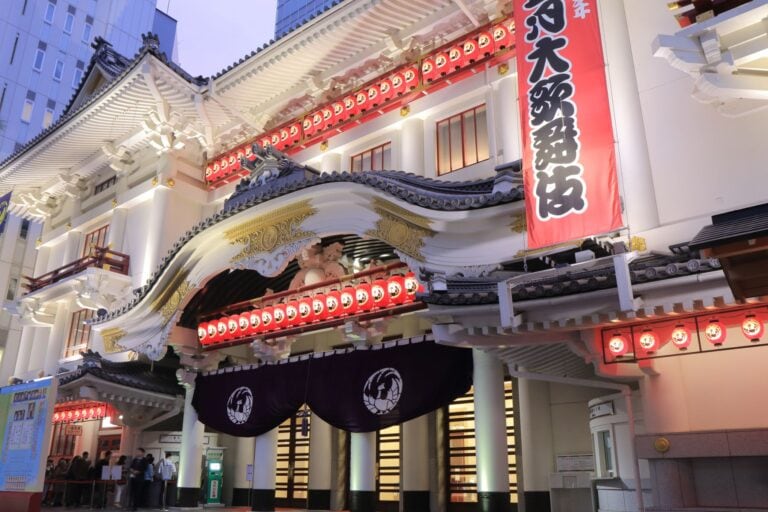

As we walked away from the box office, I held our tickets close for that evening’s performance of Tokyo’s premier Kabuki Theater. Having researched the history of Kabuki before arriving in Japan, attending an enactment moved into my list of the top five ‘must do’ activities in Tokyo. In 2005, UNESCO registered Kabuki Theater as a Masterpiece of Oral and Intangible Heritage and Humanity.
Kabuki Theater: Japan’s 400-Year-Old Art of Song, Dance, and Drama

Kabuki Theater, recognized internationally as one of Japan’s most important offerings to the performing arts, has been central to Japanese culture for over 400 years. The three characters of the word, ‘ka-bu-ki’, literally reflect its components; ka means song, bu refers to dance, and ki means acting skill. All performances reflect intricate slices of Japanese history.
Kyoto reigns as the birthplace of the art form, created by a Shinto priestess, Izumo no Okuni, in the early 17th Century. Although originally performed by female dancers, the Shogunate rulers of the time, concerned that the roles were too risqué, banned women as kabuki performers.
This unique practice of only male kabuki actors, known as kabukimono, has remained unchanged to this day. Early on, this entertainment had been produced for the common people, but soon it became a favorite of the nobility as well.
Process to Obtain Tickets

Kyoto only schedules performances during certain seasons, so seeing a performance at Tokyo’s Kabuki-za Theater became our quest. Three acts make up Kabuki-za Theater. In Part I, performers enact a domestic drama set in the Edo period (1603-1868), plus dance, and begin at 11:00 am; Part 2 also reflects drama in the Edo era, plus dance at 2:30 pm, and Part 3 provides a modernized version of kabuki drama, without dance, at 6:15 pm.
Although the patron can attend all 3 parts, I advise the available ‘single-act only’ ticket. The foreigner, unfamiliar with the nuances of the Japanese language and history, can enjoy the flavor and spectacle of Kabuki in any one-act performance. If desired, single-act English captioning service costs 1000 Yen, cash only.
To obtain non-reserved tickets for Same Day, Single-Act Performance, go to the Single-Act Box-Office after 10:00 am, located to the left of the theater’s main entrance, at 4-12-15 Ginza Chuo-ku, Tokyo. The cost for this type of first-come, first-served ticket varies and is determined by the performance selected.
Non-Reserved Seats
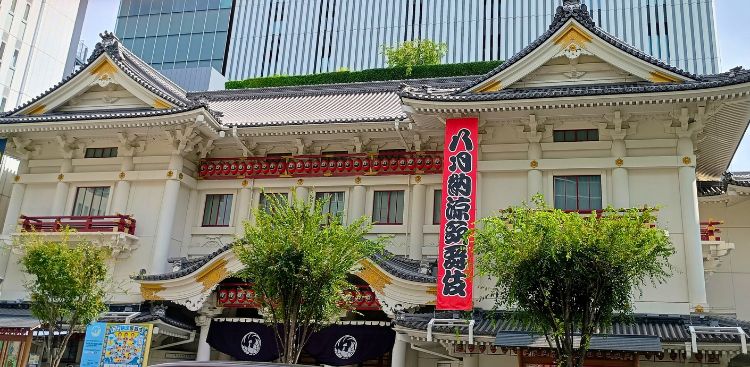
There are around 70 Single Act seats available to reserve online starting the day before the performance at noon, plus roughly 20 more that go on sale same-day, cash only, at the Single Act Box Office starting at 10:00 am. Beware that the spacing between these fourth-floor rows is extremely narrow. Anyone over 5’5″ will have knees screaming.
For the same-day seats, arrive at least 30 minutes before performance time to be first in line. Once the patron reaches the fourth floor, every person is given a consecutive number, and that is how the audience is allowed to enter the seating area. As with everything in Japan, the process is orderly, punctual, and controlled to avoid chaos and allow a calm, enjoyable experience.
Reserved Seating
Reserved seating tickets can be purchased online or at the box office located in the basement of the theater for specific performance dates, but cost considerably more, cost considerably more, depending on the program and seat class.
Again, most travelers to Japan have an aggressive itinerary, and few have a full day to devote to Kabuki Theater. Single Act, Same-Day tickets give patrons an overview of the drama, vibrancy of costumes and masks and the sound of live music from unique Japanese instruments.
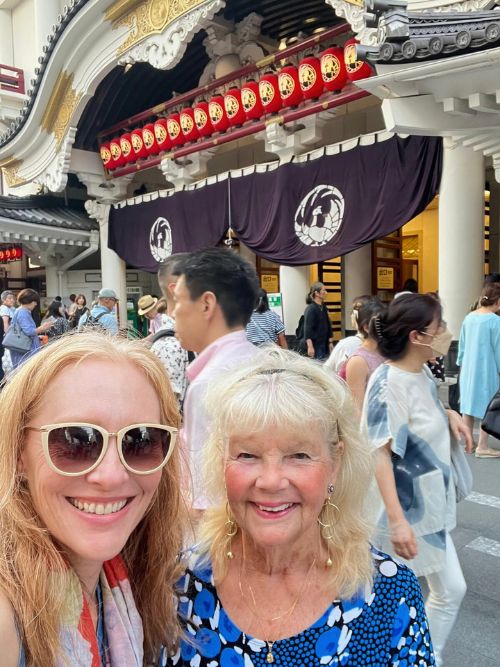
The theater itself, located on one of Tokyo’s busy, wide avenues, stands out with its traditional Japanese architecture between modern, gleaming skyscrapers. Waiting outside the theater for the performance felt like attending a Broadway play in New York. Excited patrons, dressed up for the event, milled around outside until the doors opened. Once we entered Kabukiza Theater, the spirit of Japanese tradition came alive.
If you’re planning a trip to Japan, check out our Japan Travel Guide, where you’ll find a curated selection of articles to inspire you and help plan your trip.
Kabuki Masks and Costumes
Kabuki masks and vibrant costumes used in all performances are recognized as a separate iconic art form. The facial coverings, characterized by ornate and exaggerated design, can be constructed from wood, lacquer, or cloth and decorated with feathers, colorful paint and gold leaf patterns prevalent in the Edo Period.
Their purpose is two-fold: first to conceal the actor’s identity, particularly for those female roles being played by male Kabukimon; and, more importantly, each mask represents the expressions and emotions of the part being played, essential characters of demons, gods, or animals, or good and evil, in fighting scenes or dance.
The Japanese people believe that masks have the power to transform the wearer into a character. They are familiar with the meaning of each mask’s color and facial expression. White represents honesty; black represents death, darkness, and evil; green represents a new beginning and youth; red represents violence and anger; and gold represents wealth.
Before attending the evening performance, we visited the Kabuki Museum across the avenue from the theater and briefly studied mask expressions.
We had not purchased the English caption service; an error, as being able to understand the dialogue could have enhanced the legend. But the dramatic staging, special effects, changing scenery and intense, live, background music provided two hours of cultural entertainment. I encourage any traveler to Tokyo to experience the thrilling art form of Kabuki Theater.
If You Go
Kabuki Tickets
Travelers who would rather not navigate the box office in person can book a Kabukiza Theatre admission ticket in advance on GetYourGuide, with a seat and the English or Chinese captioning device built into the price.
Where to Stay
Kabukiza sits in Ginza, so staying nearby keeps the walk to curtain time short.
- Hotel GINZA7 Tokyo is steps from the theater, with in-room WiFi and secure luggage storage for anyone dropping bags between acts.
- Tokyu Stay Ginza offers larger rooms than most Ginza properties, a welcome perk after a full day of sightseeing before an evening show.
Need a hand planning your trip? Here are the sites and services we rely on most, from booking tools to travel products we love.
Inspire your next adventure with our articles below:
Author Bio: After a life-long profession of treating the mentally ill at a PA psychiatric hospital for 33 years, Carol retired to Lake Chapala, Mexico in 2006 with her husband, to pursue more positive passions. Her family thought that she too had ‘gone mad.’ Carol has taught English to Mexican adults and disadvantaged local children for the past 18 years. She writes for local, international, on-line and print publications. Using her adventures to over 120 countries, she has captured a niche in travel writing, and her stories have been featured in Go World Travel Magazine. A frequent contributor to El Ojo del Lago, the largest distribution English magazine in Mexico, she’s won several literary awards from that publication. Her psychiatric field work netted a contribution to the anthology, Tales from the Couch. Recently she has also been featured in two more anthologies, Insider’s Guide to the Best of Mexican Holidays, and Bravados, Life, Love and Living in Lake Chapala, Mexico, all available on amazon.com.
Want to discover more hidden gems and helpful travel tips? Join our free newsletter for the latest travel secrets and travel articles.
We are reader-supported and may earn a commission on purchases made through links in this article.

- Slow Down on Prince Edward Island: A Relaxed Four-Day Itinerary of Dunes, Seafood and Seaside Inns - September 25, 2026
- Two Sides of Cape Town: Table Mountain Trails, Winelands Dawn and Township Voices - September 25, 2026
- St. Pierre and Miquelon: Visit France Without Leaving North America - September 25, 2026
Planning another trip soon? ✈️
Add GoWorldTravel.com as a preferred source on Google. Click the button below so our local guides, packing hacks, and hidden-gem itineraries always show up first when you search!
Add to Preferred Sources