
Tokyo is a city of layers, where the neon-drenched chaos of the street level often hides sanctuaries of stillness just a few stories up—or, in the case of Roppongi, more than fifty-three stories up.
Roppongi itself is a district of contrasts. By day, it hums with the cadence of international business—suited professionals crossing wide avenues, taxis threading through streets lined with high-end shops and polished hotels.
By night, neon signs flicker on, drawing crowds to nightlife spots and contemporary art galleries tucked between office blocks. Cafés, bistros, and casual eateries spill onto sidewalks, serving everything from matcha lattes to steaming bowls of ramen.
Conversations in Japanese, English, and countless other languages drift through the air. Walking through Roppongi is like traversing overlapping worlds at once: sleek modernity meets curated tradition, and at every corner, there is something to notice if you slow down.
In this corner of the Minato ward, the local geography is defined by more than just subway exits and ramen stalls; it’s anchored by a geometric loop of high-concept culture known as the Roppongi Art Triangle, or ATRo.
But to call it a “triangle” feels a bit too academic for a place that feels like an architectural and artistic playground. Navigating this triangle is less an exercise in geometry and more a study in sensory shifts.
As my wife, Nataliya, our kids, Nicole and Alex, and I discovered one hot summer day, one moment we were confronting the dizzying vertigo of a skyscraper summit; the next, we descended into the cool, subterranean silence of a concrete bunker.
When Architecture Is Art
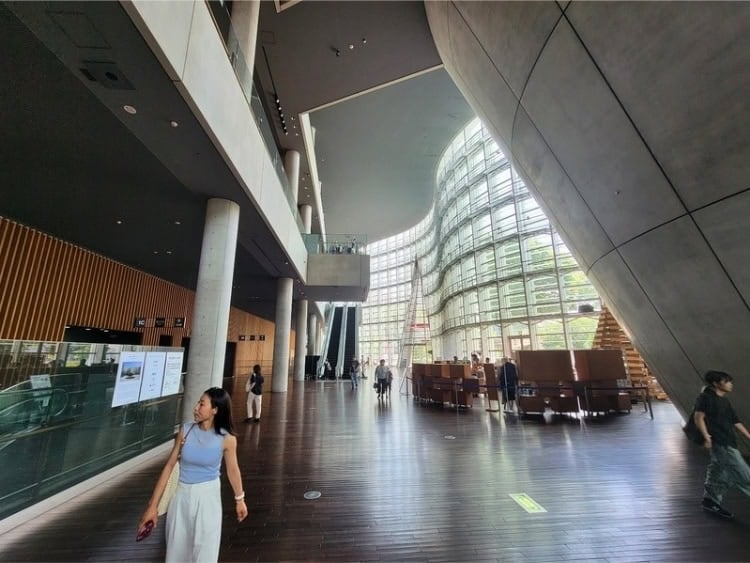
The National Art Center, Tokyo, is a glass-and-steel marvel—an undulating wave of green-tinted glass that looks like a frozen ocean cresting over Roppongi. Designed by the legendary Kisho Kurokawa, the building doesn’t just hold art; it is art.
The day we arrived, the galleries within were between major exhibitions, leaving the building itself to stand as the primary art installation. The National Art Center rotates galleries and exhibits, so you never know what may be in store.
Regardless, the building itself, inside and out, is well worth a visit. Inside, the atrium is so vast it seems to have its own weather system. Massive concrete cones rise from the floor like inverted volcanoes, topped with cafes where people sip espresso.
They sit suspended in mid-air, seemingly indifferent to the vertigo-inducing drop below. With the galleries quiet, the focus shifted entirely to the interplay of light and geometry. Nataliya, with her mathematician’s cap on, was immediately struck by the scale.
She pointed out how the afternoon sun filtered through the horizontal glass slats to paint a barcode of shadows across the polished floor. We wandered through the architecture as if it were a curated path, lingering by the info desk and the gift shop.
“It’s strange to be in a museum where you aren’t looking for a painting or sculpture,” Nicole said, tilting her head back to trace the curve of the glass wall. “I think that’s the point,” I said, leaning against the railing of the atrium.
“The building is the thing.” Alex, fresh from a semester of anatomy courses, observed that the structure felt like it was “breathing,” a living organism of light and space that expanded and contracted as clouds passed over the facade.
As we stepped back out into the heat of Roppongi, it was clear that in this part of Tokyo, the street and the structures are just as vital as anything hanging on a wall.
Read More: Exploring Tokyo: A Local Expert’s Guide to Must-See Spots and Hidden Gems
Ghosts of Channel 10
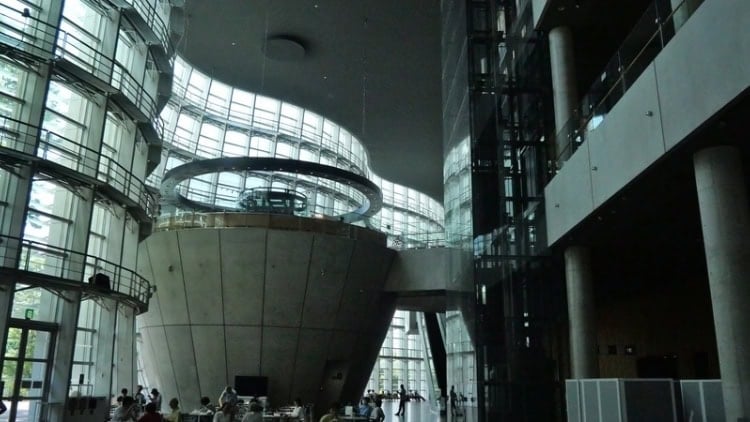
As we turned toward the towering silhouette of the Mori Building, our path took us past the curved glass wall of the TV Asahi Headquarters. Inside the bright, multi-story atrium, the studio lights were humming.
Through the glass, we could see a live morning show in progress—a woman in a sharp blazer leaning forward to interview a guest, their movements mirrored perfectly on the monitors hanging above them. I stopped, glass replaced by a grainy, neon-tinted memory.
“You know what?” I gestured toward the cameras. “I’ve been here! Back in the mid-eighties. When I was a high school student in Japan, we took a field trip to this very station—though it looked a lot different back then.”
Alex slowed down, curious. “You were in a Japanese TV studio?” “We sat right in the studio audience,” I said, smiling as the details sharpened. “I can’t remember the name of the program, but I remember the energy of it.”
“It’s strange; I probably haven’t thought about that day in forty years, but standing here now, I remember it clearly.” Pleasant, unexpected surprises—like a long-lost memory returned—are a joy of coming back to a place after many years.
This memory, although my own, felt like a new souvenir—of both now and then.
Moomins in the Mori
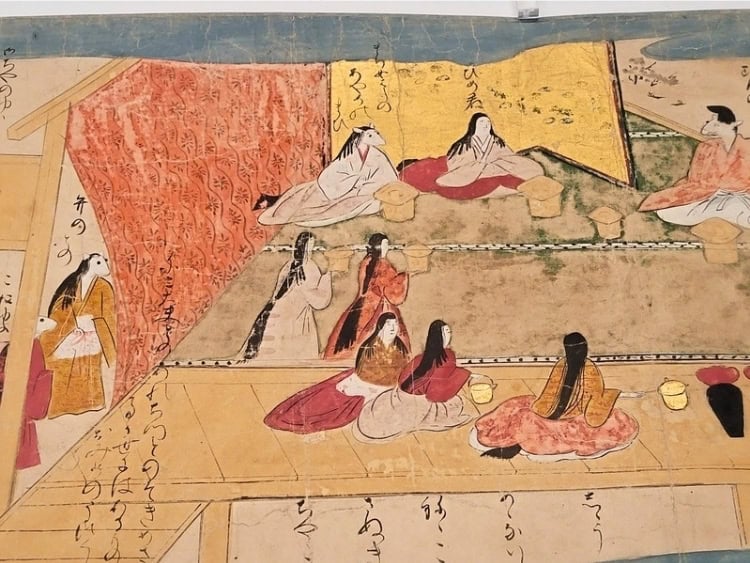
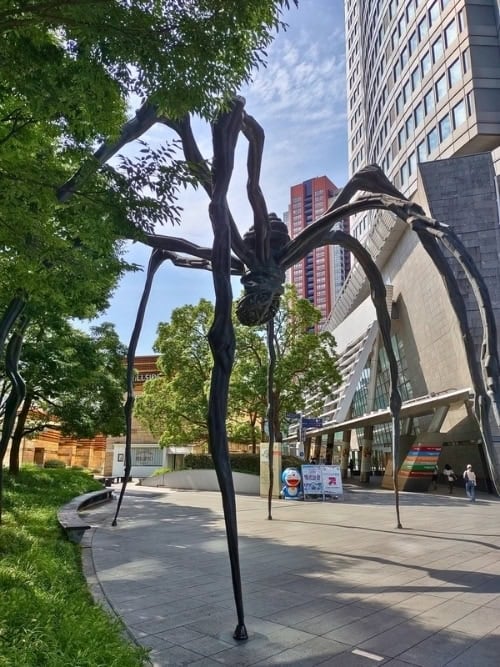
If the National Art Center is a curated wave, the Mori Art Museum is a summit. To get there, you first pass “Maman”—Louise Bourgeois’s nine-meter-tall bronze spider—standing guard at the base of the Mori Tower like a surreal, spindly gatekeeper.
From the ground, it looks monumental; from the 53rd floor, it’s just a tiny bronze speck on the pavement. “It feels like we’re ascending to a different climate zone,” I said as the high-speed elevator shot us toward the clouds.
The Mori doesn’t just show contemporary works; it frames the entire metropolis. Because the museum is perched at the top of the Roppongi Hills complex, the observation deck makes Tokyo look like an intricate, hyper-dense circuit board.
On our visit, the orange-and-white needle of Tokyo Tower felt close enough to touch. Inside, the vibe shifted from the monumental skyline to the whimsical and profound world of artist Tove Jansson.
The galleries were hosting a major Moomintroll retrospective, and it felt like stepping into a hand-drawn sanctuary of Nordic philosophy. We moved through original ink sketches and watercolor studies tracing the evolution of Moominvalley’s inhabitants.
Alex lingered in front of a large cutout of the main character, tilting his head with a skeptical grin. “I don’t know, Mom,” he said, pointing to the rounded snout and pear-shaped body. “He looks like a big white hippo to me.”
Nataliya, who grew up on the books and was visibly tickled by every sketch we passed, didn’t even look up from the display case. “He is absolutely not a hippo, Alex,” she said with mock indignation. “He’s a Moomin. There’s a big difference.”
We stopped to read a quote on the wall by Jansson that seemed to anchor the entire experience: “All things are so very uncertain, and that’s exactly what makes me feel reassured.”
Building the Future
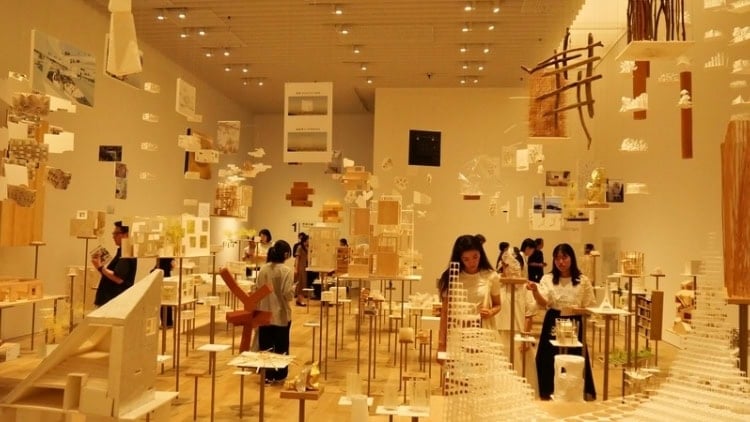
In the next wing, the vibe shifted from the whimsical to the visionary as we entered the world of conceptual architecture. The rooms were packed with thousands of small models.
Some rested on slender white pedestals; others were suspended from the ceiling like geometric clouds. There was something hypnotic about the sheer volume of “what ifs.” We saw conceptual skyscrapers and abstract experiments with staples and ashtrays as dwellings.
“I think the altitude changes how you look at the models,” Nataliya remarked, looking from a small-scale conceptual forest to the sprawling city unfolding about 240 meters below. “You’re already detached from the ground, so your brain accepts the abstract.”
Architecture as Imagination
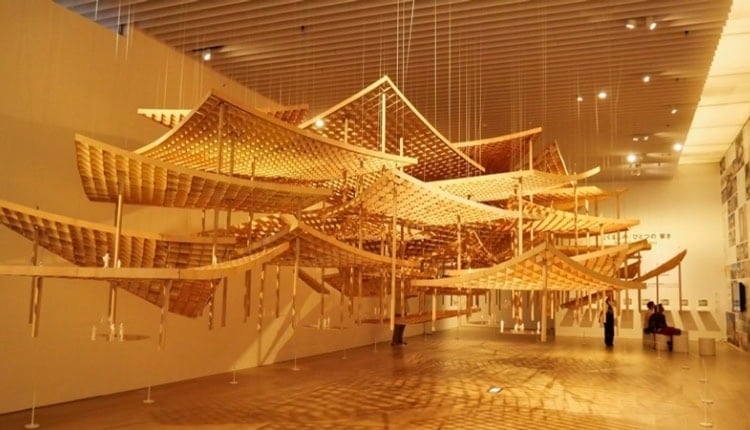
One space was dedicated to an innovative retrospective of architect Sou Fujimoto. We stepped into his “Forest of Thoughts,” a surreal landscape where the very air seemed to be made of architectural potential.
“It’s like looking at a city through a kaleidoscope,” Nicole said, pointing to a large mockup of Sou Fujimoto’s Osaka Expo 2025 Grand Ring. As chief architect of the Expo site, he developed a timber structure where traditional craft meets futuristic scale.
We lingered over the joinery mockups, seeing intricate wooden connections of the massive loop that we were scheduled to walk across ourselves in Osaka the following week. “It’s the perfect primer for next week,” I said.
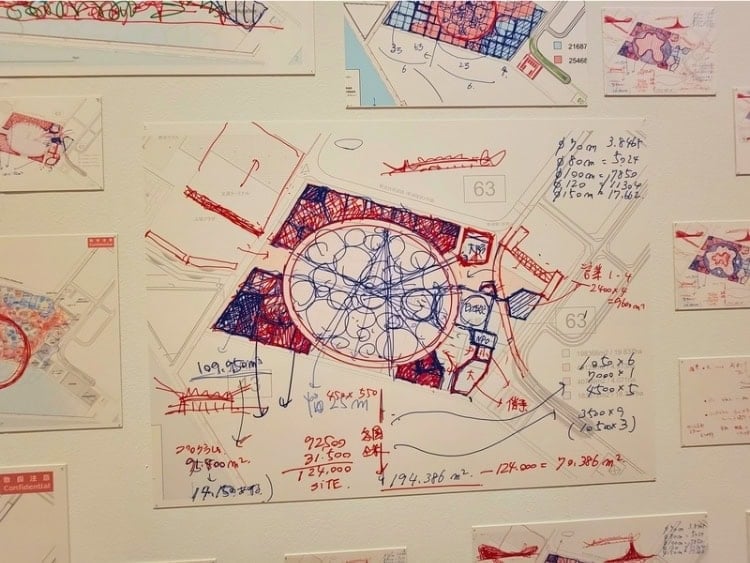
“Seeing the model here at the summit, then walking the real thing in Osaka … it makes the architecture feel less like a building and more like a journey.” Against the walls, display cases held Fujimoto’s notebooks and dozens of hand-drawn sketches.
Seeing his frantic, energetic pen strokes—the raw DNA of his ideas—made the massive structures feel human. A large screen nearby pulled us in, playing a video of his vision for future cities: organic structures where nature and steel blur into one.
“It’s the only museum,” Alex said as we took the elevator back down, “where the ‘exit through the gift shop’ involves a descent that makes your ears pop.”
Suntory’s Urban Living Room
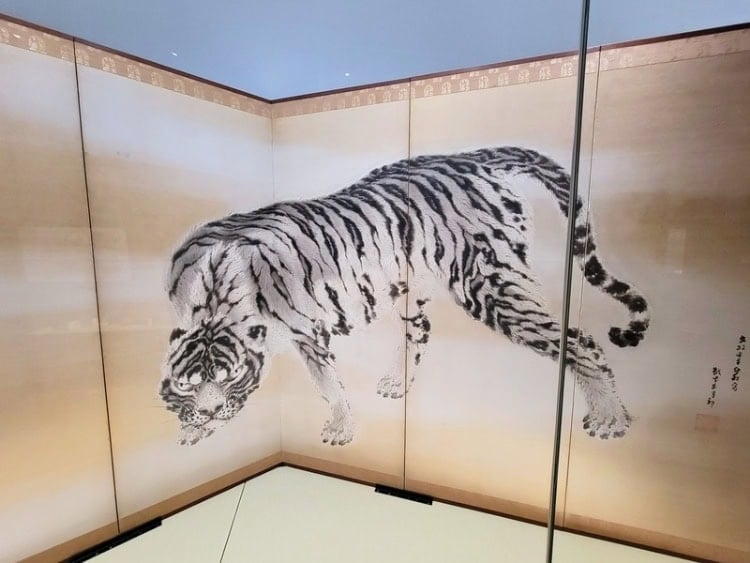
If the Mori is the ATRo’s summit and the National Art Center is the wave, the Suntory Museum of Art is the sanctuary. Tucked inside the sleek Galleria of Tokyo Midtown, the entrance feels like stepping into a neighbor’s refined residence.
Designed by Kengo Kuma, the space is a masterclass in Japanese Modern. The glass-and-steel of the mall vanishes as you’re greeted by the warmth of local cedar and the soft glow of light filtered through muso lattice windows.
Even the floors are said to be made of white oak recycled from old Suntory whiskey barrels. The museum’s philosophy is “Art in Life,” focusing on how beauty integrates into the everyday.
During our visit, we explored a collection that highlighted this perfectly—ranging from delicate Edo-period glassware to an intricate, multi-paneled folding screen depicting a bustling Kyoto street scene.
The detail in the screen was so fine that Nicole and I spent ten minutes trying to find a single figure without a unique expression. “It’s like a 17th-century Where’s Waldo,” Nicole said, leaning in to see a tiny merchant haggling over a fish.
“Look, they have mice,” I said, pointing to another work featuring mouse characters alongside humans. Nataliya was drawn to the ceramics—specifically a tea bowl with a “hare’s fur” glaze that seemed to shift colors under the gallery lights.
Nicole observed that the museum managed to feel intimate despite being inside a massive shopping complex. “Like a cozy eye in the storm,” she said. We ended our tour at the museum’s café, a necessary refuge from the humid July heat.
We leaned into the “Art in Life” theme by ordering the seasonal summer wagashi—a translucent, jelly-like sweet served with a bowl of whisked matcha. Cool and subtle, it was shaped like a morning glory, a perfect edible reflection of the season.
We traded the climate-controlled sophistication of the Galleria for the humid air of Midtown Garden, a surprisingly lush park where the city’s frantic pace is muffled by cedar trees and winding gravel paths.
Midday Stroll Through Midtown Garden
Midtown Garden is a serene ribbon of green threading through Roppongi, where glass towers and sleek steel sculptures rise like futuristic sentinels, and the city hums quietly—distant chatter, occasional subway rumbles, and leaves stirred by a soft breeze.
Low stone benches and sculpted paths invited slow wandering, while artful landscaping framed views of the surrounding skyline, from minimalist office towers to the geometric elegance of nearby Roppongi Hills.
Nestled within this layered neighborhood, Midtown Garden offers a curated pause. Sculpted trees, reflecting pools, and quiet paths create a sense of breathing room, letting visitors orient themselves before stepping into the city’s more intense energy.
It’s here, tucked into the far corner of the greenery, that the architecture shifts again—from Kengo Kuma’s warm wood to the sharp, subterranean angles of our next destination. After a brief stroll, we stepped from leafy green back to concrete, glass, and steel.
21_21 DESIGN SIGHT: Disaster Design
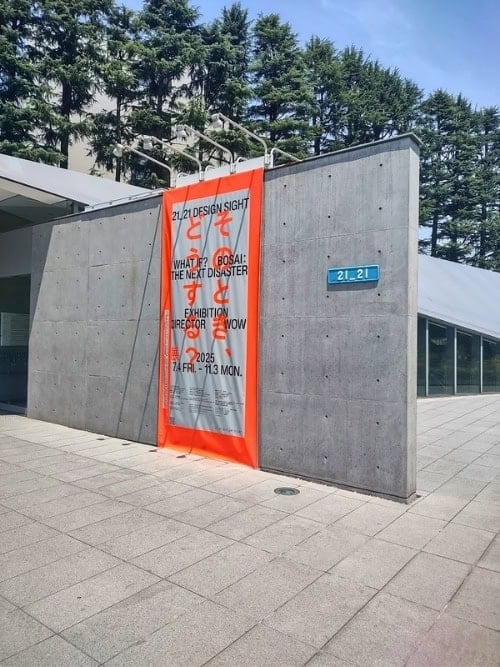
It is here—framed by steel, glass, and sky—that 21_21 DESIGN SIGHT rises. Its folded roof catches the light like a silent invitation, modern and mysterious, promising a journey where architecture and imagination merge.
Emerging from the garden, the building seemed almost to wait for us. Entering the lobby, we were greeted by signage for the current exhibit, both in Japanese and English: What If? BOSAI: The Next Disaster.
This exhibition explored a question that felt both urgent and timeless: Are we ready for the next disaster? Disaster wasn’t just a news headline here—it was personal, communal, and profoundly human, a lesson we felt at interactive stations.
The exhibit didn’t lecture; it invited thought and conversation. What defines a disaster? When does preparedness become a habit, or a philosophy? How do our daily choices ripple into moments we cannot predict?
Nataliya lingered near a display of earthquake and flood maps, tracing lines not with fear, but curiosity. “It’s like reading the world’s pulse,” she said. Alex dove into an interactive station titled “What If? — Answers from Everyone.”
Visitor responses from across the globe appeared. The deeper we went, the more the exhibition felt like a conversation. One installation asked us to spot disaster signage in our own city. Another introduced speculative protective gear.
Alex paused in front of BOSAI‑Gradation, a subtle, provocative piece that suggested preparedness is more mindset than checklist. Even folklore appeared: generational tales of living alongside nature’s unpredictability.
“Two languages at once,” Alex murmured. “Japanese and English?” I asked. “No—science and story,” he said. A small station offered stickers to represent your personal “disaster answer.” Simple, symbolic—yet grounding.
The gallery didn’t tell us what to think; it asked how we think. That, I realized, was the point. It wasn’t a warning so much as a mirror, reflecting who we are in uncertainty and who we might become if we notice the world around us.
As always, the space itself—Tadao Ando’s concrete, light-filled structure—shaped the experience. It reminded us that design isn’t just what you see; it’s how what you see changes the way you think, reflect, and act.
The building offered multiple ways of seeing. The site changes exhibitions seasonally, giving each visit a fresh lens on life, creativity, and the world around us. Our visit stayed with us after we left. In our strolling conversation, we unpacked ideas like souvenirs.
Living Gems at Art Aquarium
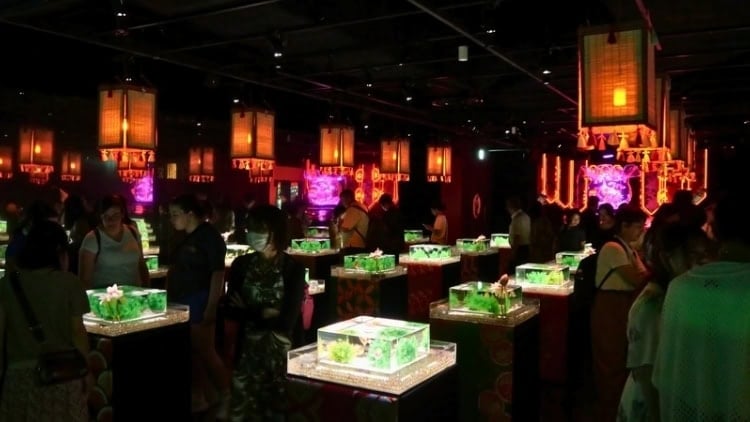
If the Roppongi sites are high-minded and architectural, a quick detour to the Art Aquarium Museum in Ginza, about fifteen minutes away on the Hibiya Line, offers a neon-soaked, surreal cousin.
Into the Neon Deep
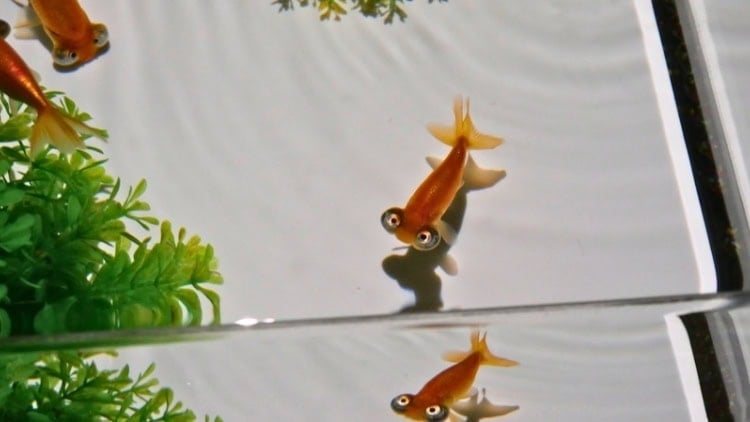
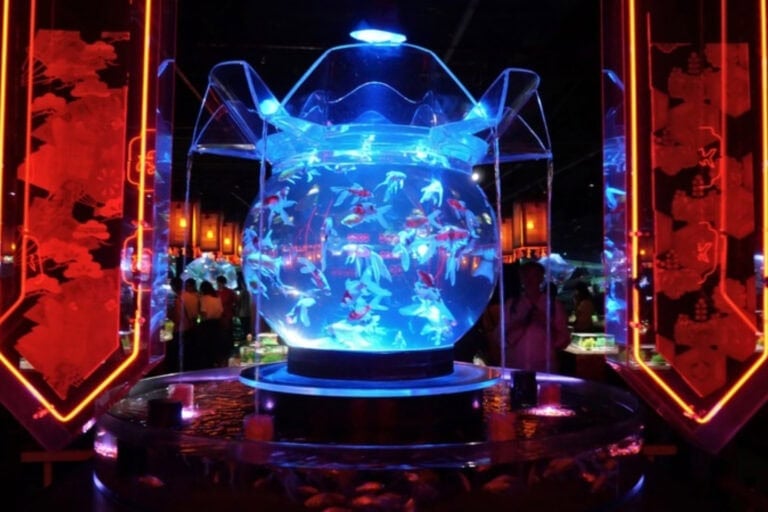
Here, the boundary between living biology and high-concept art dissolves. Inside, the atmosphere shifts from daylight-drenched atriums to a dark world of neon and shadow. Hundreds of goldfish—revered in Japan as living gems—glow in elaborate glass vessels.
Some are housed in massive, illuminated columns that shift through deep purples and electric blues; others swim through spherical bowls that act like magnifying lenses, turning a single fantail into a swirling, kaleidoscopic abstraction.
Gold Scales and Folding Screens
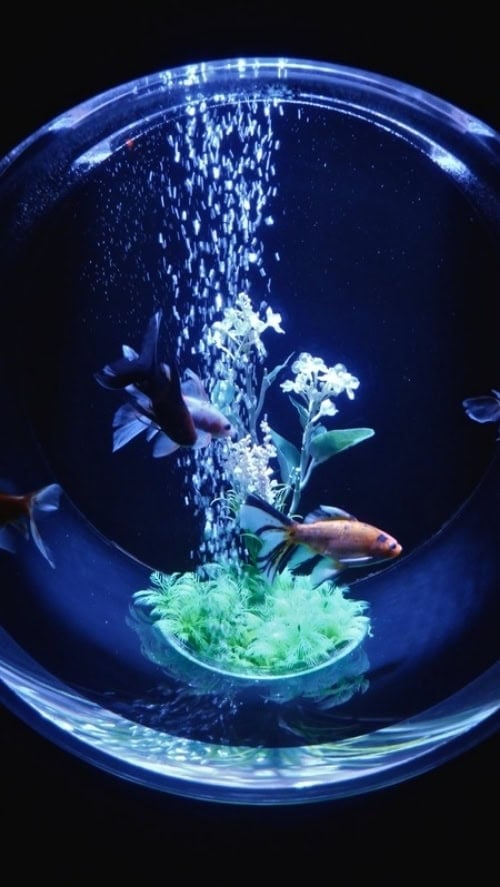
The backdrop is meticulously curated. We wandered corridors lined with hanging flowers and traditional folding screens, where golden scales caught the light like moving gold leaf. “It’s like being inside a giant lava lamp,” Nicole said, leaning in for a selfie.
Nataliya laughed, watching an ornate fish navigate a forest of artificial aquatic plants. “I don’t know if it’s more about the fish or the lighting design, but it’s definitely hypnotic.” Alex noted the Edo-period obsession with goldfish, remixed for today.
“It’s a bit strange, isn’t it? Taking something alive and turning it into a light show.” It was surreal and slightly unsettling in the best possible way.
Read More: Japan in Tsuyu: Hydrangeas, Moss Gardens, and Rainy-Season Travel Tips
If You Go
The Roppongi Art Triangle (ATRo) is remarkably walkable, with each point within a fifteen-minute stroll of the others. Most sites are easily accessible via the Roppongi (Hibiya and Oedo lines) or Nogizaka (Chiyoda line) subway stations.
National Art Center: A short walk from Nogizaka Station, this “museum without a center” is free to enter if you just want to admire Kisho Kurokawa’s architecture or grab an espresso on a concrete volcano. Note that the center is generally closed on Tuesdays.
Mori Art Museum: Located on the 53rd floor of the Mori Tower in Roppongi Hills, the Tokyo City View observation deck provides one of the best “circuit board” perspectives of the city.
Suntory Museum of Art: Found on the 3rd floor of the Tokyo Midtown Galleria, it’s an ideal spot to transition from the urban hustle to the quiet of Midtown Garden. The museum typically closes on Tuesdays.
21_21 DESIGN SIGHT: Tucked into the far corner of Midtown Garden, like many Tokyo galleries, it is closed on Tuesdays and during installation periods between exhibitions, so check their website before making the trek.
Art Aquarium Museum: While not in the Triangle, it’s a quick 15-minute hop on the Hibiya Line to Ginza Station. Located in the Ginza Mitsukoshi building, it often stays open later than traditional galleries, making it a vibrant after-dark finale.
If you plan to visit all three Triangle museums, look for the “Art Triangle Roppongi” (ATRo) map or discount vouchers at the ticket counters. Presenting a ticket stub from one Triangle museum often nets you a small discount at the others.
We used the Tokyo Pass during our visit, offering admission to a number of sites throughout Tokyo. It’s available at www.mytokyopass.com and offers admission to all of these sites except the one that we entered for free to begin with.
Need a hand planning your trip? Here are the sites and services we rely on most, from booking tools to travel products we love.
Inspire your next adventure with our articles below:
- Toyama, Japan’s Sushi Capital: Savoring 1,000 Years of Sushi Tradition
- How Bamboo Farming in Japan Balances Tradition and Modernity
Want to discover more hidden gems and helpful travel tips? Join our free newsletter for the latest travel secrets and travel articles.
We are reader-supported and may earn a commission on purchases made through links in this article.

- Montenegro’s Bay of Kotor: Stone Towns, Venetian Walls and Mirror-Calm Water - October 11, 2026
- Rila Monastery: A Day Trip Into Bulgaria’s Spiritual Heart - September 23, 2026
- Castles, Carriages, and Cellars: Following the Liechtenstein Trail Through Moravia - August 14, 2026
Planning another trip soon? ✈️
Add GoWorldTravel.com as a preferred source on Google. Click the button below so our local guides, packing hacks, and hidden-gem itineraries always show up first when you search!
Add to Preferred Sources