
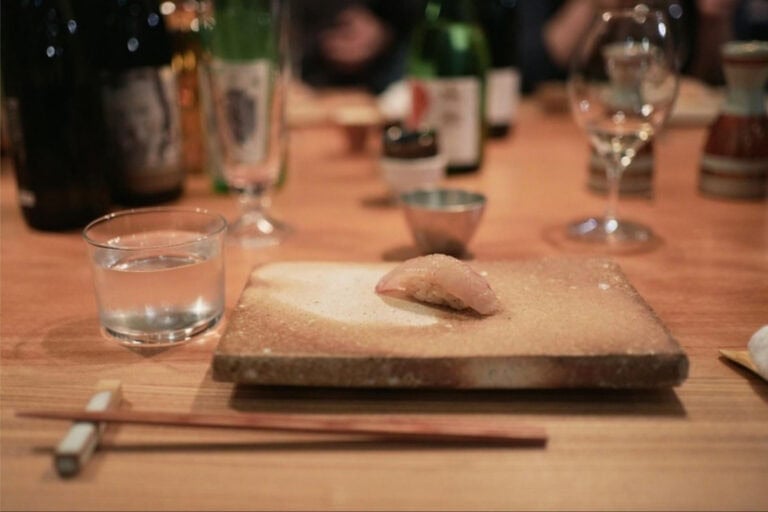

Most people know sushi as a cuisine born in Japan, and travelers to the country can enjoy it almost anywhere they go.
But when people think of sushi, certain places tend to come to mind: Hokkaido, famed for its abundance of fresh seafood; Tokyo, the birthplace of nigiri sushi; or gourmet cities such as Kyoto and Osaka.
Now, however, another destination is making a bold claim. Toyama Prefecture, facing the Sea of Japan, has officially declared itself Japan’s “sushi capital.”
Governor Hachiro Nitta has repeatedly promoted the title as part of a prefecture-wide campaign, and the message is steadily gaining attention and credibility across the country.
Why does Toyama make this claim? This article explores the natural, cultural, and culinary foundations that support Toyama’s growing reputation as one of Japan’s most compelling sushi destinations.
Toyama is Where Sushi’s 1,000-Year Journey Remains Alive
![Vinegared rice used in sushi dishes. Photo by [Author's Name]](https://www.goworldtravel.com/wp-content/uploads/2026/02/Vinegared-Rice.jpg)
First, where exactly is Toyama? Even many Japanese living in major cities such as Tokyo or Osaka may hesitate to pinpoint it on a map.
Toyama lies on the northwest coast of Japan’s main island, Honshu, facing the Sea of Japan. Most of Japan’s major population centers developed along the southeastern Pacific coast, which leaves Toyama on what is often described as the country’s “hidden” side.
That “hidden” position, however, is not a disadvantage. On the contrary, regions like Toyama have been able to preserve uncultivated landscapes and traditional ways of life, including culinary practices that have quietly disappeared elsewhere.
Sushi itself has a history of roughly 1,000 years, and the world-famous nigiri sushi is only one expression of a much broader tradition.
The earliest form of sushi was narezushi, in which fish was fermented with rice and salt. Its defining sourness gave rise to the word sushi, derived from the Japanese term sushi (酸し), meaning “sour.” In this ancient style, only the fish was eaten; the rice used for fermentation was discarded.

During the Muromachi period (1392–1573), sushi evolved into namanare, or semi-fermented sushi, with a shorter fermentation time. This marked a turning point: the rice, once discarded, began to be eaten along with the fish.
Later, during the Edo period (1603–1868), lactic fermentation was largely replaced by vinegar, which had become widely available as a seasoning. Vinegar allowed sushi makers to recreate sourness without fermentation, giving rise to hayazushi, or quick sushi.
Vinegared rice was combined with seasoned or marinated fish, pressed into molds, covered with a lid, and weighted for several hours. This pressed sushi, known as oshizushi or oshi sushi, flourished in the Osaka region.
That technique eventually led to an even faster innovation in Edo (modern-day Tokyo): nigiri sushi, formed by hand without pressing.
Ancient Forms of Sushi Still Remain

What is remarkable is that Toyama’s culinary landscape still encompasses all of these forms today.
Ancient forms of sushi, such as narezushi, are still served today as ceremonial dishes at renowned temples in Toyama.
Sekiko Kakitani, who runs a family business specializing in fermented fish, also continues this tradition by producing konkazuke, a time-honored fermented fish preserved in rice bran.
Masu-zushi, a form of pressed sushi, also remains one of Toyama Prefecture’s most iconic local dishes and a popular souvenir.
Kabura-zushi, another traditional pressed sushi, appears seasonally in local cuisine and is especially associated with New Year celebrations.
From fermented sushi to pressed sushi and nigiri, the prefecture offers a living continuum of sushi’s 1,000-year evolution.
Seen this way, Toyama’s claim to be Japan’s sushi capital is not mere promotion. It is rooted in geography, history, and a rare preservation of sushi’s full diversity, making the region something like a living library of Japan’s sushi culture.
One practical note: Toyama is off the main tourist trail, so grabbing a Japan eSIM through Airalo before you leave means maps and translation apps are ready the moment you land.
Local Culinary Artisans Owe Much of Their Craft to These Natural Gifts

When it comes to the world-famous nigiri sushi, Toyama’s position is also particularly strong.
Toyama consistently ranks among Japan’s top prefectures for sushi consumption per capita, and the number of Michelin-starred sushi bars and fine-dining restaurants has risen sharply in recent years, including SOTO.
Prestigious sushi establishments based in Tokyo, such as Sushi Shunji, are also preparing to open branches in Toyama. Hokuriku Sushi Academy in Toyama, scheduled to open in 2026, has formed a partnership with Tokyo Sushi Academy, one of Japan’s best-known sushi schools.
Behind this momentum lies Toyama’s exceptional geography and natural abundance.
Toyama’s inhabited areas sit between the 3,000-meter (nearly 10,000-foot) peaks of the Tateyama Mountain Range and the almost 1,000-meter (about 3,300-foot) depths of Toyama Bay. Thus creating a dramatic vertical difference of roughly 4,000 meters (around 13,000 feet) within a remarkably short distance.
This extraordinary elevation range supports everything from top-grade Koshihikari rice to an exceptional diversity of seafood.
Fresh and Natural

Toyama Bay is often described as a “natural fish preserve.” Of the roughly 800 species found in the Sea of Japan, about 500 are known to live in or pass through the bay.
Beneath the surface, three distinct layers of seawater coexist. In the upper layer, the warm Tsushima Current flowing from the southwest mixes with mineral-rich snowmelt carried by rivers from the Tateyama range and the Hida Highlands.
Below that, at depths greater than 300 meters, colder, heavier indigenous seawater remains largely undisturbed. Nutrient-rich groundwater, filtered through mountain and forest soil, also emerges from the seabed, further enriching the marine environment.
The bay’s undersea canyons add another advantage. These steep drop-offs extend close to shore, allowing fishermen to operate near ports and bring their catch ashore quickly.

Fish are immersed immediately in seawater ice on the fishery boats, slowing activity without triggering rigor mortis. The result is fish that reach sushi chefs in an ideal state, primed for umami development.
Naruki Takimoto, a representative traditional sushi chef in Himi, Toyama, notes that this fishing method is both rare and uniquely beneficial to the region’s cuisine.
Fumiya Higuchi, a rising young chef in Imizu, Toyama, adds that fish from Toyama Bay gives chefs exceptional flexibility, allowing them to decide whether to serve fish immediately or rest it to draw out deeper umami.
Local culinary artisans owe much of their craft to these natural blessings. Geography, water and time work together in Toyama, enabling chefs to create sushi that reflects not only technical skill but the land and sea themselves.
Sushi Creations That Challenge Convention

Photo by Kenta Nakashima
The horizon of sushi is also expanding in Toyama. The prefecture is not only a living library of sushi history but also an experimental stage where chefs are actively creating new forms of the cuisine.
One of the driving forces behind this movement is Shiawase Design, a public-private organization dedicated to deepening and promoting Toyama’s culinary culture, particularly its sushi tradition.
The group organizes workshops that bring local chefs together to develop new sushi concepts, as well as forums and promotional events where professionals and residents alike can taste the results.
In one such collaboration, local chef Koushu Matsusaka partnered with natural farming specialist Tomonori Maruyama to create vegetable-forward sushi, a new style of vegan sushi that emphasizes depth of flavor rather than substitution.
Fumiya Higuchi, mentioned earlier, has also taken experimentation even further with what he calls “sushi candy.” Made with red snow crab essence, red vinegar, and rice-based candy, the creation challenges conventional expectations while remaining true to sushi’s defining element: sourness.
The original meaning of sushi is rooted in acidity, and beneath the sweetness, Higuchi argues, that essential character remains.
In Toyama, it is possible to taste ancient fermented sushi, pressed sushi, classic nigiri made with Toyama Bay seafood, and entirely new expressions such as sushi candy. In effect, diners can experience 1,000 years of sushi history while also sampling its future.
This breadth of tradition and innovation is what gives Toyama’s claim to be Japan’s sushi capital its credibility. Adding to its appeal, the region still offers a calm, unhurried travel experience, largely free from overtourism.
Where to Eat Sushi in Toyama

For travelers planning their next trip to Japan, Toyama stands out not only as a place to eat sushi but as a destination to understand what sushi is.
High-End & Signature Sushi
- Naruki — Traditional Edomae-style Sushi
32-31 Saiwaicho, Himi City, Toyama, Japan - SOTO — High-End Sushi & Kaiseki
2-8-21 Izumicho, Toyama, Toyama, Japan
Creative & Experimental Sushi
- Sate Hitsuji ni Modorutoshiyou — Innovative / Vegan Sushi (inside WINE LAB.)
5-4-7 Ekinan, Takaoka City, Toyama Prefecture, Japan
Hotel Dining with Sushi
- AKAMA Toyama — Auberge with local seafood and sushi offerings
1-3 Chuomachi, Imizu, Toyama, Japan
Traditional Sushi Culture / Fermentation
- Kakita Suisan — Traditional fermented fish producer
3-37 Kitaomachi, Himi City, Toyama, Japan
If You Go
Getting There: Search flights to Tokyo (NRT or HND) or Osaka (KIX), then connect via the Hokuriku Shinkansen to Toyama Station — approximately two hours from Tokyo. Search fares at CheapOAir.
Getting Around: The prefecture’s top sushi destinations span Toyama City, Himi, Takaoka, and Imizu. A rental car makes the most sense. Compare rates at Discover Cars.
Staying Connected: Pick up a Japan eSIM from Airalo before departure. Plans start around $4.50 for a week of data.
Tours: The Local Food and Cultural Tour in Toyama offers a guided look at local food producers and cuisine with an English-speaking guide.
Travel Insurance: SafetyWing offers affordable, flexible travel medical coverage. Worth picking up before any international trip.
Need a hand planning your trip? Here are the sites and services we rely on most, from booking tools to travel products we love.
Inspire your next adventure with our articles below:
- 20 Japanese Customs Every Visitor to Japan Should Know
- 10 Must-Do Experiences That Will Make You Fall in Love with Japan
Author Bio: Masayoshi Sakamoto is a Japanese writer, translator, and editor living in Toyama, Japan. He is the editor-in-chief of a local magazine, Hokuroku, and was the chief editor of a popular digital business magazine based in Tokyo, bizSPA!
Want to discover more hidden gems and helpful travel tips? Join our free newsletter for the latest travel secrets and travel articles.
We are reader-supported and may earn a commission on purchases made through links in this article.

- Bonaire, Savored Slow: Cactus Liqueur, Caviar, Donkeys and Shore Diving - October 23, 2026
- Two Colorado Hot Springs Worth the Drive from Denver - October 23, 2026
- Is 55 Too Young for a River Cruise in Europe? - October 23, 2026
Planning another trip soon? ✈️
Add GoWorldTravel.com as a preferred source on Google. Click the button below so our local guides, packing hacks, and hidden-gem itineraries always show up first when you search!
Add to Preferred Sources