
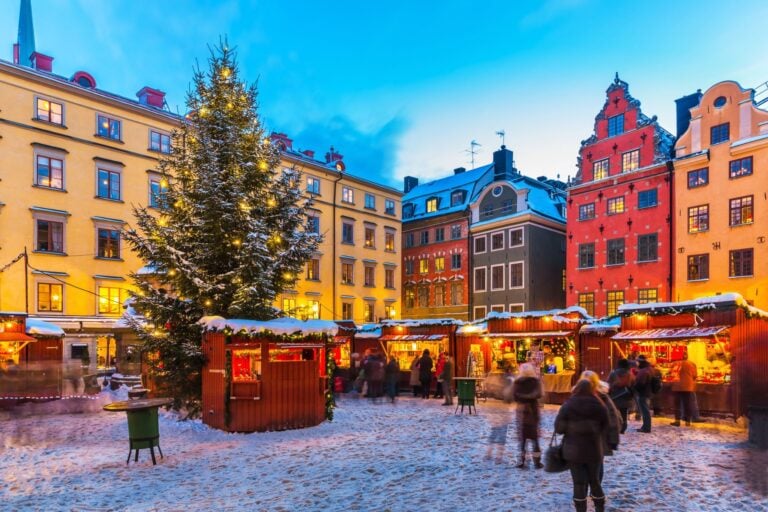
On a brief trip to Stockholm last December, I initially felt dispirited by the late sunrise and the early sunset. But that changed while wandering the busy streets of the City Centre and the higgledy-piggledy medieval lanes of Gamla Stan, the historic district. If there’s one thing Swedes excel at, it’s creating cheerful holiday environments, both inside and out.
There’s really no shortage of holiday gaiety in the Swedish capital to lift the spirits during the darkest time of the year.
Department stores dress their windows in whimsical displays. Christmas concerts and Christmas markets (julmarknader) fill the calendar. Light festivals brighten several dozen City Center streets. Signature baked goods and spiced drinks, both hot and cold, warm the soul.
There’s also a museum that features an inspiring gingerbread house exhibit, and Kungsträdgården (the King’s Garden) in Norrmalm (City Center) has a festively lit ice rink.
The list goes on. I wanted to experience as much as I could in the short time I had. Here are some of my favorite Christmas holiday experiences in Stockholm.
ArkDes Gingerbread Exhibit
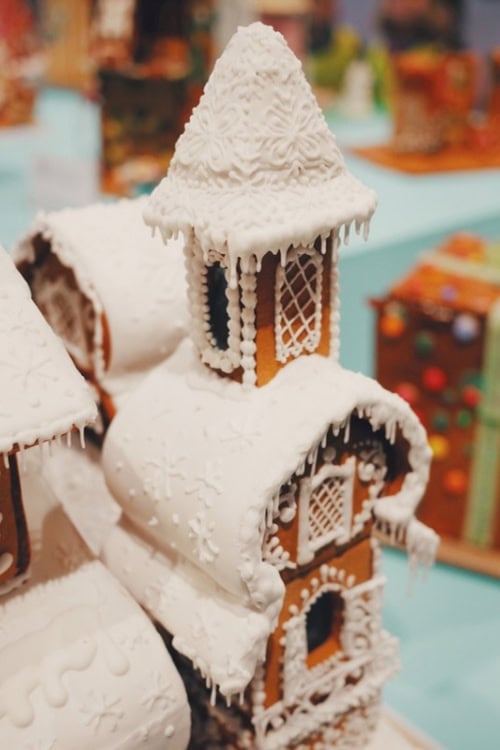
For a fun, fragrant and fantastical Christmas exhibition, visit the Swedish Center for Architecture and Design’s (or ArkDes) Gingerbread House exhibition. Now running for over 35 years, the ArkDes competition invites participants and visitors alike to explore architecture and design through gingerbread dough.
Knowing little about this exhibition beforehand, I expected to see cute, even pretty pieces. But I was delighted by the beauty, intricacy and inventiveness of some of the creations.
It turns out that, in addition to children and adult amateurs, there’s a separate category for professional architects, designers and bakers, which explains the high caliber of some of the entries.
This exhibition runs from late November through early January and entrance is free.
Stortorget Christmas Market
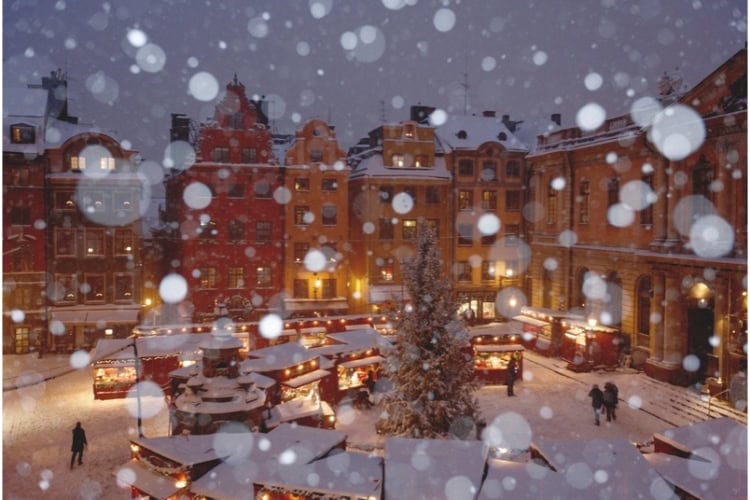
Photo by Ola Ericson, imagebank.sweden.se
With medieval origins and operating in its modern form since 1837, Stortorgets Julmarknad in Gamla Stan, the historic center, is Sweden’s oldest Christmas market.
While farmers’ markets have been held here since the 14th century, Sweden’s first Christmas market took place here in 1523. It would take another 300-plus years, until 1837, for Stortorget to become the Stockholm Christmas market’s permanent home.
When I visited one evening, the scent of mulled wine and roasted almonds filled the air. The 40-plus red timber stalls, strung with lights and spruce, squeezed together in the small square, gave the market an intimate ambiance.
Stortorget merchants sell quality Swedish goods, ranging from candy and mulled wine to ceramics, ironwork, handicrafts and toys.
After having lived in Germany and visited many Christmas markets in that country, including The Fairy Tale Christmas Markets of Hesse, Germany, I was surprised by the smaller scale of Stockholm’s most famous Christmas market.
But reflecting on this later, I realized that Stortorget was far less commercial than many of the Christmas markets I’d visited in Germany and Austria, and that its small scale not only made it more cosy, but also more authentic.
To hear the stories behind the stalls, this Stockholm Christmas Tour and Food Tasting Experience starts at the Nobel Prize Museum on Stortorget and winds through Gamla Stan, with warm glögg, a stop at a traditional candy maker and the Christmas lights along the waterfront before ending in Kungsträdgården.
Skansen Christmas Market
While I didn’t have the chance to visit Skansen Christmas Market, it’s been a Stockholm tradition since 1903. Larger than Stortorget, it is more family-friendly, with 70 stalls selling everything from baked goods, waffles and roasted almonds to homemade candles, textiles and handicrafts.
Spending so much time outside can leave hands and feet cold, so the firepits are especially appreciated.
Also popular at Skansen are activities like dancing around the Christmas tree, Christmas carol sing-alongs, Santa’s workshop and craft-making such as candle dipping.
Stockholmsjul Christmas Lights
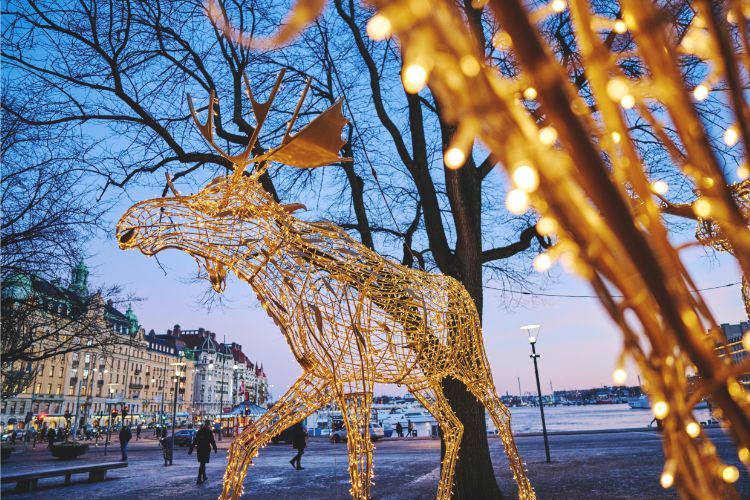
Since 2011, the City of Stockholm has been putting on Stockholmsjul Christmas Lights. The city centre is transformed into an illuminated wonderland of cheerful holiday decorations and light displays, covering over 40 streets and public spaces with one million LED lights.
What struck me most about this project is the impressive work and preparation that go into creating the displays before the lights are officially switched on. The magic is unveiled at the opening ceremony at Kungsträdgården (the King’s Garden) in mid-November.
Among my favorites were the larger-than-life moose family and the royal deer, both stationed near Kungsträdgården. Also, the fetching fox at the foot of the Christmas tree at Norrmalmstorg and the giant pine cones and chandeliers hanging above certain streets.
A downloadable map of the Walk of Lights is available on the Stockholmsjul website.
Nobel Week Lights
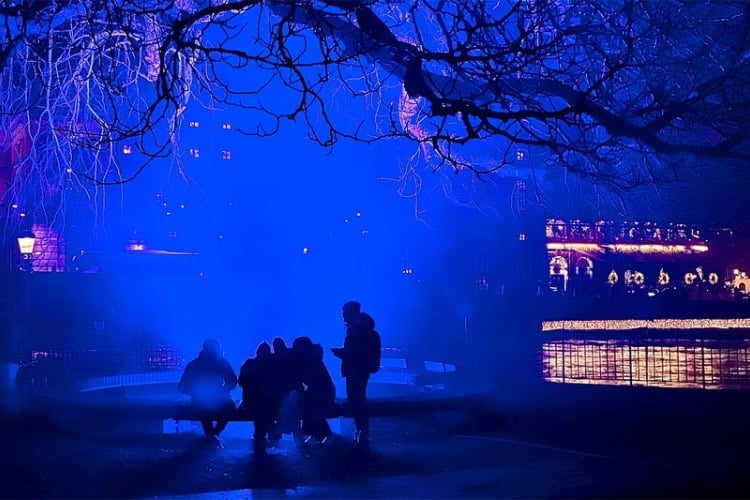
During Nobel Week, in early December, all prizes except the Peace Prize (awarded in Oslo, Norway) are awarded in the Swedish capital. During this time, the Nobel Prize Museum puts on the Nobel Week Lights festival.
Launched in 2020, the festival is a free, large-scale light, video and sound installation event inspired by Nobel Prize-awarded discoveries and achievements in physics, chemistry, physiology, medicine, literature, economics, and peace work.
Notable buildings, streets and public squares in the city center and a neighborhood called Tensta serve as canvases for these striking, highly creative and thought-provoking light and sound installations.
Standout Installations
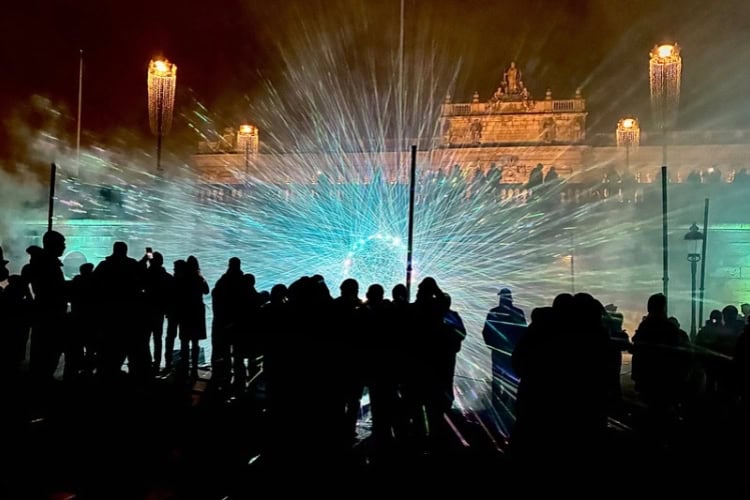
One of my favorite installations last year was “Pro Pace”. The massive light, sound and video installation celebrating the work of Nobel Peace Prize laureates was projected onto the Stockholm City Hall, which overlooks the Bay of Riddarfjärden.
“Divine Geometry” was an installation that took up a large portion of a waterfront park. The piece explored the complexity and harmony of the natural world, inviting viewers to look for the hidden patterns that shape our existence.
Since the work was so large and the electronic music quite loud, our guide let us wander on our own for a while.
Standing before the centerpiece of the installation, I watched, mesmerized, as a wreath of perhaps two dozen lights shot out. Circling laser beams of calming green and blue cast diamonds on the ground and seemed to morph into tinted dry ice as it wafted back toward the center from the other direction.
Another that impacted me was “In a Heartbeat”. Highlighting the work of the Red Cross, the piece featured changing colors on what looked like an old-school television screen. The sounds of a pumping heart were interspersed with emergency calls from around the world.
Thus, a simple cube shape morphed into an environment of urgency and compassion, honoring the courage of Red Cross staff and volunteers.
Saint Lucia Day
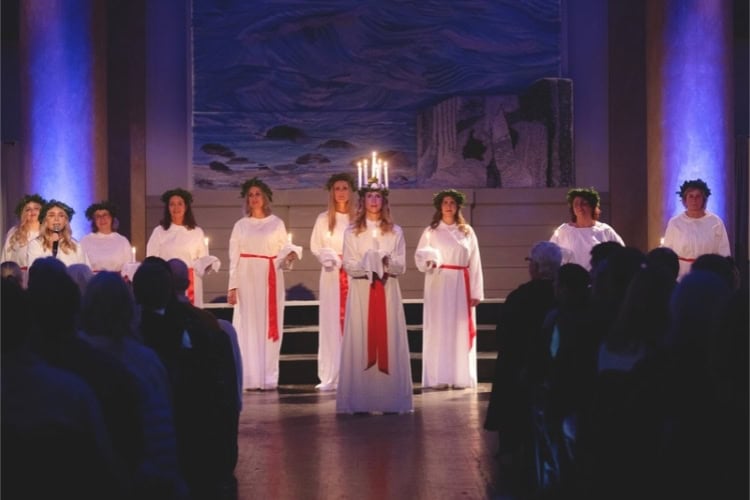
Photo by Rickard Kilström, imagebank.sweden.se
For anyone visiting Sweden in the week leading up to December 13, celebrating Lucia is a must.
St. Lucia Day, “Luciadagen” in Swedish, is more commonly known by the shorter form, “Lucia”. The holiday honors a fourth-century saint, though the Swedish celebration as we know it took shape in the 1900s. Derived from the Latin word for “light”, Lucia is, unsurprisingly, a traditional festival of light.
The holiday commemorates the martyr Lucia of Syracuse, who was said to have brought food to Christians hiding in Roman catacombs, lighting her way with a candlelit wreath on her head.
Today, celebrations commemorating Lucia, the bearer of light who brings brightness and hope during the darkest time, take place all over Sweden. In every school, church choir, cultural club or other community, a young girl is chosen to represent Lucia in the Lucia procession, with every girl hoping to be chosen for the role.
Donning a long white dress and a red sash, with a crown of flickering candles on her head, Lucia leads a train of handmaidens, star boys and sometimes kids dressed as elves or gingerbread figures as they sing “Sankta Lucia” and other Christmas carols.
Where to See Lucia Celebrations in Stockholm
Performances take place across Stockholm in various churches, community centers, history museums and other venues, including a synchronized swimming Lucia show.
The most storied of these, and the most beautiful according to my Stockholmer friends, is the Lucia concert at Storkyrkan, Stockholm’s 13th-century cathedral in Gamla Stan. The gold standard of classic Lucia concerts, the atmospheric Storkyrkan is where some of the city’s best children’s and youth choirs perform.
You can buy tickets online through the cathedral website, or directly through Nortic. Tickets can also be purchased in person at the cathedral entrance beforehand. Some performances are sold out by early November, so it’s best to buy a ticket well in advance. Be sure to arrive on time, as doors close a few minutes before the show begins and you will not be allowed in, no matter what.
Traditional Lucia treats include glögg (mulled wine) and saffron buns called lussekatter (see Holiday Drinks and Sweets section below).
Holiday Drinks
No experience of the Christmas season in Sweden would be complete without tasting its emblematic baked goods and seasonal drinks.
Glögg, known as mulled wine in English, is especially popular in Sweden during the holiday season. Thankfully, it’s not only available at Christmas markets or parties. I saw signs for it outside restaurants and cafes, with some handing out steaming cups of the fragrant drink from takeaway windows in Gamla Stan.
With the growing market for nonalcoholic drinks, restaurants and bars like The Hairy Pig and Tak Bar in Gamla Stan are serving alcohol-free versions of glögg alongside the original wine-based ones. I had some homemade berry glögg at a private home during my stay and was smitten.
Julmust, or Christmas soda, a non-alcoholic, spiced, cola-like drink made with hops and malt, outsells Coca-Cola every December. While the beery flavor isn’t for me, it is beloved by Swedes, for whom Christmas wouldn’t be Christmas without it.
Normally available as early as the first week of November, Julmust can be found in any grocery or convenience store throughout the nation, with the beverage also served in many restaurants, cafes and bars.
Swedish Christmas Treats
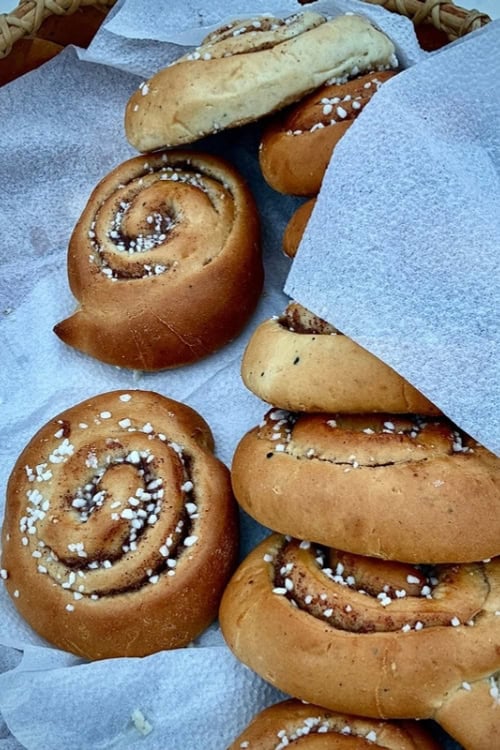
Roasted, sugar-coated almonds, or brända mandlar in Swedish, are a staple at holiday markets. Torparens Konfektyr has made candied almonds for more than 30 years and now has several shops, but it started by selling at various markets.
They still maintain a booth at the Stortorget Christmas market, with a small banner hung from the roof that simply reads, “Brända Mandlar.”
Sweden is famous for its cinnamon buns, kanelbullen, which, unlike the North American version, contain cardamom as well as cinnamon. Nor are they covered with white icing but with specks of pearl sugar.
Along with coffee, kanelbullen are a key player in Sweden’s beloved fika ritual. Cinnamon buns are a favorite during the holidays, of course, as are cardamom buns, but both are year-round fika staples.
Pepparkakor: The Ultimate Ginger Cookies
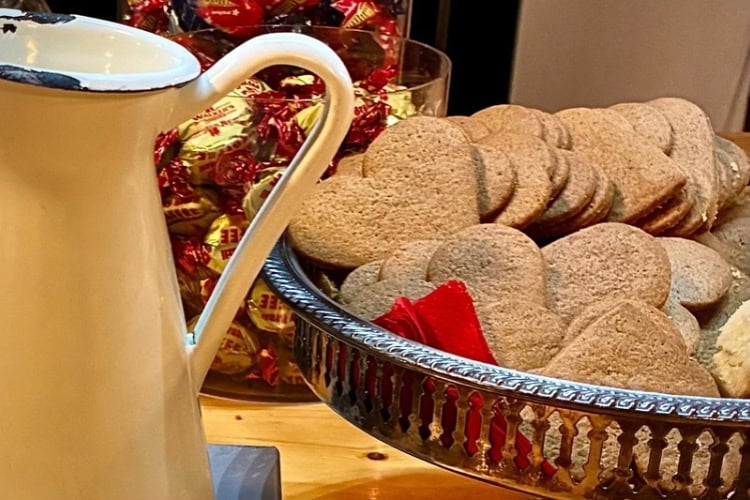
Pepparkakor (ginger thins) also know no seasonal limits, but they are especially in demand at Christmastime, when they are cut into different shapes and sometimes decorated with designs in white icing.
The cookies may also be baked with a hole at the top so a ribbon can be laced through and hung on a Christmas tree, or several may be strung together on a long ribbon to make a garland.
I’d had store-bought Anna’s Swedish ginger cookies several times before, and though I liked them, I didn’t love them. That is until I tried homemade pepparkakor, which my Swedish host made without butter especially for me.
Lussekatter: Saffron Buns for Lucia
One sweet treat that is associated solely with the holiday season, more specifically, Lucia celebrations, is saffron buns, called lussekatter in Swedish. Lussekatter translates to Lucia cats, so called because the S-shape of the buns recalls a curled-up cat with two raisins for eyes.
Famous for their form and their bright golden hue, a result of the saffron, lussekatter are sweet, chewy yeast buns baked for Advent and St. Lucia Day in the lead-up to Christmas.
As I rushed into the train station to catch the Arlanda Express to the airport on my last morning in Stockholm, I regretted not having had the chance to try a saffron bun.
It was December 12, the eve of Lucia, and lo and behold, two women stood on the platform: one holding a tray of coffee, the other holding another tray of lussekatter.
I declined the coffee, but was handed a warm saffron bun wrapped in a napkin. I devoured the warm, chewy bread shortly after taking my seat on the train. Then I wished I could have another.
Getting Around Stockholm
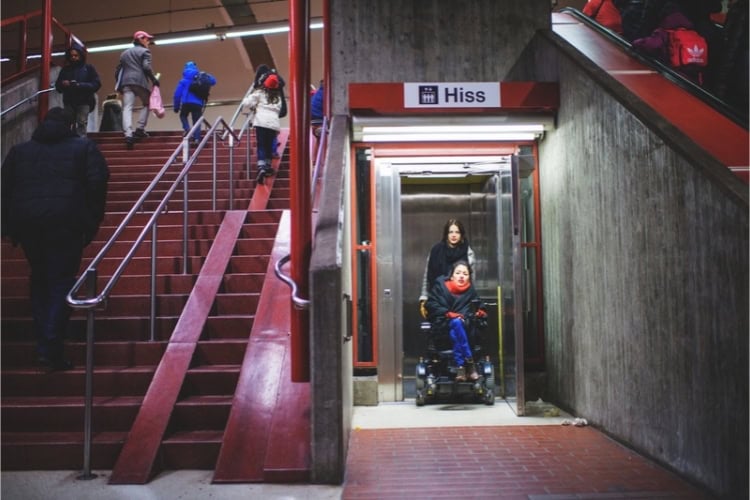
Whether by foot, metro, tram, bus, ferry or train, the Swedish capital is easy to navigate.
According to a 2026 Time Out survey, the city has a walkability score of 88 percent. And despite being spread across 14 islands, it’s easy to walk between them all, thanks to bridges and well-maintained pathways. This is a city that puts pedestrians first.
Stockholm Public Transport: SL manages public transport across the city, including certain ferry lines within Greater Stockholm. The system is reliable, clean and efficient, with trains and buses running on renewable energy since 2017. This aligns with the city’s goal of providing the world’s most sustainable public transport system.
The tunnelbana, as the metro system is known in Swedish, is the fastest way to get around the capital since it covers the inner city as well as the suburbs and outskirts, spanning 110 kilometres of rail.
The Stockholm metro is also famous for its art and beautiful stations, with more than 90 of its 100 stations displaying artwork.
Stockholm’s public transport system also offers accessibility guarantees to help travelers with disabilities reach their destinations.
A single ticket is valid for 75 minutes, but full-day and multi-day tickets are also available. You can buy tickets at SL’s customer service shops, through their app, or directly at the turnstiles and on buses with a credit card. You can’t pay cash for tickets on buses in Stockholm.
If You Go
Spread over 14 islands, where Lake Mälaren flows into the Baltic Sea, Stockholm has a mild climate. Average December temperatures range from -2°C to +2°C, though it was between +8°C and +10°C when I was there.
This means that if you don’t travel inland or to the Arctic, you won’t need clothing designed for extreme cold temperatures. Keep in mind, however, that it can rain a lot in December, the skies are often grey and the dampness can make it feel colder.
In December, the sun rises between about 8:15 and 8:45 am and sets before 3 pm, as early as 2:47 pm mid-month.
Getting Around
- On foot: Stockholm placed sixth in Time Out’s 2026 ranking of the world’s most walkable cities, with a score of 88 percent. Bridges link its 14 islands, so the markets, light displays and concert venues in this story are easy to reach on foot.
- Public transport: SL runs the city’s metro, buses, trams, commuter trains and some ferries. A single ticket costs 43 SEK (26 SEK for travelers under 20 or over 65) and is good for 75 minutes. Passes are also sold for 24 hours, 72 hours, 7 days and 30 days. You can tap a contactless card at the gates or buy tickets in the SL app. Buses don’t accept cash, parents with strollers ride red buses free, and riding without a valid ticket can bring a 1,500 SEK fine.
- Metro art: The tunnelbana doubles as an underground gallery, with art in more than 90 of its 100 stations.
- From the airport: The Arlanda Express connects Arlanda Airport with Stockholm Central Station in about 20 minutes.
Where to Stay
Hotel Gamla Stan, BW Signature Collection sits on the Skeppsbron waterfront, a short walk from the Stortorget Christmas market and the Lucia concerts at Storkyrkan.
For more information about Stockholm and Sweden, see Visit Sweden and Visit Stockholm.
Need a hand planning your trip? Here are the sites and services we rely on most, from booking tools to travel products we love.
Inspire your next adventure with our articles below:
- Embracing Yuletide Magic: A Guide to Celebrating the Holidays in London
- Zermatt in Winter: Matterhorn Views, an Igloo Village and Fondue Every Night
Author Bio: A freelance journalist and photographer based in Montreal, Quebec, Elizabeth Warkentin has contributed to Condé Nast Traveler, Travel + Leisure, Smithsonian, Nat Geo, Afar, BBC, The Guardian, and The Toronto Star, among others.
Want to discover more hidden gems and helpful travel tips? Join our free newsletter for the latest travel secrets and travel articles.
We are reader-supported and may earn a commission on purchases made through links in this article.

- Christmas in Stockholm: Markets, Light Festivals and Lucia Traditions - November 15, 2026
- See Belgium Like a Local: A Belgian Guide’s Insider Tips Beyond Brussels and Bruges - November 14, 2026
- Beyond Belgrade: 5 Underrated Towns in Serbia Worth the Trip - November 14, 2026
Planning another trip soon? ✈️
Add GoWorldTravel.com as a preferred source on Google. Click the button below so our local guides, packing hacks, and hidden-gem itineraries always show up first when you search!
Add to Preferred Sources