
When I arrived in Luleå, a coastal city in Swedish Lapland in northern Sweden, I wasn’t entirely sure what to expect from a winter destination where temperatures can plummet to -35°C. But I’ve learned that sometimes the most rewarding experiences come from the places that push you outside your comfort zone.
Luleå turned out to be one of those places.
This Arctic city of 80,000, perched on the edge of the Gulf of Bothnia, transforms when winter arrives. The sea freezes solid, creating an expansive winter landscape. The darkness of December gives way to the northern lights.
And the locals don’t hibernate—they embrace the season with an enthusiasm that had me swapping my usual travel gear for thermal layers and winter boots within hours of arrival.
Spend the Night in an Igloo-Shaped Cabin in the Woods

My base during my visit was one of the more unusual accommodations I’ve encountered: the Ice & Light Village.
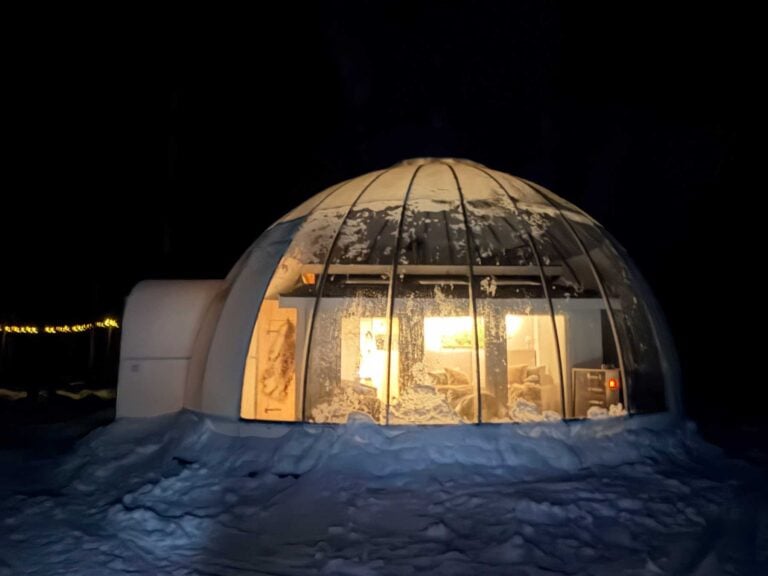
Tucked away in the forest just outside Luleå, the Ice & Light Village offers a modern cabin enclosed by an igloo-shaped glass shell, designed to let you take in the surrounding wilderness through large windows while staying warm inside.
As I arrived at dusk, the forest was quiet except for the crunch of snow under my boots. My cabin sat among the trees, its curved glass dome reflecting the last light of day.
Inside, the space was spacious and comfortable—quite different from what the word “igloo” might suggest. Large windows wrapped around the structure, offering a clear view of the forest and meadow beyond.
After settling in, I headed to the on-site restaurant for a three-course dinner featuring Swedish Lapland cuisine. The meal included local ingredients—Arctic char, reindeer, and cloudberries—showcasing the region’s culinary traditions.

The restaurant’s warm atmosphere provided a good contrast to the winter landscape visible through the windows.
After dinner, I returned to my cabin for the night. I lay in bed while the Arctic sky stretched above me through the transparent dome. Although it was snowing during my visit and the northern lights weren’t visible, the cabin’s location—surrounded by forest with minimal light pollution—makes it an ideal spot for aurora viewing when conditions cooperate. The glass dome offers a nice view of the sky.
The Ice & Light Village captures what Luleå offers: the ability to experience nature in comfort, where modern design meets wilderness.
Explore the Ice Track

One of Luleå’s most popular winter activities is the 10-kilometer ice track that loops around the city’s central peninsula on the frozen Gulf of Bothnia. The frozen ice becomes a wonderful winter playground.
CNN listed Luleå’s frozen archipelago as number 45 on their “50 awe-inspiring natural wonders for your bucket list,” and standing at the edge of this expanse of ice, I could see why. Every winter, when the sea freezes to a depth of about 40 centimeters, machines plow and maintain a track that becomes a popular outdoor recreation space.
The ice track is accessible to everyone. Don’t skate? There’s a snow-covered walking path running parallel to the polished ice, with a thin layer of snow that provides traction for regular boots.
Kicksleds are also available for those who want to try this traditional Scandinavian mode of transport. These contraptions—essentially a chair on runners that you propel by kicking, like a winter scooter—are parked at lending stations near the entrances at both the north and south harbors.

They’re free to borrow on a first-come, first-served basis, with just one request: take care of them and return them to any kicksled station when you’re done.
You’ll see families with young children, long-distance skaters, and locals out for their morning exercises, some even jogging across the ice.
For those who prefer traditional skating, the polished ice works for both regular ice skates and long-distance skates. You can rent long-distance skates at Äventyrsbutiken in central Luleå, just a short walk from the track entrances, or borrow regular ice skates at Fritidsbanken on Porsön.
What struck me about the ice track was how it shows the Swedish approach to winter: rather than fighting the cold and darkness, embrace it. The track is within walking distance of cafés, restaurants, and shops, making it easy to warm up with a coffee break before heading back out onto the ice.
Have a Good Burger Lunch at Bastard Burgers

After working up an appetite on the ice track, I stopped at Bastard Burgers, a Swedish chain known for its high-quality burgers. I’m an American who loves a good hamburger, and I can tell you this popular Swedish restaurant chain makes an excellent burger (and many variations).
Their tagline is “Streetfood Like a Bastard™.” What caught my attention was their collaboration with chef Marcus Samuelsson, the Ethiopian-Swedish chef who runs the acclaimed Red Rooster in Harlem, New York. Samuelsson partnered with Bastard Burgers to create a line of vegan burgers using Peas of Heaven, a plant-based protein alternative.
The burger I ordered was well-constructed: juicy, flavorful, with quality ingredients that went beyond typical fast-casual fare. It’s worth noting that Sweden takes its food seriously at every level, from Michelin-starred restaurants to burger joints.
For travelers looking for good, affordable meals while exploring, Bastard Burgers is a reliable option—and a glimpse into contemporary Swedish food culture, where even casual dining emphasizes quality.
Visit Gammelstad Church Town

About 10 kilometers northwest of central Luleå sits Gammelstad Church Town, a UNESCO World Heritage Site that’s particularly photogenic when covered in snow.
Gammelstad was the original location of Luleå, serving as the town center until the 17th century. Post-ice age land uplift gradually made the harbor too shallow for ships, forcing the town to relocate closer to the coast in 1649.
The church and its surrounding cottages remained, preserving a piece of history that’s now one of 15 UNESCO World Heritage Sites in Sweden.

The centerpiece is a late medieval stone church built in 1492—the largest of its kind in Northern Sweden. It still stands in the same spot where it was constructed over 500 years ago, and services are still held there regularly.
Surrounding the church are more than 400 traditional red wooden cottages, called church cottages. These small buildings served a specific purpose: in centuries past, Swedish law mandated regular church attendance, but many people lived in remote rural areas, too far to make the journey in a single day. Families built or rented these cottages to stay overnight during church weekends and religious festivals.
This tradition continues today. Many families still own their historic cottages and use them during special occasions.

I joined a guided tour that started at the Gammelstad Visitor Center (housed in a 19th-century chapel) and wound through the snow-packed lanes between cottages. Our guide explained how the cottages were used, why they’re all painted the distinctive Falun red, and how the church town functioned as a social and spiritual hub for the region.
The tour guides are knowledgeable about the site’s history. If you want to understand why Gammelstad earned its UNESCO designation and what makes it the largest and best-preserved church town in the world, a guided tour is worthwhile. You’ll get to see inside one of the cottages and learn about the people who gathered here over the centuries.
Visit the Open-Air Museum Hägnan

If you’re visiting Gammelstad, the Open-Air Museum Hägnan is worth a stop, though it has limited winter hours. This cultural and historical center features buildings from the 18th through 20th centuries that show life in a traditional Norrbotten row village.
The museum sits adjacent to the church town, and while I was there primarily for the guided tour of Gammelstad itself, I made time to explore Hägnan as well.
The collection of historic buildings—farmhouses, barns, workshops, and other structures—have been relocated here from across the region to preserve them and tell the story of rural life in northern Sweden over the past few centuries.
During winter, the museum is open occasionally for special events like the Christmas market and Fire Festival. If your visit coincides with one of these events, it’s an opportunity to experience traditional Swedish celebrations in a historical setting.
During summer (mid-June to mid-August), the museum is open daily with demonstrations of traditional crafts and activities—you might see someone making traditional bread in a historic oven, demonstrating old farming techniques, or working with traditional textiles.
The museum adds context to the Gammelstad experience, showing not just how the church town functioned, but how people lived and worked in the broader region surrounding it.
Learn About Swedish Culture with an Authentic Fika Experience

One way to understand Swedish culture is through fika—the tradition of taking a break for coffee and something sweet, usually a pastry. In Gammelstad, I found a fika experience that went beyond the typical café stop.
Singer and storyteller Anna Sellén offers cultural experiences focused on Swedish traditions. I joined one of her Swedish Fika Experience sessions, held in a space within the church town area.
Anna began by explaining the cultural significance of fika—how it’s about taking time to slow down, connect with others, and appreciate simple pleasures. In Swedish culture, fika is a daily ritual that prioritizes quality of life over productivity.

She had prepared traditional Swedish cinnamon buns for us to enjoy with coffee (while Anna does offer hands-on baking workshops, our session focused on the cultural experience itself).
As we settled in with our coffee and warm buns, Anna performed Swedish folk songs and shared stories about Swedish traditions and culture specific to this northern region. Her insights offered a window into the daily lives and values of the people who have called this landscape home.
The conversation flowed easily over coffee and cinnamon buns—simple, but that’s precisely the point of fika.
Anna offers seasonal variations of the experience. During the Christmas season, she focuses on saffron buns and gingerbread. In spring, it’s semla—the cardamom bun filled with almond paste and whipped cream. Each session connects to Swedish traditions and offers a hands-on cultural experience.
For travelers who want to go beyond surface-level tourism, experiences like this provide useful context. I left with a better appreciation for Swedish values of community and tradition.
Go Shopping for Unique Arts and Handicrafts

Before leaving Luleå, I wanted to find souvenirs that reflected the craftsmanship and culture of Swedish Lapland. Luleå has several options for authentic handicrafts.
My first stop was Lapland Heartwork, Luleå’s biggest handicraft shop, located in central Luleå along Smedjegatan. The shop specializes in quality, design, and Nordic crafts.
The items on display showcased the work of Norrbotten’s craftspeople: hand-knitted woolens in traditional patterns, wooden items carved from local birch, jewelry incorporating reindeer antler and leather, Sami-inspired textiles with geometric designs, and ceramics with Scandinavian lines.
I also visited the Handicraft and Design Center (Slöjd- och formcenter), located on the first floor of a shopping mall in central Luleå. This is part of a three-year project (2023-2025) aimed at strengthening the craft and design area in Norrbotten.
The center serves as both a shop and a meeting spot, collaborating with artisans working in handicrafts, design, and architecture. The range of items included both traditional and contemporary pieces—modern interpretations of Nordic design principles.
Both shops emphasized local artisans and authentic craftsmanship. These were works created by skilled craftspeople in the region, each piece reflecting the materials, techniques, and cultural heritage of Swedish Lapland.
Where is Luleå?
Luleå is located in Swedish Lapland, in the far north of Sweden, about 900 kilometers north of Stockholm. The city sits at approximately 65° N latitude, just below the Arctic Circle, on the coast of the Gulf of Bothnia—the northernmost arm of the Baltic Sea.
Despite its remote location, Luleå is accessible. It’s home to Sweden’s fifth-largest airport, with direct flights from Stockholm Arlanda taking just over an hour. The city also has a central train station with regular connections to other major Swedish cities.
With a population of about 80,000, Luleå is the largest city in Norrbotten County and serves as a regional hub for education, technology, and culture. The city is surrounded by an archipelago of 1,312 islands that freeze over in winter.
Luleå’s Green Vision

While Luleå charms winter visitors with its frozen archipelago and glass igloo cabins, the city is quietly positioning itself as a leader in Europe’s green transition. The Swedish Lapland city already derives most of its electricity from renewable hydro and wind power, and has attracted major investments in fossil-free steel production, green hydrogen, sustainable aviation fuel, and battery technology.
At the new Luleå Industrial Park, companies like SSAB are pioneering revolutionary HYBRIT technology to eliminate coal from steel production, while Uniper develops hydrogen solutions for heavy transport.
The goal is ambitious: climate-neutral industrial production while maintaining economic sustainability. It’s a vision that demonstrates Luleå’s commitment to innovation extends far beyond mastering winter—this Arctic city is helping shape a sustainable future for industries worldwide.
When to Visit

Winter conditions typically run from mid-December through the end of March. The ice track usually opens in late December and remains operational through February or March, depending on temperatures.
For northern lights viewing, the darkest months of December and January offer the longest viewing windows, though February and March provide a sweet spot with still-dark nights, slightly warmer temperatures, and often clearer skies.
The sun sets around 1 PM in late December, but by March, you’ll have about 12 hours of daylight—a significant difference if you want more time for daytime activities.
Getting There

Luleå Airport (LLA) is about 10 minutes by bus from the city center. Airlines, including SAS and Norwegian, operate regular flights from Stockholm and other Swedish cities. From the airport, the Flygbussarna (airport bus) runs frequently to the city center, or you can take a taxi.
If you’re already in Sweden, trains run daily to Luleå Central Station from Stockholm (about 13-15 hours) and other cities, offering a scenic journey through Sweden’s varied landscapes.
Getting Around
The city center is compact and walkable. Many attractions, including the ice track entrances, are within walking distance of central hotels.
For trips to Gammelstad Church Town (about 10 kilometers away), local buses operate regularly, or you can take a taxi or rent a car.
The local bus system, LLT (Länstrafiken i Norrbotten), is efficient and affordable. You can purchase tickets via their mobile app or at the bus station.
For visiting the archipelago islands via ice roads (when conditions permit), you’ll need to rent a car. Several international rental companies have offices at the airport and in the city center.
What to Pack
Temperatures in winter can range from 0°C to -35°C, so proper clothing is essential:
- Thermal base layers (merino wool or synthetic)
- Insulated winter coat rated for extreme cold
- Warm hat that covers your ears
- Insulated, waterproof winter boots with excellent traction
- Warm gloves or mittens (I preferred mittens)
- Scarf or neck warmer
- Sunglasses (sun reflecting off snow is intense)
- Hand and toe warmers for extra cold days
- Small backpack for day trips
Dress in layers so you can adjust as you move between heated indoor spaces and the frigid outdoors.
For more information on Luleå see https://visitlulea.se/en/

- The Family Reunion Hack That Eliminates All the Planning Stress - September 30, 2026
- 10 Days in Portugal: A Mother-Son River Cruise Along the Douro - September 29, 2026
- 9 Places to Experience Amazing Sea Life Up Close - September 15, 2026
Planning another trip soon? ✈️
Add GoWorldTravel.com as a preferred source on Google. Click the button below so our local guides, packing hacks, and hidden-gem itineraries always show up first when you search!
Add to Preferred Sources