

Prague’s train station bustled with energy, travelers hurrying through the wide halls, the smell of fresh pastries mingling with the metallic tang of tracks.
We had been in the Czech Republic, or Czechia, for a week and decided it was time to get out of Prague for a day. Nataliya (my wife), Alex (our son), and I jostled our way to the platform, tickets in hand, and found seats aboard a regional train.
The farther we traveled from Prague, the more the urban landscape gave way to rolling fields and picturesque Czech villages. We were headed to a place we had visited 17 years prior, so we had an idea of what was in store. But on this visit, we would dig deeper and see more.
By the time we arrived at Kutná Hora’s train station, it felt as though we had stepped into another era. The station—a modest, weathered structure—brought to mind an American town from the wild west, quiet and desolate.
Kutná Hora’s history is as rich as the silver veins that once flowed beneath its streets. In the medieval era, it was a key player in Europe’s silver trade, minting coins that fueled economies far and wide. Today, the town’s charm lies in its blend of historical significance and modern life.
Riding Up That Hill (A Deal with St. Barbara)

The bus carrying us up the hill from the train station to the summit pierced through the town’s heart. Locals clutched tote bags and briefcases, their expressions betraying the ordinary rhythm of a workday.
Travelers, on the other hand, leaned into conversations, brimming with excitement, clutching cameras and guidebooks as the bus climbed the narrow streets. Nataliya and I stood near the middle, holding onto the overhead bars as the bus swayed.
Two Italian nuns sat in front of us, their black habits standing out in the crowd. They spoke quietly in rapid Italian, their excitement clear despite the language barrier.
From the seat beside them, a young Czech woman with a sharp blazer and leather bag glanced over. “Are you here to see the cathedral?” she asked in accented English.
“Si,” one of the nuns replied with a smile, nodding. “St. Barbara. We are on the right path, yes?”
“Yes,” the woman said warmly. “It’s just three more stops from here.”
“That’s where we’re going too,” Nataliya chimed in, exchanging smiles with the sisters and the local.
As we neared our stop, the town’s medieval skyline began to emerge through the windows, a mix of spires, red-tiled roofs, and green hills. The nuns leaned forward, catching their first glimpse of the cathedral’s silhouette against the sky, their whispered excitement contagious.
The bus wheezed to a halt, and the sisters stood and exited the bus.
“Quick, follow those nuns!” I said, half joking. We hurried after them, the promise of Gothic grandeur pulling us forward.
Spires from Silver

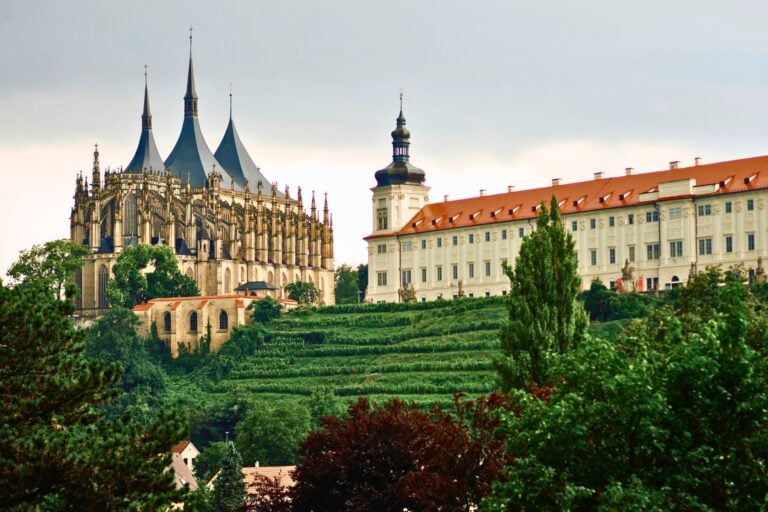
At the summit, the first stop was the Cathedral of St. Barbara, a breathtaking masterpiece of Gothic architecture.
Construction began in 1388, funded primarily by Kutná Hora’s silver miners, who dedicated it to their patron saint. Despite interruptions due to the Hussite Wars and financial difficulties, the cathedral was completed in 1905.
During that 500-year span, a succession of architects, including Jan Parléř, Matyáš Rejsek, and Benedikt Rejt, left their marks on its evolving design, culminating in a Neo-Gothic restoration by Josef Mocker.
Its iconic three-tent roof and intricate flying buttresses dominate the Kutná Hora skyline. Inside, light streamed through vibrant stained-glass windows, illuminating frescoes that vividly depict mining life, a tribute to the town’s rich history.
These frescoes, reflecting the societal values of the time, depicted the dangers and hardships faced by the miners, alongside scenes of religious devotion and the importance of community.
Above, the tracery vaults by Benedikt Rejt exemplify an exquisite blend of engineering and artistry.
Climbing to the upper gallery was both surreal and humbling. From above the original roof beams, the sanctuary below appeared as a marvel of medieval ingenuity.
As we exited the cathedral, we made our way to the overlook behind it, where the view stretched across red-tiled rooftops, church spires, and a mosaic of green fields and forests, framing the town below.
Minting Majesty at the Italian Court
Descending the hill, we arrived at the Italian Court (Vlašský dvůr), which once served as both the royal mint and the ruler’s administrative seat in Kutná Hora.
Its name pays homage to the Italian minters brought here during the reign of Wenceslas II in the late 13th and early 14th centuries. These Florentine experts revolutionized coin production, helping establish Kutná Hora as a critical hub of wealth in medieval Europe.
It was here that the iconic Prague groschen was minted, a currency that would circulate across the continent, fueling economies and consolidating the power of the Bohemian kingdom.
The building itself showcased a harmonious blend of Gothic and Renaissance styles, reflecting its evolution through the centuries. A bearded guide greeted us warmly and led us through its storied halls.
The royal apartments exuded a subtle grandeur, with high ceilings, intricate woodwork and large windows. Sunlight streamed in, casting patterns on the polished wooden floors and highlighting velvet-cushioned furniture and gilded accents.
In the Chapel of St. Wenceslas and St. Ladislav, the atmosphere turned solemn. Frescoes lined the walls, blending religious devotion with tributes to Kutná Hora’s mining heritage.
One particularly vivid image depicted miners laboring in silver shafts, their work immortalized in this sacred space. The frescoes also incorporated hidden symbols, coins doubling as halos and mining tools etched into decorative borders, a testament to the profound intertwining of faith, commerce, and power in the town’s history.
Standing amidst the artistry and the echoes of history, we marveled at how this place once shaped the fortunes of a kingdom. It was more than a mint or a palace; it was a linchpin in Europe’s economic and political tapestry.
The Sedlec Ossuary: Beautiful to the Bone

Our next stop was the Sedlec Ossuary, perhaps Kutná Hora’s most famous, and most macabre, destination. Also known as the Bone Church, the Sedlec Ossuary stood in stark contrast to its surroundings.
From the outside, the small Gothic chapel seemed unassuming, with its modest spire and simple façade. But stepping inside revealed a breathtaking and haunting sight: an interior adorned with human bones arranged in elaborate and artistic displays.
The ossuary’s origins date back to the 14th century, when an abbot brought soil from Golgotha, making the cemetery a sought-after burial site.
Over time, plagues such as the Black Death (14th century) and conflicts like the Hussite Wars (15th century) filled the graveyard. The remains were later exhumed to create the unique decorations seen today.
The most striking piece was the chandelier, composed of every bone in the human body, its intricate design both beautiful and unsettling.
A coat of arms belonging to the Schwarzenberg family dominated one wall, meticulously constructed from skulls, femurs, and other bones. The coat of arms featured a raven pecking at a Turk’s eye, a potent symbol of the family’s power and military victories.

Candleholders crafted from vertebrae lined the walls, their eerie elegance accentuating the chapel’s dim lighting.
Towers of carefully stacked bones rose in each corner, resembling ancient watchtowers. Along the railings, garlands of bones were draped like festive decorations for a macabre celebration.
Even the altar bore adornments, blending Gothic spirituality with this unique medium.
Walking through the ossuary, we noticed massive piles of bones arranged into geometric patterns, a fusion of art and mortality. The decorations, designed by František Rint in the 19th century, honored both the fragility and the resilience of life.
“This is creepy … but amazing,” Alex summarized. The Bone Church is a solemn reminder of life’s fleeting nature and the artistry that can emerge from even the grimmest materials.
Serenity in Stone
Our next destination was the Church of the Assumption of Our Lady, a masterpiece blending Gothic and Baroque styles.
It was originally constructed in the 13th century as part of the Cistercian monastery in Sedlec. The cathedral underwent a dramatic Baroque Gothic reconstruction under the visionary architect Jan Blažej Santini-Aichel in the 18th century.
Today, this stunning cathedral, along with the Sedlec Ossuary, is a UNESCO World Heritage site.
The interior, bathed in natural light, displayed Frescoes depicting biblical scenes interwoven with local legends. The intricate high altar commanded attention, its gilded carvings a testament to the craftsmanship of the period. Walking through the cathedral, we were struck by its timeless beauty and a sense of calm.
The Silver Mine and Museum
No trip to Kutná Hora would be complete without exploring the town’s silver mining heritage. We arrived at the Silver Mine Museum eager to step back in time.
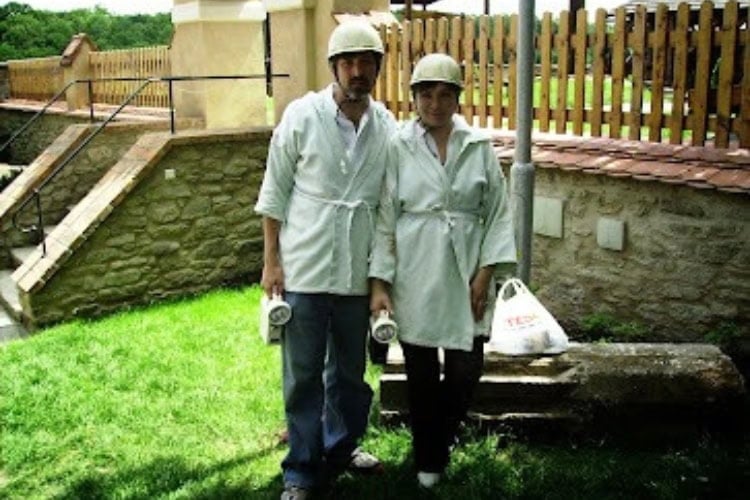
After a brief introduction to the history of silver mining in the region, we donned white protective robes, helmets, and headlamps, the necessary gear for the adventure ahead.
Descending into the mine, the air grew cooler and the passages narrower. The guides instructed us to crouch and shimmy through certain sections, a thrilling yet slightly claustrophobic experience.
As we navigated the labyrinthine tunnels, they pointed out chisel marks left by medieval miners and explained the grueling conditions they endured. It was humbling to imagine the sweat and determination that fueled Kutná Hora’s prosperity.
“Glad we’re not claustrophobic,” Nataliya said as we shimmied through a narrow passage. “So this is what it was like to be a silver miner,” Alex said. “Well, not exactly,” I said. “The actual conditions for medieval miners were probably a lot worse. For one thing, they didn’t have smartphones.”
After our mine tour, we visited the museum that told the story of the constant workplace risks: rockfalls, flooding, and respiratory illnesses due to poor ventilation.
The museum offered a comprehensive look at the silver trade, from ore extraction to coin minting. Artifacts, including mining tools, scales, and coins, were displayed alongside detailed explanations of the processes involved.
One exhibit featured a life-sized replica of a miner at work, bringing the history to life in vivid detail. The experience left us with a deep appreciation for the labor that shaped the town’s identity.
A Bite and a Laugh

For a late lunch, we ventured into a rustic restaurant tucked along one of Kutná Hora’s cobblestone side streets. Inside, the warm, wood-paneled walls and faint scent of roasted meat created an inviting ambiance, but we opted for the beer garden outside, shaded by broad-leafed trees. It was a perfect spot to unwind after the day’s explorations.
The waitress brought us hearty mugs of a local pilsner, its golden hue shimmering in the afternoon sunlight.
Alex, always hungry, ordered roasted chicken, the crispy skin glistening as it arrived at the table. I couldn’t resist the fried cheese, a quintessential Czech comfort food served with tartar sauce. Nataliya chose the creamy Svíčková, a velvety goulash-like dish with tender slices of beef and a dollop of cranberry sauce.
“Try this,” she urged, offering me a bite of her Svíčková. The rich, tangy sauce paired beautifully with the beef.
Alex, holding up a chicken bone after finishing his meal, grinned mischievously. “Hey, doesn’t this remind you of something?” “The ossuary,” Nataliya and I replied in unison, laughing at his macabre sense of humor. We lingered a while longer, savoring both the food, atmosphere, and camaraderie.
Kutná Hora to the Bone
By evening, we found ourselves back at the train station, the sun setting as we awaited our train at what looked from this vantage to be practically deserted. Exhausted but exhilarated, we sank onto a bench to wait.
“So,” I started, stretching out my legs, “favorite part of the day?” Alex didn’t hesitate. “The Bone Church, obviously,” he said. “It’s certainly unique,” Nataliya agreed as she adjusted her scarf. “But for me, the Cathedral of St. Barbara was the highlight. The frescoes, the soaring ceilings—breathtaking.”
I nodded. “It was incredible. But the silver mine was something else, too. Crawling through those narrow tunnels was unlike anything else we’ve done here.” “Actually, the Italian Court was pretty amazing too.
We sat quietly for a moment, the clatter of a distant train filling the air. Kutná Hora, from the heights of St. Barbara’s Cathedral to the depths of the silver mines, left an impression that would last a long time. It left its mark—not just in memory, but in marrow.
If You Go
Kutná Hora is located about an hour east of Prague. The most efficient way to reach Kutná Hora is by train, with regular departures from Prague’s main train station (Praha hlavní nádraží). Buses also operate frequently between Prague and Kutná Hora.
The best way to experience Kutná Hora’s historic center is on foot. The town is compact and most major sights are within walking distance. For those seeking a break from walking, local buses connect different areas of Kutná Hora. Taxis are also readily available at the train station and around town for a quick ride.
Consider purchasing a Kutná Hora Card for discounted entry to major attractions and public transport within the town. It often covers admission to three or more major sites for less than the cost of visiting them individually.
If time allows, consider staying overnight for a slower pace and a chance to enjoy the town after the day-trippers have gone.
Need a hand planning your trip? Here are the sites and services we rely on most, from booking tools to travel products we love.
Inspire your next adventure with our articles below:
- Hidden Gems in the Czech Republic: Exploring Top Experiences Beyond Prague
- Brno’s Beautiful Secrets: Dragons, Bones and Beer in the Czech Republic
Author Bio: Eric D. Goodman is author of seven books. His most recent, Faraway Tables, is a #1 bestselling collection of poems focused on travel and a longing for other places. Learn more about Eric and his writing at www.EricDGoodman.com
Want to discover more hidden gems and helpful travel tips? Join our free newsletter for the latest travel secrets and travel articles.
We are reader-supported and may earn a commission on purchases made through links in this article.

- Rila Monastery: A Day Trip Into Bulgaria’s Spiritual Heart - September 23, 2026
- Castles, Carriages, and Cellars: Following the Liechtenstein Trail Through Moravia - August 14, 2026
- Dubrovnik’s Old Town: Stone Walls, Adriatic Light and Living History - July 31, 2026
Planning another trip soon? ✈️
Add GoWorldTravel.com as a preferred source on Google. Click the button below so our local guides, packing hacks, and hidden-gem itineraries always show up first when you search!
Add to Preferred Sources