

One morning in late December, my husband and I found ourselves speeding in a motorboat down the Napo River, a major tributary of the Amazon.
We had just left Coca in eastern Ecuador, where an airport brings tourists and oil rig workers from Quito to set off for their river adventures.
The small settlements we saw along the banks became scarcer, and at the second oil rig we passed, our guide, Andres, pointed out that the road that led to this rig was the last one we would see on the trip.
Transitioning to the Blackwater River

After two hours on the wide brown waters of the Napo, we turned into a much narrower blackwater river, where we transferred from a motorboat to a long 12-person canoe.
At a slower pace, we began to see wildlife, lots of wildlife.
Several species of monkeys and birds, including the outrageously coiffed Hoatzins, which, as one of the few birds that can swim to escape predators, are always found on the banks of the river.
We also spotted a thick, coiled anaconda, which Andres estimated to be at least 25 feet long.
Arrival at Napo Wildlife Center

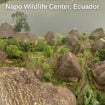
At the end of our journey, the river widened into a large lake. On the far shore was a cluster of reddish thatched-roof cabins and a tall, tiered tower, mirrored perfectly on the lake’s surface.
This was the astonishingly beautiful Napo Wildlife Center, our home for the next five days.
Ecotourism Philosophy

The International Ecotourism Society defines ecotourism as “responsible travel to natural areas that conserves the environment, sustains the well-being of local people, and involves interpretation and education.”
Of all the many places I’ve visited that use (and overuse) the ecotourism label, the Napo Wildlife Center is the only one that unquestionably meets all three of these criteria. The reason lies in the Center’s history.
A Community’s Transformation
In the late 1990s, the Kichwa Añangu, the local indigenous community, found their way of life threatened.
Oil and logging jobs were extracting resources from their lands and taking men away from their families in search of short-term employment.
Overhunting and overfishing were degrading their territory. The band’s leaders partnered with Eco-Ecuador and an American NGO to build a tourist lodge.
All materials had to arrive the same way I did – two hours of motorboating from Coca, and two hours of canoeing from the Napo River.
The lodge came together slowly, the first guests arriving five years after the project began. But in the meantime, a radical transformation had taken place in the community.
Hunting and fishing were now prohibited, and the Añangu were fully committed to the conservation of their 82 square miles of Amazon jungle.
Best Ecuador Tours & Excursions
A Thriving Ecotourism Destination
As more tourists came to enjoy the resurgent wildlife, the Center grew, both in the number of cabins and in the richness of what it could offer.
By the time we arrived, 20 years after the first guests, the experience of luxury in the jungle had been perfected.
As we disembarked from the canoe, we were greeted by the staff (all from the local community), who provided a eucalyptus-scented towel and a just-squeezed glass of Naranjilla juice.
These were small amenities that we would come to look forward to after every canoe trip.
Daily Rituals and Dining
Before dinner that first night, we climbed the seven-story tower for a wider view – untouched jungle in every direction.
This climb became a daily ritual for me, a way to take it all in, like pinching myself to make me fully realize the remoteness and the beauty of this place.
At dinner, we sat with the same group of seven adults and two teenagers that we had arrived with; this was to be our “pod” for our stay.
Every night we were served a buffet with a choice of beef, fish, or chicken. And I was delighted that there were many salads and vegetables offered, and a choice of fruits.
Our favorite was the passionfruit, which we ate by pressing our thumbs into the center, cracking open the fruit like an egg, and slurping the mass of seeds inside.
Comfortable Cabins and Ambiance
The cabins were comfortable, and we were delighted with the many Napo-branded gifts that we found there – local chocolate, a waterproof backpack, and a baseball cap.
We would spend many hours on the porch, relaxing in the hammock and watching the many orapendula birds that were building hanging nests in the tree just in front of our cabin.
Their calls sounded like amplified drops of water falling into a pool. That night, I had trouble falling asleep because of the surprisingly loud jungle sounds, but I was happy to lie awake listening to the chorus of frogs and insects.
Early Morning Wildlife Adventures

The days started early, very early. Breakfast was available at 4:30 AM. Although this early wake-up was a bit of a challenge, wildlife is most active at dawn, and so we had to be too.
On our first morning, we hiked through the rainforest, where our second guide, Miguel, astonished us with his ability to spot wildlife in the dense canopy.
We caught a rare glimpse of two night monkeys just climbing into a hole in the tree to sleep. We also saw a troop of spider monkeys.
In the past, these were widely hunted for food and hid whenever humans were around. But now that the area was protected, they paid no attention to us, and we watched their acrobatics with delight.
Read More: Three Dishes You Need to Try in the Ecuadorean Amazon Rainforest
Learning Traditional Skills
Miguel taught us to strip bark off a palm tree, separate it into thin strips, and use it to make a trap for small animals.
He no longer needed, and in fact was not permitted, to use his impressive skills as a hunter for food, but ironically, this type of knowledge was part of what drew us to Napo, to learn about a way of life that was no longer sustainable and that was being replaced by our very presence there as ecotourists.
Cultural Immersion at Napo Cultural Center
The following day, we visited an affiliated organization – the Napo Cultural Center. A group of Añangu women greeted us with a traditional dance.
In a hut with no chimney, an open fire burned.
The women explained that traditionally, this fire would be kept going at all times; when we tried to create a spark using a traditional fire starter, we understood why – it’s very difficult to create a spark in the extremely humid rainforest.
And although it was smoky, that was actually a benefit – there were no mosquitoes in the hut.
The women first served us warm chicha, made from fermented cassava. Miguel told us that traditionally, a man evaluated a woman’s skill in making chicha as part of the courting ritual.
Over the fire, the women prepared a light meal – cassava, hearts of palm, and roasted beetle larvae.
The latter was surprisingly tasty, but not tasty enough for anyone else in our group to do what my husband volunteered to do – eat a squirming, warm, very much alive larva. He said that it tasted like the heart of palm it feeds on.
Birdwatching Highlights and Clay Licking Parrots

The Wildlife Center was wonderful for all animal lovers, but especially for birdwatchers.
Over the course of our five days, on our hikes, canoe trips, and time spent on an observation platform high above the canopy, we saw dozens of bird species, like the Spangled cotinga, the Many-banded aricari, and the Blue-gray tanager.
But there was one excursion that was especially exciting for all of us.
On the morning of our last full day, we took the canoe to a cliff on the main Napo River.
There, hundreds of parrots gathered to lick clay from the exposed river bank, ingesting minerals they needed to neutralize toxins from the seeds they eat.
We counted four different species, all squawking and jostling each other to find feeding perches. The spectacle lasted until the sun warmed and dried the clay, making it less lickable.
We moved on to a salt spring in a cave deep in the forest. We settled onto benches and waited in hushed anticipation, like an audience before the curtain goes up.
After a few minutes, a brilliant scarlet macaw flew in nervously, checked for predators, and then hopped down to drink the salty river.
We didn’t make a sound, and soon several more arrived, their red, blue, and yellow wings catching the morning light. We watched this beautiful sight for close to an hour.
A True Ecotourism Success Story

As travelers, we want to be responsible and to give back to the communities we are visiting. But, despite the many places that have branded themselves with the ecotourism label, we rarely are.
The Napo Wildlife Center is an exception. As tourist dollars have flowed in, wildlife has rebounded and the community has prospered. All while giving visitors an experience of a lifetime.
If You Go
- Napo Wildlife Center
- Getting there from Quito: A flight on Latam Airlines brings you to Coca. The Wildlife Center will meet your flight and arrange for boat transportation to the Lodge.
Need a hand planning your trip? Here are the sites and services we rely on most, from booking tools to travel products we love.
Inspire your next adventure with our articles below:
Author Bio: Jill Singer is a filmmaker living in the Boston area who enjoys adventure travel, gardening, and crossword puzzles (both making and solving them).
Want to discover more hidden gems and helpful travel tips? Join our free newsletter for the latest travel secrets and travel articles.
We are reader-supported and may earn a commission on purchases made through links in this article.

- Slow Down on Corfu: A Perfect Day at Kontogialos Beach - October 21, 2026
- Fort Lauderdale’s New Era: The Best Places to Stay, Eat, and Explore Around Pier Sixty-Six - October 21, 2026
- 11 Incredible Reasons to Visit Fairbanks, Alaska This Winter - October 21, 2026
Planning another trip soon? ✈️
Add GoWorldTravel.com as a preferred source on Google. Click the button below so our local guides, packing hacks, and hidden-gem itineraries always show up first when you search!
Add to Preferred Sources