

I am a late-night writer and detest waking up early. Not at 5 a.m. and definitely not in late December. But I am in a different land, in a quiet, lesser-known hamlet that edges on the marshlands of the largest lagoon in India.
This is Mangalajodi on the northern fringes of Lake Chilka – and there is magic in its air. The magic to transform people, on a scale that this lesser-known village has now become the poster child of nature conservation.
Poachers and cullers from yesterday have changed into protectors and keepers. The winter air then was not difficult to transform this night owl into an early riser and witness a spectacle unseen, at least in the city life I am used to.
Where Is Mangalajodi?

Mangalajodi (pronounced ‘Mang-la-jo-ree’) is a village located in Odisha, in the eastern part of India.
It’s situated on the northern edge of Chilka Lake – Asia’s largest brackish water lagoon and a designated Ramsar site of international importance.
Mangalajodi is 75 km from the state capital, Bhubaneshwar, which has an international airport and takes 2-3 hours to reach. Roads are impeccable, except for the last stretch, and it is easiest to take a cab from the airport.
Read More: Rooting for Change: How Gardening is Changing Urban India
A Bird-Watching Paradise
The sun is not yet out. A lightly blemished dawn awakens another brand-new day.
As I stand on an embankment on these marshlands, hugging my green shawl ever tighter, I think I see movement on the faraway horizon where hills meet the plains.
It is too far away to discern what is moving, but something is.
As I adjust my eyes to the dim light and wish maniacally for a cup of hot steaming tea, I realize it’s not one large beast, but several tens of dozens…wait, no, thousands of black dots, moving like a collective giant, waking up for a morning feast on the marshlands.
I am dazed to see these numbers of migratory birds – apparently on the rise over the last few years – a smile on my lips that there’s still a bit of hope in this human world.
‘It’s time,’ my guide wakes my stupor, ‘the herons have landed.’ I follow him, my complex mind reading those words as a seeming metaphor for some super-surreptitious activity we are about to embark on.
But this is a land of bucolic simplicity – here, herons actually mean the winged beauties.
There is nothing complex here: the land teaches you to just sit back and take it easy, be patient, and watch the everyday wonders of the world.
And that was precisely the next step – a canoe trip for the next three hours, with a guide and a bamboo-oarsman for companions.
As I tottered over the embankment to get up on the wobbly boat, I reminded myself that the last time I sat three straight hours without a break was way back in college.
Could I repeat that, after years of restlessness and bite-sized breaks filled with WhatsApp and Facebook in between work?

As I said earlier, this place had magic in its air. Perhaps, nature itself is the source, and when you take a lesson in that classroom, it takes a jiffy to unlearn and relearn things.
Yes, I sat three straight hours without a phone (but with a camera), focused completely on the winged wonders of this land. Mesmerized.
Almost meditative. Mind you, this is precisely what the handful of visitors come here for. It is a well-kept secret, not for the busloads of tourists but for the self-reflecting wayfarers.
If getting up en masse for a midday steamer ride among jubilant holiday-makers is your thing, then head off to Barkul, Rambha, or Satapada – the three tourist hotspots on Lake Chilka.
But don’t complain if you fail to spot the dolphins or the Central Asian avian visitors that the postcards promised you. Everything comes for a price.
The price in Mangalajodi is the lack of five-star properties or multicuisine menus, the absence of asphalt roads to blaze your 4WD, and the need to hunch up in a green shawl in the early morning hours while allowing nature to take a splendid lecture in avifauna, without making much of a noise.
And the reward?

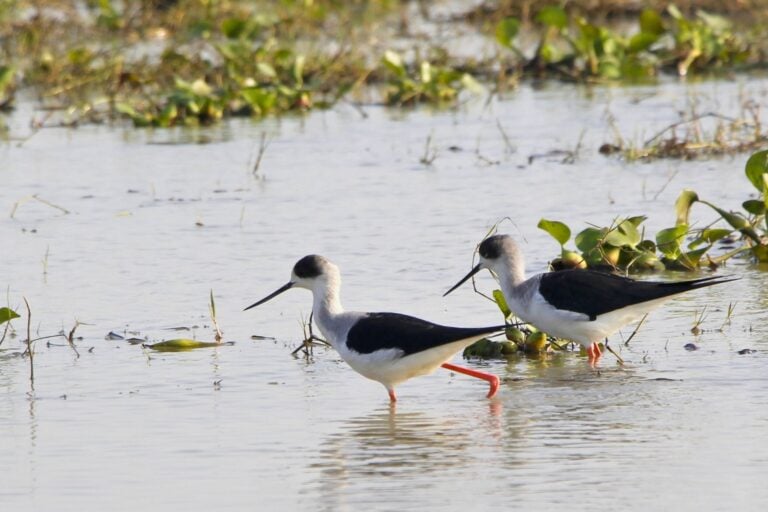
Scores of black-tailed godwits, little grebes, Temminck’s stints, black-winged stilts, ruddy shelducks, whiskered terns, northern pintails, wood sandpipers, bronze-winged jacanas, large and intermediate egrets, and roffs – the list runs long, full of avian visitors from faraway Siberia and Central Asia.

The lesson forces you to be patient and mindful, aware and watchful. For as your canoe glides over the muddy waters noiselessly, there’s a yellow bittern just a meter to your right waiting petrified for the frog to raise its head.

To the left are flocks of purple swamphens, their plumage glistening in the early sun. Your guide whispers into your ears that if you look beyond the swamphens, you can see a pair of ruddy shelducks about to take flight.
Marshland Wonders

The canoe moves deeper into the marshlands, and then are revealed the bigger stars of the show. The intermediate and large egrets are so commonplace that you can ignore them and be forgiven.

The more colorful open-billed storks prance beyond, careful observation helping demystify their name. And then come the grey herons and the purple herons, the latter too distinctive with its unique colors and S-shaped neck.
The canoe comes to a rest – any further movement and the two purple herons in front will be disturbed.
We wait for over five minutes, and almost simultaneously, the stupefied two have plonked into the waters with a wriggling fish as a prize in each of their beaks.
Then they fly off together, almost creating a time-lapse photo of the same bird in two poses of flight.

The boat glides on, as flocks of godwits, glossy ibis, stilts, and stints fly all around as if this were Eden itself. Denizens, visitors – they are all safe.
The Transformation of Eden

It is important to mention here that the safety didn’t descend by itself.
Decades of relentless efforts from NGOs and a few local visionaries helped in the conversion of poachers who once killed these migratory birds in dozens and scores for their much sought-after meat.
Years of transparent conversation, education, training, and the promise of a better future where man can co-exist with wild have resulted in this Eden today.
My guide and oarsman – both poachers in a past life – tell me many a tale of this transformation with a fair bit of pride.
It has been almost three and a half hours on the boat now. No one complains. Here, no one will rush you to get to the next boatload of tourists.
After watching so many of the birds, I almost feel like a country David Attenborough – I can now spot the birds and name them with ease.
Almost. As our canoe comes to a halt near the embankment, I ask my guide for help – he says I have spotted a citrine wagtail and a red wattled lapwing. I am nearly there.
Morning is now in full bloom. I get back on land and now take note of a makeshift camp. My guide tells me the war is not yet over.
During prime migratory phases such as winter, there are camps where sentinels watch over their precious marshlands and deter whatever is left of the poaching industry.
Yes, the war is not yet over, but it is fortunately one where the wild is winning for a change. Census numbers of the migratory birds have shown increases over the last three years. Let’s hope the trend continues.
My boat ride is over, and there’s hot tea on the stove at the only eatery that has now opened. As I relish my tea, I see quite a few visitors arriving, mostly locals from nearby towns and cities.
Perhaps even this charming little village will become a tourist hotspot in a few years.
But as long as the numbers are restricted to retain the peacefulness of our winged visitors, it will imply a sustained way of living for the nearby villagers. Until then, hopefully, these marshlands will retain their magic…
How to Reach
Mangalajodi is a 2-hour drive from Bhubaneshwar. The last stretch is a dirt track that moves through the village – don’t be surprised to see cars making way for bullock carts here.
When to Go
Winter is the best time to spot the migratory birds. The end of January is the peak, which is when most birds would have arrived.
Where to Stay
There are a couple of options: Mangalajodi Bird View Resort and the Mangalajodi Ecotourism Cottage. Both offer good options with clean and tidy rooms and locally sourced food.
While the hosts will ensure a very comfortable stay with delicious meals, don’t expect luxury. Meals and the canoe rides on the marshlands come with the stay package.
I stayed at the Mangalajodi Bird View Resort – its owner, Manas Pradhan, is a great storyteller and can keep you regaled for hours, narrating many a tale of the transformation in these lands.
What Not to Miss
Sunrise and sunset are amazing times for birdwatching, though the canoe rides are available all day.
If you happen to stay in winter here, do not forget to go outdoors just after sunset to find hundreds of open-billed storks flying to the hills.
They are visible from anywhere in the village, and their distinct silhouettes against the orange sunset skies offer an unforgettable and mesmerizing experience.
Why Should You Go?
Mangalajodi is India’s greatest community wildlife conservation story.
There have been government-led conservation projects to save the Tiger, the Indian rhinoceros, and the Asian elephant, but Mangalajodi is different.
Here, NGOs and the locals have joined hands and transformed themselves into guardians of this veritable paradise.
From a low point of 5,000 birds in the early 2000s, today the tally has crossed 200,000 – 300,000, perhaps more, and is on the rise every year.
Your support will not only prove that sustainability has a way and is the future in today’s world, but will also evangelize the need to replicate Mangalajodi’s success in other parts of the country and the world.
Need a hand planning your trip? Here are the sites and services we rely on most, from booking tools to travel products we love.
Inspire your next adventure with our articles below:
Author Bio: Ayan loves travelling, writing, and photography; he has travelled to over 30 countries and has published multiple books on travel and poetry.
Want to discover more hidden gems and helpful travel tips? Join our free newsletter for the latest travel secrets and travel articles.
We are reader-supported and may earn a commission on purchases made through links in this article.

- Language Learning Travel Guide - September 12, 2026
- Safari Travel Guide - September 12, 2026
- Luxembourg City in 24 Hours: Essential Sights, Views and Cafés - September 12, 2026
Planning another trip soon? ✈️
Add GoWorldTravel.com as a preferred source on Google. Click the button below so our local guides, packing hacks, and hidden-gem itineraries always show up first when you search!
Add to Preferred Sources