
Driving a contorted asphalt ribbon through a fantasy landscape of manicured tea fields and profuse rainforests in the Western Ghats of India, my guide Suresh jammed on the brakes as we crested a rise overlooking the tourmaline waters of Mattupetty Lake.
“There, there! You see?” he urgently declared while pointing to what appeared to be a clump of boulders.
“What are we looking at?” I inquired, just as one of the “boulders” started flapping its fleshy ears.
Of course, wild elephants – mom, dad, the grandparents, rowdy teenagers and two babies sized somewhere between a VW Beetle and a Mini Cooper. Then, hoisting their hulking sun-baked bodies the pachyderms sauntered to the water’s edge, where trunks became gigantic water guns and a communal mudfest ensued.
“You see,” Suresh said with sage-like assurance, “I told you we would find wild elephants today.”
Elephants, check.
And during two weeks of exploring Kerala in southwest India I also encountered a tiger, monkeys, magnificent spice gardens, and orderly tea estates. There were ornate palaces, forts, temples, churches, and shrines. I was smitten by resplendent Kathakali performers, and Indian foods as wonderful as they were unfamiliar.
I watched fishermen pole their flatboats along the languid tangle of lakes, lagoons and canals that comprise an immense waterworld known as The Backwaters. And what a surprise, I went slightly nuts for coconuts (Kerala means “Land of Coconuts”).
Where India’s megalopolises of Mumbai (Bombay) and Delhi enveloped me with controlled chaos and swirling currents of humanity, Kerala soothed me with serenity. Its only chaos might be screeching water birds sparring over fish, or villagers bartering at street bazaars.
The only swirling currents are winds rustling palm fronds, or maybe the tidal flows between The Backwaters and the Arabian Sea.
Kerala’s Ancient Trade Routes
The Slim Jim state, hemmed by the Western Ghat Mountains and Arabian Sea, is outlandishly fertile and has been a hub of foreign spice trade for at least 3,000 years. Arab and Jewish traders were first in line.
With Portuguese trader Vasco da Gama’s arrival in 1489, a flotilla of European merchants began calling upon the Malabar Coast, present-day Kerala, exporting ivory, spices, peacock feathers, and teak.
Dutch, Spanish, and British later all had a heavy hand in commerce until India gained independence in 1948. But vestiges from this crossroads coalition still intermingle with the predominant Hindu culture, making Kerala a Disney World of living history.
Queen of the Arabian Sea
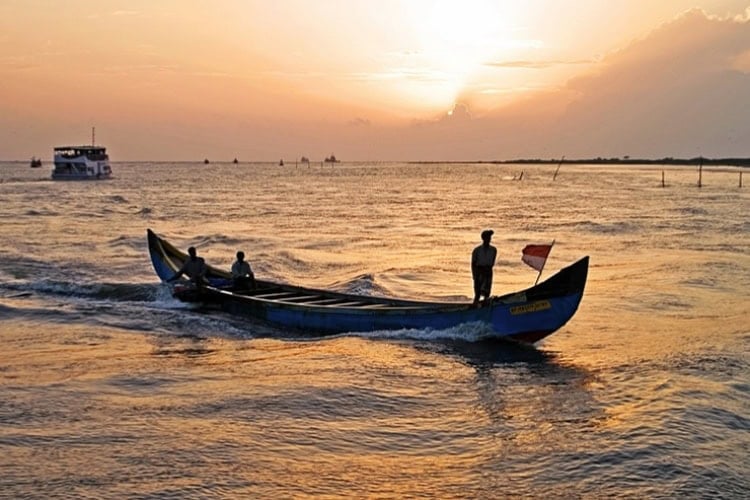
Kochi – “Queen of the Arabian Sea,” locals point out – is Kerala’s main gateway, which comes off as an improbable blend of medieval European villas transplanted on a tropical coast sprouting coconuts far as the eye can see.
The city’s eclectic heart is Fort Cochin, dating to 1766 and strewn with Indian antique shops, fabric merchants, cafes, and a ramshackle assembly of fish markets selling the day’s catch. You’ll also find an abundance of historical buildings, with the oldest church in India, a 16th-century synagogue, and the famed Mattancherry Palace rising to the top of the list.
My effusive guide took me to Mattancherry, built by the Portuguese in 1555 and used as a coronation hall for rajas. Remember, in India, edifices come by the truckload, prompting glazed eyes from “templed-out” tourists. Had I seen twenty? Thirty? I’d already lost count, but Suresh baited me well.
“Here you will see murals of Kerala dating to the 10th century,” he explained.
In other words, vintage Kerala, a proposition that could shed light beyond the ubiquitous coconuts. Entering the central hall, I procured good karma (cheap at 10 rupees) as a young girl fitted me with a jasmine blossom necklace.
Properly garnished, I wandered beneath a teak ceiling and among the multicolored gallery murals depicting Ramayana, who came to Kerala to search for his wife, and other religious legends. All the while, I was basking in a heady jasmine aroma as Suresh provided a crash course in Hinduism’s mystique.
With a little daydreaming, it was as if I’d stumbled into the 10th century. Set on a peninsula where the massive Vembanad Lake joins the Arabian Sea, the port setting of Kochi qualifies as dramatic. And so do its sunsets.
Sunsets, Kathakali, and the Rhythms of the Sea

I spent my first evening watching shore-bound fishing boats appearing as silhouettes against a molten sunset that painted the ocean flaxen. Then teams of men – some singing in a kind of heave-ho rhythm – would haul their heavy fishing nets onto the beach to dry.
But this show ranked as a prelude to my evening’s main event: the stage dance-drama of Kathakali performers, one of Kerala’s iconic assets.
Kathakali’s story play is based on Indian ballads, exploring the themes of good and evil, war and peace. In my Western way of thinking, the fascination doesn’t come from the story itself, but from the exquisitely painted and costumed dancers who’ve mastered 24 distinct facial gestures to convey the storyline.
In the intimate theater, I wasn’t more than 10 feet away, and I could see a performer’s mastery of producing tears of sadness from one forlorn eye while the other arched wide to communicate happiness. To say Kathakali is merely spellbinding would be an injustice.
The next morning, after a breakfast of frothy sweet lime juice, idiyappam (southern India style steamed rice), and flour noodles, we shuffled among fish stands selling iridescent blue lobster-size prawns that can be cooked on the spot.
Tempted but already full, Suresh and I walked to the famed Chinese fishing nets introduced by traders from the court of Kublai Khan. Fixed at the water’s edge, the cantilevered wooden nets require the muscle of four men, who use suspended boulders to counterweight the three-story contraptions that clamp down on catches at high tide.
There might be an easier way, I reckoned, but if the fish haven’t learned to stay clear of stationary nets in hundreds of years, it must be bon appétit.
Sea of Tea
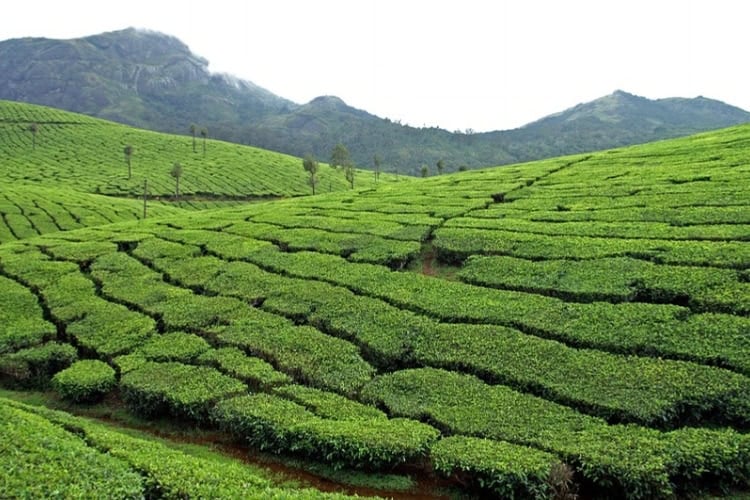
One of the incentives entrenching the British in India was the highland’s temperate tea-growing climate.
At 5,000 feet in the Western Ghats, Munnar not only became one of the world’s highest tea-growing colonies, but it served double-duty as one of India’s many hill stations – cooler summer respites where weary Brits could escape the torpid lowlands.
Threading our way up from Kochi, the verdant plantations of turmeric, pineapple, tapioca, cardamom, pepper, cinnamon, rubber trees, and coconut gave way to endless waves of tea fields resembling Japanese bonsai gardens.
In the middle of this sea of tea, Munnar has a quixotic quality, looking like a lesser twin of Marrakech with its bustling open-air markets, kaleidoscopic fabric bazaars, and shrouded Muslim women.
Being an obvious outsider, I absorbed the exotic scene like an alien discovering a new world – a world in which merchants clamored to sell me everything from sarongs to raw goat meat.
A Vanishing Way of Life
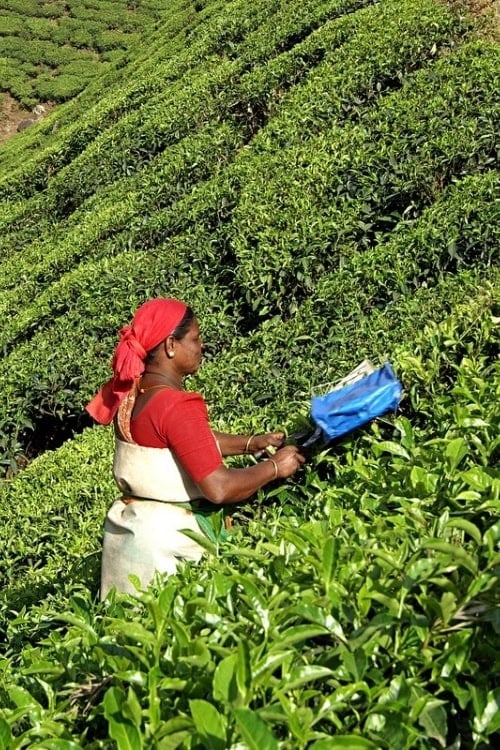
Munnar’s current tea fields were planted up to 100 years ago by the British. Visit India’s hill stations, and you witness a vanishing way of agrarian life as the colonial aspects slowly give way to trophy homes and hotels that supplant the rural countryside. Or at least I was told.
In Munnar, I saw very little of anything resembling full-blown development, and I came away appreciating the labor involved to produce the cup of tea I enjoy 12 time zones removed.
“Three leaves and a bud. That is how tea is cut,” Suresh explained as we wandered among the pickers who were clipping with the precision of florists.
Shouldering basket slings and using metal cutter boxes, the workers trim each tea bush in a variation of the bonsai method, keeping the new, less bitter growth. It’s no easy task. The hills are steep, and there are poisonous snakes. Filled baskets weigh 60 pounds, and many women tote babies for lack of an alternative.
They scour fields daily, retracing their steps every two weeks until the monsoons rake Munnar with India’s second-highest rainfall. When the deluge abates, the cycle repeats itself.
Tigers and Spice

Just inside Kerala’s border with the southeast state of Tamil Nadu is the spice haven of Kumily and the renowned Periyar Wildlife Sanctuary, among India’s first of 16 Project Tiger Reserves. If the yin and yang of stalking tigers amid aromatic spices sounds implausible, Periyar provides proof that the scheme is possible.
My first attempt was lackadaisical, packed with Indian families aboard a large tourist paddleboat that cruised Periyar’s 26-square-mile lake. We spotted hyena-like dholes, rotund sambar deer, and innumerable birds I couldn’t begin to ID.
But we came up empty on any of the Sanctuary’s 38–40 tigers, or unbelievably, its 750 elephants. Suresh reminded me of what ethical safari guides tout, that “It’s not about bagging the trophy (pictures in our case) but the hunt.” Understood.
Into the Forest

But I’m a cat person, and I still wanted to see those tiger stripes. So early the next morning, we employed Raji, one of Periyar’s tribal trackers whose kinsmen once hunted tigers before the area was declared a Project Tiger Reserve in 1978.
As tiger tourism took off, India’s Wildlife Department “rehabilitated” the tribes from poachers to educators and guides.
Not that they had much choice, but as Raji explained in broken English, “We protect tiger now. It is good.”
Protecting tigers is fabulous, which made me think about my own hide. Traipsing in a shadowy rainforest with a diminutive guide armed only with a stick to repel any tiger (tigers?) that might be having a bad day has apprehension written all over it.
I knew people had been dispatched here by tigers, but details beyond that disturbing fact? No thanks. Broken shafts of sunlight illuminated what passed for a trail, and above and around us, we saw slender loris, a Nilgiri marten, huge fruit bats, and noisy black monkeys. The cacophony of bird chatter was everywhere.
Then, like flipping a switch, silence. Raji suddenly motioned us to stop, and we unerringly held our breaths. Without a word, he pointed through the foliage to a clearing, and for the most fleeting seconds, I saw the unmistakable stripes that I’d traveled half a world to see.
“You have your trophy now,” Suresh proclaimed.
Spice Markets and Street Food

Carousing the Keralan hill country, the family of Mattupetty Lake elephants we spotted was a bonus on top of the spice garden tours in the valleys surrounding Kumily.
The three-hour guided walkabouts are enlightening and good exercise to boot, but to see and taste these wonderful spices, you don’t have to tromp in the jungle.
I was amazed at the town’s lavish collections of spice markets, and incessantly muttered “What does this taste like?” as I gazed at dried botanicals I’d never seen, much less sampled.
My wish was granted as Suresh invited me to a back-alley eatery filled with locals inhaling traditional thali meals served on banana leaves.
It’s literally a messy hand-to-mouth affair where you consume an all-you-can-eat mound of dhal (lentils), rice, coconut chutney, and other staples of India’s common people. One of these was paan. The spicy mixture of betel nut and lime paste is a digestive aperitif, and as I was told after polishing off two helpings, it’s mildly narcotic.
Satiated and buzzed like I chugged a quadruple espresso, I later caught a surreal scene as massive fruit bats on their nightly sorties filled the early evening sky.
Backwater Escape

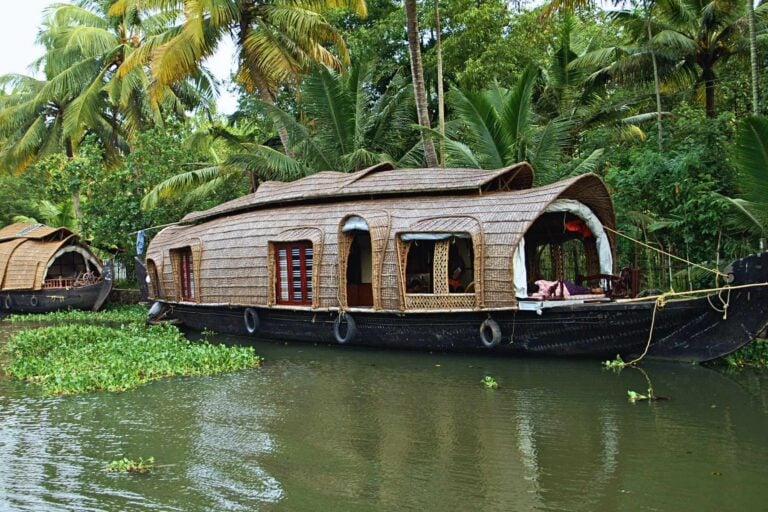
Kerala’s popular image is a sultry tropical paradise of golden sands, swaying palms, and lazy lagoons fringed by coconut trees. I had no quibbles with this well-worn description as I set off from the village of Kumarakom on an engulfing houseboat tour of The Backwaters.
With a staggering 1,200 miles of protected shoreline, the labyrinth of interconnected waterways is an inland sea dotted with small villages and surrounded by fluid rice paddies and coconut plantations galore. It’s the ultimate idyllic drop-out, but that’s only half of it.
The other ingredient luring travelers is The Backwaters’ irresistibly charming kettuvallam houseboats, rigged with plush furnishings fit for kings and queens. These converted wooden rice barges, numbering about 250, are a signature attraction in Kerala.
You’ll spend a pretty rupee for charters, too, but in a decompressing setting that must be what the makers of Prozac had in mind, you won’t care.
“I feel like a sultan,” I quipped to Suresh, who was just as placated as I.
Life passes you by when you’re sprawled on thick linen deck cushions, drinking chai tea and feasting on fresh fruit while your crew navigates watery corridors where tranquil daily village life unfolds.
The tableau of women washing clothes at the water’s edge, tending their children, while men fussed with their boats and fishing nets, impressed me as if I were watching a documentary.
The fishermen are striking, too: dark and sinewy from the constant rituals of sun, water, and work, and carrying a dignified demeanor proclaiming their success with the sea. In the shallows, they quietly push their flatboats along by plunging long bamboo poles into the water. Push, glide, lift. Repeat.
Watch long enough, and this artful punting process almost becomes hypnotic. Heading further into a maze of canals, we pulled up to a dock with a “Toddy Sold Here” sign. I’d heard about this stuff, a mild alcohol drink made from the sap of immature coconut flowers before they develop into hulls.
To me, understanding a culture sometimes means tilting back a glass of the local hooch.
“You will try, no?” Suresh said.
“No…I mean, yes, I will try.”
And with that, we toasted with this nutty, fizzy concoction only hours old while watching another Keralan sunset, a crimson extravaganza melting behind a horizon of – quite naturally – coconuts. Life’s rhythm takes on a different dimension aboard a houseboat in The Backwaters.
Life Along the Canals
If you want to check out a village, say the word, and the crew will drop anchor while you explore the neighborhood.
At a low-key resort village predictably named Coconut Lagoon, I met friendly locals who insisted on showing me their pet projects: two butterfly gardens where special butterfly-friendly flowering plants seduced thousands of flittering flyers in every color imaginable.
But another display of assistance really blew my mind as I was enjoying an enchanting performance by Indian classical musicians.
“I love your music,” I remarked to one member during a break. “Do you have any CDs I could buy?”
Yes, I was told, “But we have to go get the CD if you can please wait.”
Well, since time is all you have in The Backwaters, I could think of no excuse not to wait while enjoying the twangy Indian sitar melodies. Three hours later, the CD was handed to me by a young boy who volunteered to be the courier for my request.
I learned he had paddled over two miles in the dark to fetch it from one of the musicians’ homes. And all for $4.
Into the Villages
From Coconut Lagoon, Suresh and I paddled kayaks along narrow canals shaded beneath canopies of palms. He suggested we hoof it overland and pay a visit to a simple rural village that, by all intents and purposes, could have existed in the 1700s.
We walked along berms of high ground that escaped the annual flooding of rice fields, and through groves of rubber trees and more coconuts. In time, we were met by a simple woman in front of her hand-crafted home. She yelled out “Sahib” at my presence.
For a fact, I certainly don’t feel like a kingly Sahib, but Suresh explained the villagers don’t see many tall, fair-featured Westerners. And when one does appear – let’s just say I felt like the subject of an anthropology discussion.
I was surrounded by a score of children, the most beautiful children I think I’ve ever seen.
They were touching me, all wide sparkle-eyed at this funny-looking vagabond who fell into their isolated world. And there we all were, children, giggling, their mother smiling, Suresh laughing, and inside my heart was melting.
Destination Details: India
Getting There: Air India, United Airlines, American Airlines, and various international carriers offer flights from the U.S. to Mumbai (BOM) and Chennai (MAA). Nonstop flights to Mumbai are available from Newark (EWR), San Francisco (SFO), and New York (JFK), while Chennai requires a connection. Major U.S. departure points include New York, Chicago (ORD), San Francisco (SFO), and Los Angeles (LAX).
Currency: India’s currency is the rupee (INR), with the exchange rate hovering around $1 USD to 91.92 INR. U.S. dollars are widely accepted, and credit cards work in most metro areas and tourist destinations. International debit cards including Visa, MasterCard, Maestro, American Express, and Cirrus work at most ATMs, typically with a 1 to 3% transaction fee plus a small currency conversion fee. Carry pocket cash for smaller towns and street vendors, and don’t expect to find ATMs in rural areas.
Documentation: You must have a visa before arriving in India. As of 2025, the e-Visa process is streamlined and typically takes under a half-hour to complete, eliminating the need to visit embassies or mail your passport. The most common option is the e-Tourist Visa, valid for 30 days, with fees ranging from $10 to $25 depending on the time of year. A one-year e-Tourist Visa is also available for $40. Be cautious of fraudulent websites mimicking the official portal. The only authorized site is indianvisaonline.gov.in.
Official Tourism Sites:
- India’s official tourism website: incredibleindia.gov.in
- Kerala’s official tourism website: keralatourism.org
Smart Travel Tips for India
India can be the most engaging, stimulating travel experience on the globe. Here are some things to keep in mind to help minimize misadventures.
Staying Healthy
See your doctor as part of your pre-departure planning. Keep up to date on tetanus and polio boosters (every 10 years), and consider diphtheria, hepatitis A, and hepatitis B vaccinations. Malaria occurs throughout India, so ask about prescription antimalarial drugs. A prescription antibiotic for bacterial diarrhea is also recommended, along with stomach relief medication like Pepto-Bismol.
Travel insurance with medical coverage is worth serious consideration for any extended trip to India. SafetyWing (safetywing.com) offers flexible, affordable coverage popular with international travelers, while Squaremouth (squaremouth.com) lets you compare multiple policies side by side to find the best fit for your trip length and budget.
Food and Water
Wash your hands regularly. Drink bottled water from reputable hotels and shops, and skip the beverage ice. Part of India’s charm is its street vendors, so don’t be paranoid about meager-looking street stands, but use common sense. Avoid shellfish, unrefrigerated dairy products, and undercooked meats. Freshly prepared meals cooked over searing heat are generally safe. Wash fresh produce with purified water.
When to Go
It’s hard to generalize weather across a subcontinent stretching from the Himalayas to the Indian Ocean. Generally, November through March brings cooler, drier conditions and tends to be the main tourist season. April through June are the hottest months. In Kerala, monsoons usually begin in early June and last through August.
Getting Around
Getting around India is an adventure in itself. Domestic carriers Air India, IndiGo, Akasa Air, and SpiceJet connect over 90 cities with both full-service and low-cost options. India Railways can be confusing but is fairly dependable, with multi-day passes available. Buses are an alternative, though most tourists opt for trains. In towns, autorickshaws are perfect for short hops. Self-drive rentals are available in some areas, but hiring a car and a local driver is advisable given India’s chaotic driving conditions.
Read More: Additional articles on travel in India
Tour Providers
India can be daunting for first-time travelers, and an experienced tour operator can make a significant difference. For travel in Kerala, Big Five provided a flexible itinerary, lodging, air transfers, a private vehicle, and a guide. I also traveled independently for three weeks and would rate the logistics “challenging.” Whether you’d enjoy that hands-on experience is a question worth asking yourself.
Travel Guide
The trusty, well-organized Lonely Planet India ($28.99; lonelyplanet.com) is loaded with practical advice, cultural history, maps, and nearly everything a traveler needs to know.
Need a hand planning your trip? Here are the sites and services we rely on most, from booking tools to travel products we love.
Inspire your next adventure with our articles below:
- 2,000 Kilometers Through Rajasthan: One Family’s Unique Journey
- The Blue City That Stops Time: Discovering the Magic of Jodhpur’s Ancient Streets
Author Bio: Ted has followed his passions for travel and adventure for several decades, traveling to 50 some-odd countries on six continents. He’s worked on assignments for outlets including Outside, CNN, BBC, Islands, Sport Diver, Outdoor Photographer and many more.
Want to discover more hidden gems and helpful travel tips? Join our free newsletter for the latest travel secrets and travel articles.
We are reader-supported and may earn a commission on purchases made through links in this article.

Planning another trip soon? ✈️
Add GoWorldTravel.com as a preferred source on Google. Click the button below so our local guides, packing hacks, and hidden-gem itineraries always show up first when you search!
Add to Preferred Sources