
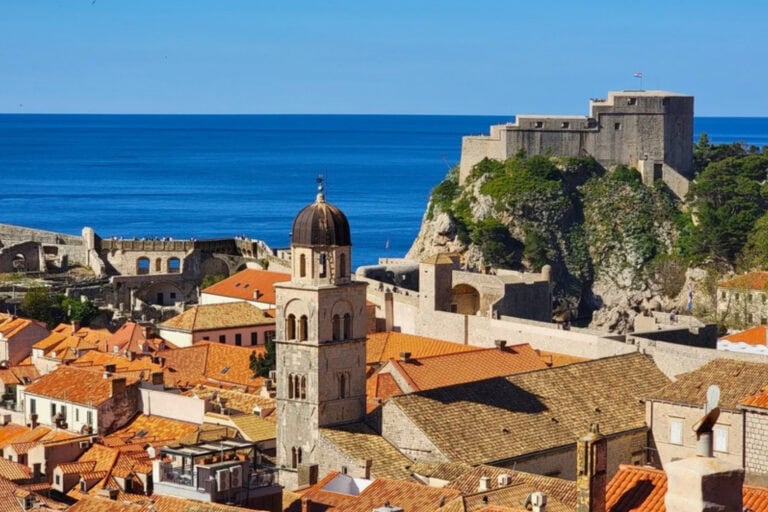
The first thing we noticed about Dubrovnik is not the walls themselves, though they rise almost immediately into view. The first thing we noticed was the light.
Sunlight reflects off the pale limestone in a way that feels practiced, as if the city has spent centuries learning how to hold it. The stone streets—worn smooth by generations—don’t absorb the sun so much as return it, casting a quiet glow upward. Even after a long journey, even in the late afternoon, the place feels awake in a way that has nothing to do with the movement of people.
Nataliya and I stepped through Pile Gate with our bags in hand, lifting rather than rolling them along the polished stone—a small courtesy to the place itself. It’s the kind of detail you notice right away: Dubrovnik isn’t preserved accidentally. It’s protected, deliberately, by people who understand what they have. Case in point: most people carry their roller bags rather than disturb the polished limestone pedestrian street.
Down the Stradun to Onofrio’s Fountain
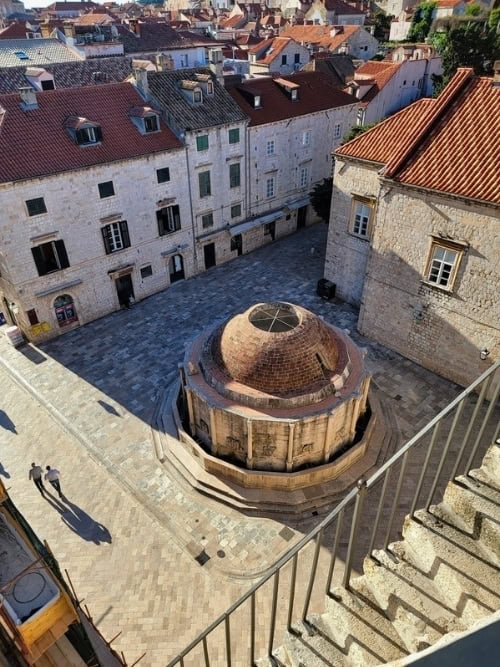
Dubrovnik’s main pedestrian street, the Stradun, stretches ahead in a broad, gleaming line, its surface almost mirror-like in the slanting light. To one side, the great Onofrio’s Fountain murmurs steadily, a 15th-century lifeline that once supplied much of the city with fresh water. Ahead, towers, monasteries, and rows of red-tiled roofs rise in orderly confidence.
We had barely walked a few minutes before my wife, Nataliya, slowed. At first I thought it was because she needed help with her bag, but she was simply taking it in.
“It doesn’t feel real,” she said.
I nodded. “It’s like we walked through those gates and into another century.”
Our home away from home was tucked just off the Stradun, along one of the many winding sidestreets, in a building that had lived several lives before ours briefly intersected with it. In fact, this current guest house was in an aristocratic household that once formed part of the historic fabric of the old Republic-era city. We dropped off our bags, rinsed off the long day of travel, and stepped back out into Dubrovnik’s charming evening.
Read More: From Game of Thrones to Mamma Mia: Discover Croatia’s Top Film and TV Locations
Getting Lost in Old Town
Dubrovnik’s Old Town is compact, and that is part of its power. Within its walls, first raised in the early Middle Ages and fortified over centuries by the Republic of Ragusa, everything feels contained and intentional. Streets narrow and climb into quiet residential corners where laundry hangs between buildings and potted plants soften stone thresholds worn by time.
For our first evening, still weary from travel, we opted to get lost in the streets without a plan. The perfect plan for a place like Dubrovnik.
We strolled through Loggia Square, where Orlando’s Column still marks the city’s long independence. We passed by the Church of St. Blaise, its baroque façade catching the last of the day’s light. And we walked into side streets where the rhythm slows, where the city feels less like a destination and more like a place people still live: locals sitting in cafes and enjoying meals or drinks; people meeting in the street, men walking their dogs and women carrying groceries from the market to their homes.
Top Tours in Dubrovnik
Down to the Water at Ploče Gate
Eventually, we drifted through Ploče Gate and down toward the water. Here, the city exhales. Steps lead to rocky outcroppings and small piers where locals sit with drinks, watching the Adriatic stretch toward Lokrum Island, its dark green silhouette rising just offshore.
“This is better than any bar or cafe,” I said, settling onto a stone ledge.
Nataliya shrugged. “I guess we’ll have to research that for ourselves.”
Dinner in the Old Quarantine Quarter
Dinner came in the Lazareti, the old quarantine buildings just outside the eastern walls. In Dubrovnik’s maritime days, arriving travelers were required to spend periods of quarantine here before entering the city—a precaution that helped preserve both health and trade. Now, those same structures house restaurants and cafés, their purpose changed but their presence intact.
We enjoyed Sporki Makaruli, or “dirty macaroni,” a traditional Ragusa pasta dish with slow-cooked beef, red wine, and warm spices. It paired perfectly with a Croatian red. Not to mention, the beautiful scenery in the outdoor seating area, with the mountains to one side and the sea to the other.
Above the City, Beyond Time
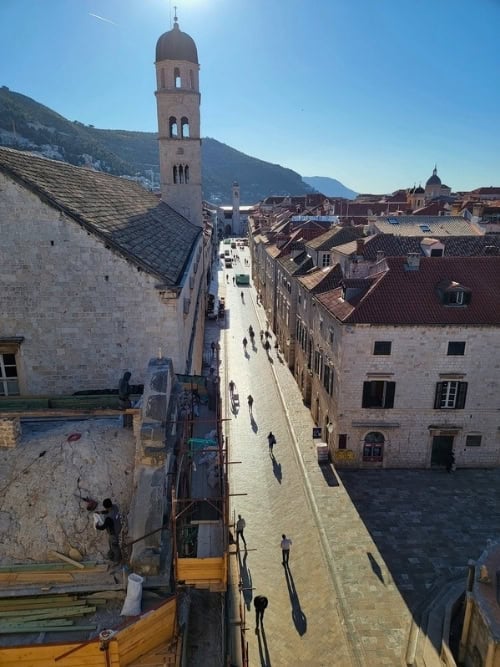
We began our first full day in Dubrovnik by tackling what we found to be the most impressive site of the city: the massive city walls themselves.
We made our way from our guest house, along the Stradun, back to Pile Gate before the crowds had fully gathered. There, we climbed the narrow entry to the city walls—one of the best-preserved medieval fortification systems in Europe, and among the most walkable.
The walls are fully intact all the way around, allowing visitors to walk the perimeter (with a bird’s-eye view) in about an hour. Or a few hours, if you take your time to take it all in.
Looking Down Over the Stradun
From above, Dubrovnik seems to rearrange itself. The red roofs merge into a pattern. The streets compress into narrow lines of shadow. And beyond it all, the Adriatic opens wide and indifferent, a constant presence against which centuries of human effort feel both impressive and temporary.
You can almost forget you’re in a sea town when you’re in the heart of Old Town. But there’s no forgetting it atop the city walls.
We moved slowly, enjoying the views inside and outside the walls. The full circuit stretches just over a mile, but distance is not the point. Every turn offers a different vantage: into courtyards where laundry sways between buildings; along cliffs that drop sharply into the sea; toward Lokrum and the scattered islands beyond.
A Coffee Break on the Ramparts
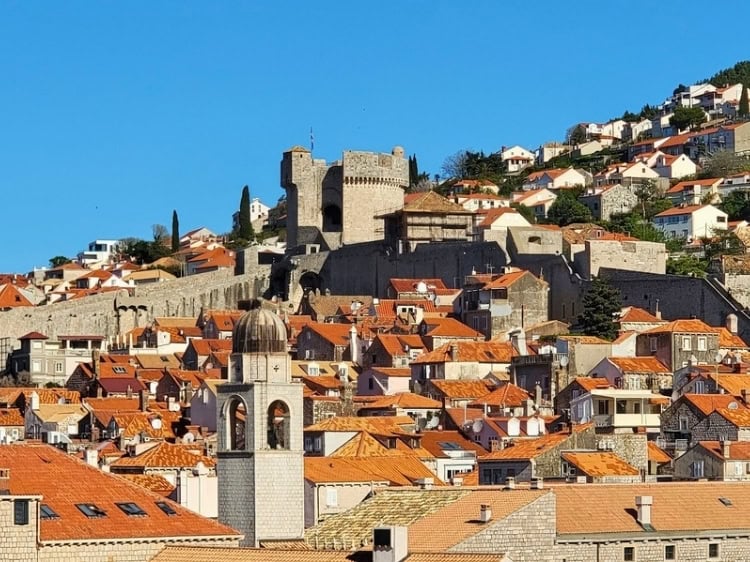
At one of the small cafés perched improbably along the wall, we stopped for coffee.
“Not a bad place for a break,” I said.
Nataliya smiled. “We could get used to this.”
From our outdoor café table, sipping strong coffee, we could see Fort Lovrijenac to our right, Lokrum Island to our left, and the sea reflecting the sun in between.
We continued our leisurely stroll along the wall, energized by the coffee. From Minčeta Tower, the highest point along the walls, the city settles into a kind of stillness. From here, Dubrovnik feels complete—self-contained in a way that few places are anymore. It is easy to forget, at least for a moment, how much history presses in on these stones.
A Republic Built on Its Walls
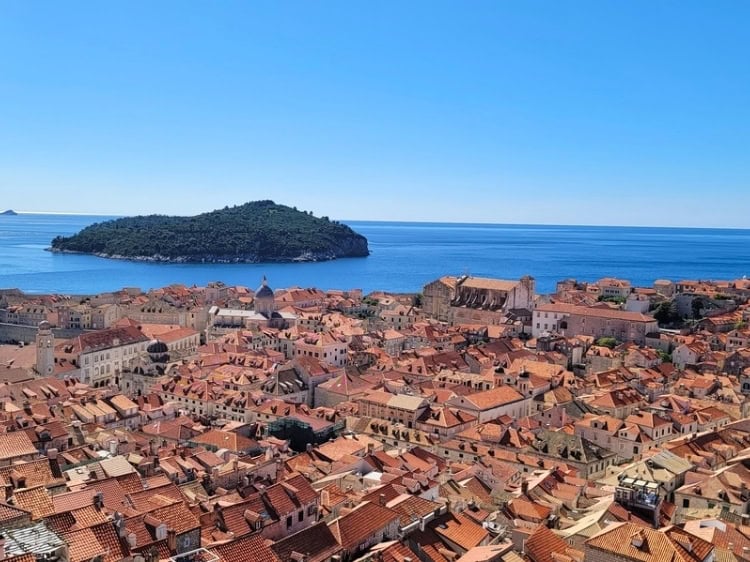
Dubrovnik’s city walls were not built all at once, but expanded and strengthened over centuries as the Republic of Ragusa grew into a prosperous maritime power. First established in the early Middle Ages and continually reinforced between the 12th and 17th centuries, the walls eventually stretched nearly 1.2 miles around the Old Town, protected by forts, towers, bastions, and thick stone ramparts designed to repel both land and sea attacks. Their defenses were considered among the most advanced in the Mediterranean, reflecting a republic that survived less through military conquest than through careful defense, diplomacy, trade, and vigilance.
Remarkably, these walls were never breached by hostile forces during the republic’s independent era, and today they remain among the best-preserved medieval fortification systems in Europe—a lasting symbol of Dubrovnik’s resilience and self-determination.
What the Walls Remember
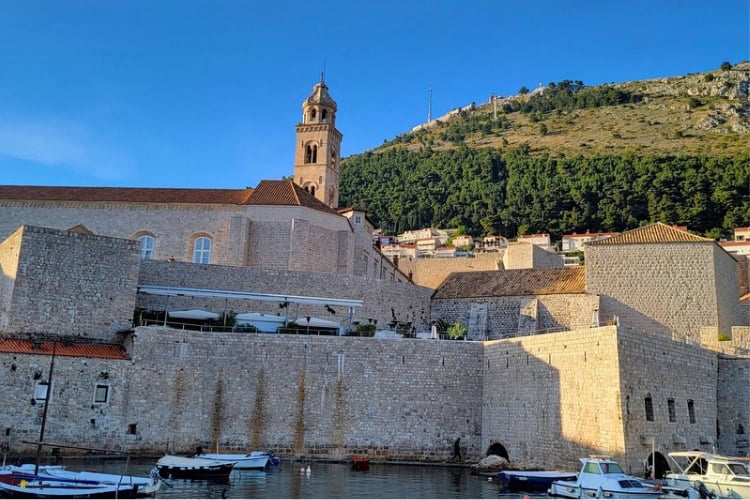
Inside the walls are reminders, quiet at first, then harder to ignore. In places like Sponza Palace, where exhibits commemorate those killed during the siege of Dubrovnik and the Croatian War of Independence. In photographs that show streets we had just walked reduced to rubble. In the understanding that this city, so carefully preserved, has not simply endured time—it has survived it.
Later, on a walking tour, our guide gestured toward a section of the wall.
“My family used to live right there,” he said. “Before the war.”
He pointed to what is now a public space.
“My kitchen had the best view in Dubrovnik,” he added with a smile.
There was humor in his voice, but something else as well: a sense of what time and conflict and change can take and leave behind.
Stone and Sea: The City at Its Edges
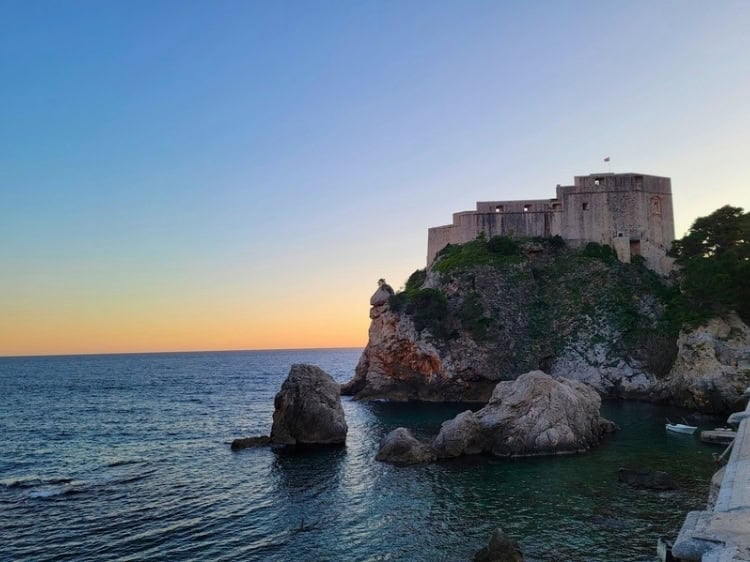
If the walls of Dubrovnik offer perspective, then the spaces just beyond them offer contrast.
From Pile Gate, it’s only a short walk along the outer edge of the Old Town to Fort Lovrijenac, the massive stone fortress perched on a sheer cliff above the sea. The path curves past a small harbor—often photographed, instantly recognizable—before rising along a set of steps carved into the rock itself.
“Imagine trying to attack this place,” I said, pausing halfway up. “As if the city walls weren’t intimidating enough.”
“I wouldn’t even try,” Nataliya said with a laugh.
Inside Fort Lovrijenac
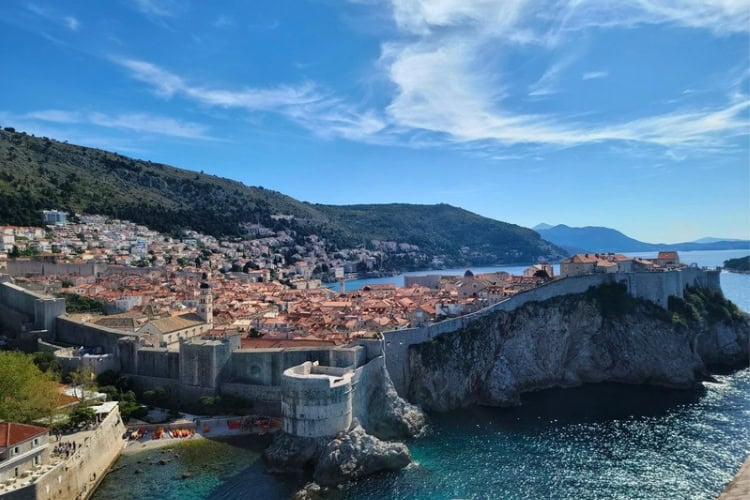
Lovrijenac was built to ensure no one else would either. Standing apart from the main fortifications, it guarded the western approach to the city, its thick walls and commanding position serving as both shield and statement.
From the top of the fort, the view folds Dubrovnik back into itself—the walls, the rooftops, the narrow lanes—while the Adriatic stretches outward in every other direction.
Lovrijenac continues to live, not just for tourists, but for culture. While we visited, Game of Thrones cosplayers took photographs and movies of each other in scenes they knew from the television show.
Medicine and Meditations
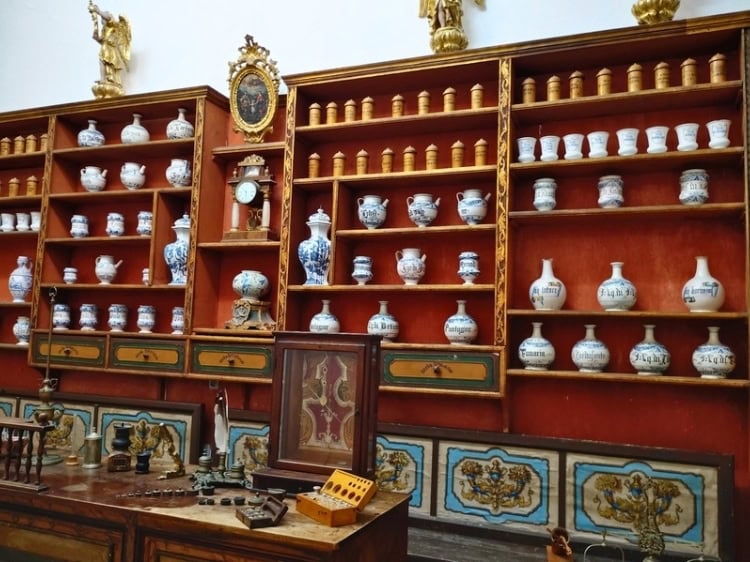
Back inside the city walls, the Franciscan Monastery, just inside Pile Gate, offers a different kind of defense. Its cloister is a study in symmetry and calm, a square of stone columns surrounding a small garden that seems untouched by time. It seemed a perfect place to take a seat and enjoy the quiet, removed from the people walking the streets.
More than meditation is offered here. Tucked within the monastery’s walls is one of Europe’s oldest operating pharmacies, dating back to the 14th century, a reminder that care, too, has a long history here.
Nataliya paused near a display of ancient jars and instruments as I took a picture.
“No photos here!” the pharmacist said.
“Not without a prescription?” I asked. I noticed, tucked behind an indoor plant, a “no photo” sign and put my camera away. This was, after all, a working pharmacy with modern medicines along one wall and the ancient remedies along another.
The Dominican Monastery and a Hidden Synagogue
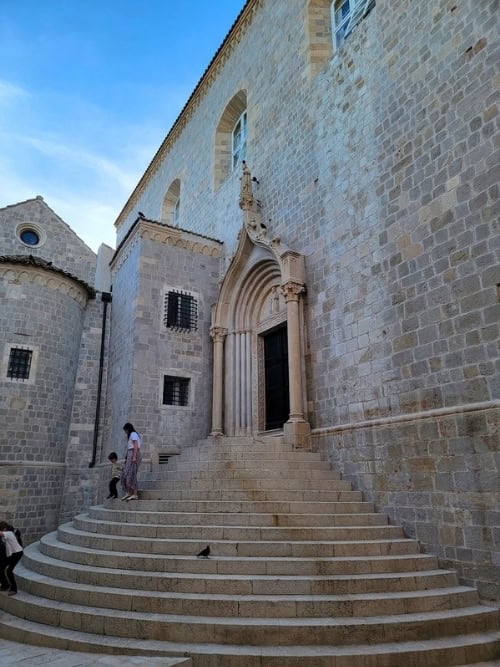
Across town, the Dominican Monastery tells another part of Dubrovnik’s story: Gothic arches, religious art, and the subtle layering of cultures that passed through this Adriatic crossroads.
Dubrovnik, for all its Catholic identity, has long been a place of intersections. Not far away, hidden modestly within a residential building, sits one of the oldest Sephardic synagogues still in use in the world, a quiet testament to a Jewish community that has existed here for centuries—not always prominently, but persistently.
The Republic and Its People
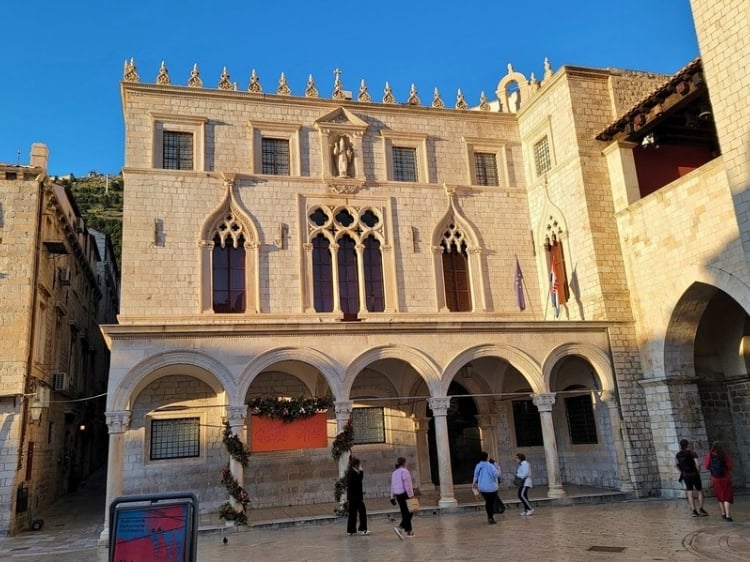
In Loggia Square, where the Stradun widens and the city seems to gather, the past feels closer to the surface.
Orlando’s Column still stands as a symbol of Dubrovnik’s independence, a marker of the centuries when the Republic of Ragusa governed itself with careful diplomacy, navigating between larger powers while maintaining its autonomy. Nearby, Sponza Palace, once the customs house and treasury, speaks to the city’s economic reach, its role as a maritime hub that connected East and West.
Inside, however, the tone shifts. Photographs line the walls with names, dates, and evidence of a more recent past that sits uncomfortably close to the present. The war of the early 1990s is not a distant memory here. It is part of the lived experience of many who call this place home. The exhibit, which included photographs and videos of that war and the bombing of buildings, streets, and walls of Dubrovnik, was simple but effective. You could feel it, watching tormented residents scavenge in the rubble of their homes and shops. These were the very streets and buildings we had just walked along, and it was hard to imagine that they had been rubble just thirty years earlier.
The Orphanage Door
Later, walking through a quieter side street, our local guide pointed to a bricked-in doorway set into the stone. She explained that it had once belonged to an orphanage, where children were left anonymously through a revolving window. Families sometimes left identifying tokens—occasionally half coins or matching objects—so a child might someday be reclaimed if family circumstances changed. In most cases, the city would raise the child, providing food, education, and sometimes even a dowry, in a system designed to preserve dignity even in abandonment.
“No questions asked,” the guide said. “Any questions?”
I wondered if this were more legend or history, but I didn’t dare pose the question.
Read More: When to Visit Croatia: A Month-by-Month Guide for Every Type of Traveler
A City That Lives in Layers
Days in Dubrovnik tend to blur, not because they lack distinction, but because they are packed full of experiences.
One morning led to another: museums tucked into fortresses, galleries devoted to local artists, quiet churches filled with relics and flickering candles.
In Fort St. John, the Maritime Museum traces Dubrovnik’s seafaring past—ships, trade routes, the careful balance of power that allowed a small republic to thrive.
Nearby, the aquarium occupies stone chambers that once served entirely different purposes, a reminder that every space here has been repurposed, reimagined.
Inside the Rector’s Palace
We wandered through the Rector’s Palace, once the seat of government, its rooms offering glimpses into the political life of the republic: measured, restrained, designed to avoid the concentration of power. The rector himself served only a short term and lived under strict rules, a system intended to preserve balance.
“Term limits and restrictions on power,” I mused. “Not a bad idea.”
Nataliya smiled. “Those were simpler times.”
Artists and Writers
Some of the smaller museums offered quieter moments: collections of art, fragments of daily life, the work of writers and painters who drew inspiration from the same streets we were walking.
One of the most intimate of these was the former home of Marin Držić, Dubrovnik’s great Renaissance playwright and satirist, now preserved as a small museum tucked into the Old Town.
Držić wrote in the 16th century with a sharp, irreverent voice that challenged authority and captured the textures of everyday life in the Republic of Ragusa, often drawing comparisons to Shakespeare for the vitality of his characters and dialogue. Walking through his former house, the rooms feel modest but charged with imagination, as if the city’s literary memory is still quietly anchored there.
A Painter’s Museum Inside a Fortress
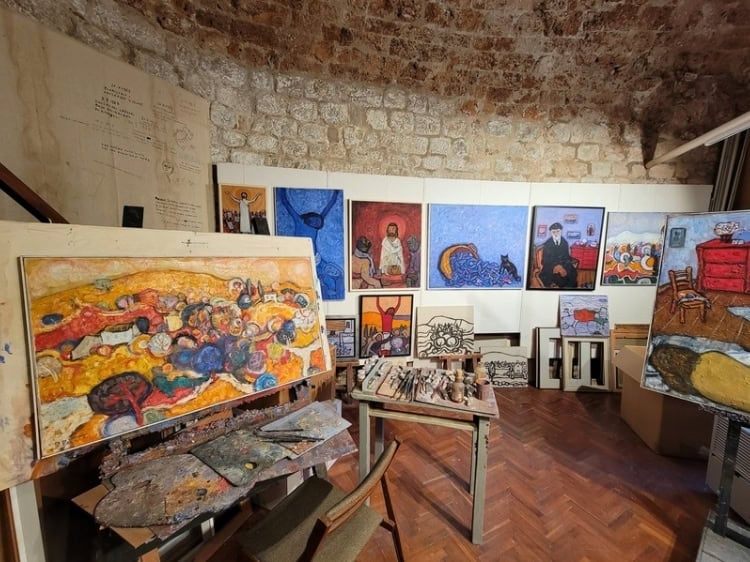
Inside one of the city’s fortifications, within the stone mass of a defensive tower overlooking the sea, another small museum is devoted to the painter Đuro Pulitika, a key figure in Dubrovnik’s modern artistic life.
Pulitika’s work moves between abstraction and figuration, often drawing on the rhythms of the Adriatic landscape—sea, stone, and sky distilled into color and form. His paintings carry a quiet confidence, less concerned with dramatic statement than with atmosphere and light, as if the act of looking itself were the subject. It feels especially fitting in a city defined by reflection and endurance.
The setting heightens that effect: art displayed inside military architecture, where thick defensive walls and painted canvases occupy the same space. Brushstrokes and battlements coexist here, each speaking in a different language about observation, time, and permanence.
Modern Art in a Former Villa
Outside the walls, near the Lazareti complex, the Museum of Modern Art Dubrovnik provides a broader, more contemporary counterpoint. Housed in a former aristocratic villa overlooking the sea, its galleries trace Croatian art from the late 19th century to the present, moving from academic traditions into abstraction and modern experimentation. Large windows open toward the harbor and the eastern cliffs, so that even as you move through the galleries, the Adriatic remains present—less as subject matter than as an ongoing influence, quietly shaping the work on display.
The Ethnographic Museum
Another revealing stop was the Ethnographic Museum, where the focus shifted to the textures of everyday life in Dubrovnik’s past. Housed within a former granary space inside the Old Town, it preserves traditional clothing, agricultural tools, household objects, and maritime equipment that once shaped the rhythms of life in the Republic of Ragusa and its surrounding villages.
Embroidered folk costumes, worn for festivals and religious processions, speak to a strong sense of regional identity, while simple implements—olive presses, fishing gear, weaving tools—ground that identity in labor and landscape. It is a quieter kind of museum, but one that fills in the human scale behind the stone walls and formal histories, reminding you that Dubrovnik was always not just a city of diplomacy and fortresses, but of working lives lived within them.
As always, the city itself remained the central exhibit.
The Residential Lanes
We found ourselves returning, again and again, to the residential lanes north of the Stradun. Narrow staircases climbed between stone walls, past doorways marked by potted plants and small details that suggested permanence. Laundry hung overhead. A cat watched from a windowsill. Somewhere, a radio played classical guitar softly behind a half-open shutter.
“This is my favorite part,” Nataliya said.
That’s often the case. The museums and historical sites are the glue that hold such a trip together. But the best moments are the walks between them, just existing in a place that is exciting and new to us, even if it’s been around long before our own home existed.
“Mine too,” I said, debating whether to suggest a stop at a stand for ice cream or a café for a local beer.
An Unexpected Celebration
Curiosity during travel has a way of rewarding attention. That evening, after a stop at one of the cliffside bars carved into the outer walls—a place more lively than expected, music spilling out over the rocks—we made our way back toward the center of town.
Loggia Square was already filling. A crowd had gathered outside the Church of St. Blaise, shifting, waiting without quite knowing what for. Then the doors opened, and the reason became clear: a wedding had just concluded, and the celebration was beginning to spill into the square.
Music blared—live, immediate, impossible to ignore. Three men waved large flags in sweeping arcs, red and blue smoke rising around them out of canisters as the bride and groom stepped into the square. Friends and family surrounded them, dancing, cheering, drawing in anyone close enough to be considered part of it.
We didn’t plan to join. But drawn in by the enthusiasm, we did anyway.
Candy was thrown into the crowd—one piece striking me in the shoulder, another catching Nataliya by surprise. Laughter followed as the procession moved down the Stradun, pausing intermittently for bursts of music, flags, and dancing. It seemed the entire city, locals and tourists, had briefly agreed to participate.
“This doesn’t happen at home,” Nataliya said, half laughing.
“No,” I said. “You don’t see this in our neighborhood.”
We followed for a while, along with a mix of locals and travelers, the line between observer and participant dissolving. Near Ploče Gate, the celebration reached its final crescendo, at least here. The bride and groom slipped into an old sports car, the flag bearers got into an SUV, and the rest of the wedding party boarded two large buses. The musicians continued to play on one bus, which bounced with the dancing inside. A trio of tourists tried to talk their way onto the bus, but a polite gentleman said they were already beyond legal capacity for the buses and turned them away with an offering of more wedding candy.
Only later did we realize we had seen the beginnings of this wedding party earlier that day, when a wooden sailing ship entered the harbor filled with singing and flags. We had assumed it was a performance staged for visitors. But it was actually the wedding party, entertaining themselves with song and dance.
“Now that’s a party,” Nataliya said.
I admitted that while I wouldn’t ask to impose, had we been invited, I would have joined in a heartbeat. After all, the spontaneous experiences often outdo the planned ones.
Across the Water, Away from It All
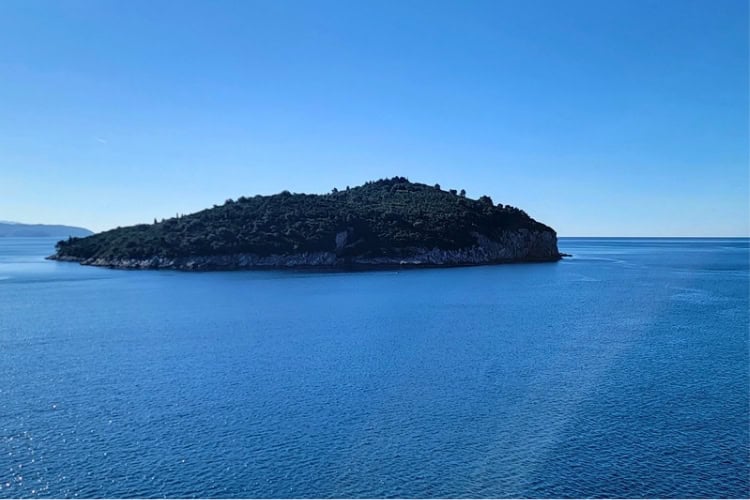
From the Old Port, Lokrum Island feels close enough to reach. The ferry takes only a few minutes, just long enough for the city to begin to shift in perspective. The walls recede, the rooftops compress, and Dubrovnik looks like the little picture on a refrigerator magnet.
“It looks so different from far away,” Nataliya said, turning back toward the harbor.
“A place always looks different, once you leave it,” I replied.
But we were just leaving for half a day, to enjoy the nearby island of Lokrum. Lokrum is a contrast in nearly every way. Where Dubrovnik is structured, deliberate, and defined by stone, the island feels looser, overgrown, shaped more by nature than by design. Paths wind through trees and open onto rocky outcrops where the sea presses in from all sides. The ruins of a Benedictine monastery sit quietly at its center, softened by time and weather.
There are stories here, of course. One of them involves a curse: it is said that no one who tries to live on Lokrum can remain for long. And anyone who takes a stone from Lokrum will be cursed.
“Make sure there aren’t any rocks in your shoes when we leave,” I said.
Nataliya glanced down, then laughed. “I’m checking now.”
Peacocks moved through the grounds as if they belonged, their feathers catching the light in flashes of color against gray stone and green foliage. They are not native to the island, but they have made it their own, another example of how things in this region tend to layer rather than replace.
We walked most of the island in a few hours—past monastery ruins, through botanical gardens, along flat stone edges that dropped into the sea. At one point, the path opened onto a natural pool carved into the rock, the water shifting gently with the tide.
The Stone Arch at Lokrum
A small, inland saltwater lake known as the Dead Sea links to the Adriatic Sea by hidden channels. Along Lokrum’s rocky shoreline, we came upon a natural stone arch carved by wind and sea, its opening shaped over time into something that felt almost intentional. Through it, the Adriatic framed itself perfectly—blue water, horizon, and light aligned so precisely that the rock seemed to be looking outward, like an eye formed from stone.
We returned to the ferry and made our way from Lokrum back to Dubrovnik’s Old Town. As Lokrum grew smaller, regaining the appearance of just being a green island of trees, we felt we knew it better, having spent several hours exploring it. Now it was time to resume our exploration of Old Town Dubrovnik, where we spent the evening having dinner, watching the sun set over the Adriatic Sea, and trying to get lost in the side streets we were beginning to know like home.
If the island leaves you wanting more time at sea, consider a Croatian sailing charter to island-hop along the coast.
Overlooking the City from Mount Srđ
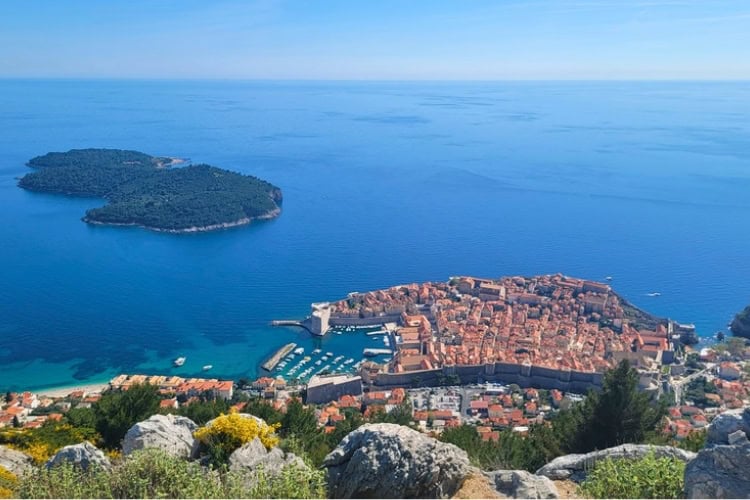
The next morning, we embarked early on a day of hiking high above the city. Our destination: Mount Srđ.
Rising above Dubrovnik, the mountain has long served as both lookout and line of defense. Today, a cable car carries visitors to the top in a matter of minutes, lifting them from the dense streets of the Old Town to a vantage point that feels almost removed from time. We opted to take the scenic route, hiking all the way up from our guest house in Old Town to the top of the mountain.
Our ascent of Mount Srđ followed a quieter, less direct route than the cable car, a hiking path that wound steadily upward in long switchbacks, revealing Dubrovnik in shifting fragments as we climbed.
On the way up, we passed through Bosanka, a small hillside village perched just below the summit plateau. It felt calm and rural, with stone houses, narrow lanes, and terraces edged with dry scrub, but there was also an undertone of history here, with signs and markers acknowledging how heavily the area had been affected during the siege of Dubrovnik from 1991 to 1995.
Traces of the Siege on the Mountain
From the village, the path continued into more open, rugged ground where the landscape began to carry visible traces of conflict: abandoned concrete positions and bunker-like structures left behind from the war, their rough openings still oriented toward the city and sea below. Through those narrow firing slits, the view was almost disorienting in its continuity—the same sweeping Adriatic panorama we had just seen from peaceful overlooks now reframed as a strategic line of sight.
Fort Imperial stands as a reminder of more recent history, housing a museum dedicated to the Croatian War of Independence. The exhibits are direct, unvarnished—photographs, artifacts, accounts of a time when the view below was not one of calm continuity, but of disruption and survival.
The View from the Top
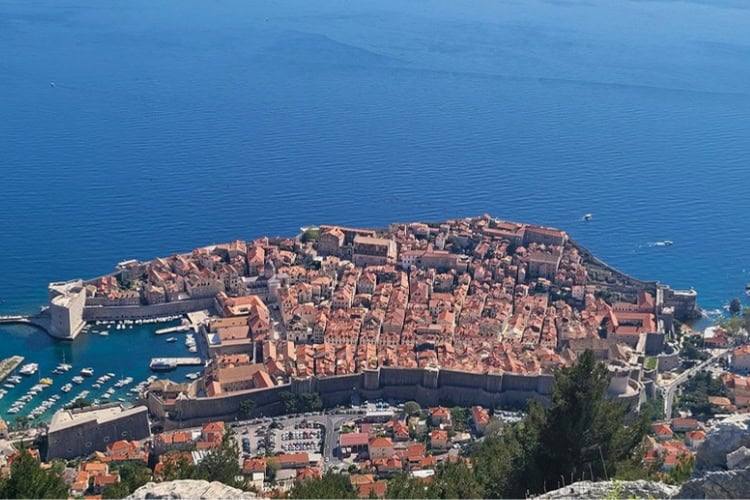
From the outlook atop the mountain, everything aligned. The walls form a perfect boundary around Dubrovnik. The Stradun becomes a pale line through the center. Lokrum sits just offshore, and beyond it, the Adriatic stretches outward in layers of blue that fade into the horizon.
“This is the view,” I said, though it hardly needed saying.
Nataliya stood quietly for a moment, taking it in. “It’s amazing.”
Going down, the geometry felt reversed and more immediate; the same bends that had invited lingering on the way up now carried momentum, the city rising back into view with each turn until the final switchbacks released us again at the edge of stone and street. It was an exhausting day, but that made the homecoming to the streets of Dubrovnik even more rewarding.
At Home in Dubrovnik
On our final day, we slowed down. As we often do, we wanted to spend less time exploring museums and historical sites and more time strolling the streets and enjoying the places we had passed daily and come to enjoy. The places we would soon come to miss.
We returned to the Stradun without direction, sat at a café, and watched the city move around us. We walked again through the residential lanes where daily life continued just beyond the visitor’s gaze. At one of the fountains, we refilled our water bottles, as we did every day, the flow unchanged from centuries past.
Nearby, a conversation drifted from another traveler—a teacher from England—speaking with her group.
“It’s been nice not paying attention to the news,” she said.
There was a pause. Then the woman said, “It’s a privilege, really. Some people don’t have that choice.” The comment lingered even after we parted.
Dubrovnik has known conflict. The marks remain if you know where to look, layered into buildings, museums, and memory. And yet the city continues, not by forgetting, but by absorbing—folding history into the present until the two become inseparable.
Later, we walked once more to the water’s edge, to the same stone where we had sat on our first evening. The light was softer now, the day beginning its slow turn toward night.
“We’ve seen just about everything,” Nataliya said, “but I’m not ready to go.”
It was true, in a way: the walls, the forts, the monasteries, the museums, the viewpoints, the planned and unplanned moments. Yet it didn’t feel finished.
“I think there’s enough left to see to warrant a return.”
Carrying the City with You
There is a certain kind of ending that travel rarely provides. It’s not closure, exactly, but something looser.
We reluctantly left, through the gates, past the walls, back into a modern-day reality that moves at a different pace. And yet, even back home, back in the daily grind, something of the intensified living stays with you.
For us, Dubrovnik did not conclude. It receded into memory. It became the sound of footsteps on stone, the reflection of light off a narrow street, the memory of standing above a city that has endured more than it reveals at first glance. Side streets and passages, stone walls and sea.
If You Go
Where to Stay
We stayed at B&B Andio, tucked inside the city walls in a centuries-old stone residence dating to the days of the republic, just off the Stradun. Its location is ideal: we stepped out each morning directly into the Old Town and returned each evening through the same stone passages once the crowds had thinned. It felt less like a hotel and more like temporary residency inside the city itself.
Getting Around
We relied on the Dubrovnik Pass for getting around the city’s major sights, especially the three day version. It includes access to the city walls along with a number of key museums, forts, and cultural sites, and it represented strong value for us given how much time we spent moving between the Rector’s Palace, Fort Lovrijenac, and several museums. If you plan to visit more than two sites, the pass is a better option than paying individually. Check current pricing and options for the Dubrovnik Pass.
Where to Eat
- Ruđer became our easy, unhurried breakfast and dinner spot, just steps from the city’s historic churches.
- For something more atmospheric, we’d point you to Lazareti, set within the old quarantine complex outside the eastern walls. It had reasonable prices on comfort food, with the mountains on one side and the sea on the other.
For a rewarding regional day trip from Dubrovnik, consider Mostar—see From Dubrovnik to Mostar: Bosnia and Herzegovina’s Living History, Cuisine and Waterfalls.
Need a hand planning your trip? Here are the sites and services we rely on most, from booking tools to travel products we love.
Inspire your next adventure with our articles below:
- Top 10 Things to Do in Dubrovnik, Croatia: Pearl of the Adriatic
- 15 Surprising Facts About Croatia That Will Make You Want to Visit
Want to discover more hidden gems and helpful travel tips? Join our free newsletter for the latest travel secrets and travel articles.
We are reader-supported and may earn a commission on purchases made through links in this article.

- Montenegro’s Bay of Kotor: Stone Towns, Venetian Walls and Mirror-Calm Water - October 11, 2026
- Rila Monastery: A Day Trip Into Bulgaria’s Spiritual Heart - September 23, 2026
- Castles, Carriages, and Cellars: Following the Liechtenstein Trail Through Moravia - August 14, 2026
Planning another trip soon? ✈️
Add GoWorldTravel.com as a preferred source on Google. Click the button below so our local guides, packing hacks, and hidden-gem itineraries always show up first when you search!
Add to Preferred Sources