
There is a distinct kind of electricity in the air when you’re planning a major international trip. Whether you are a Fanshawe College student mapping out a summer backpacking trek through the bustling markets and remote beaches of Southeast Asia, a professional from downtown London taking a well-deserved sabbatical to hike the Peruvian Andes, or a family booking an off-the-beaten-path eco-lodge in the dense rainforests of Costa Rica, the pre-trip checklist is always exhilarating.
You’ve renewed your passport, bought the universal outlet adapters, double-checked your flight times, and notified your credit card companies of your upcoming geographic shifts. Your itinerary is a beautiful masterpiece of carefully curated experiences, local food tours, and breathtaking vistas.
But amidst the frantic excitement of packing cubes, luggage weight limits, and travel insurance policies, a critical, potentially life-altering question often gets completely left behind: If something goes sideways halfway across the world, do you actually have the physical skills to handle it?
When we travel, we willingly and enthusiastically step out of our comfort zones. We embrace unfamiliar food, unpredictable transit systems, changing altitudes, and rugged terrains. Yet, many travelers fail to realize that they are also stepping entirely away from the reliable, fast-acting emergency healthcare systems they take for granted at home in Southwestern Ontario. That is exactly why a growing number of savvy, forward-thinking globetrotters in London, Ontario are prioritizing lifesaving emergency training before they ever hail a ride to the airport.
The Global Reality: Emergency Care Is Not Equal Worldwide
In London, if someone suddenly passes out at a local café or sustains a deep cut while working in the backyard, the response from bystanders is almost mechanical: dial 911, and a team of highly trained paramedics will arrive with a fully equipped emergency vehicle in a matter of minutes. Our urban centers are built on a foundation of rapid-response infrastructure.
However, the moment you cross international borders, that invisible safety net can look radically different, or vanish altogether. In many developing nations, remote island paradises, or high-altitude adventure destinations, emergency infrastructure is severely underfunded, understaffed, geographically isolated, or practically non-existent.
————————————————————————
The International Travel Gap
————————————————————————
Home: 911 Call ➔ Standardized Care ➔ Rapid Local Hospital EMS
Abroad: Language Barrier ➔ Unknown Emergency Number ➔ Hours of Delay
————————————————————————
Your Skills Bridging the Gap = The Ultimate Lifeline
————————————————————————
Consider these very real, common travel scenarios that glossy tourism brochures rarely mention:
- The Severe Language Barrier: If you find yourself in a medical crisis in a rural town in Eastern Europe or Central America, can you clearly communicate the nuances of a complex medical emergency to a foreign emergency dispatcher who doesn’t speak a word of fluent English?
- The Logistics and Terrain Challenge: If you are scuba diving in a remote region of Indonesia or trekking through a cloud forest in Ecuador, how long will it physically take for a medical vehicle to navigate the terrain to reach your exact coordinates?
- The Infrastructure Deficit: Does the region you are visiting even have a centralized ambulance dispatch system, or are local citizens completely reliant on private transport, scooters, or community volunteers to reach medical aid?
The Concept of the “Golden Hour” Abroad
In emergency medicine, the “Golden Hour” is the critical window of time immediately following a traumatic injury or medical event during which rapid intervention can mean the difference between full recovery, permanent disability, or death. When you are traveling in remote areas, professional medical help might be hours or even days away.
This means that during that vital first hour, you are no longer just a tourist or a backpacker. You are the primary first responder on the scene. Having basic medical knowledge allows you to act as the essential bridge between the moment an injury occurs and the moment professional medical help finally arrives.
Why Londoners Are Getting Certified Before Taking Off
London, Ontario is a major provincial hub for international minds and adventurous spirits. With a massive student population, booming technology sectors, and an active community of retirees who spend their winters exploring the globe, the city sends thousands of eager travelers across international borders every single year.
Traveler’s Insight: The best travel gear isn’t something you pack inside a premium hardshell suitcase. It’s the muscle memory and mental confidence to step into a chaotic situation and systematically save a life. It weighs absolutely nothing, requires no customs declaration, and works flawlessly in every country on Earth regardless of the local currency.
By empowering themselves with certified skills before departure, Londoners are transforming how they travel. They aren’t just protecting themselves; they are ensuring they can protect their friends, family members, and the local communities they visit.
5 Critical Travel Skills You’ll Learn in a Certification Course
A modern, comprehensive first aid and CPR course gives you far more than a simple piece of paper to show an employer—it delivers practical, high-stakes skills that directly translate to the unique challenges of global travel.
1. Advanced Choking and Airway Management
Trying local street food is undeniably one of the greatest joys of international travel, but it introduces distinct risks. From unfamiliar bone structures in authentic fish dishes to exotic fruits with large, slippery seeds, choking is a surprisingly common travel emergency that requires immediate action. Knowing how to confidently and immediately perform back blows and abdominal thrusts on an adult, child, or infant can completely resolve a lethal situation in under sixty seconds, long before emergency services could ever be dispatched.
2. Severe Wound Care and Hemorrhage Control
Motorbike mishaps on loose gravel roads in Thailand, slips on wet, historic cobblestones in Rome, or accidental cuts from sharp coral reefs while snorkeling in the Caribbean—trauma can happen anywhere. When a major blood vessel is compromised, a person can bleed out rapidly. You will learn the exact mechanics of applying direct, targeted pressure, creating improvised pressure dressings, and managing severe external bleeding so a minor accident doesn’t turn into a tragic end to your journey.
3. Recognizing and Treating Environmental Hazards
Travel often exposes your body to extreme, volatile climates it isn’t accustomed to handling on a daily basis in Southwestern Ontario. A proper first aid curriculum trains you to spot the subtle, early warning signs of heat exhaustion before it degrades into deadly heatstroke. Conversely, if you are backpacking through chilly high-altitude regions or alpine passes, you’ll learn how to properly insulate and rewarm a companion showing the early signs of hypothermia.
4. Shock Management and Patient Stabilization
When a severe injury, illness, or major psychological trauma occurs, the body’s circulatory system can begin to fail, leading to clinical shock. If left completely untreated, shock can become fatal even if the primary injury itself isn’t inherently lethal. You’ll learn how to properly position a patient, maintain their core body temperature, systematically monitor their vital signs, and keep them calm and stable over extended periods while evacuation logistics are sorted out by local authorities.
5. Managing Medical Emergencies (Heart Attacks and Strokes)
Cardiovascular crises do not care about your vacation itinerary. The physiological stress of traveling—including severe sleep deprivation, dehydration, altitude adjustments, long-haul flights, and intense physical exertion—can trigger underlying health conditions. You will learn to rapidly identify the warning signs of a heart attack or stroke, understand the critical importance of early aspirin administration, and know exactly how to manage a patient who loses consciousness.
Blended Learning: Get Certified Without Ruining Your Packing Schedule
Let’s be entirely realistic: when you are actively counting down the days to an international flight, the last thing you want to do is spend an entire, consecutive weekend sitting inside a traditional, stuffy classroom looking at endless PowerPoint slideshows. You have apartments to clean, houses to sit, clothes to launder, documents to print, and foreign currency to exchange. Your time is incredibly valuable.
Fortunately, the modern blended training model eliminates that barrier entirely, making safety training accessible for even the most chaotic schedules. Local Londoners can complete the vast majority of their training through an interactive online portal.
————————————————————————
The Blended Learning Pathway
————————————————————————
Step 1: Online Theory (4-8 hours) ➔ Learn at your own pace at home
Step 2: In-Person Practical (Condensed) ➔ Perfect skills on mannikins
Result: Official Canadian Red Cross Certification ➔ Valid for 3 Years
————————————————————————
How the Blended Format Works in Practice
- The Online Self-Paced Theory: You complete the comprehensive digital modules whenever it suits your personal schedule. Review cardiovascular emergencies on your tablet while relaxing at a local coffee shop on Richmond Row, or study diabetic emergencies late at night from the comfort of your room. The system saves your progress automatically, allowing you to learn in bite-sized chunks.
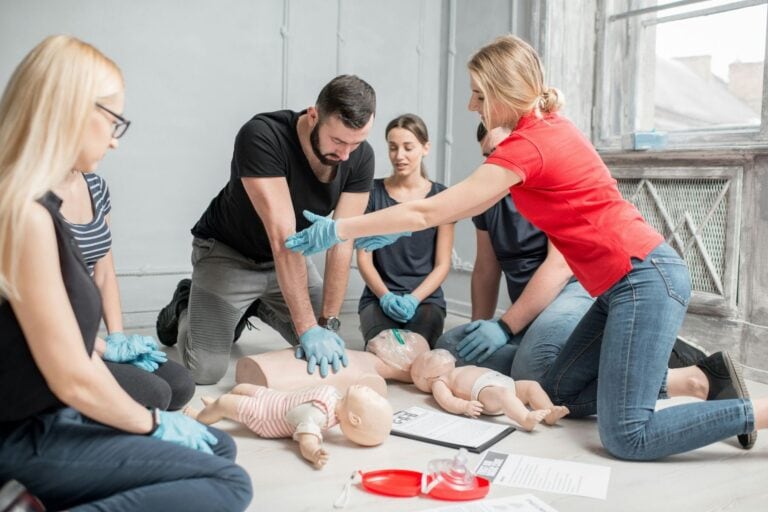
- The Fast In-Person Skills Class: Once the theory portion is fully completed, you book a condensed, hands-on session at a professional London training facility. Under the direct supervision of a certified instructor, you’ll practice chest compressions on state-of-the-art mannikins, learn how to handle an AED, and practice real-world bandaging techniques.
You get the exact same elite, fully accredited certification as a traditional multi-day course, but you only spend a fraction of the time in a physical classroom. It’s efficient, modern, and perfectly suited for a busy traveler’s pre-departure schedule.
The Psychological Edge: Overcoming Panic in an Unfamiliar Land
One of the less talked-about benefits of completing a first aid course is the profound psychological transformation it provides. When an accident occurs in a foreign country, panic is the default human response. Panic paralyzes bystanders, causes critical delays, and escalates the stress levels of the injured person.
First aid training strips away that panic by replacing fear of the unknown with a structured, step-by-step action plan. You learn to assess the scene for hazards, determine the priority of care, and execute lifesaving interventions with calm, methodical precision. This mental clarity is an invaluable asset when you are navigating an unfamiliar environment where everything else feels chaotic.
The Ultimate Travel Companion
When you travel with a companion—whether it’s a lifelong friend, a spouse, a sibling, or a classmate from Fanshawe—you are entering into an unwritten social contract. You are implicitly agreeing to look out for each other’s well-being in exchange for shared adventures. If you are both thoroughly trained in first aid, you create an ironclad mutual pact of safety. You look after them, and they look after you.
Even if you are a solo traveler charting your own path across the globe, having a first aid certification fundamentally transforms how you interact with the world around you. You stop being a vulnerable, dependent tourist hoping that nothing goes wrong, and you become an empowered, capable global citizen ready to actively assist others in need.
Before you zip your bags shut, snap your suitcases locked, and catch that shuttle ride out of London to the international airport, make sure you’ve packed the ultimate peace of mind. Get certified, stay prepared, and explore every corner of the world with genuine confidence.
Frequently Asked Questions
1. Will a Canadian Red Cross First Aid certification be recognized if I have an emergency outside of Canada?
While the physical paper certificate is officially issued under Canadian standards, the lifesaving protocols you learn (such as CPR compressions-to-breaths ratios, choking maneuvers, and severe bleeding control) are completely aligned with international medical guidelines established by ILCOR (the International Liaison Committee on Resuscitation). The human body reacts to trauma, severe blood loss, and cardiac arrest exactly the same way in Paris, Tokyo, or Lima as it does in London, Ontario, meaning your hands-on physical skills are universally applicable across the entire globe.
2. Can I take a first aid course if I am a student at Fanshawe College with a hectic exam schedule?
Yes, absolutely! The blended learning option is specifically designed for busy students, co-op participants, and professionals who cannot afford to lose an entire weekend. Because you can complete all the reading, instructional videos, and short quizzes online at your own pace during study breaks, weekends, or late evenings, you only need to commit to a brief, single-day in-person practical session in London to finalize your official certification.
3. Should I still pack a basic medical kit if I already know first aid?
Without a doubt. First aid training gives you the necessary knowledge, but a well-stocked travel medical kit gives you the physical tools to execute that knowledge. Your training will teach you exactly how to maximize the contents of a compact travel kit—such as utilizing sterile gauze, medical tape, shears, antiseptic wipes, and splints safely and effectively under immense pressure, rather than just carrying them around as heavy, mysterious dead weight.
4. Is it necessary to learn how to use an AED if I am traveling to a remote, developing region?
Yes, for two major reasons. First, your travel journey doesn’t actually start at your remote destination; it includes transit hubs like busy international airports, train stations, cruise ships, and large hotel resorts, almost all of which are heavily equipped with accessible AEDs. Second, modern AEDs are globally standardized and designed with universal, multilingual audio prompts, meaning that knowing the basic mechanical steps of applying the pads will allow you to confidently operate an automated defibrillator anywhere in the world.
Want to discover more hidden gems and helpful travel tips? Join our free newsletter for the latest travel secrets and travel articles.

- 10 Essential Tips for Surviving Major Flight Disruptions - October 22, 2026
- Helicopter-Access Hiking at Durrand Glacier Chalet in British Columbia’s Selkirk Mountains - October 22, 2026
- An Artist’s Safari: Seeing the Soul of the Wild in Black and White - October 22, 2026
Planning another trip soon? ✈️
Add GoWorldTravel.com as a preferred source on Google. Click the button below so our local guides, packing hacks, and hidden-gem itineraries always show up first when you search!
Add to Preferred Sources