
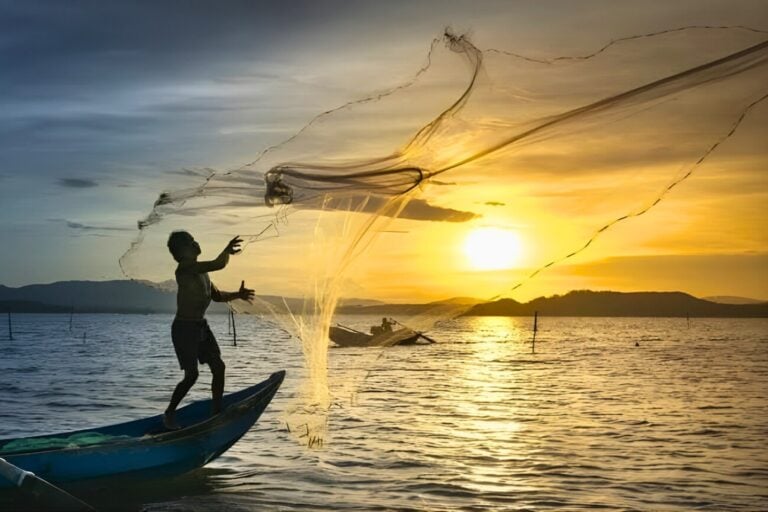

The sky was still half-asleep when I followed the sound of wooden paddles slicing through water. The beach at Benaulim, quiet now, stripped of its daytime glamour, smelled of salt, wet nets and something ancient.
A man in a faded blue shirt waved at me to help pull in a boat. By the time I gripped the rope, the Arabian Sea had already baptized my ankles.
It wasn’t the Goa from postcards or playlists. There was no trance music, no shacks selling smoothies. Just the rhythm of the waves and the laughter of fishermen who had already been working for hours before sunrise.
The Sea’s Clock

“Six o’clock is too late,” said Manuel, the eldest of the group, his palms rough and dark as driftwood. “The fish don’t wait for tourists.”
He grinned, revealing a row of gold-capped teeth that flashed in the dawn light. Around him, younger men sorted through the morning catch of silver mackerels, a few prawns and something tiny that wriggled with stubborn life.
Their movements were synchronized, practiced through generations, like a dance taught by the tide itself.
I asked when they slept. “After lunch,” Manuel said, shrugging. “The sea decides when we rest.”
He poured me tea from a steel flask; it was sweet, thick, and fragrant with cardamom. The cup was chipped, but the warmth was generous. That tea, sipped barefoot beside their boats, tasted like belonging.
A Shoreline Without Tourists

As daylight spread across the sand, I noticed how this part of Goa, the real Goa, lived quietly behind the postcards.
A few kilometers away, Baga and Calangute were waking up to brunch buffets and Instagram reels. But here in South Goa, life unfolded more slowly, almost sacred.
The fishermen worked in small cooperatives. They didn’t compete; they shared nets, boats and even gossip. One man whistled to another across the surf, and laughter rolled like a wave.
There were no beach chairs, no resort walls, only sea, sky, and human rhythm.
A young boy, maybe ten, ran barefoot with a basket of shrimp, his shorts dripping with saltwater. “For my mother,” he said when I asked where he was going. “She sells breakfast.”
Breakfast by the Sea

That “breakfast” became my second invitation of the morning.
Behind a cluster of palm trees, a few women had set up makeshift stalls, old wooden planks balanced on buckets, covered with banana leaves. Smoke from coal stoves curled into the air, carrying the smell of frying fish, garlic and lime.
I sat beside Maria, a fisherman’s wife, who served me a steaming plate of xeerelachi bhaji (spicy fish curry) with bread so soft it melted in the mouth.
She laughed when I reached for a tissue. “Use your hand,” she said, tearing bread with practiced ease. “That’s how you taste the sea.”
The curry was fiery, bright with kokum and tamarind, yet balanced with coconut milk. Every bite told a story of survival, simple, humble and proud.
Maria’s daughter joined us, braiding her hair while watching the boats return for a second catch. “My brother will go to Dubai,” she said, “but Papa says the sea never leaves us.” Her words lingered, like the smell of charcoal on my shirt.
Between Tides and Faith
Later that morning, Manuel invited me to visit their small chapel near the dunes. Inside, candles flickered beside a statue of St. Peter, the patron saint of fishermen. There were no tourists here, only faith carved into walls and whispers.
He knelt, murmuring a prayer in Konkani. I stayed quiet, absorbing the rhythm of devotion. Outside, women spread nets under the sun, mending them with fingers that knew more patience than any clock.
I asked Manuel what he prayed for. “For wind,” he said, “and forgiveness, for the fish we take.” That sentence alone was worth the whole morning.
A World Hidden in Plain Sight

By noon, the beach had changed. The tide pulled back, leaving behind shells, sandals, and the marks of labor, ropes, nets and the imprint of bare feet. The fishermen were gone, resting in the shade, their boats tilted like sleeping beasts.
I walked along the shoreline, thinking about the contrasts of this place. Tourists come for sunsets, but the real life of Goa happens in the gray hours before dawn.
The true heartbeat isn’t in the clubs or cafés, it’s in the soft hum of a man untangling his nets, or a woman balancing a basket on her hip.
For the first time, I saw Goa not as a destination, but as a living story; humble, cyclical, resilient.
The Lesson of the Sea
That evening, as I watched the horizon blur into gold, I realized something: the fishermen’s life is a mirror of travel itself. You set out each morning with faith, not knowing what you’ll catch. Sometimes the nets come up heavy, sometimes empty, but you return anyway.
Manuel’s words echoed: “The sea decides when we rest.”
Travel, like the sea, isn’t about control. It’s about surrender, to moments, to people, to stories you never planned to find.
When I left that small village, Maria handed me a small dried fish wrapped in paper. “For luck,” she said. I still keep it, not for the luck, but as a reminder of the morning I shared breakfast with the sea.
If You Go
- Where: Benaulim Beach, South Goa, India — about 40 minutes from Goa International Airport (Dabolim).
- Best time to visit: November to March, when the seas are calmer and local fishing is in full rhythm.
- What to do: Skip the tourist strips. Visit early morning near the fishing cooperatives, chat with locals, and share a simple Goan breakfast by the shore.
- Respect: Always ask before photographing fishermen or their families. Support their stalls directly — your breakfast helps keep an old rhythm alive.
Travel insurance is essential for any trip, offering peace of mind and protection. Explore options with SafetyWing or SquareMouth to find the coverage you need.
Need a hand planning your trip? Here are the sites and services we rely on most, from booking tools to travel products we love.
Inspire your next adventure with our articles below:
- Visit India’s Latest Inclusion to the UNESCO World Heritage List: The Maratha Forts Around Mumbai and Pune
- Exploring the Backwater Wonderlands of Kerala, India
Author Bio: Ranjan Kumar is a travel writer and storyteller who believes the best journeys happen before sunrise and beyond comfort zones. Over the past decade, [he/she/they] has explored the hidden corners of India and Southeast Asia, writing about culture, food, and the people who bring places to life.
Want to discover more hidden gems and helpful travel tips? Join our free newsletter for the latest travel secrets and travel articles.
We are reader-supported and may earn a commission on purchases made through links in this article.

- Fall Day Trips from Vancouver: 7 Scenic Walks Worth the Drive - September 15, 2026
- Laos for Backpackers: Vientiane, Vang Vieng and Luang Prabang on a Slow-Travel Route - September 15, 2026
- Why “Just Immerse Yourself” Won’t Teach You Spanish, No Matter How Long You Stay - September 15, 2026
Planning another trip soon? ✈️
Add GoWorldTravel.com as a preferred source on Google. Click the button below so our local guides, packing hacks, and hidden-gem itineraries always show up first when you search!
Add to Preferred Sources
it is amazing article after read some 15 lines i am going to imagine that moment that tell you by the help of this article such a genious author salute from india. we want more articles such like from you ranjan kumar . you are magician i dont believe that it is part of my memory thank you so much