


We were witnessing the magic of the monsoons atop the famous Raigad Fort, about 150 km from Mumbai into the ridges of the Western Ghats.
As indigo clouds wafted by, the landscape atop the fort seemed almost ethereal. After two hours of ascent, navigating rapids tumbling down the staircases of the fort and being mesmerized by steep waterfalls plunging from the centuries-old ramparts and parapets, we had reached the top of the fort.
Here, the world couldn’t get wetter, as the clouds almost seemed to pass you by, while a soft precipitation lingered on. Yet, the world couldn’t get any more refreshing. As we approached the edge of a steep wall of the fortress, the sight stole my breath.
While the rains had created a heavy waterfall, the air circulating through the hills and fortress walls had created a uniquely strong convection current that was lifting the waters upwards, almost as a reverse waterfall.
‘What do we call that now?’ my friend, amused and astonished like myself, had never seen anything as magical as this huge spray of water rising upwards and drenching us even further.
‘A water-rise? A water-leap? A water-swing?’ We were lost for words. Literally.
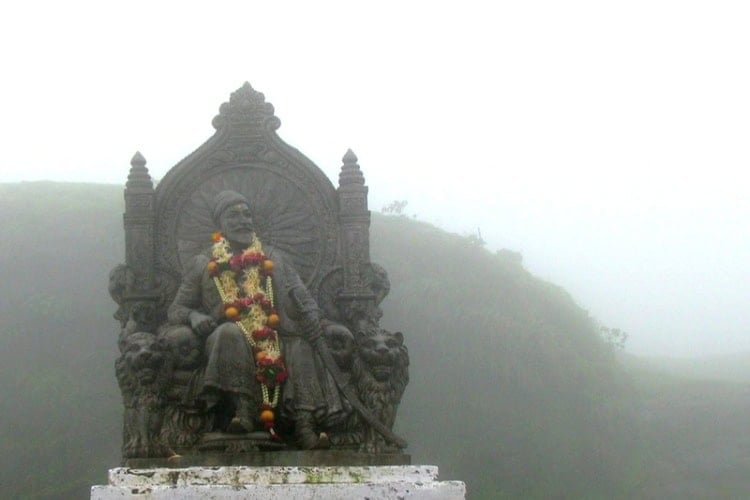
A large black statue of the greatest Maratha King, Shivaji, stared at the horizon as if silently proclaiming that this magic was commonplace in the Western Ghats, woven intricately with the hills, as if the military landscapes here are not just historical sites but living, breathing stories waiting to be experienced.
India’s Latest Inclusion to the UNESCO World Heritage List – Where Are the Maratha Forts and Why Do They Matter?
Spread across the lush Sahyadri mountain ranges of Maharashtra and the Deccan Plateau lies a network of forts that were once the backbone of the mighty Maratha Empire, one of the last formidable kingdoms of India that lasted until the 19th century.
These forts served as military strongholds, royal residences, and strategic outposts during an era when the Marathas mastered guerrilla warfare against powerful empires and amassed one of the last, large empires in the subcontinent, sprawling all the way north towards Delhi and east towards Bengal.
In 2025, UNESCO officially recognized 12 of these forts as a World Heritage Site under the title “Maratha Military Landscapes of India,” a testament to their cultural and historical significance.
Many of these are easily accessible within a couple of hours’ drive from Mumbai or Pune, and can be scaled as an exciting day trip or a weekend getaway.
While spring and summer months desiccate the landscape of these arid hills, the monsoon months (June – September) usher in a magical, almost unbelievable transformation to these hills, swathing them in iridescent shades of green, making these the most beautiful months to scale the forts and fortresses.
Ephemeral waterfalls gush out as paroxysms of the monsoon’s momentum, while grey-blue clouds keep wafting in wave after wave like brush strokes on a painter’s palette.
If you trek even once, the allure of the Sahyadris will keep pulling you for more – the good thing is there is a mighty long list of forts that offers a checklist of sorts, thereby providing unending motivation to keep returning to the hypnosis of these hills.
The UNESCO Forts: Sentinels of the Deccan

The 12 forts inscribed in the World Heritage List include Raigad, Rajgad, Torna, Shivneri, Lohagad, Salher, Khanderi, Suvarnadurg, Panhala, Vijaydurg, Gingee, and the famous Sindhudurg.
These forts reveal the strategic genius of the Marathas, blending seamlessly into their surroundings, whether perched high on rugged hills or standing defiantly against the sea.
Each of these forts had an important role to play in the life of Shivaji, or in the checkered history of the Maratha Empire itself that ruled these lands for nearly two centuries.
It is worth noting, though, that many of these forts are over 2000 years old, constructed by earlier empires such as the Satavahans, Chalukyas, Rashtrakutas, and Bahamanis before being captured by the Marathas, who in turn heavily upgraded many of them.
Nonetheless, the legends associated with these forts resonate most strongly with the Marathas, who created a unified stronghold of the Deccan propped by these forts of utter formidability.
A little more about these forts is required to appreciate their origin, history, and contribution to the tome of Maratha history. (Note that the terms ‘Gad’ or ‘Durg’ imply fort in the local language)
Lohagad Fort

Lohagad Fort (~90 km from Mumbai) is one of the closest forts to visit from Mumbai and is located near Lonavala, a much sought-after hill station. The name “Lohagarh” means “Iron Fort,” reflecting its formidable strength and robust construction.
The fort is especially popular for its iconic “Vicchu Kata” (Scorpion’s Tail) structure and is a favored destination for trekkers and history enthusiasts alike. Fort aside, this is a very ancient country, and if you travel here or to Lonavala, do drop by at the 2000-year-old Buddhist rock-cut caves of Bhaja and Karla.
Shivneri Fort
Shivneri Fort (~200 km from Mumbai) ranks highly in historical importance as it was the birthplace of Shivaji. The fort itself changed hands from the earlier Bahmani Sultanate to the Ahmednagar Sultanate before being handed over to Shivaji’s grandfather, long before the Maratha empire was consolidated.
Built strategically to guard ancient trade routes, the fort is surrounded by steep cliffs and fortified walls, making it nearly impregnable. It features strong gates, water tanks, and a temple dedicated to the goddess Shivai Devi, after whom perhaps Shivaji was named.
Khanderi Fort
Khanderi Fort is one of the closest forts to Mumbai, less than 100 km south off the coast of Alibaug, a popular seaside tourist destination for Mumbaikars.
Built on the island of Khanderi, the historic sea fort was built in the 17th century to strengthen the naval defense of the Maratha empire, particularly in response to the gathering strength of the tiny enemy kingdom of the Siddis on the island of Janjira (besides the Portuguese colony further south in modern-day Goa).
With roots in Africa, the Siddi warlords were superb maritime navy fighters. Khanderi, along with its twin fort, Underi, played a key role in controlling the maritime activities of the Siddis along the Konkan coast.
The fort features a lighthouse, cannons, and old structures that reflect its strategic importance and architectural strength.
Raigad Fort

Raigad Fort (~160 km from Mumbai) is one of the most significant forts in Maratha history, serving as the capital of Shivaji’s empire. Strategically located and nearly inaccessible from three sides, the fort symbolizes Maratha pride, resilience, and sovereignty.
It was here that Shivaji was crowned as the first Chhatrapati or king of the Marathas in 1674. The fort complex includes the royal palace, the queen’s quarters, watchtowers, and the revered Samadhi (memorial) of Shivaji Maharaj.
Rich in history and offering stunning views, Raigad Fort remains a powerful symbol of Maharashtra’s cultural legacy. If you have to visit just one fort, this should be your choice.
A cable car has been added to ease the trek to the top – if visiting during the rains, it is a magical experience to see your cable car get enveloped in thick clouds as you summit to the top.
Rajgad Fort
Rajgad Fort (~200 km from Mumbai) – Before the move to Raigad, Rajgad served as the capital of the Marathas for over 25 years. Built on the Murumbadevi hill, the fort is known for its impressive architecture, massive gates, and strong defensive structures.
Rajgad is where Shivaji spent most of his life and holds immense historical significance as the site of many key events, such as his son’s birth and his wife’s demise. The trek to the top is refreshingly beautiful, and on a clear day, one can see the hilltops and forts of Torna and Sinhagad.
The region abounds in spectacular dams such as Panshet and Bhatghar, which are very scenic detours.
Pratapgad Fort
Pratapgad Fort (~200 km from Mumbai) is renowned as the site of the legendary battle between Shivaji and Afzal Khan, general to the Bijapur Sultanate in 1659.
Treachery abounded in one of the meetings between the two, and while Afzal Khan tried to stab Shivaji, the latter killed him instead with his legendary tiger claws, resulting in the first major victory of the Marathas.
The fort is located close to Mahabaleshwar, one of Maharashtra’s most famous hill stations, and is worth a short stay by itself.
Suvarnadurg Fort
Suvarnadurg Fort (~230 km from Mumbai) is a coastal island fort built to secure the western coastline and support naval shipbuilding.
Located near Harnai, it was part of the chain of coastal forts (along with Khanderi, Underi, Kolaba, Vijaydurg, and Sindhudrug) that the Marathas had built to counter other maritime powers such as the Siddis, the Portuguese, and, in later days, the British.
Salher Fort
Salher Fort in Nashik district (~300 km from Mumbai) is one of the highest forts in Maharashtra, perched at around 1,567 meters above sea level at what is the second-highest peak in the state.
It was the site of the significant Battle of Salher in 1672, where the Marathas secured a formidable victory over their arch-nemesis, the Mughals.
Panhala Fort

Panhala Fort (~400 km south-east of Mumbai) is situated close to Kolhapur and has a lot of extant architecture still intact. It was originally built in the 12th century by Raja Bhoje II of the Shilahara dynasty, moving on to the Bahmanis and then the Bijapur kingdom.
Its strategic location connecting to the Deccan south, and long fortifications made it a sought-after military outpost and exchanged hands regularly between the Marathas, the Bijapur sultanate, and the Mughals.
One of the fort’s most intriguing features is Andhar Bavadi, a three-tiered subterranean well that once served as a hidden source of water during enemy blockades. Its clever engineering ensured a continuous supply of fresh water, even during prolonged sieges.
Equally notable is Sajja Kothi, a strategically placed watchtower that offers sweeping views of the valley below. It is said that Shivaji Maharaj often retreated here for quiet reflection, further enhancing its historical significance.
The Teen Darwaza, or “Three-Gate Entrance,” forms the majestic gateway to the fort. With its detailed carvings and robust architecture, it stood as a powerful defensive structure against invading forces.
Another remarkable element is the Ambarkhana, a vast granary that once held essential food reserves, enabling the fort’s inhabitants to endure long periods of isolation without facing starvation.
Vijaydurg Fort
Vijaydurg Fort (~400 km south of Mumbai), often called the “Eastern Gibraltar,” was also built by Raja Bhoja II and later strengthened by Shivaji. After Shivaji’s death in 1680, Kanhoji Agre became admiral of the naval forces of the Marathas.
He made Vijaydurg the capital of his territory along the coast. Under his leadership in the early 18th century, Vijaydurg became the main base of the Maratha navy, from where he controlled the Arabian Sea and fiercely resisted the European naval powers of the British, Portuguese, and Dutch.
Sindhudurg Fort
Sindhudurg Fort (~450 km south of Mumbai) is perhaps the most legendary of forts built by Shivaji himself. It was built in 1664 on an islet off Malvan; the fort is known for its massive walls, hidden entrances, freshwater wells, and a temple dedicated to Shivaji himself—the only one of its kind.
Sindhudurg lies on the southern tip of Maharashtra, very close to bohemian Goa, once a Portuguese colony, and a maritime superpower predating the British. It was to counter their presence that the walls of Sindhudurg and Vijaydurg were raised.
Nearby Tarkarli is a refreshingly beautiful destination, with beautiful beaches rivaling those of Goa.
Gingee Fort
Gingee Fort in Tamil Nadu, far from Maharashtra, was captured by Shivaji in 1677 during his southern campaign. Spread over three hillocks, it is known as the “Troy of the East” for its strong fortifications.
Originally built by the Chola dynasty and later expanded by various rulers, including the Vijayanagara kings and the Marathas, the fort gained prominence when Chhatrapati Shivaji Maharaj’s son, Rajaram, made it the Maratha capital during his resistance against the Mughal Empire.
Though not close to Mumbai, its inclusion on the UNESCO list reflects the southern reach of Maratha influence.
How to Reach the Maratha Military Landscapes?

Most of these forts are accessible from Mumbai and Pune, two major cities well connected by road and rail. From Mumbai, a 2- to 4-hour drive on scenic highways through the Western Ghats will bring you to many of these forts and caves.
Public transport is available but limited, so renting a car or booking a guided tour is often the easiest way to explore multiple sites. The monsoon season (June to September) is the most magical time to visit, but requires caution due to slippery trails.
For Sindhudurg, you can reach the coastal town of Malvan by road or train and then take a short boat ride to the fort island. This offers a unique adventure combining land, sea, and history.
What Else Awaits You?

Beyond forts and caves, the Sahyadri ranges are dotted with serene waterfalls, spice plantations, and quaint villages where Maratha heritage lives on in stories and festivals.
The monsoon season transforms the entire region into a lush, misty paradise—perfect for trekking, photography, and soaking in centuries of history.
Keep an eye out for staggering waterfalls in the monsoons, for ancient Buddhist caves from a time when nearby ports would trade with Rome and Egypt.
Besides the 12 forts above, there are over 300 Maratha forts dotting the undulating hills of the Deccan. Torna, Tikona, Sinhagad, Shivgad, Devgad, and Padmadurg are a handful of these forts that are equally popular with hikers and historians alike.
Beyond Maratha forts, there are also forts that belonged to the Siddis (Murud-Janjira) and the Portuguese (Bassein, Bandra, or Castella de Aguada, Korlai, among others) that are worth visiting to enhance your knowledge of the history of this place.
Final Thoughts
Visiting the Maratha military landscapes is more than a trip; it’s a journey into India’s spirit of resistance and resilience. Besides Rajasthan, you will be unable to find such an intricate network of forts and military landmarks anywhere else in the subcontinent.
Whether you’re tracing Shivaji’s footsteps, exploring towering hill forts, or sailing out to Sindhudurg, these sites offer a unique blend of adventure, history, and nature. They remind us that the past isn’t just something to read about—it’s something to explore, experience, and embrace.
Need a hand planning your trip? Here are the sites and services we rely on most, from booking tools to travel products we love.
Inspire your next adventure with our articles below:
Author Bio: Ayan loves travelling, writing, and photography; he has travelled to over 30 countries and has published multiple books on travel and poetry.
Want to discover more hidden gems and helpful travel tips? Join our free newsletter for the latest travel secrets and travel articles.
We are reader-supported and may earn a commission on purchases made through links in this article.

- Language Learning Travel Guide - September 12, 2026
- Safari Travel Guide - September 12, 2026
- Luxembourg City in 24 Hours: Essential Sights, Views and Cafés - September 12, 2026
Planning another trip soon? ✈️
Add GoWorldTravel.com as a preferred source on Google. Click the button below so our local guides, packing hacks, and hidden-gem itineraries always show up first when you search!
Add to Preferred Sources