
The Minoans, at least the people that we know as Minoans, lived on the island of Crete during the Bronze Age and may very well have been Europe’s first advanced civilization.
The Palace of Knossos, found near Heraklion, stands as one of Crete’s and, therefore, Greece’s most significant archaeological sites. Construction began around 1900 BC; it served as the ceremonial and political center for the Minoan civilization.
They were remarkably advanced in terms of plumbing and hygiene. The Palace of Knossos, for instance, had an extensive sewer system, utilizing terracotta pipes for fresh water and drainage canals for sanitation. Over a millennium before the aqueducts of Rome were built, one of the earliest known flushing toilets operated at the palace.
A Modern Lesson in Ancient Plumbing
Our guide elaborated on this point to us as we stood staring into one of the many sanitary canals of the palace. I could not help but give my wife a sideways glance punctuated with a smirk.
I mention this since we had experienced a somewhat quaint custom of modern Crete earlier that morning, in which we discovered that you do not put the toilet paper in the toilet after its customary use and flush it.
This is because Crete’s sewerage pipes are half the width of pipes utilized elsewhere, and if you flush the paper, things tend to block up, forcing what you thought you had disposed of to make an unwelcome return.
Instead, toilets have a bin next to the bowl. The paper goes in there and is disposed of with the other trash at the end of the day.
A lesson learned in a day full of newfound knowledge.
Souda Bay Port
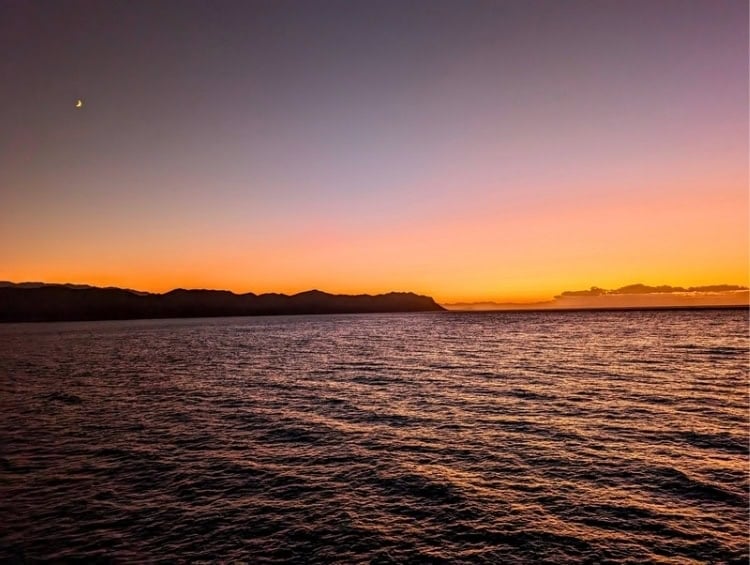
Our day had begun with us watching our cruise ship, the Viking Star, undergo the elaborate dance of docking in the Port of Souda Bay on the northwest coast of the Greek island of Crete. Before the waves had disappeared, we were disembarking in order to board our bus for the 2½-hour drive to our destination, the Palace of Knossos, which is a UNESCO World Heritage site.
The Coast Road
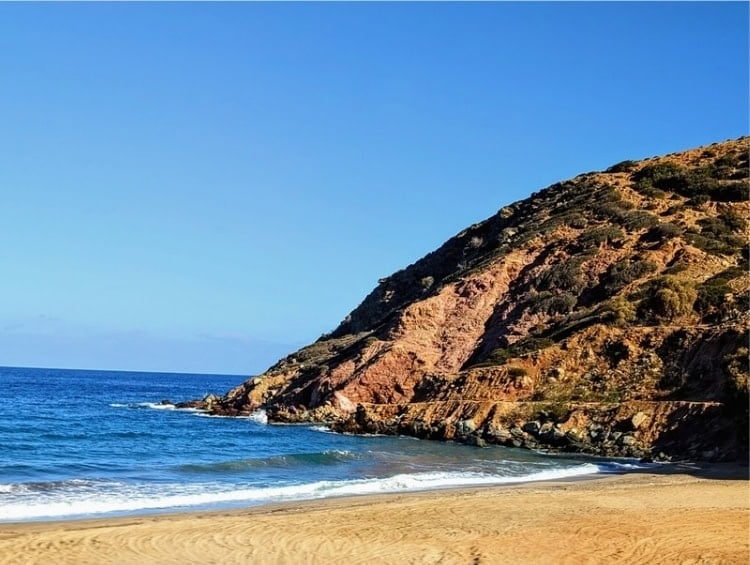
Our route took us along the coast, offering views of the sea and beaches arrayed against a backdrop of mountains terraced with olive groves.
It was along the coast road that we learned our first lesson in Cretan bathroom culture when our bus stopped at a large travel stop.
We were directed to a solid structure behind the store that housed the restrooms. It was here that we found several of our bus mates congregating with perplexed looks.
It soon became apparent that the restrooms were coed. On one side of the interior were three enclosed stalls, the same on the other. In the middle on the far wall was a bank of sinks.
After a few moments of indecision, and with silent agreement, the men sauntered to one side, the women to the other. It was here that we learned our second lesson, that of the local toilet paper etiquette.
Crete’s Largest Palace
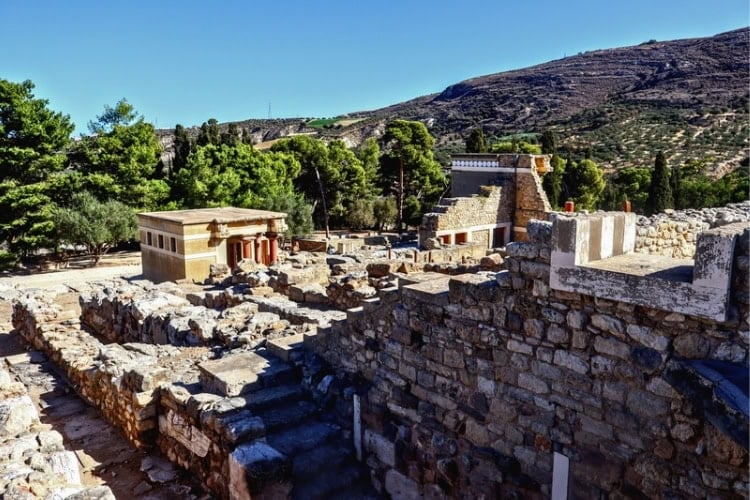
We eventually arrived at the palace, which is located just outside the modern city of Heraklion, the governmental seat of Crete, by mid-morning. The Palace of Knossos is the largest of all Minoan palaces on the island of Crete.
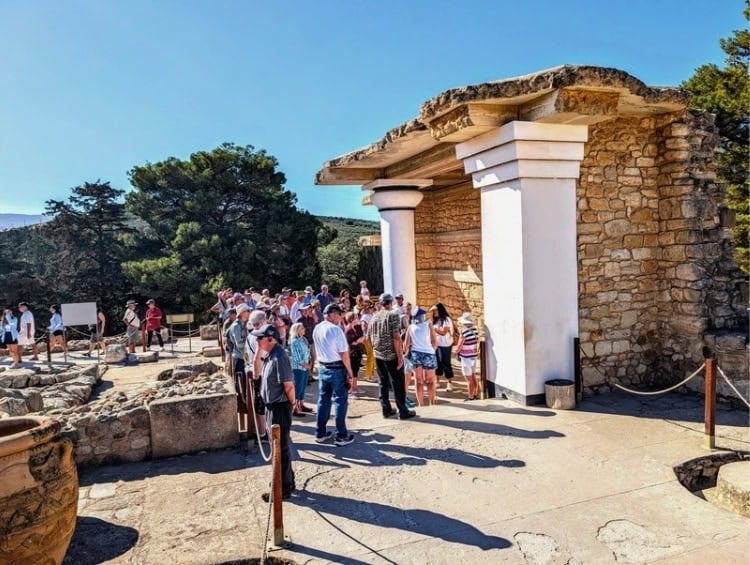
Although we were not the first to arrive, the crowds were not overwhelming, which was a little surprising as the archaeological site is the second-most popular tourist attraction in all of Greece (after the Acropolis in Athens), hosting hundreds of thousands of tourists a year.
Read More: Athens’ Parthenon, Then and Now: Walking the Acropolis in My Father’s Footsteps
Sir Arthur Evans
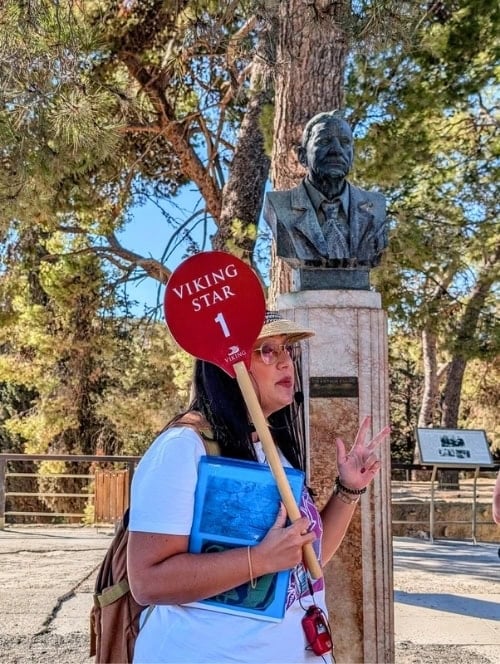
The bronze bust of Sir Arthur Evans gazed down upon us as we gathered at the west entrance. Evans was a British archaeologist who, beginning in 1900, over the course of 30 years, excavated a great deal of the palace and helped to enlighten the world to the Minoan culture.
He was not the first on the site; that accolade belongs to Minos Kalokairinos, a Cretan businessman and scholar who originally found the famous ruins.
However, it was Evans’s extensive work that enhanced our understanding of the unearthed ancient architecture and the people who brought the palace to life.
A Maze of Ruins
We entered the grounds, passing three 10-foot-deep, large, stone-lined circular pits known as kouloures (koo-loo-RAHS). Evans thought they were rubbish pits. Since then, many scholars have interpreted their function as granaries; some have suggested that they were cisterns.
After nearly 4,000 years, the ruins of the palace do not reveal their secrets easily.
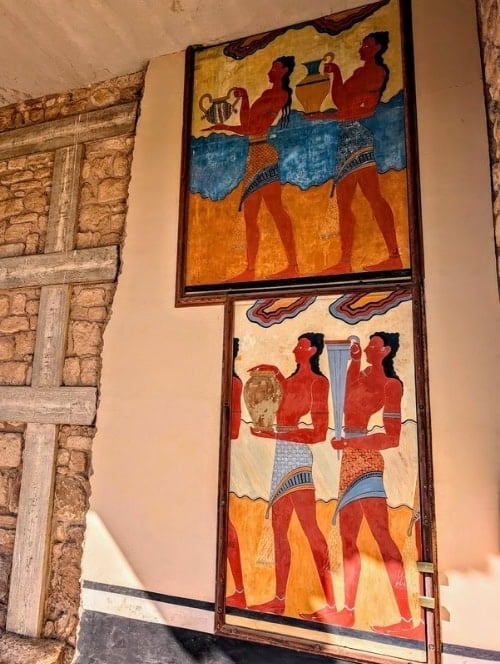
We made our way to the South Propylaea with its reconstructed Procession Fresco. The fresco depicts men walking while holding large pitchers and vases, as if in a procession, bearing gifts to the Throne Room. Nearby is the reconstructed Horns of Consecration, a symbol of the bull-loving Minoans.
Following the pathway, we walked upon a raised platform where, before us, spread a vast array of ancient foundations, interconnected stone-walled rooms, halls, courtyards, staircases, workshops, storerooms, and corridors. The maze follows different levels, rising and falling in a challenging but seemingly well-organized arrangement.
It is this masonry puzzle that led Sir Arthur to conclude that he had discovered the palace of King Minos.
King Minos and the Minotaur
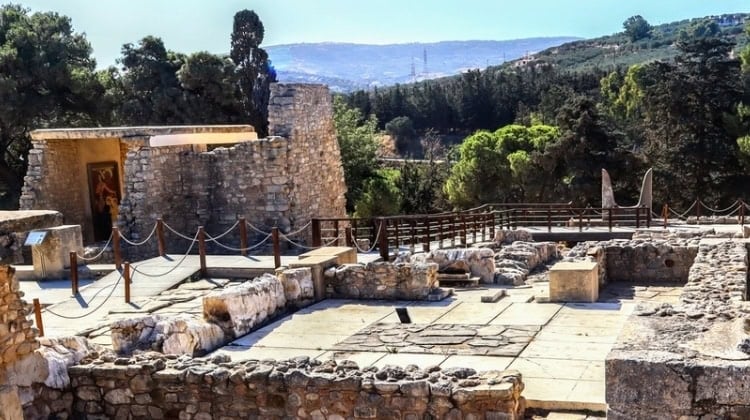
Admittedly, I am a little weak on my Greek mythology, but even I remember the tales of the Minotaur.
Knossos is mentioned in the earliest work of Greek literature, Homer’s Iliad. According to Homer, Knossos was ruled by King Minos, whose wife, Pasiphaë, had fallen in love and mated with a bull. From their highly unusual union, the Minotaur, a half-bull and half-man-like creature, was born. Minos had his architect, Daedalus, build the confounding network of dead-end corridors beneath the palace where he kept the beast locked away.
The myth of the Minotaur captivated Sir Arthur, driving him to discover the labyrinth. As Evans’s excavations revealed the layout of Knossos, he believed he had found the tangled web that had given rise to the myth.
The sun-baked stone foundations extend for over four acres of the vast complex. Radiating from a large central court, narrow passages and ramps run through the structure, connecting various entrances with rooms. Many of the rooms extend several stories deep into the earth. Corridors lead off into a dizzying array of directions, creating the image of a labyrinth.
Restorations at Knossos
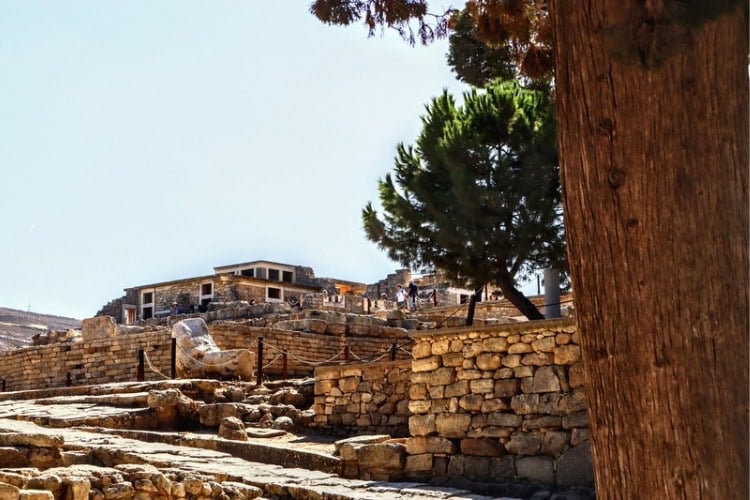
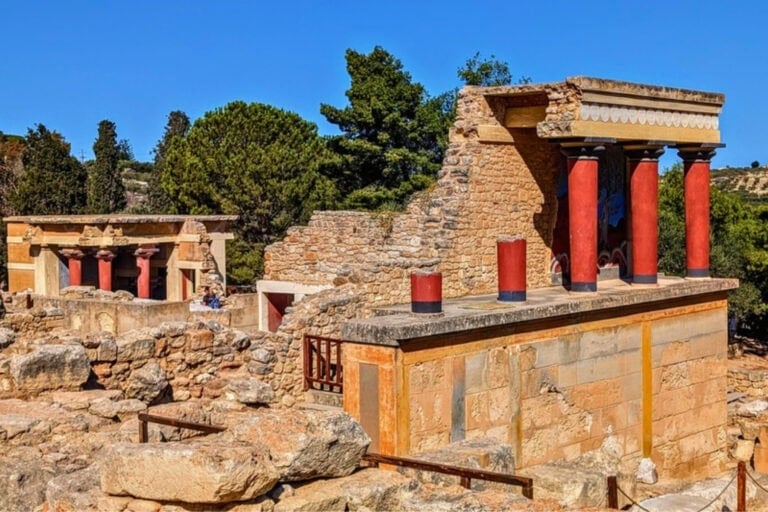
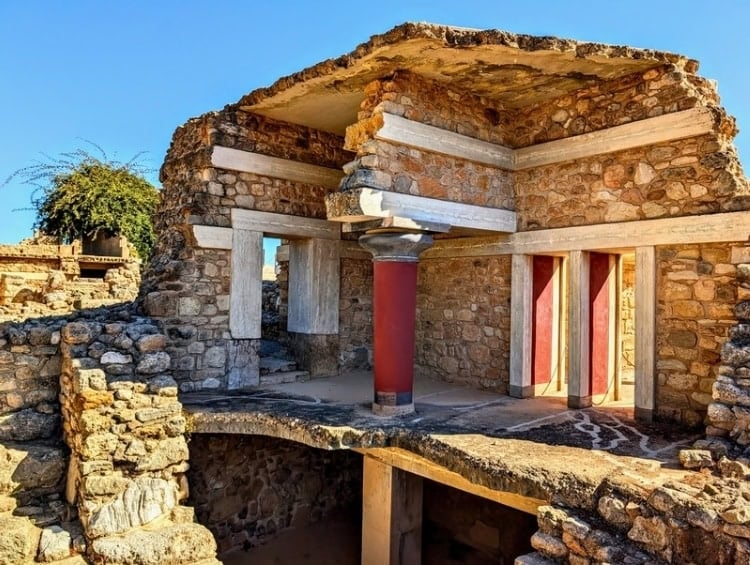
Here and there, the geometric forms of the stone foundations are pierced by rising walls, trimmed with colorful columns and decorative cornices. Some enclosed, most unfinished with irregular stonework and incomplete roofs.
These are billboards into Minoan history. Restored by Evans as an insight into how the Minoans built the palace and where they lived, these picturesque and colorful walls, however, have created a bit of angst in the archaeological world.
The West Magazines
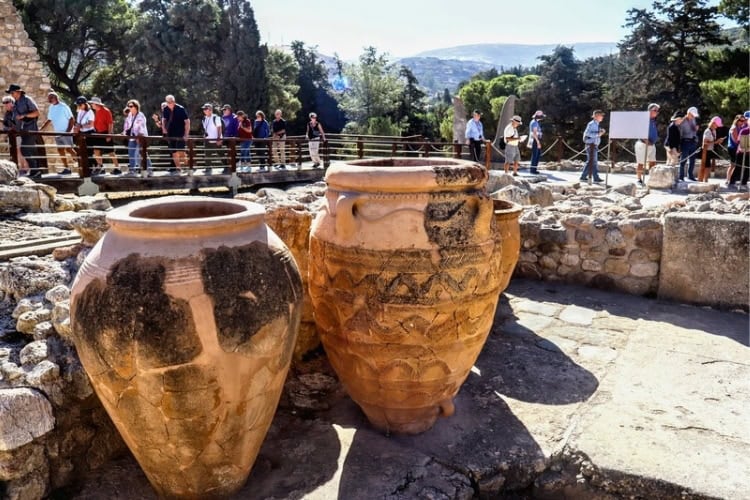
We continued to the West Magazines past four giant, highly decorated pithoi (storage jars) once used to store wine, olive oil, and grains. Over 150 of these jars have been excavated from the magazines.
Mercifully, as the temperature continued to rise, we were led to a restored room overlooking the Central Court. This is one of several reconstructed buildings on the palace grounds. According to our guide, the troubling aspect of the restoration is the materials Evans used—modern concrete instead of the limestone and wood used by the original inhabitants.
The midday sun found its way into the interior and played across the walls, lighting several copies of frescoes that were found throughout Knossos during excavations.
Frescoes and Bull Leaping
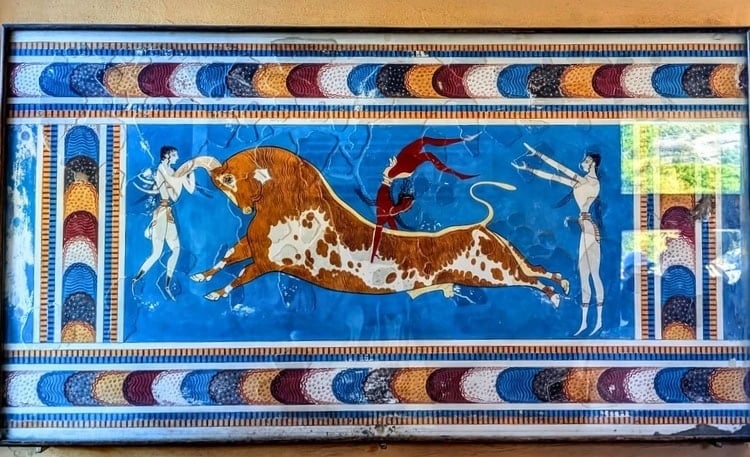
While mainland Greece was still grappling with its artistic identity, Minoans had perfected the art of the fresco. The originals have long since been moved to the Heraklion Archaeological Museum, along with most of the artifacts discovered on the grounds.
These frescoes are some of the most striking imagery handed down to us from the Minoan civilization, providing the strongest insight into their lives and beliefs.
One is the famous Bull-Leaping Fresco, which depicts two female figures positioned at each end of the bull, while a male figure throws himself into a somersault from the bull’s back.
Images of bulls were in abundance throughout the grounds. For Evans, this confirmed the tales of the Minotaur and his labyrinth home.
Beyond the frescoes, and dominating the room, is a deep well framed with black and red Minoan columns, providing natural lighting to the lower floor, which holds the Throne Room.
The Throne Room
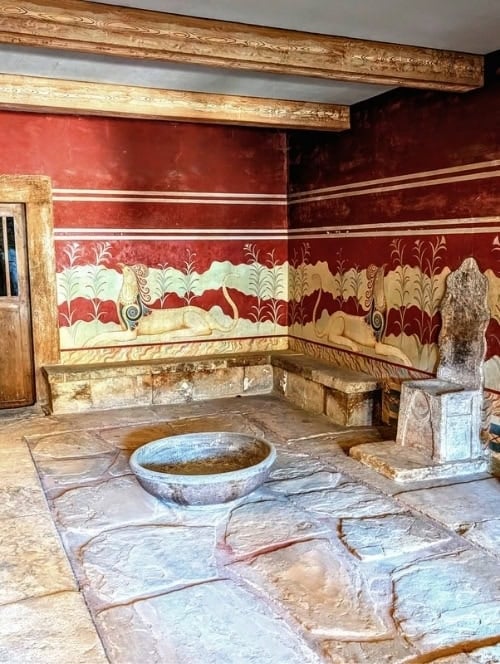
Descending a broad, stone staircase into the Central Court, we entered the antechamber that precedes the Throne Room.
During excavations of the complex, this room was discovered by Evans, who named it due to the stone seat in the room behind the antechamber.
The throne is flanked by stone benches, all neatly sitting upon large pavers. Framing the carved gypsum throne are frescoes of painted palm trees with a pair of crouching griffins shown against a backdrop of papyrus plants. A stone basin sits on the floor in front of the throne.
Opposite the throne, a low partition with a column forms a small space that resembles a cistern due to its sunken floor. Evans believed this to be a ritual bath and called it the “lustral basin.”
This may be the most accurate of Evans’s restorations.
Daedalus and Icarus
The sun rose higher into the sky and beat down on the exposed ruins and on us. The fragrant pines that fringe the grounds cannot extend their cool shade far enough.
It is this very sun that caused heartbreak for Daedalus, the architect of the labyrinth.
An Athenian hero, Theseus, eventually felled the Minotaur, finding his way back out of the maze with the use of a thread.
Because Minos thought Daedalus had failed him, he imprisoned Daedalus and his son Icarus. To escape, Daedalus made wings from feathers and wax. However, Icarus flew too close to the sun, which melted the wax, and he fell to his death.
Knossos is enveloped in Greek tragedy.
North Passage and Exit
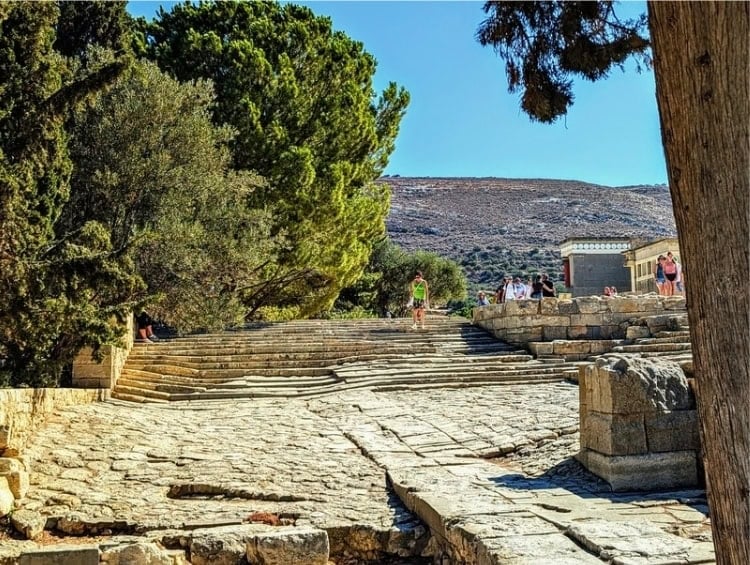
The colorful North Passage, near the end of our tour, is one of the most photographed parts of the palace. It was a narrow passage connecting the Central Court and may have been used as a customs house.
As we exited the complex, we passed by what Evans believed to be a small theatrical area. The central stage is flanked by wide, shallow steps used for seating.
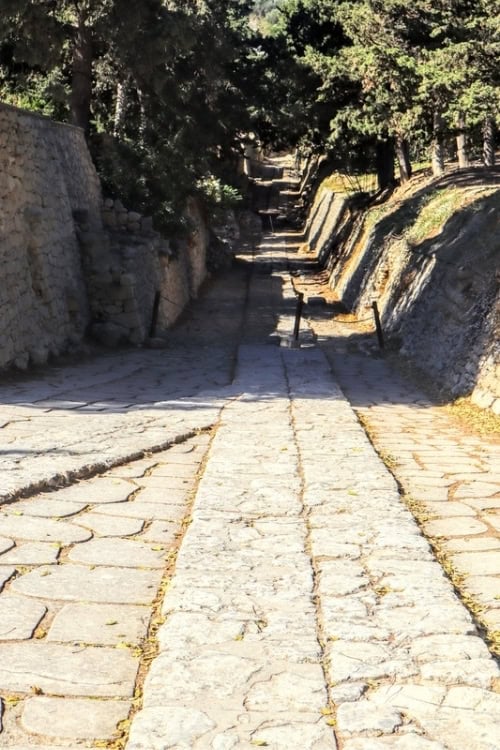
We stepped off the stage to walk upon the 3,500-year-old sandstone blocks of the Royal Road, the oldest known paved road in Europe, to our bus.
Enduring Mysteries of Knossos
This magnificent site, dating back nearly 4,000 years, is steeped in history and mythology. It is believed that only about 3–4% of Knossos has been excavated, with most of the excavations focusing on the central court.
Sir Arthur concluded that the Knossos complex was the palace of King Minos and, therefore, the people who built and occupied it must be the Minoans.
The reality is that we have no idea what they called themselves. Or even what their language was like. They had a language based on hieroglyphs that has yet to be decoded. Even the reasons for the demise of the Minoan civilization continue to be debated.
And then there are the picturesque, although sometimes inaccurate, restorations of Sir Arthur.
However, without Evans’s decades of excavations and restorations, which thrill visitors like us, what would we know of the Palace of Knossos, home of Homer’s King Minos, the Minotaur, and his labyrinth?
If You Go
Getting There: Several cruise lines, including Viking, include Crete and the palace in their itineraries. The main airports on the island are Heraklion (HER) and Chania (CHQ), both well-connected to Athens and other European cities.
Getting Around: From Heraklion, Knossos Palace is about 5 kilometers (3.1 miles) southeast of the city center, reachable by taxi, bus or car.
Tickets: Timed entry tickets are required for all visitors. Adult tickets cost roughly €20; EU citizens under 25 and non-EU visitors under 18 receive free admission. Book in advance at knossos-palace.gr.
Travel Insurance: Protect your trip with Squaremouth or SafetyWing, both of which offer policies covering medical emergencies, trip cancellations and cruise itinerary disruptions.
eSIM: Stay connected on the island without roaming fees. Airalo offers affordable eSIM plans for Greece.
Need a hand planning your trip? Here are the sites and services we rely on most, from booking tools to travel products we love.
Inspire your next adventure with our articles below:
- 10 Best Places to Visit in Greece for an Unforgettable Trip
- Greece Without Roads: Why the Best Way to Experience the Cyclades Is by Sea
Want to discover more hidden gems and helpful travel tips? Join our free newsletter for the latest travel secrets and travel articles.
We are reader-supported and may earn a commission on purchases made through links in this article.

- Yellowstone Digital Detox: A Week Off the Grid - October 15, 2026
- A Swiss Village, Lakeside Mansions and Door County Bluffs: Fall in Wisconsin - October 3, 2026
- The Sleeping Bear Dunes: Discovering the Splendor of Michigan’s National Lakeshore - September 24, 2026
Planning another trip soon? ✈️
Add GoWorldTravel.com as a preferred source on Google. Click the button below so our local guides, packing hacks, and hidden-gem itineraries always show up first when you search!
Add to Preferred Sources