
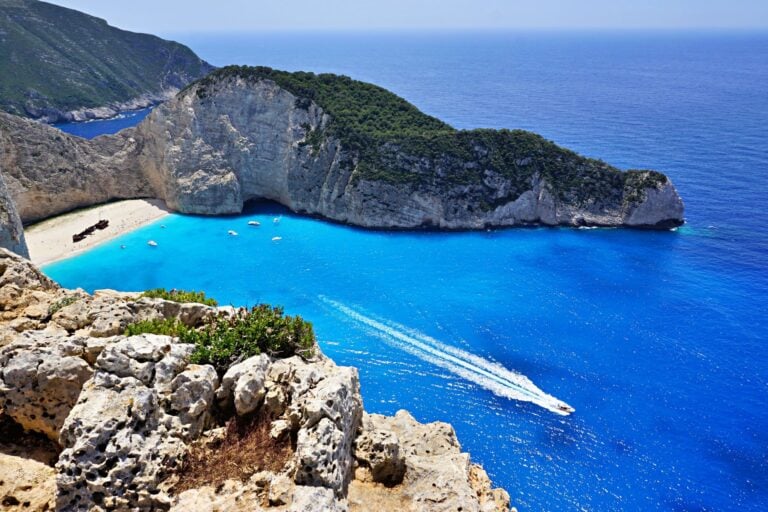
Just after leaving the harbor in the Cyclades, something shifts. The marina noise fades into the background. The sails rise and catch the wind with quiet certainty. The coastline rearranges itself into white houses, chapel domes, and sun-bleached cliffs into the open sea.
And suddenly, the day no longer belongs to check-in times, restaurant reservations, or road maps. It belongs to the wind.
A Different Structure of Travel
Chartering a yacht in Greece is often framed as a luxury indulgence, a postcard-perfect summer reserved for the fortunate few. But once at sea, the language of luxury feels incomplete.
What unfolds instead is a different structure of travel, one defined less by amenities and more by movement. This is not simply an accommodation; it is a way of crossing a country built from islands.
Visiting Greece From the Water
![Yachts and boats docked in a Mediterranean marina at sunset. Photo by [Author's Name]](https://www.goworldtravel.com/wp-content/uploads/2026/04/Marina-at-Sunset.jpg)
Greece is often experienced from land; archaeological ruins, whitewashed villages and narrow alleys polished smooth by centuries of footsteps.
From the water, those same landmarks appear differently. They are not places to drive toward. They are silhouettes to approach slowly, under sail.
The First Evening at Anchor
The first evening at anchor makes this clear. You drop anchor in a bay with no road access. There are no beach bars, no curated playlists drifting across the water. Only the gentle sway of the hull and the faint scent of salt carried on warm air.
The sea darkens from turquoise to cobalt. Dinner is simple. Conversation lingers longer than expected. There is no lobby to pass through. No checkout time to anticipate. No packing and repacking between islands.
The boat becomes both transport and home, constant, steady, familiar. And that continuity changes everything.
Catamaran or Monohull: Two Ways to Experience the Same Sea
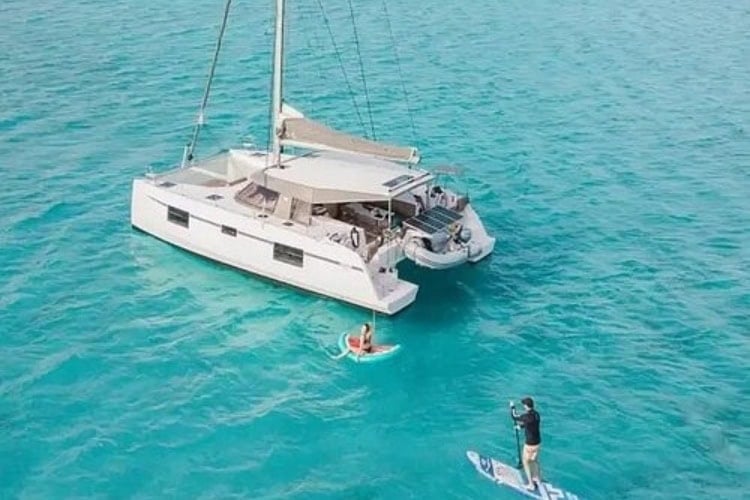
In Greece, most charters involve choosing between a catamaran and a monohull sailboat. A catamaran offers space and stability. With wide decks and generous communal areas, it feels expansive, particularly for families or groups of friends.
Breakfast unfolds across a shaded cockpit. Afternoon swims happen directly from the stern platforms. At anchor, the motion is minimal, the atmosphere relaxed.
A monohull, by contrast, leans into the wind. There is more tilt, more sensation and a stronger connection to traditional seamanship. It is often the more affordable option, but the distinction is not only financial.
One prioritizes openness and comfort. The other emphasizes intimacy with the elements. Both, however, place you in the same geography: a scatter of islands close enough to reach in a few hours, yet distinct enough to feel like separate worlds.
Choosing How You Sail
Some travelers choose to sail themselves, particularly in the Cyclades or Ionian, where short distances make navigation manageable for experienced sailors.
Others opt for a skipper, not only for ease, but for local knowledge: which bay offers shelter from a northern wind, which harbor taverna still cooks for locals after midnight.
Either way, the structure remains the same. The sea becomes the road.
Why Greece Makes Sense by Sea
![Seaside dining and colorful waterfront houses in Mykonos, Greece. Photo by [Author's Name]](https://www.goworldtravel.com/wp-content/uploads/2026/04/Waterfront-and-Seaside-Restaurants-in-Mykonos.jpg)
Few countries are as naturally suited to yacht travel as Greece. Island distances, especially in regions like the Cyclades, the Saronic Gulf, or the Ionian, are short.
A morning departure can bring you to a completely different landscape by lunchtime. A shallow lagoon one day. A harbor town of stone alleys and whitewashed houses the next. A wind-sheltered cove for sunset.
Unlike land-based travel, where changing islands often means changing hotels and dragging luggage through ports, a yacht remains your constant. The scenery shifts; your base does not.
The Flexibility of Travel by Sea
Flexibility becomes part of the design. If northern winds strengthen, you alter course south. If a harbor feels crowded, you move to the next bay. And if the afternoon light makes one coastline irresistible, you stay longer.
The itinerary adapts to weather and mood rather than fixed reservations. The schedule breathes.
What the Cost Really Represents
![Private catamaran cruising in crystal-clear turquoise waters in the Cyclades. Photo by [Author's Name]](https://www.goworldtravel.com/wp-content/uploads/2026/04/Private-Catamaran-in-Cyclades.jpg)
Chartering a yacht is not a low-budget holiday in absolute terms. It requires planning, coordination, and a realistic understanding of expenses.
Travelers considering a yacht charter in Greece can explore typical options and routes on various platforms such as Voyarent, which connects visitors with verified yachts and catamarans across the Cyclades. Yet cost behaves differently at sea.
When shared among six, eight, or even ten travelers, the overall charter fee is naturally split. Compared to reserving multiple boutique hotel rooms on a popular island during peak season, where nightly rates can rise dramatically in July and August, the per-person difference is often less dramatic than assumed.
But the comparison is not purely financial. You are not paying only for a cabin. You are paying for mobility without transit days. For private access to bays without roads. For waking up somewhere new without packing a suitcase.
Accommodation, transportation, and experience merge into a single framework. And that cohesion carries value beyond numbers.
A Day at Sea
Morning arrives through light rather than alarm clocks. The sun reflects off the water, filling the cabin with light. Someone dives in before coffee. The splash echoes softly against rock.
Later, sails rise again. The coastline drifts slowly: small white chapels perched on cliffs, fishermen tending nets, subtle gradients of blue shifting from emerald to deep cobalt.
By afternoon, you might dock in a harbor town; perhaps Mykonos, perhaps Paros, perhaps a quieter port in the Saronic.
Narrow alleys invite wandering. Wooden chairs face the water. Lunch stretches without hurry. Then back to the boat, always back to the boat, which waits without reception desks or housekeeping schedules.
Evenings stretch easily. The anchor chain tightens beneath the hull. Ropes creak softly in the dark. The horizon dissolves into a thin line between sea and sky. Days feel fluid rather than segmented.
The Advantage of Timing
Season matters. While August attracts the largest crowds, late spring and early autumn (May, June, and September) often bring stable winds, warm waters, and a noticeably calmer atmosphere.
Charter rates during these months tend to soften, while anchorages feel more spacious and personal.
Harbors breathe more easily. Tavernas feel less hurried. Bays feel less claimed. Choosing the right season subtly shifts the narrative from indulgence to intention.
The Human Element
Life aboard a yacht reshapes social dynamics. Space is shared. Decisions are collective. There is no retreat into separate hotel rooms at the end of the day. Instead, there is collaboration over routes, anchoring choices and simple daily routines.
Freed from rigid schedules and constant distraction, time stretches. Meals last longer. Laughter carries across open water. Silence becomes comfortable rather than awkward. This is not passive travel. It is participatory.
What It Ultimately Feels Like
Chartering a yacht in Greece does not resemble checking into a luxury resort. There are no marble lobbies or curated infinity pools.
Instead, there is wind direction, anchor depth, and the quiet satisfaction of navigating toward the next island under your own terms.
It requires adaptability, cooperation and attention. But in return, it offers something rare: continuity with a base that moves with you rather than being replaced every few days.
In the end, it becomes less about price and more about perspective. From the deck of a moving boat, Greece is not a series of destinations. It is a landscape without roads.
If You Go
Getting There: Most Cyclades charters depart from Athens (Piraeus or Alimos Marina) or from island bases including Mykonos, Paros, and Lavrion. Fly into Athens International Airport (ATH) and allow time to reach the marina before embarkation. Flights to Athens: CheapOAir
When to Go: The best time to charter in the Cyclades is late April through October. In May, June, and September, offers stable winds, warm water, and less-crowded anchorages. July and August are peak season, which means busier and more expensive, with the Meltemi winds adding sailing challenge.
Skipper or Bareboat? A sailing license recognized by Greek port authorities is required for bareboat charters. If you don’t hold one, hiring a skipper is straightforward and adds local knowledge that’s hard to replicate. Greece’s charter companies can arrange skippers for guests who prefer not to handle navigation themselves.
Need a hand planning your trip? Here are the sites and services we rely on most, from booking tools to travel products we love.
Inspire your next adventure with our articles below:
Author Bio: Konstantina Louloudi writes about sailing travel and experiential journeys across the Greek islands. She is the founder of Voyarent, a platform connecting travelers with verified yachts and curated sailing experiences in Greece.
Want to discover more hidden gems and helpful travel tips? Join our free newsletter for the latest travel secrets and travel articles.
We are reader-supported and may earn a commission on purchases made through links in this article.

- Along the Gambia River: Markets, Crossings and Chimpanzees - September 14, 2026
- Kagawa, Japan Is the Udon Capital—Where to Eat Sanuki Noodles and How to Get There - September 14, 2026
- Inside the Vatican: An Exclusive Walk Through the Pope’s Private Corridors - September 14, 2026
Planning another trip soon? ✈️
Add GoWorldTravel.com as a preferred source on Google. Click the button below so our local guides, packing hacks, and hidden-gem itineraries always show up first when you search!
Add to Preferred Sources