
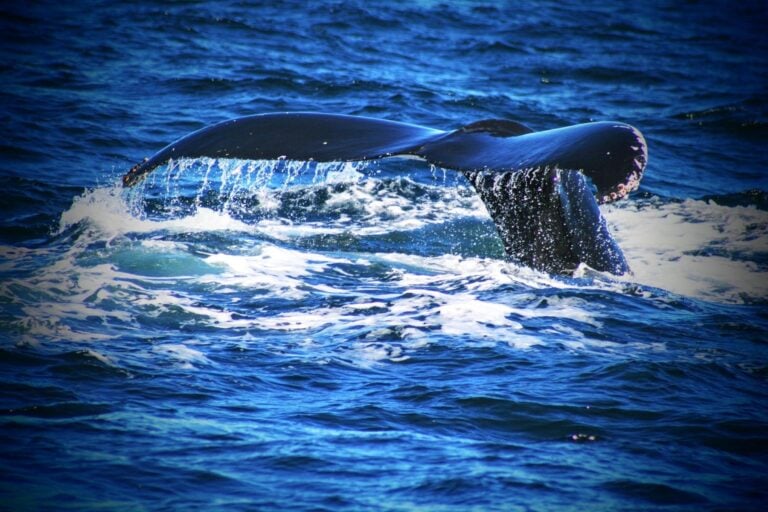
The wrinkled, glistening black back exploded from the indigo-blue waters, briefly hanging in the air before twisting its body, exposing its spotty white underside and smashing back into the ocean, sending a torrent of sunlit, sparkling spray skyward.
My wife enthusiastically cried out, asking if I had seen it and if I got a picture?
With my camera dangling by my side, I smiled weakly while leaning heavily against the railing as I grasped it with both hands, as though that alone would alleviate the queasy feeling and cold sweats that had overcome me.
In the distance, the Humpback calf repeated its remarkable performance time and again. I never did get the picture, but even in my less-than-stellar condition, it was an extraordinary sight.
Located off the northeast coast of the United States, roughly 25 miles east of Boston, Massachusetts, between Cape Ann and Cape Cod, this was our third trip into the waters of Stellwagen Bank National Marine Sanctuary. Created in 1992, the sanctuary recognizes and protects the region’s unique and abundant marine life.
An easy boat trip from the vibrant and quirky world of Provincetown, Cape Cod, the 842-square-mile preserve supports a wealth of marine life. It is an important feeding ground for endangered marine mammals such as the Humpback whale, the Finback whale, and even the elusive North Atlantic Right whale.
It was the first time that the waters had gotten the best of me. However, it had taken over 3 thoroughly entertaining hours of spyhopping, fluke diving, fin slapping, and, of course, breaching before the rolling waves upended me. It was well worth it.
Provincetown
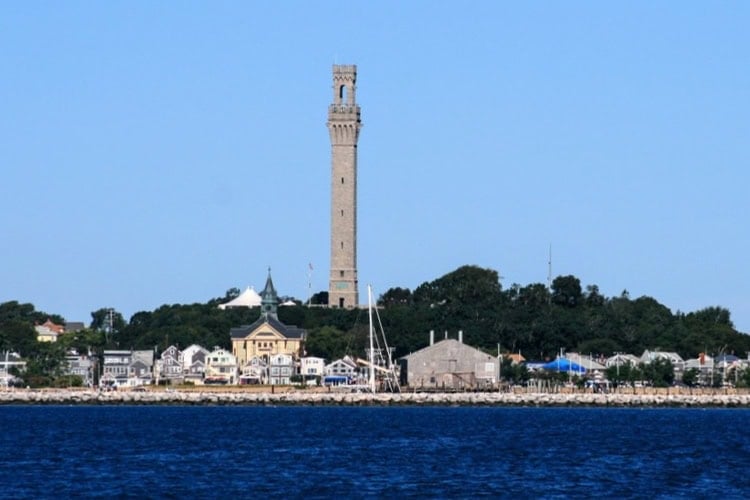
Our morning had started on the shores of Provincetown, a little village on the spindly arm of sand at the very tip of Cape Cod. Anthony Bourdain once described Provincetown, where the Pilgrims first set foot in the New World before moving on, as “a wonderland of tolerance.”
A popular vacation spot, its population of 3,600 can swell 20-fold in the summer months.
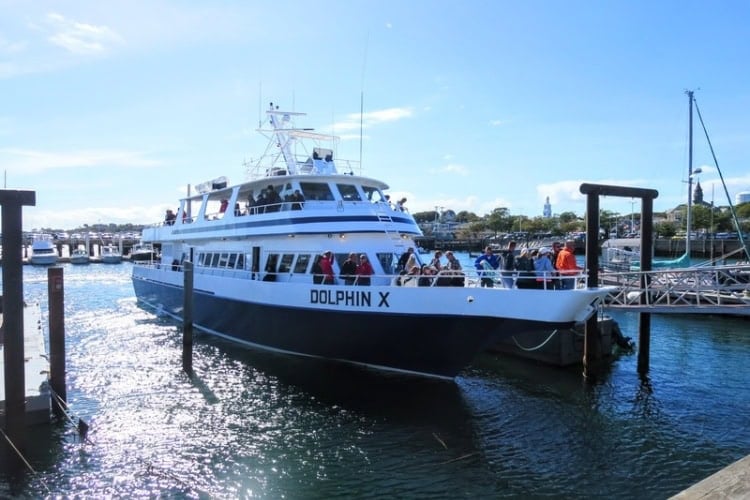
We boarded our boat, the 100’ Dolphin X, at MacMillan Pier in Provincetown for our trip to Stellwagen Bank. The Dolphin X is one of a fleet of four boats operated by Whale Watch Dolphin Fleet. Two-decked, with restrooms and a fully stocked snack bar, it is spacious and comfortable.
Whale Watch has been operating since 1975 and was the first-ever Cape Cod whale watching endeavor.
Provincetown is the closest port to access Stellwagen Bank National Marine Sanctuary, a federally protected marine habitat off the tip of Cape Cod in Massachusetts Bay. It is a perennial summer feeding ground for many whale species, but especially humpbacks.
The whales are typically here from April until the end of October. As the weather warms in spring, the Humpback whale population enters the rich waters to feed.
Whaling Heritage Of Cape Cod
In the mid-19th century, at the peak of American whaling, the New England ports of New Bedford, Nantucket, Boston, and Provincetown were the mainstays of the Yankee whaling fleet. The United States owned 640 whaling ships, more than the rest of the world put together. Provincetown and whales have a long, troubling history.
While Cape Cod’s Nantucket Island receives the bulk of the attention for being a whaling center, Provincetown had its own fleet of whalers. Between 1820 and 1920, more than 160 vessels were launched from Provincetown in search of oil-producing blubber. Whaling meant wealth to its small population.
However, the need for whale oil for lighting was superseded by the discovery of oil in Pennsylvania in 1859, and the market for whale products in the USA began its slow decline.
Although ports like Provincetown continued whaling for many more years, the peak of Yankee whaling had passed.
Read More: Gliding with Giants: My Whale Shark Encounter in Oslob, Philippines
Seeing Whales In A New Light
While other countries continued to pursue whaling into the mid-20th century, American industry pursued oil, and Americans began to embrace the largest creatures ever to populate Earth.
Nearly hunted to extinction, scientists started pursuing these gentle giants in the name of research and conservation. Partnering with enterprising charter boat captains out of Provincetown Harbor, whale watching mushroomed in the 1970s.
It’s a pursuit that Kathy and I have embraced and never seem to tire of, seeing these enormous, beautiful creatures effortlessly glide through their watery world.
We left Provincetown Harbor and its frolicking seals, rounding Long Point Peninsula with its 1875 lighthouse, past fishing boats, and entered the chilly Atlantic waters.
Even with the sunlit sky, sweaters, pullovers, and jackets were donned or pulled closer as the boat picked up speed and the cool breeze whipped by us.
First Encounters
Nancy Scaglione-Peck, one of the Dolphin Fleet naturalists, spoke of the whales we might see, their behavior, and the unique characteristics that enable biologists to track them.
As we moved farther into the sanctuary, the sapphire waters became a deeper, richer blue-green, and the rolling waves began to increase in size.
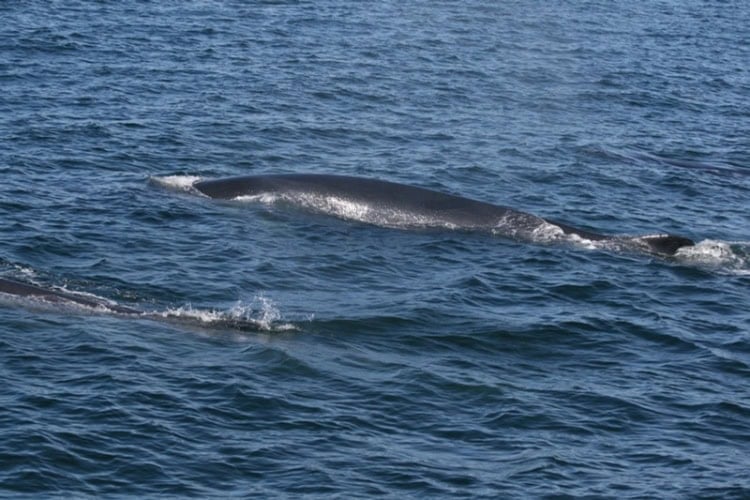
Soon, our first sighting announced itself with what appeared to be synchronized fountains shooting three towering plumes of mist, or spouts, into the air. This turned out to be three Finback whales off the starboard side.
Second only to the Blue whale as the largest animal on the planet, the Finback is also extremely swift, as was attested to as we tried to keep up with them as they cruised easily past us.
Long and sleek, the Finback is sometimes referred to as the “Greyhound of the ocean.”
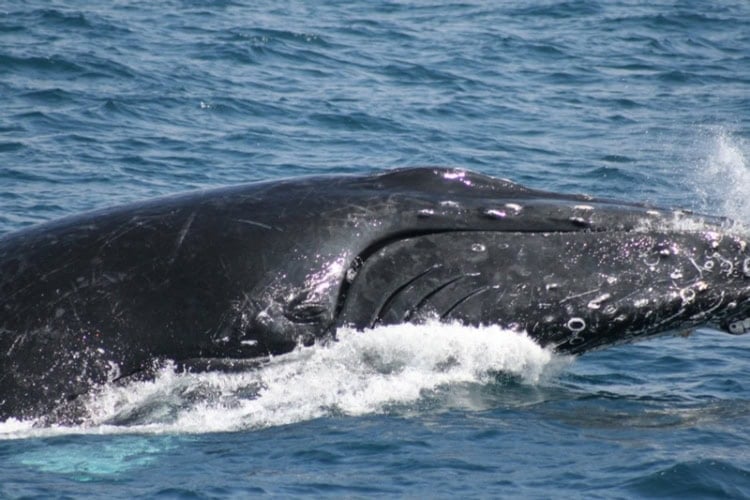
But what most of us had come out to see were the Humpback whales, those lively, 50-foot-long acrobats that sometimes leap high out of the water and fall back with a magnificent splash.
They have distinctive, long white fins, and males have been known to “sing” for up to 20 minutes.
And on cue, two Humpbacks appeared almost magically across our bow.
Read More: 9 Places to Experience Amazing Sea Life Up Close
Humpback Whales
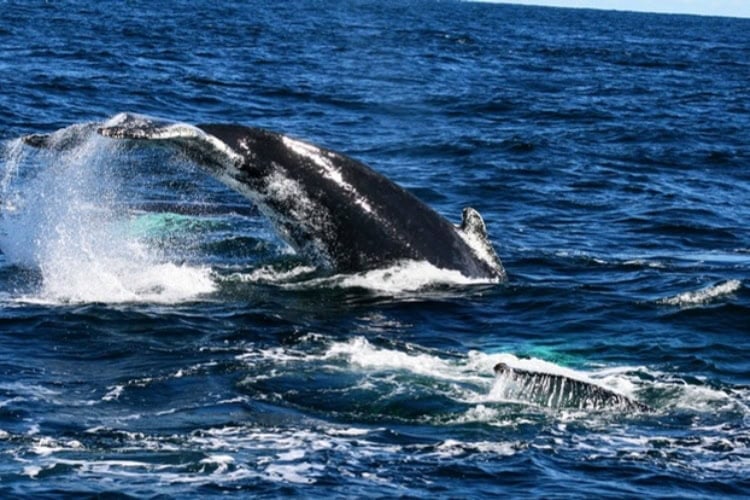
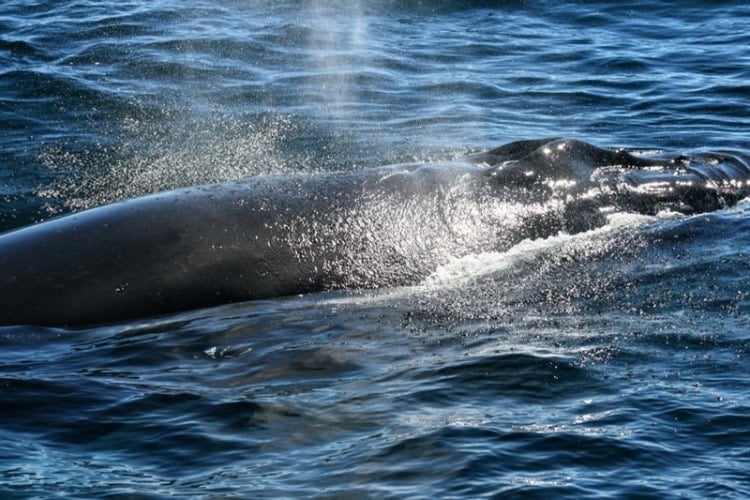
Nancy pointed out that it was a mother and calf. But what amazed us was how close they came to our boat. It is a remarkable sight as they break the surface with the sun sparkling off their glistening backs like so many twinkling diamonds.
The mother slipped effortlessly beneath the waves, disappearing into the depths with just its long white pectoral fins visible like disembodied wings as it swam across our bow.
Just as we were settling into a sort of bemused wonderment of the trip’s first Humpback whale sighting, someone cried out excitedly as several blows, or whale spouts, were sighted in the distance.
And suddenly we were charging across the waves seeking out another pod. As we encountered each new group, it was surprising how inquisitive they appeared to be as they circled the boat, matching our own curiosity as excited exclamations and ubiquitous cameras followed their every movement.
And then, in a slow ballet of motion, they arched their backs as they dove into the depths to feed, providing that momentary “money shot” when their tail fluke is raised completely out of the water just before disappearing beneath the waves.
When feeding, humpbacks’ throats expand their flexible pleats, inflating into almost a balloon-like bag. Opening their mouths wide, they strain their food using strips of baleen—made of keratin, the same substance found in human fingernails—that hang from their upper jaws.
Identifying Individual Whales
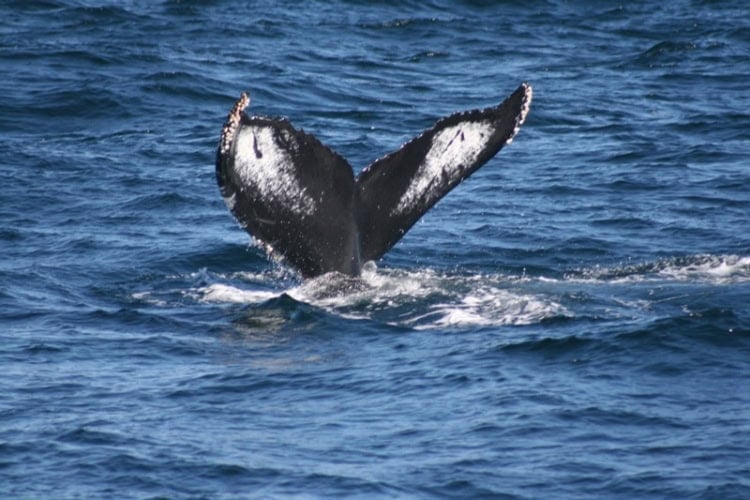
For these deep feeding dives, the whale will raise its tail in a vertical position, providing a good view of the lower side. Each whale’s unique pigmentation pattern on the underside of the flukes allows for identification.
Ms. Scaglione-Peck explained how naturalists will document a whale by its flukes, which are as unique to them as our fingerprints are to us. Over the course of the 3½-hour trip, we had several opportunities to examine the different fluke-prints as we encountered dozens of whales all told.
In a running discourse, Nancy noted the “names” that had been assigned to the various whales, such as Zeppelin, Longboard, and Fracture, simply by matching their flukes.
By now, the increasing rolling waves, the camera’s narrow viewfinder, and my lack of sea legs had gotten the best of me. I couldn’t help but smile, though. There is something undeniably magical about an encounter with a single whale, let alone several. It is exhilarating, thrilling, and a life-altering revelation.
Too soon, we were headed back to port. A boatload of thrilled seekers who had just witnessed, whether for the first time or the hundredth, one of the more splendid creatures on earth.
When one of these animals surfaces next to the boat, and you look into its eye, you are hooked for life.
If You Go
Getting There: Provincetown is about 2.5 hours by car from Boston — but the fast ferry is the better call. Boston Harbor Cruises departs from Long Wharf and Bay State Cruise Company from the Seaport, both arriving at MacMillan Wharf in about 90 minutes. Both run seasonally from May through October — book ahead in summer, they fill up. Driving? Discover Cars is worth a look for comparing rental rates.
Whale Watching: Dolphin Fleet Whale Watch departs MacMillan Pier from mid-April through October, with 3-4 hour naturalist-guided trips and a guaranteed-sighting policy. Book directly or through Viator for flexible cancellation options.
Where to Stay: If you’re making a weekend of it, Brass Key Guesthouse is consistently ranked among the best in Provincetown — adults-only, with an infinity pool, courtyard garden, and daily wine and cheese hour, all steps from Commercial Street. For a full-service option with a spa and on-site restaurant, Crowne Pointe Historic Inn is a classic choice in a beautifully restored 19th-century sea captain’s estate.
What to Bring: The temperature on the water can drop 10-15 degrees from shore, even on warm days. Pack layers, sunscreen, flat shoes with grip, binoculars, and a real camera — phone shots rarely survive the distance and the boat motion.
Need a hand planning your trip? Here are the sites and services we rely on most, from booking tools to travel products we love.
Inspire your next adventure with our articles below:
- Montagu Island: A Wilderness Haven on NSW’s Spectacular Sapphire Coast
- Inside Palau’s Otherworldly Underwater World, From Giant Clams to Golden Jellyfish
Want to discover more hidden gems and helpful travel tips? Join our free newsletter for the latest travel secrets and travel articles.
We are reader-supported and may earn a commission on purchases made through links in this article.

- The Great Lakes Shipwreck Museum: Honoring the Legend of the Edmund Fitzgerald - September 11, 2026
- Driving I-90 Across South Dakota: Badlands, Wall Drug and Roadside Icons - September 2, 2026
- Gettysburg National Military Park: A Visit to Hallowed Ground - August 31, 2026
Planning another trip soon? ✈️
Add GoWorldTravel.com as a preferred source on Google. Click the button below so our local guides, packing hacks, and hidden-gem itineraries always show up first when you search!
Add to Preferred Sources