
The glint of the August sun on the ice made me misstep, almost slipping down a deep, narrow crack as our group of trekkers traversed the Matanuska Glacier in Alaska, one of the adventurous cruise excursions we experienced.
I shuddered remembering our guide Scott’s warning about getting “corked” – wedged into a crack so tightly that not even rescue equipment can help. The pressure of the ice combined with your body heat can cause the ice to melt and then refreeze, securely trapping you.
I breathed easier as my crampons, or shoe spikes, gripped the ice. Then I pierced the lip of the crevasse with a trekking pole to test its strength before leaning over to peer down the gap.
The ice was an intense blue color, fading into nothingness like a black hole. It was visually impossible for me to judge the depth of the crevasse, but I’d read that the deeper the blue, the deeper the ice. On average, the crevasses measure over 100 feet deep.
Scott led a group of us across the 27-mile-long and 4-mile-wide glacier. The crunching of ice beneath our boots disrupted the quiet rhythms of the terrain.
Two teenagers in our roving party playfully tossed ice chunks at each other. Scott warned them to stop, faking a fall to show how slick and unstable this icefield could be. He advised us all to walk with short, flat steps, bent knees and arms slightly extended to stay balanced on the slippery landscape.
“You look like a penguin!” said one of the teens with a laugh.
Ice Sculptures and Wilderness Sound
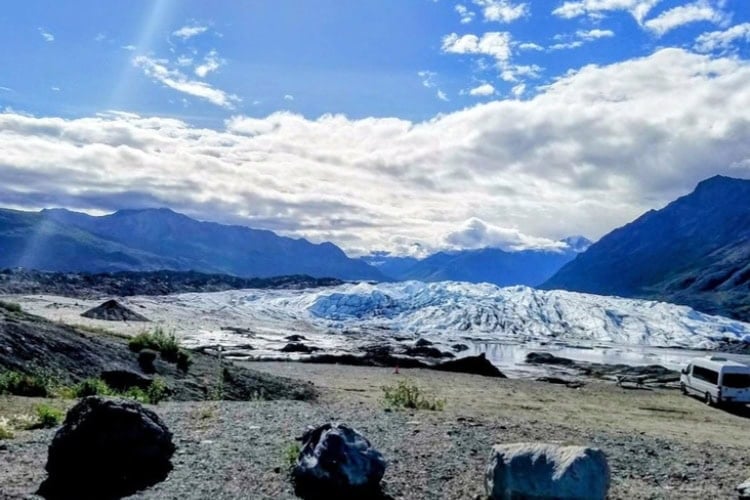
Most of us chuckled, but I was distracted by stark beauty emerging in every direction. Mounds of natural ice sculptures perceived by some, Scott said, to be shaped like a roaring lion and others like rolling surf.
Towering walls of blue ice with jagged icicles, and purplish mountains with a misty hue, shimmered in the distance.
Despite wondrous surroundings, the howling of wolves somewhere in this vast wilderness put me on edge. In Native American lore, a harmony of spirits between humans and the rest of the living world is honored and practiced. Their connection to nature is nurtured to confirm the belief that we are all related.
Wolves in Native American mythology are often portrayed as guides, protectors and symbols of teamwork and family unity. However, unless we were prepared to use trekking poles or rocks as weapons, Scott warned us to stay vigilant for wolves, bears and moose along glacial trails.
But I sensed we’d be safe. He’d said earlier that most of our time would be spent traversing the glacier and not on nearby trails. I had read that these animals rarely venture onto the ice due to a lack of food.
Moulins, Moonwalks and Glacial Hazards
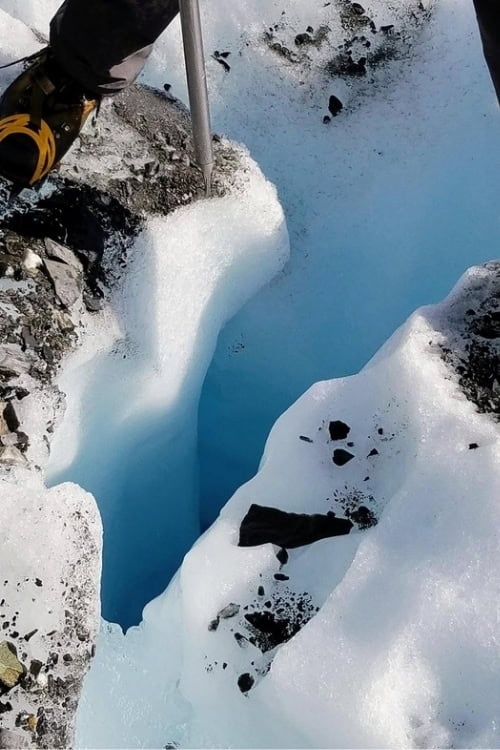
Photo by Dorothy Maillet
I’d trekked across the Columbia Icefield twice along the border of Alberta and British Columbia, Canada. But hiking the Matanuska Glacier felt more rugged and adventurous, as we crossed terrain that resembled an alien landscape.
We traversed around moulins or deep, dangerous holes formed by summer snowmelt. The teens crossed the cratered landscape with lighthearted laughs and reckless attempts at moonwalk dance moves.
“Guys, save the fooling around for another time,” Scott exclaimed. He went on to explain that the vibrations from their horseplay could cause the moulins, or ice structures, to collapse.
If someone falls into the freezing water, there are rarely ledges or handholds to grip. You can rapidly get hypothermia and drown without specialized rescue equipment.
We Crossed Brittle Ice and Deep Chasms
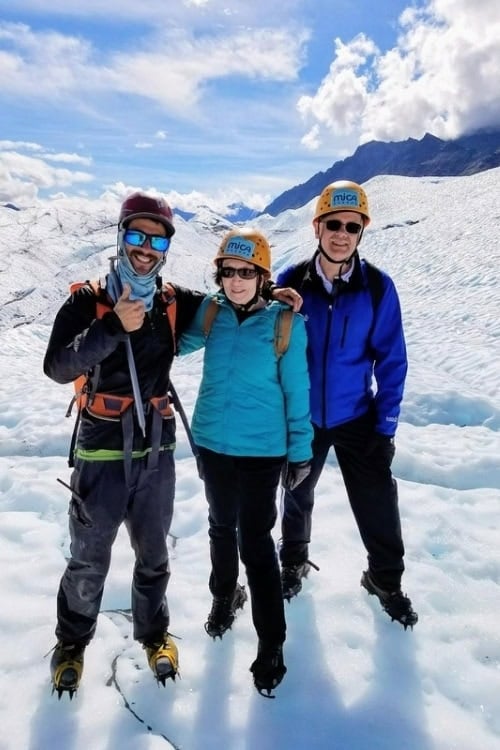
Photo courtesy Dorothy Maillet
After the sobering alert about glacial hazards, the teens fell silent. Dan, I, and the two other couples surveyed the icy ground and surroundings.
We had trusted our gear and guide while navigating shifting ice, steep angles and massive crevasses. I felt a deep sense of accomplishment.
Other than periodic wolf wails, raspy raven calls and creaking ice, the silence was overwhelming and, at times, haunting.
Though I hadn’t read about Sasquatch sightings on the Matanuska Glacier, I understood how this remote setting could trigger the imagination.
Embarking on a Dog Sledding Adventure
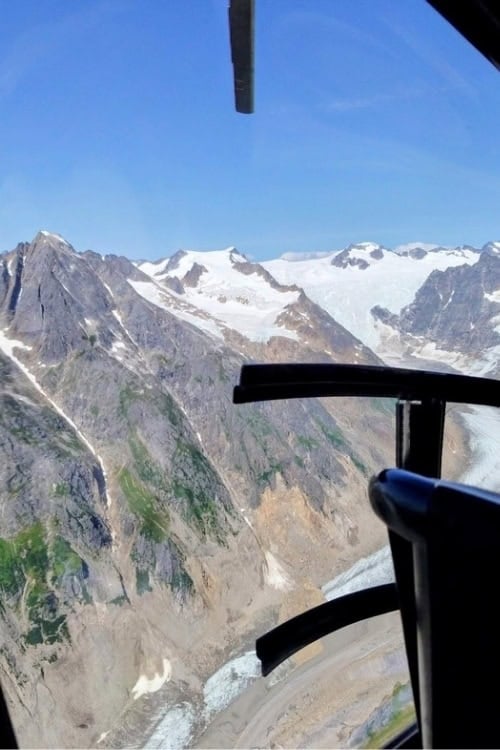
Two days later, the cruise ship dropped off Dan and me in Juneau, where we took a shuttle bus to the airport for our helicopter ride to the Mendenhall Glacier.
As we hovered above miles of wilderness, fjords, and cloud-piercing peaks of snow, I felt far removed from civilization.
We were high above a vast, unsettled hinterland. Now was our opportunity to escape the ordinary and go on a dog-sledding adventure.
Arriving at the Mendenhall Dog Sled Camp
We exited the helicopter and stepped onto an icy, mountainous landscape like that of the Matanuska Glacier. The high-energy barking from the dog sled camp and the noise of whirling helicopter blades stirred my excitement.
A team of professional dog trainers, mushers and working dogs welcomed us. We were fitted with glacier overboots or arctics for extra traction on snow and ice, as well as windproof vests for core warmth.
A safety training session emphasized keeping a firm grip on the handlebar with a dog team hooked to your sled. The handlebar is the key command point for the musher to maintain steering, balance and control during sudden jolts forward, for example, by the dog team.
Meet the Team: Lead Dogs, Swing Dogs, Wheel Dogs
It’s also essential for the driver to know how to operate a hinged bar brake wedged between the sled runners.
By stepping down with one or both feet, the driver drives two to five metal spikes into the snow to create friction that slows or stops the sled. If the sled stops, passengers are to remain seated while the driver stands on the brake until the guide secures the dogs.
These dogs, of course, are bred to run. If they break free from the sled, a runaway team can become entangled in the ropes or harnesses, collide with trees, or clash with other wildlife on their path.
The partnership between the dogs and the mushers was clear in a video shown to us. As in most relationships, the essential elements are mutual trust, communication and an emotional bond.
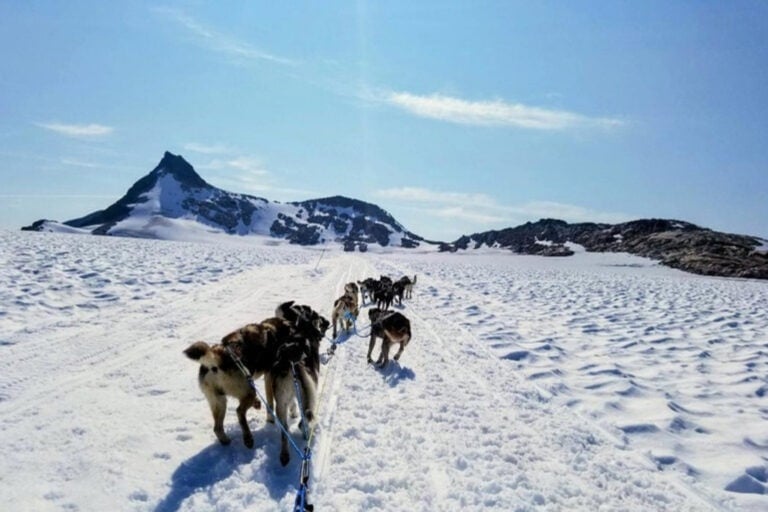
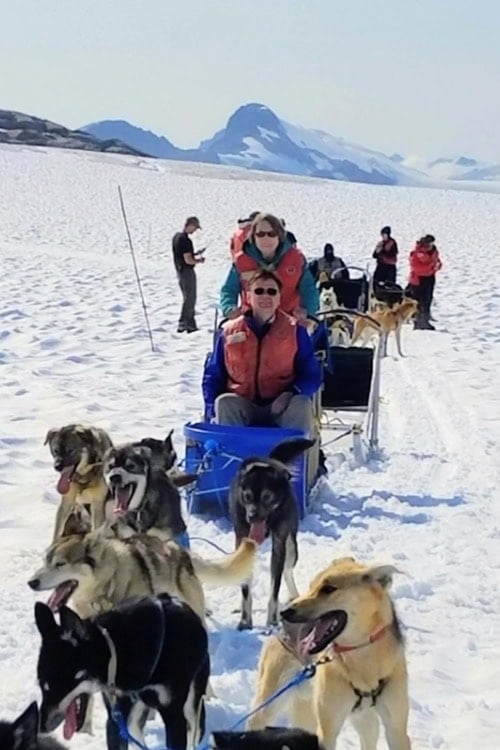
There are 10 to 14 Alaskan huskies on each sled team, depending on the weight of those they’re pulling.
The lead dogs initiate the movement and set the pace. They navigate and, at intersections, decide which direction to take.
Swing dogs are right behind the lead dogs to manage curves smoothly and guide the team on a specific course.
Wheel dogs, the largest and strongest of the team, are closest to the sled and provide power up steep inclines and brawn to haul the sled out of deep snow.
Whoosh! The Dogs Set a High-Speed Pace
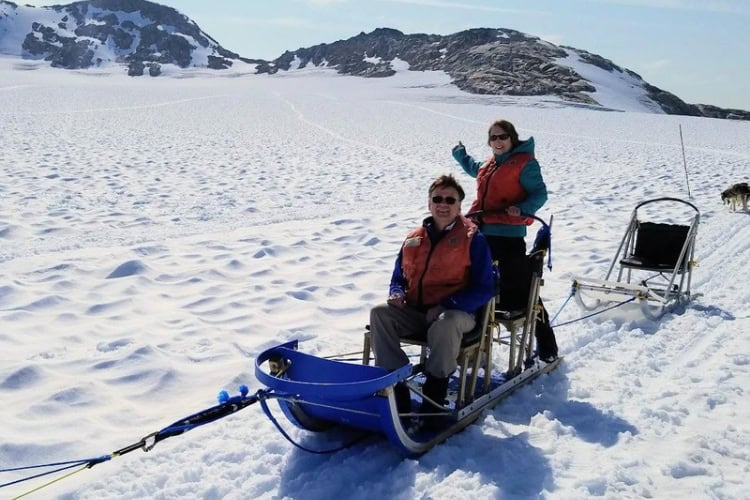
I was ready to connect with the dogs and wilderness while taking the risks of the ride. As a first-time dog musher, I aligned both feet with the runners and focused on balance. Shifting my body weight would help steer the sled.
I gripped the handlebar, gave the command “OK!” to the dog team, and lifted my feet off the bar brake. We were off!
From the outset, I felt a rush of high energy exuded from the dogs amidst their barking and clear adrenaline rush. Once on the run, they fell into a rhythmic high-speed pace in focused silence.
I was overwhelmed by their pulling power as we flew over sparkling icefields, and the wind and bits of ice stung my face. The experience filled me with an intense sense of freedom and exhilaration I didn’t want to end.
Puppy Cuddles and the Future Iditarod Stars
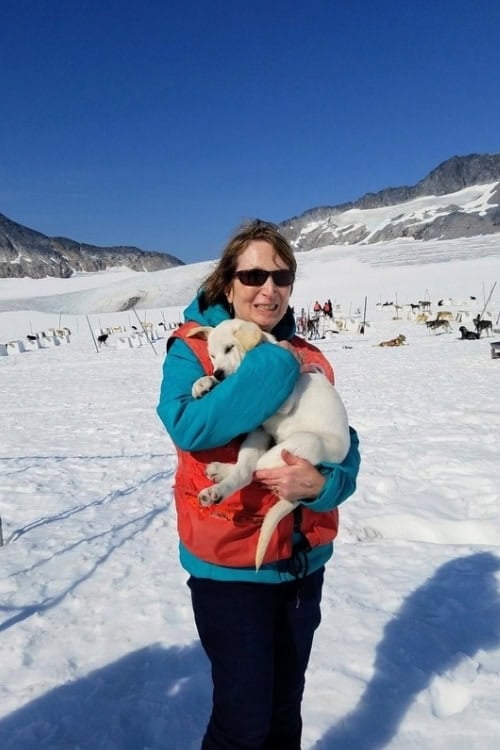
When we returned from the mushing adventure 30 minutes later, a dog trainer let both Dan and me cuddle with Alaskan Husky puppies.
We were told the dogs staying at this camp were bred and trained in Vermont, where they build endurance and develop temperament and companionship. He said the puppies needed socialization to strengthen the bond between future working dogs and guests on dog sled tours.
Some would become competitors in the 1,000-mile Iditarod race. Dan and I were honored to hold the future elite athletes of the Mendenhall dog camp.
As our helicopter ride back to Juneau soared above deep blue crevasses, rugged peaks, and the Tongass National Rainforest, I was struck by the unspoiled nature of it all.
Raw. Natural. Unblemished.
Perhaps the call of the wild had prompted us to go glacial trekking and dog sledding. We listened and, ultimately, followed it.
If You Go:
Glacier Trekking: MICA Guides leads glacier trekking adventures on the Matanuska, with experienced guides, all necessary gear, and routes tailored to conditions on the ice. For an independently booked alternative, the Matanuska Glacier Hike Day Tour on Viator departs from Anchorage with crampons provided and a full day on the glacier’s surface.
Dog Sledding: Cruise passengers can book the helicopter and dog sledding combination directly through Celebrity Cruises’ shore excursion program or through independent operators via Alaska Shore Excursions. For those booking independently, the Juneau Icefield Helicopter Tour and Dogsledding Experience on Viator includes cruise ship shuttle pickup and lands at a remote glacier camp on the Juneau Icefield for the dog sled ride.
Flights: Alaska’s glacier country is accessed through Anchorage for the Matanuska and Juneau for the dog sledding. Search flights to both cities on CheapOAir. Their search covers hundreds of airlines and routes to help find the best connection for your itinerary.
Need a hand planning your trip? Here are the sites and services we rely on most, from booking tools to travel products we love.
Inspire your next adventure with our articles below:
- What You Need to Know to Plan an Alaska Cruise
- The Big Wild: Alaska Cruise Thrills with Glaciers and Stunning Scenery
Author Bio: Dorothy Maillet is a writer and adventurer from Irvington, N.Y. Her travels have taken her across Europe, Asia, Africa and North America. She has been a freelance feature writer for Gannett Newspapers, and her stories have appeared in the anthology, A Pink Suitcase: 22 Tales of Women’s Travel, Pembrokeshire Life, BootsnAll Travel, Westchester Life, and Go World Travel Magazine.
Want to discover more hidden gems and helpful travel tips? Join our free newsletter for the latest travel secrets and travel articles.
We are reader-supported and may earn a commission on purchases made through links in this article.
Want to discover more hidden gems and helpful travel tips? Join our free newsletter for the latest travel secrets and travel articles.
We are reader-supported and may earn a commission on purchases made through links in this article.

- Darwin, Australia’s Northernmost Capital, Combines Vibrant Markets, Waterfront Life and Access to Kakadu and Litchfield - October 11, 2026
- The Ghostly Side of Edinburgh: Haunted Castles, Underground Vaults and Murder Sites - October 11, 2026
- A Quest for the Best Frango Assado in Portugal’s Algarve - October 10, 2026
Planning another trip soon? ✈️
Add GoWorldTravel.com as a preferred source on Google. Click the button below so our local guides, packing hacks, and hidden-gem itineraries always show up first when you search!
Add to Preferred Sources
Thank you for your kind comments. I hope my piece inspires a trip to Alaska, so you’ll experience its raw beauty first-hand and make memorable adventures.
Wow! What an adventure. I eagerly look forward to Maillet’s pieces. When I read about her latest travels, I feel as if I’m there, and the pictures bring it even more to life. I especially appreciate that she’s a real person, someone I can relate to. The practical tips are also helpful. Wonderful story!