

We embraced unpredictability, sparse amenities and a resilient spirit to campervan through Iceland in the depths of winter, defying conventional holiday norms.
With Iceland now serving as the muse for cinematic photography, swarms of tourists venture to the land of fire and ice, drawn to its natural beauty. Most choose the more favorable, warmer days and extended daylight hours.
But summer wasn’t for us. Iceland in winter — now that is extraordinary.
Iceland’s tourism surge can be traced back to the 2008 financial crash. This saw the króna drop significantly, making the country a more affordable travel destination. Then, the eruption of Eyjafjallajökull in 2010 effectively acted as an international marketing campaign, placing Iceland on the map, figuratively speaking.
Fast-forward to 2017. The króna had significantly recovered, and traveling in Iceland required some financial creativity. But our broke selves made it work.
Trading Comfort for Van Life on Iceland’s Ring Road

“Van life” had risen in popularity across the travel sphere, making travel more affordable for those willing to push the limits of comfort. With limited heating and only a few hours of daylight, layers, hearty soups and down sleeping bags became our best friends when tackling Iceland’s Ring Road in the colder months.
One of our must-sees was Eyjafjallajökull, we told the campervan hire employee, as we shamefully butchered its pronunciation. Laughing, he responded, “If you say ‘Aye-I-forgot-la-yogurt’ really fast, consider yourself an expert in Icelandic pronunciation.”
So, with this linguistic tip, we traded accessible roads, drier weather and plush bedding for thermal underwear, canned soup, full car insurance and no showers.
“Call us if you get stuck in the snow,” the van hire man said cheekily as we thanked him with a cheerful “Takk” and set off on our adventure.
The Golden Circle

We started our adventure in Reykjavík, following the popular Golden Circle—a 300km loop showcasing Iceland’s highlights.
The first stop was Þingvellir National Park, a UNESCO World Heritage Site where the North American and Eurasian tectonic plates visibly pull apart.
“North America, Europe, North America, Europe,” my friend gleefully shouted, finding amusement in having two feet simultaneously on two continents.
As we continued, we quickly noticed how winter gave Iceland’s fragile and often overcrowded ecosystems a chance to breathe. With fewer tourists around, the pressure on popular sites eased noticeably.
Aligning with the country’s values of minimalism and resourcefulness, our campervan let us embrace nature more simply, stopping roadside to heat our two-minute noodles while admiring the view.
The cold deepened our crash course in mythology and amplified the mystical feel of the landscapes, with dark shadows, overcast skies and quiet snowfall enhancing the magic.
Strokkur geysers put on a dramatic show, erupting every few minutes, sending boiling water 30 metres in the air. With each burst, we held our breath, in awe of nature’s raw power – and the unmistakable smell of rotten eggs.
Steam vents and bubbly mud pots surround this natural phenomenon in the Haukadalur Geothermal Valley. Long before Instagram dictated our travel itinerary, Haukadalur had been drawing travelers since the 18th century.
“Well, it’s certainly not the smell that draws people here,” my mate muttered, pulling his beanie lower as the sulfur-ridden smell tickled his nostrils.
After our olfactory senses had their fill of sulphur, Gullfoss Waterfall provided a more peaceful and subdued experience, perfectly completing our Golden Circle journey.
Golden Circle Tours and Tickets
A Midnight Dip

As the sun set on that remarkable first day, we furthered our adventurous appetite by hiking to Reykjadalur Hot Springs.
It was a moderate climb through a valley of snow-capped mountains — the moonlight and the soft glow of our headlamps guiding the way. Steam vents lined the track in places, casting an ethereal veil that created a magical, fairytale-like experience.
Ed Sheeran’s I See Fire played quietly on our portable speaker, adding a cinematic touch and making me feel like a character from The Hobbit.
We wound along the mountain trail, our senses heightened, and arrived at the hot springs. Though it felt like a cheeky midnight dip, it was only 6 pm, and no one else was around.
The solitude was remarkable. Mist closed in, and light rain began to fall as we immersed ourselves in the mineral-rich waters, thinking, “Does it get any better than this?”
That night, we slurped our canned minestrone as it warmed our innards before crashing peacefully to sleep by 7 pm in the comfort of our campervan, heater blazing.
If you’re planning a trip to Iceland, check out our Iceland Travel Guide, where you’ll find a curated selection of articles to inspire you and help plan your trip.
Myths and Legends

Iceland is home to over 100 waterfalls. Seljalandsfoss, Gljúfrabúi and Skógafoss are three powerful representations of the wild North Atlantic weather. Rooted in mythology and folklore, these natural wonders are believed to be home to fairies, elves, Norse gods, and hidden treasure.
We discreetly joined a local tour group, blending in with the sea of Kathmandu puffers, and listened to the guide say, “According to legend, a chest of gold lies hidden in a cave behind Skógafoss, where Iceland’s first Viking settler and sorcerer, Þrasi Þórólfsson, is said to have dragged his boat ashore after landing in the 900s.”
Myth, folklore and legends are not limited to waterfalls alone. According to local tales, two trolls attempted to drag a ship to land but were turned to stone as daylight broke. The large rock formations on Reynisfjara’s black-sand beach are believed to be these trolls.
Iceland’s jet-black shores symbolized the true wildness of nature. Winter intensified the contrast between the harsh and unrelenting beauty of black-sand beaches against the softer, more serene landscapes of the mountains.
It stretched endlessly along the jagged coastline – a stark reminder of how far from Bondi we really were.
Read More: When Is the Best Time to Visit Iceland? Find Your Perfect Month for Budget, Weather, and Activities
Beyond the Beaten Track: Swimming Beneath a Volcano

Travel is about pushing boundaries and exploring beyond the typical Lonely Planet or Instagram checklist. It’s about venturing to places that aren’t always roadside and require creative navigation.
The next day, we veered off Route 1 to find Seljavallalaug – a treasured gem hidden in the valley beneath the infamous Eyjafjallajökull volcano.
A blend of artificial and natural architecture, swimming beneath a volcano on a cold winter’s night was an otherworldly experience. With snow-capped peaks and a star-filled sky, the land of fire and ice truly captured our hearts.
As we slept in our campervan that night, we hoped Eyjafjallajökull would sleep as soundly as we did.
Slow Mornings, Icebergs and the Stillness of Jökulsárlón

As light rain fell the next morning, the aroma of instant coffee filled our van. There is something simply sublime about sipping gas burner-brewed coffee and peering out at a whitewashed world.
Those slow campervan mornings were magical, forcing us to do nothing but enjoy the warmth of the coffee mug in our hands and the soft hum of the heater.
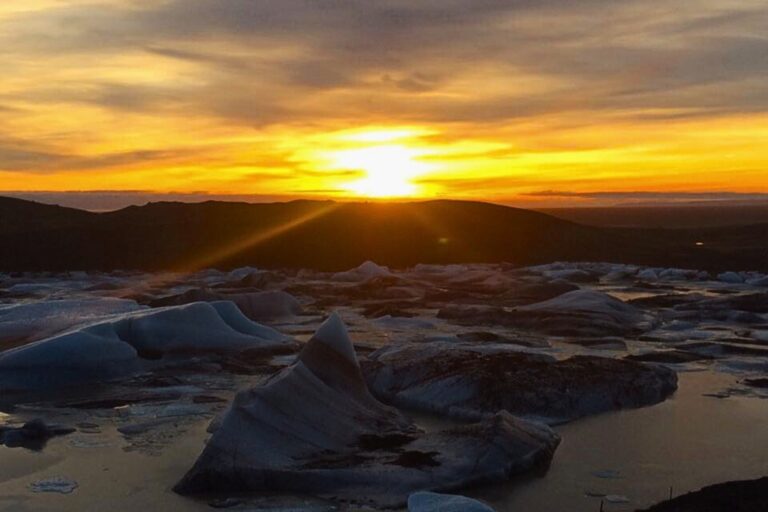
Several hours later, as the clouds began to lift, the sun’s rays reflected brilliantly off several hundred icebergs that floated in the calm waters. Beautiful Jökulsárlón.
The grandeur of this ecological phenomenon is impossible to summarize in a guidebook. You can’t begrudge the tourists for flocking in droves to witness such a sight, even in the freezing temperatures.
That evening, another detour landed us in a remote hot spring, just big enough for the two of us. I genuinely think we wandered into someone’s backyard, as, to this day, I cannot find any resources suggesting this place even exists for tourists.
As snowflakes fell softly, we soaked in our secluded hot spring. No one else was in sight. A cascading waterfall beside us enhanced the moment’s intimacy — barely visible under the moonlit sky but unmistakable in its sound.
The temperature was perfect, warming our bodies as we lowered our shoulders beneath the surface, leaving only our faces exposed to the elements.
Above, the Northern Lights danced in green, purple, and pink ribbons. Here, nature revealed its true beauty — unfiltered and serene. I turned to my friend, who put it as plainly as Darryl Kerrigan from the beloved Australian film The Castle, “How’s the serenity?”
Rewards of Challenging the Norm

Winter brought fewer crowds, serenity and snow-covered landscapes. While sub-zero nights and a time cap on heater usage meant waking in the morning to use the toilet was an extreme challenge, that added a solid dose of humor.
There’s something truly spectacular about challenging the norms of conventional tourism to embrace a more raw and unfiltered experience of the wild forces of nature.
Campervanning made us dive deeper into nature’s heart because cooking a one-pot vegetable curry with headlamps next to a volcano as rain drizzles down will always beat room service.
I have truly never wanted to return to a country more.
Need a hand planning your trip? Here are the sites and services we rely on most, from booking tools to travel products we love.
Inspire your next adventure with our articles below:
Author Bio: Hannah Joseph is a beginner writer seeking the chance to submit her first travel feature, vying for an opportunity to catapult into the world of travel writing and leave an old career behind. With many hobbies to her name, she always finds herself returning to one: writing.
Want to discover more hidden gems and helpful travel tips? Join our free newsletter for the latest travel secrets and travel articles.
We are reader-supported and may earn a commission on purchases made through links in this article.

- Language Learning Travel Guide - September 12, 2026
- Safari Travel Guide - September 12, 2026
- Luxembourg City in 24 Hours: Essential Sights, Views and Cafés - September 12, 2026
Planning another trip soon? ✈️
Add GoWorldTravel.com as a preferred source on Google. Click the button below so our local guides, packing hacks, and hidden-gem itineraries always show up first when you search!
Add to Preferred Sources