
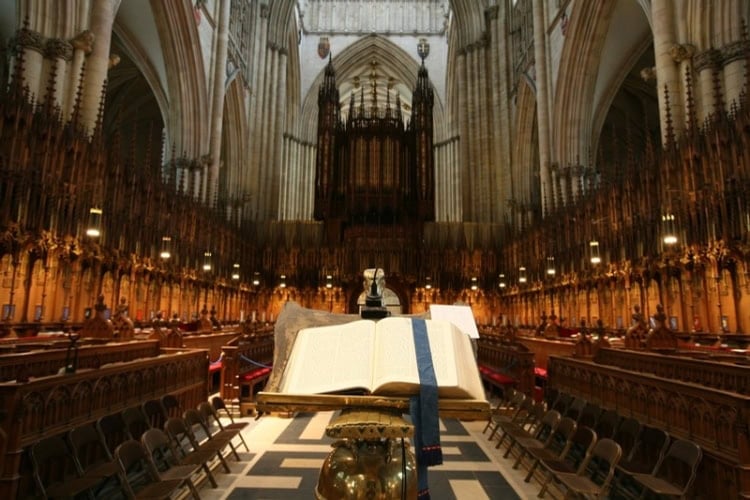
I am sitting in an 800-plus-year-old York Minster (Cathedral) listening to Evensong, with beautiful singing and dramatic organ playing.
My mind wanders to those who have sat in these wooden pews before me and the people who lived in York even before the current Minster was built—way, way back to the Romans and the Vikings.
York? Where’s That?
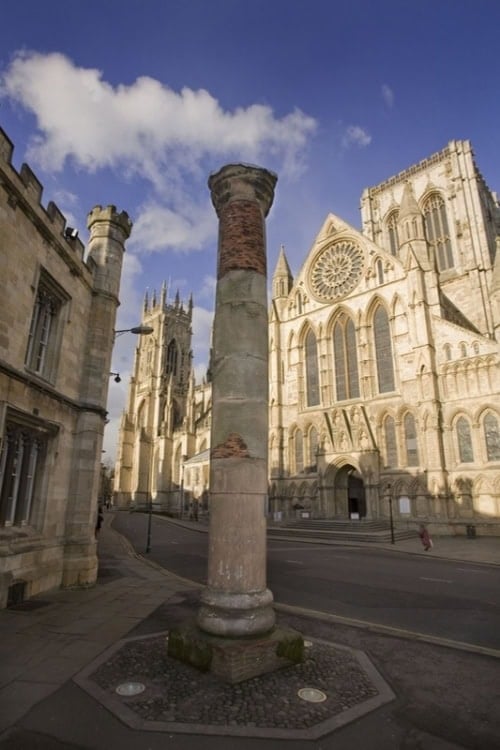
York is a historic and picturesque walled city in North Yorkshire, England, located at the confluence of the Rivers Ouse and Foss. York is about 207 miles (333 kilometers) north of London.
Founded by the Romans as Eboracum in 71 AD, York later became the Viking settlement of Jorvik. Today, York is a popular tourist destination known for its well-preserved medieval architecture, including the Shambles and York Minster.
What Did We Do In York?
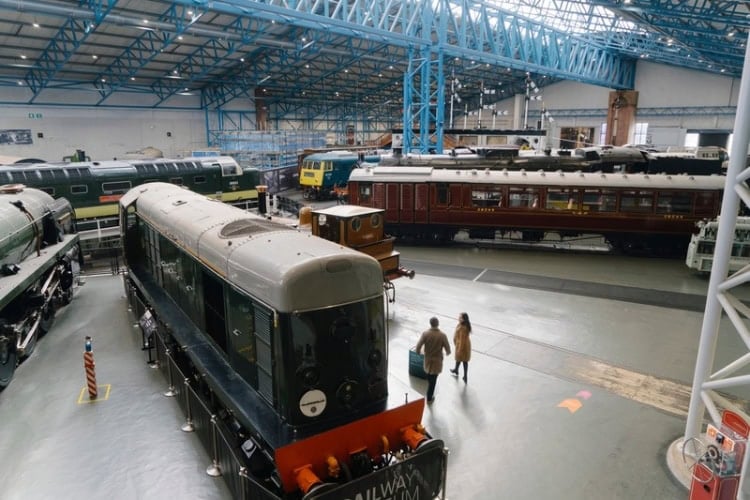
My husband and I arrived in York after lunch, and our first stop was the National Railway Museum. I know, I know…trains??!! My husband had been to this Museum before and raved about it. It is free, so what did I have to lose?
The Train Museum is actually really worthwhile seeing, even whilst much of it is closed for renovations. Station Hall reopens in September, and then the rest of the renovations are due to finish in 2027, so it will be even bigger and better.
There are many locomotive engines and railway carriages on display, including a steam train from 1839 (Stephenson’s Rocket), a Eurostar, a Shinkansen (a Japanese bullet train), the Mallard (which set the steam locomotive world speed record in 1938; that record still stands!), and the Flying Scotsman.
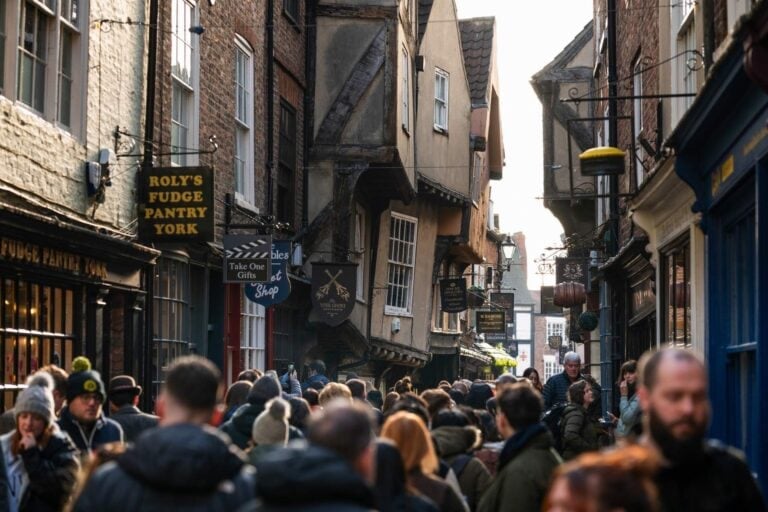
On our first day and our two full days after that, we couldn’t get enough of The Shambles—a narrow, medieval, cobblestone street with overhanging (“jettied”) buildings. The first “Harry Potter” film was partly filmed in the Shambles.
The whole historic town area was bustling, full of life, and perfectly suited for meandering.
We also couldn’t get enough of the City Walls—the longest city walls in England. We walked sections of the Walls, up and down steps hewn from millions of footsteps.
The Walls have Roman origins, but much of the current stonework dates back to the thirteenth century. In the Victorian era, the Walls were repaired, and footpaths were added.
My husband and I each had a Visit York Pass, which gave us free admission to over thirty attractions and two days to make the most of it, so we did! We also squeezed in a walking tour, so it was a busy two days!
Discovering Viking York
We started with a visit to the Jorvik Viking Centre. This is an interactive experience exploring Viking York, and it sells out, so book online (you can book online even if you have a Visit York Pass). The Viking Centre is built on top of a Viking settlement.
That was the first thing I learned. The second thing I learned was that Viking means raider.
A visit starts with a look (through a glass floor) at the archaeological dig beneath, accompanied by some live commentary. There are remains of a house from 900 years ago and a few of the 750,000 oyster shells found by archaeologists in the 1970s.
The Vikings used to eat oysters and throw the shells in their backyard. The litter remains to tell the story!
Even in the days of the Vikings, there were toilets—you can see the remains of one and the remains of some clothes. Color was a designation of class in those times—red was expensive, purple was even fancier, and brown was for the poor.
The next stage of the Viking Centre tour is a ride in a capsule that seats 4-6 people. There is even a wheelchair-accessible capsule. Commentary is in various languages (including “kids’ English!”). Kids must love this part of the experience as you “ride” through a recreated Jorvik settlement.
The last part of the experience is museum exhibits of some of the Viking objects found by archaeologists—all sorts of objects, including combs, shoes, jewels, tools, keys and padlocks, cooking implements, tweezers, cutlery, games, and musical instruments.
Exploring Georgian Life At Fairfax House
For something completely different, we then toured a Fairfax House, a Georgian house formerly owned by a family named Fairfax. The gentleman who bought it had nine children, but only one survived (a daughter), and he bought the house for the two of them to live in.
The daughter sold it, and the house had many different lives, including as a theatre, but it was restored as a house in the 1980s and is staffed by passionate volunteers.
One of the volunteers told us that she was born and bred in York and remembered using a porcelain potty like the one on display here at her grandma’s house.
York Castle Museum and Clifford Tower
The last tourist attraction for the day was the York Castle Museum, housed in the former debtors’ prison. There is an eclectic collection of objects inside.
Highlights for us were walking through cells where prisoners were kept and a 1960s room, which used to be where prisoners awaited transportation to America or Australia.
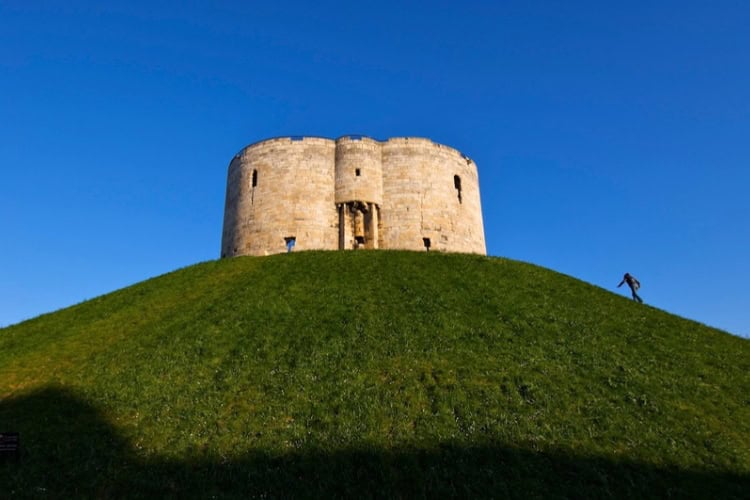
Opposite the Museum is Clifford Tower (which sits high up on a mound). It is the only surviving part of York Castle, and you can visit inside.
Enlightening Walking Tour
We started the next day with a Walking Tour. We often do walking tours in cities, and they are usually free, but free still means tipping at the end of the tour.
In York, these tours are 100% free (no tip required) as they are organized and run by The Association of Voluntary Guides to the City of York – visit their website – twice a day every day, rain, hail, or shine, except Christmas Day. Our Guide was a retired lawyer, Neil.
Neil taught us some Viking and Roman vocabulary. The Vikings named the streets “gates” (which explained why every street sign seemed to have Gate in it).
As Neil explained, “Streets are gates, gates are bars, and bars are pubs!” Neil also taught us that the alleyways/narrow passageways in York are called snickleways. How cute!
Neil showed us the “jettied” buildings with overhanging upper floors, a feature common in medieval timber-framed structures. Buildings used to be taxed according to their width on the street level, which meant that the buildings bulged from the first story.
This created eaves that were a protection for pedestrians from the rain. The eaves were also often under bedrooms, so people waiting under them could listen in—behold, the origin of the word “eavesdropping.”
York Minster: A Grand Tour
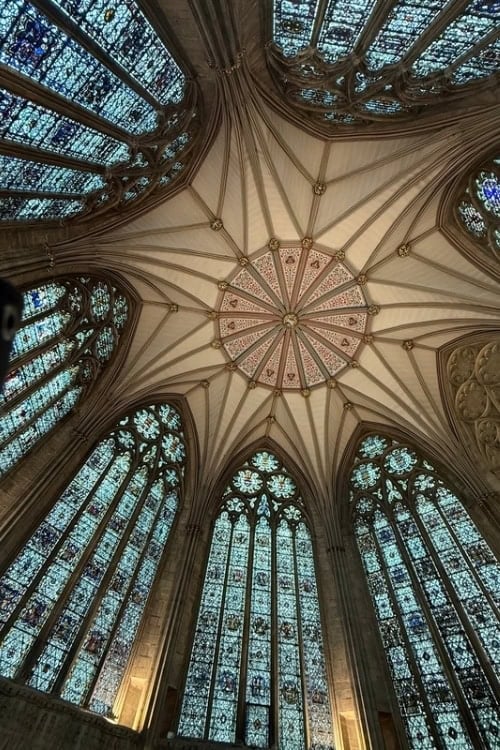
Neil talked a lot about York Minster, which we toured next. The current Gothic Minster took 200 years to build and is the seventh one on the site.
We had visited already for Evensong (which is free to attend, although you’ll need to sit through the thirty minutes of singing in silence to avoid the admission—you also won’t be able to wander around the Minster before or after Evensong).
As we had a Visit York Pass, we returned for a tour. Admission (without a York Pass) is £20 (approximately AUD $41/USD$27), but there is a lot to see and learn. The Minster is huge, and admission includes a visit to the Crypt, the Chapter House, and the Museum.
There is extensive information to read inside. We learned a lot, for example, about stained glass and the conservation work, including the threat of climate change. York Minster has one of the world’s greatest collections of stained glass, with 128 windows containing around 2,000,000 pieces of glass.
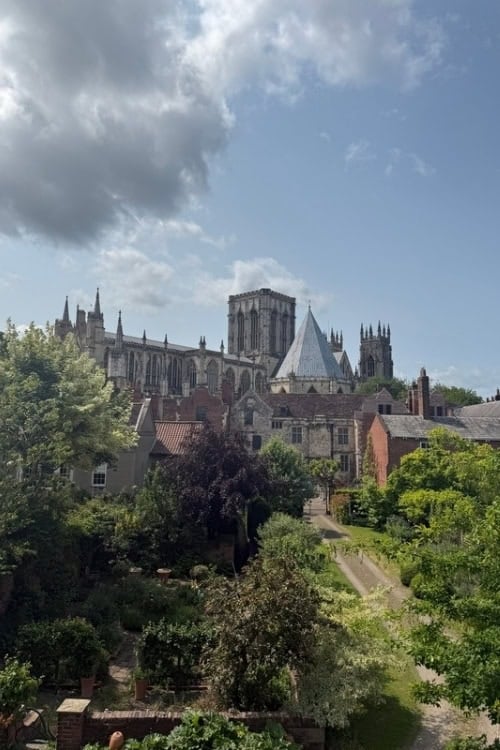
York Minster is the biggest Cathedral north of the Alps in Europe, bigger than Westminster Cathedral in London. Neil told us an amazing story—there was a fire in part of the Minster in 1984. The fire brigade dumped so much water in and deliberately collapsed part of the roof to stop the fire from spreading.
They expected to see that the water had caused devastating damage. Instead, they couldn’t find any trace of the water! They kept going down levels to find the water and uncovered a Roman sewer which had transported the water to the river and, from there, to the North Sea!

The Minster costs £30,000 (approximately AUD $61,500/USD$40,400) a day to upkeep (which accounts for the pricey admission). The Minster also employs twelve full-time stonemasons plus apprentices (another reason for the admission). Renovation is a constant.
Merchant Adventurers’ Hall and York’s Chocolate Story
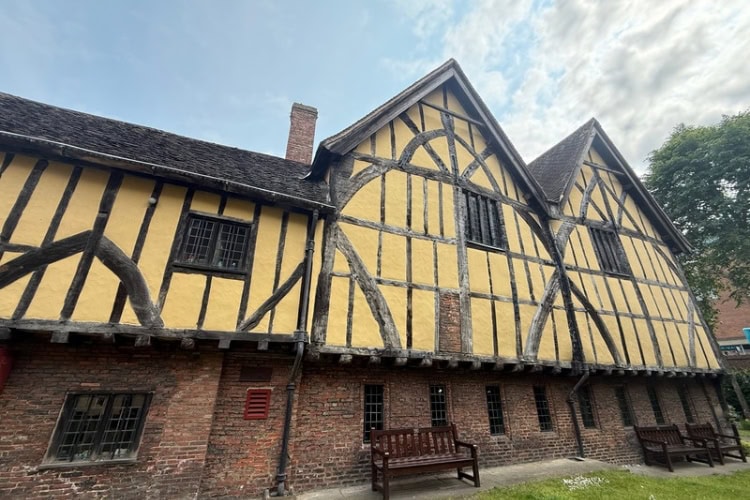
After some lunch, we visited the Merchant Adventurers’ Hall, a remarkably preserved medieval guildhall dating from the fourteenth century. The Great Hall has been in continuous use as a meeting place for over 660 years.
The last stop was York’s Chocolate Story—a museum highlighting York’s chocolate history. We had not booked, and it was full for the day, so we looked around the shop and read some information.
Kit Kats are still made in York—4,500,000 per day! Also, Rowntree (now Nestlé) and Terry’s Chocolate both originated in York.
All in all, a very busy and fascinating couple of days.
Where Did We Eat?
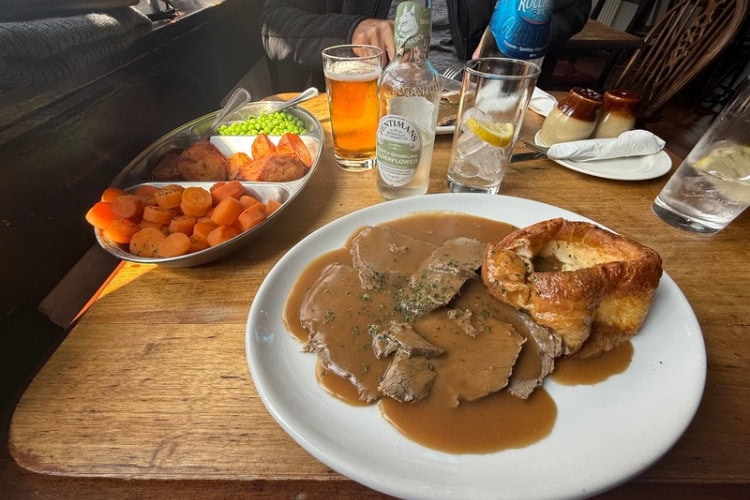
We had a mixed food experience in York. On our first night, we had dinner at a seventeenth-century pub in the Shambles that looked way better than the food tasted!
Another night, we ate delicious pies that we bought from a hole-in-the-wall bakery in The Shambles and heated up for dinner, accompanied by some salad we had purchased from the supermarket. The simple meals are often the best!
We had a yummy lunch in a café called Shambles Korner, complete with scones and clotted cream for dessert. Another day, we lunched at Gert & Henry’s, a Tudor-style pub. This was a truly English meal—roast beef and Yorkshire pudding (what else in York?), followed by jam Roly Poly and custard for dessert. Yum!
Where Did We Stay?
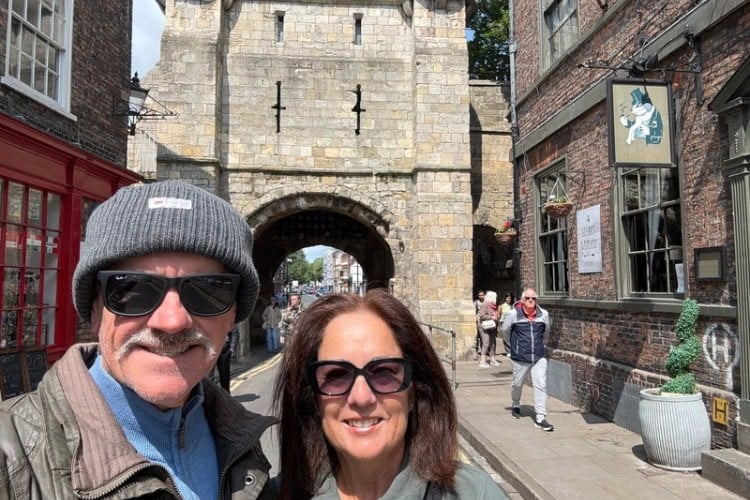
We rented an apartment in an apartment hotel—the Lawrance Apartments in Mickelgate, about a ten-minute walk from The Shambles.
The apartment was very schmick. And it had a washing machine—a bonus when you’re traveling.
How Did We Travel to York?
My husband and I took the train from Oxford to York. The trip takes three hours, and our experience wasn’t great—it was cramped, full to bursting in fact with people standing and not enough room for luggage.
We did travel Standard Class, but First Class was prohibitively expensive when we traveled. If I did this trip again, I would hire a car.
Note that the train from York to London is shorter than from Oxford—more like two hours.
What to Pack?
We traveled in June (the very end of Spring). It was cold enough that my husband bought a beanie and wet enough that we wore rain jackets for most of the time!
Make sure you pack an outfit suitable for cooler weather and closed shoes, even if you travel in the warmer months. Sandals on wet cobblestones are a recipe for disaster!
Our Packing List for an International Trip
What Is a Visit York Pass?
A Visit York Pass is a digital pass allowing access to over thirty attractions in and around York over 1, 2, or 3 days. In busy periods, you should still pre-book your attractions.
We would have missed out on the Jorvik Viking Centre if we hadn’t pre-booked. We did miss out on York’s Chocolate Story as we didn’t pre-book.
The writer traveled to York at her own expense. She and her husband were provided with a Visit York Pass by Visit York.
Need a hand planning your trip? Here are the sites and services we rely on most, from booking tools to travel products we love.
Inspire your next adventure with our articles below:
Author Bio: Leonie Jarrett lives in Melbourne, Australia. She has travelled to all 7 Continents and to over 60 countries. She has cruised 16 times…and counting! Avid traveller Leonie loves writing about her travels and her experiences.
Want to discover more hidden gems and helpful travel tips? Join our free newsletter for the latest travel secrets and travel articles.
We are reader-supported and may earn a commission on purchases made through links in this article.

- Slow Down on Prince Edward Island: A Relaxed Four-Day Itinerary of Dunes, Seafood and Seaside Inns - September 25, 2026
- Two Sides of Cape Town: Table Mountain Trails, Winelands Dawn and Township Voices - September 25, 2026
- St. Pierre and Miquelon: Visit France Without Leaving North America - September 25, 2026
Planning another trip soon? ✈️
Add GoWorldTravel.com as a preferred source on Google. Click the button below so our local guides, packing hacks, and hidden-gem itineraries always show up first when you search!
Add to Preferred Sources