

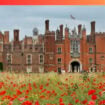
A visit to the Hampton Court Palace is about the pageantry, power and opulence of England’s former Kings and Queens. It is also about England’s history, architecture, and beautiful gardens.
Saying that this former residence of monarchs is “palatial” is a royal understatement. The structures and courtyards alone cover 600,000 square feet. The palace’s 750 acres of parklike setting are the perfect place to escape bustling London for half a day.
Construction of Hampton Court Palace began in 1514 under the direction of Cardinal Thomas Wolsey. Under duress, he gave it to King Henry VIII, who lived here with his six wives.
Between 1524 and 1540, he expanded the property into a palace to show his authority, strength and lavish lifestyle.

Future Kings and Queens made changes and modifications to the palace for the next 300 years. You can see its Tudor style on its western side, with its Baroque look behind it to the east.
The royal family stopped living at Hampton Palace in 1737. From 1760, the palace housed residents on a “grace and favour” basis. These were people who lived freely by the monarch’s consent.
The last resident left the palace in 2017. Presently, Hampton Court Palace is owned by King Charles III “in trust of the Crown”. It is cared for by an independent charity called Historic Royal Palaces.
Palace for the Public

In 1838, Queen Victoria completed the restoration of Hampton Court Palace and opened it to the public. She gave the palace a significant facelift, removing cupolas and reducing the main entrance by two stories.
The palace had become a major tourist attraction and a means to offset its associated expenses.
Visitors to the palace are given an audio guide that works by pressing a number corresponding to their current location. We found this informative, easy to use, and liked that there were options in some rooms to get expanded commentary.
Entering the Palace

When walking to the front gate, take the path in the middle of the flowered field to the entrance. In the year of King Henry VIII, you can imagine how awe-struck and possibly intimidated a visitor would feel seeing how grand this place looks.
Directly in front of you is an imposing Tudor structure with a three-story fortress-like gate. Castle-like roofs, turrets and dozens of chimneys flank it.
The first gate takes you to the first courtyard, which has no appeal and is meant for the business end of the palace. The kitchen gate is located to your left.
It is after passing through the Anne Boleyn gatehouse that you enter the splendor of the first inner courtyard. Displayed in this courtyard is the Hampton Court Astronomical Clock from 1540.
The clock, still functioning, shows the time, month, phases of the moon, date, and high tide at London Bridge. This was important because barges were the preferred mode of transportation to the palace.
The gatehouse had Anne Boleyn’s apartments under construction when she was beheaded. The center of the courtyard has a fountain and a decorated stone floor. The next courtyard leads to the palace’s Baroque-designed section.
The Palace Interior

Photo by Tab Hauser
The palace has 1,390 rooms with 18 courtyards. The royal families used 280 extravagantly finished rooms for themselves. Different monarchs added their own apartments to the palace over the years. There are 90 rooms and apartments on display today.
In most of the Royals’ rooms, you will see an impressive display of art, clocks, pottery and colorful paintings on the ceilings. You will also see the finest furnishings of the day, including bed chambers, places to rest and entertain, as well as a few rooms with regal red high-back seats where court was held for the various kings and queens.
It would take a book, not a travel article, to describe the lavishness of the different apartments. Below are a few notable places.
Feeding the Masses
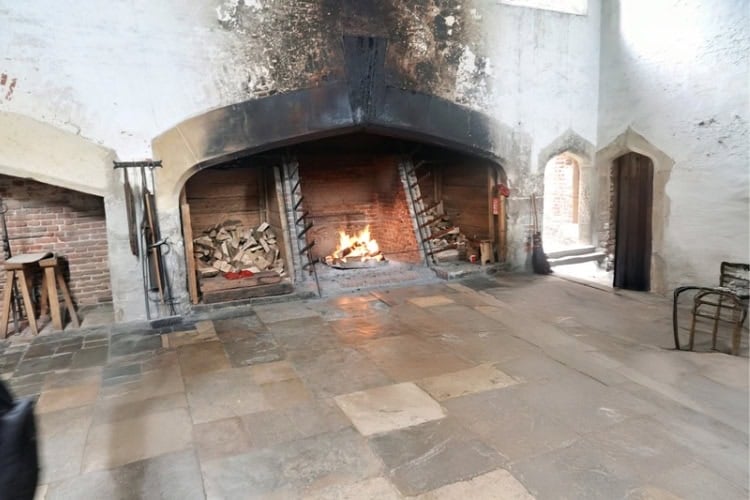
I recommend visitors start their tour at the vast kitchen complex near the entrance of the palace.
It took a staff of 200 to feed approximately 1,200 people who lived and worked in the palace. This required the largest kitchen in England to be built. It is one of the best-preserved Tudor kitchens.
The kitchen is separated into 55 different rooms that King Henry VIII had completed in 1529. They included areas for six large roasting fires and another for boiling pots.
Visitors are treated to a large fire and can go to a carving table with life-like meat cut up. The different rooms have staff instructions posted for each department.
This was one hungry palace. Documents show that in a year, they consumed 1,250 oxen, 8,500 sheep, 2,330 deer, 760 calves, 1,870 pigs, and 53 wild boars.
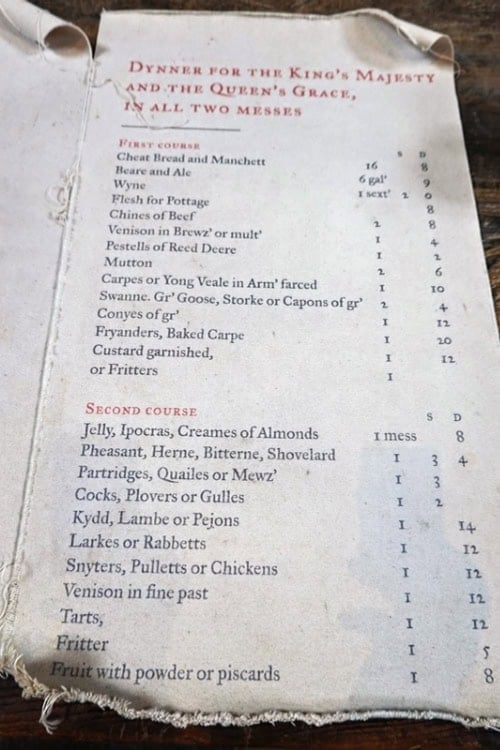
It took 1.3 million logs to cook it all up and 600,000 gallons of beer/ale annually to wash all that food down. An over-the-top menu is displayed showing two courses. The first course consists of 14 items, while the second course comprises 11 items. It was heavy on meat.
The Great Hall
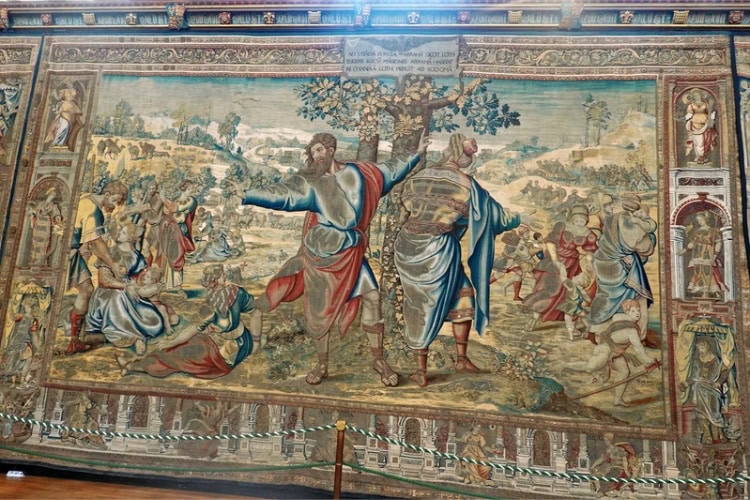
At the very heart of the Tudor palace at Hampton Court is the Great Hall, which is England’s oldest surviving Elizabethan theatre. It is said that Shakespeare himself, along with his company, performed A Midsummer Night’s Dream here. The room is 4,240 square feet with a 60-foot ceiling having a carved hammerbeam roof.
Like the palace, the Great Hall was intended to impress. Here, King Henry VIII’s subjects could watch him eat and entertain.
On display are some of England’s most valued wall-sized tapestries that were hung in 1546. They were woven in Brussels from silk, wool, silver and gold thread. King Henry VIII is illuminated on a large, colorful stained-glass window.
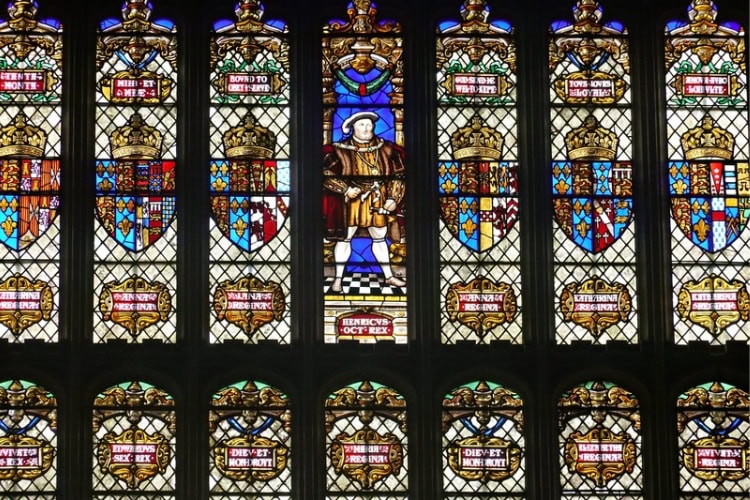
The Presence Chamber
This is the official throne room, featuring a tall, red-cushioned seat and a matching footrest under a red formal canopy. Visitors in the day had to bow to the throne even if the seat was empty.
Gorgeous Gardens

Hampton Court has 60 acres of gardens. There are several distinct gardens, each separated from the others on the grounds. The formal gardens include the Privy Garden and the Knot Garden.
During the spring, over one million bulbs bloom, creating a beautiful display of color on the grounds. The Tiltyard Garden is where we witnessed jousting being practiced for an event that weekend. At the end of the property are gardens with a nice view of the River Thames.
World’s Largest Grape Vine
Hampton Court Palace holds the Guinness World Records for having the largest grapevine. The sweet grape known as Black Hamburg was planted in 1768 from a cutting.
The base of the vine is 13 feet, with its longest vine at 120 feet. Its average harvest is 600 pounds per year.
The Great Vine is in the original greenhouse. In 1969, the vines were so intertwined that a larger greenhouse had to be built over the existing one before it could be taken down. Grapes are sold after the harvest in the palace store.
The Hampton Court Maze
The Hampton Court Palace Maze is England’s oldest surviving hedge maze. Planted by King William III in 1700, it is about one-third of an acre. It is known for confusing visitors with its many turns and dead ends. Allow about 20 minutes to figure it out.
Performers Around the Palace

During your visit, look for docents in costumes and in character. We enjoyed listening to two elderly common ladies gossiping about the court.
There were also brief presentations in various rooms on different subjects throughout the day. Information about the day’s events is available at the ticket office.
The Tudor World in The Wolsey Rooms

Located in the oldest rooms in the palace is an exhibition featuring the early years of Henry VIII. The exhibit also features the lives of the working men and women who kept the Tudor court working.
Tudor World features interactive displays of palace life, jewelry, clothing, scientific items, and rare 16th-century paintings depicting non-royalty in various scenes of the time.
There are also historical artifacts, including a manual “poo remover,” which was necessary for the time.
If You Go:
Tickets and Tours
Pre-booking is recommended at the official Hampton Court Palace site. Plan for at least four hours to see the state apartments and stroll the gardens properly. For a deeper dive, the Hampton Court Palace 3-hour guided tour covers both the Tudor and Baroque wings with a live guide, or pair it with a nearby royal residence on the Windsor Castle and Hampton Court Palace day tour from central London.
Getting There
Trains from London’s Waterloo station run direct and take about 35 minutes. Those driving, busing, or taking another route can find full details here.
Where to Eat
Bring a picnic for the gardens or eat at one of the two on-site cafés. Families visiting during the summer can look for the seasonal Peter Rabbit Afternoon Tea, a recurring warm-weather event tied to the palace’s Beatrix Potter trail.
Where to Stay
For a stay within walking distance of the palace, The Mitre, Hampton Court sits right on the Thames with river views, a walled garden, and two on-site restaurants, making it an easy option for anyone who wants to linger past closing time rather than day-trip from central London.
Need a hand planning your trip? Here are the sites and services we rely on most, from booking tools to travel products we love.
Inspire your next adventure with our articles below:
- A Visit to Stonehenge and Other Nearby Attractions in England
- Oxford Beyond the Books: A Magical Journey Through England’s Historic University Town
Want to discover more hidden gems and helpful travel tips? Join our free newsletter for the latest travel secrets and travel articles.
We are reader-supported and may earn a commission on purchases made through links in this article.

- Two Weeks in Central Newfoundland: Sharks, Small-Town Culture and Come From Away in Gander - September 11, 2026
- Slow Down on Prince Edward Island: A Relaxed Four-Day Itinerary of Dunes, Seafood and Seaside Inns - September 11, 2026
- Cape Town’s Unique Experiences for the Curious Traveller - September 11, 2026
Planning another trip soon? ✈️
Add GoWorldTravel.com as a preferred source on Google. Click the button below so our local guides, packing hacks, and hidden-gem itineraries always show up first when you search!
Add to Preferred Sources
Amazing story! I’m headed to London in October. Need to check this out based on your outstanding article!!
Hey Tab, delighted to have discovered your writing again. I’ve been following you for years! Your piece on Hampton Court brings it’s history alive & now on the bucket list. Love the bit about the kitchens and seeing the menu. So glad you’re writing again and can’t wait to read your next travel recommendation.
As a Palace fan this article is brilliantly written and great insight as someone who lives in London and never visited.
Thank you for the detail of your visit as I have now booked to go later in the year.
Amazing after so many years & knowing of the history, I never though I would even consider visiting.
Again, brilliantly written. Thank you
I found the link to here, in your Facebook post. Thoroughly enjoyed reading this, Tab. I’m glad you found another place to share your stories.
Great article! Perfect for first timers! I had a lovely party at Hampton Ct – absolute legendary place.
I saw it once but didn’t see go inside. It seemed over the top. Reading this, i guess it is.
Good article on its history. Amazing how things built hundreds of years ago still stand.
Fascinating article.
Definitely would love to put this on our bucket list!!!
sounds amazing.
just like my hunting cabin in the Adirondacks.
I have visited many palaces and famous mansions but this sounds like it is over the top.
I’d love to see the spring garden bloom.
OH, another reason to go back to London. Will definitely pay a visit to the palace next time.
Great article, really insightful piece and it is definitely on the Bucket List!
Wow, the Kitchen!!
This article about Hampton Court Palace is both interesting and easy to follow. It shares fun stories from history and explains the palace’s buildings and gardens in a way that’s easy to picture. The writer makes the place come alive with details that aren’t boring or too long.
The photos are also great. They show the beauty of the palace, from its grand halls to the quiet gardens. Together, the writing and pictures make you feel like you’re right there visiting the palace.
This sounds like an amazing place to visit. I will put it on my list of things to do, when in London! Great article!